Paper II — Q4
(a) Discuss in brief the new information technology trends that will change the way of industry workings. 15 marks (b) Discuss…
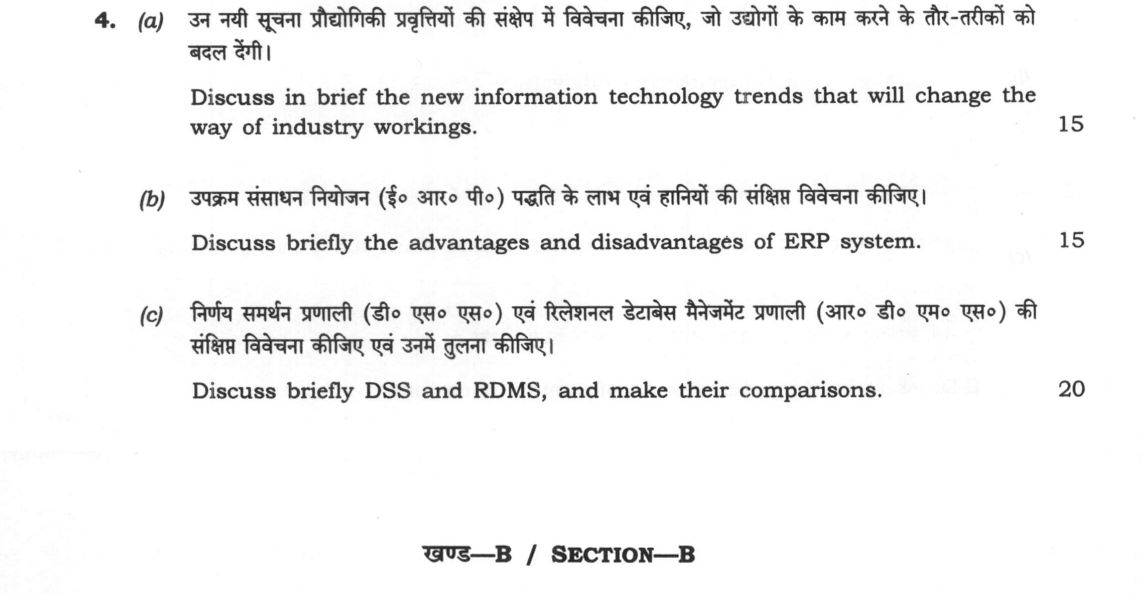
Discuss in brief the new information technology trends that will change the way of industry workings. 15 marks
Discuss briefly the advantages and disadvantages of ERP system. 15 marks
Discuss briefly DSS and RDMS, and make their comparisons. 20 marks
हिंदी में प्रश्न पढ़ें
उन नयी सूचना प्रौद्योगिकी प्रवृत्तियों की संक्षेप में विवेचना कीजिए, जो उद्योगों के काम करने के तौर-तरीकों को बदल देंगी। 15
उपक्रम संसाधन नियोजन (ई० आर० पी०) पद्धति के लाभ एवं हानियों की संक्षिप्त विवेचना कीजिए। 15
निर्णय समर्थन प्रणाली (डी० एस० एस०) एवं रिलेशनल डेटाबेस मैनेजमेंट प्रणाली (आर० डी० एम० एस०) की संक्षिप्त विवेचना कीजिए एवं उनमें तुलना कीजिए। 20
Model answer
Written by UPSC Answer Check against this question's marking rubric, to the expected length. UPSC does not publish answers for Mains — this is one way to score well, not an official key.
The contemporary industrial landscape is undergoing a structural paradigm shift driven by enterprise architectures, analytical engines, and disruptive digital technologies that collectively redefine operational efficiency and strategic decision-making.
(a) Emerging Information Technology Trends and Industry Impact
Emerging IT trends are transforming organizational workflows through automation, connectivity, and intelligence. Artificial Intelligence and Machine Learning (AI/ML) enable predictive and autonomous operations. The Internet of Things (IoT) and Edge Computing drive real-time telemetry and decentralized data processing at the network periphery. The expansion of 5G networks provides high-bandwidth, ultra-low latency infrastructure, accelerating Robotic Process Automation (RPA) in repetitive business processes. Furthermore, Blockchain ensures secure, immutable, and decentralized transactional verification, while Cloud Computing democratizes on-demand, scalable computational capacity.
These technologies drive structural transformation across sectors: Manufacturing: Industry 4.0 integrates digital twins and IoT-enabled predictive maintenance, as observed in smart automotive and heavy engineering plants. Services: The financial sector utilizes AI-driven algorithmic risk assessments and blockchain-based settlements, while healthtech leverages cloud-enabled telemedicine and precision diagnostics. Agriculture: Precision farming utilizes IoT-enabled soil sensors, drone imagery, and predictive weather analytics under national frameworks like the India Digital Ecosystem of Agriculture (IDEA) to optimize input costs and yields.
(b) Advantages and Disadvantages of ERP Systems
An Enterprise Resource Planning (ERP) system is an integrated software suite that manages and unifies core business processes across an organization through a common database.
Advantages: ERP provides cross-functional integration, eliminating organizational data silos. It facilitates real-time data visibility and reporting, which accelerates operational decision-making. Standardization of business processes improves operational consistency and quality control. In supply chain management, ERP enhances end-to-end inventory visibility, order tracking, and demand forecasting. Additionally, it streamlines regulatory compliance, such as automated GST calculations and MCA-21 reporting frameworks.
Disadvantages: ERP adoption requires substantial capital investment in software licensing, hardware upgrades, and post-implementation maintenance. Customization complexity often results in project delays and budget overruns. The transition involves severe change management friction due to workforce resistance to restructured operational workflows. Furthermore, dependency on a single enterprise platform creates vendor lock-in, and centralized data architecture elevates enterprise vulnerability to severe disruption in the event of cybersecurity breaches.
(c) DSS, RDMS, and Comparative Analysis
A Decision Support System (DSS) is an interactive, computer-based information system designed to assist decision-makers in resolving semi-structured and unstructured problems. Its primary components include the Data Management Subsystem (holding operational and historical data), Model Management Subsystem (incorporating financial, statistical, and optimization models), and the User Interface/Dialogue Generation Subsystem. Based on operational focus, DSS is categorized into data-driven systems (OLAP and data warehouses), model-driven systems (simulation and optimization tools), and knowledge-driven systems (expert systems and rule-based logic).
A Relational Database Management System (RDMS) organizes data into structured tables comprising rows and columns linked through primary and foreign keys. Its defining features include strict enforcement of ACID properties (Atomicity, Consistency, Isolation, Durability) to guarantee transactional reliability, schema normalization to eliminate redundancy, declarative data manipulation via Structured Query Language (SQL), and comprehensive data integrity controls. However, RDMS exhibits scalability limitations when processing high-velocity, semi-structured big data across distributed nodes.
Comparison between DSS and RDMS:
- Purpose: RDMS manages transactional processing and routine record-keeping (OLTP), whereas DSS provides analytical processing for strategic planning (OLAP).
- Data Structure: RDMS utilizes highly normalized, structured operational tables; DSS utilizes multi-dimensional, denormalized, summarized, and historical data repositories.
- User Base: RDMS is designed for operational personnel, database administrators, and routine applications; DSS serves business analysts, middle management, and senior executives.
- Analytical Capability: RDMS performs standard relational queries and basic aggregations; DSS executes complex "what-if" simulations, predictive analytics, and goal-seeking models.
- Decision Support Level: RDMS supports routine, operational, structured decisions; DSS supports non-routine, semi-structured, and strategic decisions.
- Implementation Complexity: RDMS requires schema design and indexing for transactional throughput; DSS requires complex ETL pipelines, multidimensional modeling, and specialized interface engineering.
Way Forward
Modern industrial competitiveness relies on the convergence of transactional stability from RDMS, enterprise integration via ERP, strategic insight from DSS, and next-generation technologies like AI and IoT. For India, harmonizing these enterprise systems is critical to advancing digital capacity, empowering MSMEs, and achieving the smart manufacturing vision targeted under the Make in India and Digital India frameworks.
What "Discuss" is asking you to do
Lay the issue out from more than one side — how it arose, what is claimed for it, what is held against it, and where it now stands. UPSC attaches discuss to broad topics with several live dimensions, so coverage of the dimensions earns more than the strength of your opinion.
Structure that answers it
Set the issue up → the case as it is made → the case against → the dimension both sides leave out → where the balance now lies
Where marks are lost
Listing facts with no thread between them, or arguing one side throughout and calling it a discussion.
How this answer will be evaluated
Approach
Framework: null. (a) discuss: intro > 3-4 dimensions > example > balanced close | (b) discuss: intro > 3-4 dimensions > example > balanced close | (c) compare: paired headings or table > key differences > significance > conclusion Full marks: Comprehensive coverage of all points with specific examples and clear comparisons.
Key points expected
- Identify 3-4 specific IT trends (e.g., AI, IoT, Cloud)
- Explain how each trend changes industrial workflow
- Provide a concrete industrial application example
- Conclude with the net impact on industry
- List 3-4 distinct advantages of ERP
- List 3-4 distinct disadvantages of ERP
- Provide a brief context or example for each point
- Offer a balanced conclusion on ERP adoption
Evaluation rubric
Each sub-part is marked on its own, against the marks and word limit printed on the paper.
- (a) Identify and explain IT trends transforming industrial operations. 15 marks
discuss— intro → 3-4 dimensions → example → balanced close
Must cover
- Identify 3-4 specific IT trends (e.g., AI, IoT, Cloud)
- Explain how each trend changes industrial workflow
- Provide a concrete industrial application example
- Conclude with the net impact on industry
Loses marks
- Listing technologies without explaining industrial impact
- Vague generalities without specific examples
- Ignoring the 'change in way of working' aspect
Earns more
- Mention Industry 4.0 or 5.0
- Reference specific technologies like 5G or Edge computing
- Discuss impact on supply chain or logistics
- Mention cybersecurity implications
Extra mark
- Cite a specific company (e.g., Tesla, Siemens) using the tech
- Reference a recent regulatory change or policy
- (b) Evaluate the pros and cons of ERP systems. 15 marks
discuss— intro → 3-4 dimensions → example → balanced close
Must cover
- List 3-4 distinct advantages of ERP
- List 3-4 distinct disadvantages of ERP
- Provide a brief context or example for each point
- Offer a balanced conclusion on ERP adoption
Loses marks
- Listing pros/cons without explanation
- Ignoring the 'disadvantages' or 'advantages' side
- Textbook definitions without application
Earns more
- Mention specific modules (Finance, HR, Supply Chain)
- Discuss data integration benefits
- Address implementation challenges (cost, time)
- Mention vendor lock-in or customization issues
Extra mark
- Cite a specific ERP vendor (SAP, Oracle)
- Reference a specific industry case study
- (c) Define DSS and RDMS and compare their features. 20 marks
compare— paired headings or table → key differences → significance → conclusion
Must cover
- Define DSS (Decision Support System)
- Define RDMS (Relational Database Management System)
- Compare at least 3 key differences (e.g., purpose, data type)
- Conclude with the significance of each system
Loses marks
- Defining only one system
- Comparing without clear criteria
- Confusing DSS with general MIS
Earns more
- Mention DSS uses models/algorithms
- Mention RDMS uses SQL/tables
- Discuss DSS for semi-structured decisions
- Discuss RDMS for structured data storage
Extra mark
- Provide a specific example of DSS (e.g., financial forecasting)
- Provide a specific example of RDMS (e.g., MySQL, Oracle DB)
Practice this exact question
Write your answer and it is marked point by point against the model answer above — what you covered, what you missed, what you got wrong.
Evaluate my answer →More from Management 2024 Paper II
- Q1 (a) Explain the necessary conditions for application of simplex method to be applied to l…
- Q2 (a) A company gives on-the-job training to its salesmen, which is followed by a test. The…
- Q3 (a) Discuss briefly capacity planning. Explain various kinds of capacity planning. 15 mar…
- Q4 (a) Discuss in brief the new information technology trends that will change the way of in…
- Q5 (a) "SMEs are backbone of any country's industrial development." Critically analyze the s…
- Q6 (a) "Removing regional imbalance of industrial development should be top priority of Indi…
- Q7 (a) (i) "Global e-business is being applied by business firms to achieve greater profits.…