Paper II — Q5
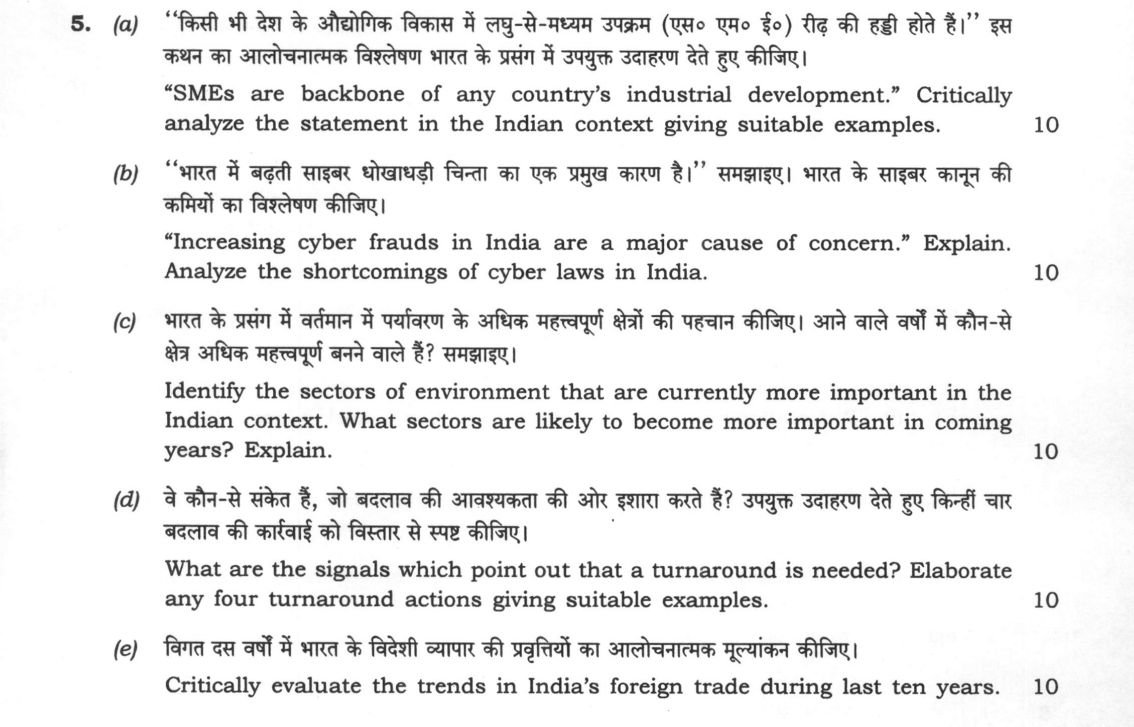
(a) "SMEs are backbone of any country's industrial development." Critically analyze the statement in the Indian context giving…
"SMEs are backbone of any country's industrial development." Critically analyze the statement in the Indian context giving suitable examples. 10 marks
"Increasing cyber frauds in India are a major cause of concern." Explain. Analyze the shortcomings of cyber laws in India. 10 marks
Identify the sectors of environment that are currently more important in the Indian context. What sectors are likely to become more important in coming years? Explain. 10 marks
What are the signals which point out that a turnaround is needed? Elaborate any four turnaround actions giving suitable examples. 10 marks
Critically evaluate the trends in India's foreign trade during last ten years. 10 marks
हिंदी में प्रश्न पढ़ें
"किसी भी देश के औद्योगिक विकास में लघु-से-मध्यम उपक्रम (एस० एम० ई०) रीढ़ की हड्डी होते हैं।" इस कथन का आलोचनात्मक विश्लेषण भारत के प्रसंग में उपयुक्त उदाहरण देते हुए कीजिए। 10
"भारत में बढ़ती साइबर धोखाधड़ी चिंता का एक प्रमुख कारण है।" समझाइए। भारत के साइबर कानून की कमियों का विश्लेषण कीजिए। 10
भारत के प्रसंग में वर्तमान में पर्यावरण के अधिक महत्वपूर्ण क्षेत्रों की पहचान कीजिए। आने वाले वर्षों में कौन-से क्षेत्र अधिक महत्वपूर्ण बनने वाले हैं? समझाइए। 10
वे कौन-से संकेत हैं, जो बदलाव की आवश्यकता की ओर इशारा करते हैं? उपयुक्त उदाहरण देते हुए किन्हीं चार बदलाव की कार्रवाई को विस्तार से स्पष्ट कीजिए। 10
विगत दस वर्षों में भारत के विदेशी व्यापार की प्रवृत्तियों का आलोचनात्मक मूल्यांकन कीजिए। 10
Model answer
Written by UPSC Answer Check against this question's marking rubric, to the expected length. UPSC does not publish answers for Mains — this is one way to score well, not an official key.
(a) Role of SMEs in Industrial Development
Small and Medium Enterprises (SMEs) form the bedrock of India’s economic architecture, contributing nearly 30% of GDP, over 40% of overall exports, and providing employment to more than 110 million people. By fostering entrepreneurship at low capital costs, SMEs decentralize industrial growth, act as vital ancillary suppliers to large-scale industries, and nurture grassroots innovation. Specialized MSME clusters such as the Moradabad brassware cluster, Tirupur textile and knitwear hub, and Ludhiana bicycle parts cluster exemplify how localized manufacturing drives global export competitiveness and regional employment.
However, labeling SMEs unconditionally as the industrial backbone overlooks severe structural constraints. Indian SMEs suffer from persistent dwarfism, where enterprises stay intentionally small to avoid regulatory oversight. Access to formal credit remains a critical barrier, with the U.K. Sinha Committee noting a massive credit deficit exacerbated by delayed payments from public and private buyers. Furthermore, low formalization, compliance friction under GST, and sub-optimal technology adoption under Industry 4.0 standards hinder scalability. While SMEs are indispensable for inclusive employment and industrial dispersion, they can only act as a genuine growth engine if institutional credit channels, technological modernizations, and cluster-based infrastructure are systematically unlocked.
(b) Cyber Frauds and Shortcomings of Indian Cyber Laws
The exponential growth of India’s digital economy, accelerated by unified payment interfaces (UPI) and high smartphone penetration, has led to a parallel surge in sophisticated cybercrimes. Cyber frauds have evolved beyond basic phishing and identity theft into automated ransomware attacks on critical infrastructure, SIM-swap scams, algorithmic loan app frauds, and organized mule-account networks. These frauds undermine public trust in digital transactions, threaten financial stability, and inflict severe economic losses on retail consumers and enterprises alike.
India's legal and regulatory mechanisms exhibit critical institutional shortcomings in addressing this threat: The Information Technology (IT) Act, 2000 is structurally outdated, conceived for an era before cloud computing, decentralized finance, and AI-driven deepfakes, with many cyber offenses remaining bailable with low conviction rates. The Digital Personal Data Protection (DPDP) Act, 2023 provides an updated privacy architecture, but its operational rules, administrative machinery through the Data Protection Board, and clarity on enterprise obligations remain transitional. The Indian Computer Emergency Response Team (CERT-In) faces practical compliance friction, such as its rigid six-hour incident reporting mandate which strains enterprise capacities without ensuring immediate threat neutralization. Cross-border enforcement bottlenecks persist, as perpetrators, command-and-control servers, and proceeds of crime frequently reside in foreign jurisdictions, rendering domestic police machinery ineffective without multilateral extradition and real-time intelligence-sharing treaties. Comprehensive containment demands the enactment of a forward-looking Digital India Act combined with specialized judicial capacity.
(c) Environmental Priorities: Current versus Emerging Sectors
In the contemporary Indian context, environmental management is heavily dominated by immediate public health and resource-security imperatives: Air Quality Management: Mitigating PM2.5 and PM10 pollution across the Indo-Gangetic Plain through the National Clean Air Programme (NCAP), managing crop residue burning, and curbing vehicular and industrial emissions. Water Conservation and Security: Addressing critical groundwater depletion highlighted by the Mihir Shah Committee, rejuvenating river basins, and building infrastructure for wastewater treatment and recycling under the Jal Jeevan Mission. Solid and Hazardous Waste Management: Enforcing extended producer responsibility (EPR) under Plastic Waste Management Rules, remediating legacy landfill sites, and managing mounting electronic and biomedical waste streams.
In the coming years, strategic environmental priorities will transition from localized pollution control to systemic resilience and global decarbonization: Carbon Markets: Establishing the domestic Carbon Credit Trading Scheme (CCTS) to price emissions and drive industrial decarbonization in energy-intensive sectors. Blue Economy: Balancing coastal zone management, sustainable marine aquaculture, and offshore renewable energy while safeguarding marine biodiversity. Sustainable Agriculture: Shifting from resource-exhaustive cereal monoculture toward climate-resilient cropping, regenerative soil management, and micro-irrigation to counter climate shocks. Climate-Resilient Infrastructure: Incorporating disaster risk reduction into urban design, transport networks, and coastal protections via bodies like the Coalition for Disaster Resilient Infrastructure (CDRI). This shift marks India’s evolution toward a circular, climate-adaptive economy.
(d) Turnaround Signals and Strategic Actions
Organizational decline is rarely sudden; it is preceded by measurable warning signals. Key distress indicators include sustained negative operating cash flows, persistent erosion of market share to agile competitors, recurrent debt servicing defaults accompanied by high interest-coverage stress, and alarming attrition of top-tier talent and operational leadership. Recognizing these signals early enables timely intervention.
Four distinct turnaround strategies illustrate this process: Strategic Repositioning: Repositioning the core product portfolio toward high-margin, future-ready markets. Example: Tata Motors revitalized Jaguar Land Rover (JLR) through the "Reimagine" strategy, pivoting aggressively toward luxury electric powertrains while restructuring unprofitable vehicle lines. Operational Restructuring: Rationalizing internal processes, stripping non-core operational expenses, and modernizing assets. Example: The privatization and takeover of Air India by the Tata Group, involving fleet modernization, route rationalization, software integration, and the consolidation of low-cost carriers into Air India Express. Financial Restructuring: Restructuring unsustainable debt profiles to restore balance sheet solvency. Example: Suzlon Energy successfully engineered a comprehensive debt restructuring through debt-to-equity conversions, operational monetization, and refinancing, allowing it to regain viability in the renewable energy sector. Leadership Change: Replacing executive leadership to reset strategic vision and corporate governance. Example: Infosys in 2017 appointed Salil Parekh to stabilize boardroom turbulence, rebuild client and investor trust, and accelerate its pivot toward digital and cloud services.
(e) Trends in India’s Foreign Trade (2014–2024)
Over the past decade, India’s foreign trade has demonstrated significant shifts in composition and orientation, accompanied by structural challenges.
On the positive side, services exports have shown exceptional resilience, expanding rapidly beyond traditional IT/ITeS into Global Capability Centres (GCCs), management consulting, and design services. This services surplus has consistently buffered India’s current account deficit. In terms of trade direction, India has successfully expanded commercial ties with the USA (its largest single export destination with a substantial trade surplus), deepened engagement with ASEAN, and operationalized new-generation bilateral agreements, notably the Comprehensive Economic Partnership Agreement (CEPA) with the UAE and the ECTA with Australia.
Conversely, merchandise exports have shown vulnerability, hovering around a low share of global merchandise trade and remaining concentrated in refined petroleum, gems and jewellery, and chemicals. The merchandise trade deficit has widened persistently, driven by high import dependency on crude oil, coking coal, and advanced electronics. A critical vulnerability is the heavy reliance on China for intermediate goods, active pharmaceutical ingredients (APIs), and solar equipment. Furthermore, India faces mounting friction at the World Trade Organization (WTO) concerning agricultural support mechanisms and export-incentive programs.
In conclusion, while India has consolidated its status as a global services powerhouse, achieving sustainable external balance necessitates scaling domestic manufacturing ecosystems through Production Linked Incentive (PLI) schemes to substitute critical imports and integrate into global value chains.
What "Critically analyse" is asking you to do
Break the subject into its working parts and show how they act on each other. The marks are in the interconnections — which factor drives which, and what the resulting structure explains — not in the inventory of factors. “Critically” is not a section added at the end: name the yardstick you are judging by — the evidence, the stated objective, a constitutional principle, a rival explanation — and let a verdict close each part of the body. Where the question quotes a claim, that verdict must land on the claim itself, accepted, qualified or rejected, and not on the theme in general.
Structure that answers it
Define the whole → separate it into its parts → show which part drives which → what that interaction produces → what the structure implies
Where marks are lost
Merits in one paragraph, demerits in the next, and a conclusion calling for a balanced and holistic approach. That is a survey with the judgement left out and it holds the answer in the middle band. The opposite error is reading “critically” as permission to attack — and with the odd pairings, critically describe or critically explain, the exposition still carries most of the marks, the judgement being a layer on it rather than a substitute for it.
How this answer will be evaluated
Approach
(a) analyse: intro > causes > effects > stakeholders/linkages > way forward | (b) explain: definition/context > points in order > small example > short close | (c) explain: definition/context > points in order > small example > short close | (d) explain: definition/context > points in order > small example > short close | (e) evaluate: criteria > evidence > balanced judgment Full marks: Comprehensive, well-structured, with specific examples and critical analysis.
Key points expected
- Define SMEs and their industrial role
- Analyze contribution to GDP and employment
- Provide suitable Indian examples
- Critically evaluate limitations or challenges
- Explain the rise of cyber frauds in India
- Identify specific types of cyber frauds
- Analyze shortcomings of current cyber laws
- Provide examples of legal gaps
Evaluation rubric
Each sub-part is marked on its own, against the marks and word limit printed on the paper.
- (a) Critical analysis of SMEs as the backbone of Indian industrial development. 10 marks
analyse— intro → causes → effects → stakeholders/linkages → way forward
Must cover
- Define SMEs and their industrial role
- Analyze contribution to GDP and employment
- Provide suitable Indian examples
- Critically evaluate limitations or challenges
Loses marks
- Generic statements without Indian context
- No critical analysis, only positive points
- Lack of specific examples
Earns more
- Mention specific sectors (e.g., textiles, auto parts)
- Reference government policies (e.g., MSME Act)
- Discuss export contribution of SMEs
- Mention regional variations in SME growth
Extra mark
- Cite specific statistics on SME contribution
- Reference a specific successful SME case study
- (b) Explain cyber frauds and analyze shortcomings of Indian cyber laws. 10 marks
explain— definition/context → points in order → small example → short close
Must cover
- Explain the rise of cyber frauds in India
- Identify specific types of cyber frauds
- Analyze shortcomings of current cyber laws
- Provide examples of legal gaps
Loses marks
- Vague description of cyber frauds
- No specific analysis of legal shortcomings
- Lack of examples or evidence
Earns more
- Mention IT Act 2000 and its limitations
- Discuss challenges in cross-border cyber crimes
- Reference specific cyber fraud cases
- Suggest improvements to cyber laws
Extra mark
- Cite specific statistics on cyber frauds
- Reference a specific court case or legal amendment
- (c) Identify and explain important environmental sectors in India, current and future. 10 marks
explain— definition/context → points in order → small example → short close
Must cover
- Identify currently important environmental sectors
- Explain why these sectors are important
- Identify sectors likely to become important
- Explain the reasons for future importance
Loses marks
- Vague identification of sectors
- No explanation of importance
- Lack of distinction between current and future sectors
Earns more
- Mention specific sectors (e.g., renewable energy, water management)
- Reference government initiatives (e.g., National Solar Mission)
- Discuss climate change impacts
- Mention emerging technologies in environmental management
Extra mark
- Cite specific data on environmental sector growth
- Reference a specific policy or international agreement
- (d) Explain signals for turnaround and elaborate four turnaround actions with examples. 10 marks
explain— definition/context → points in order → small example → short close
Must cover
- Identify signals indicating need for turnaround
- Elaborate four specific turnaround actions
- Provide suitable examples for each action
- Explain the rationale for each action
Loses marks
- Vague description of signals
- Less than four turnaround actions
- Lack of specific examples
Earns more
- Mention specific signals (e.g., declining sales, market share loss)
- Reference specific turnaround strategies (e.g., cost cutting, restructuring)
- Provide real-world company examples
- Discuss the sequence of turnaround actions
Extra mark
- Cite specific financial metrics indicating turnaround need
- Reference a specific successful turnaround case study
- (e) Critically evaluate trends in India's foreign trade over the last ten years. 10 marks
evaluate— criteria → evidence → balanced judgment
Must cover
- Identify key trends in foreign trade
- Analyze changes in trade balance
- Evaluate impact of global economic conditions
- Provide a balanced judgment on trade performance
Loses marks
- Generic description of trade trends
- No critical evaluation, only description
- Lack of specific data or examples
Earns more
- Mention specific trade partners (e.g., US, China, EU)
- Reference specific trade agreements (e.g., FTAs)
- Discuss changes in export/import composition
- Mention government trade policies
Extra mark
- Cite specific trade data or statistics
- Reference a specific trade policy or agreement
Practice this exact question
Write your answer and it is marked point by point against the model answer above — what you covered, what you missed, what you got wrong.
Evaluate my answer →More from Management 2024 Paper II
- Q2 (a) A company gives on-the-job training to its salesmen, which is followed by a test. The…
- Q3 (a) Discuss briefly capacity planning. Explain various kinds of capacity planning. 15 mar…
- Q4 (a) Discuss in brief the new information technology trends that will change the way of in…
- Q5 (a) "SMEs are backbone of any country's industrial development." Critically analyze the s…
- Q6 (a) "Removing regional imbalance of industrial development should be top priority of Indi…
- Q7 (a) (i) "Global e-business is being applied by business firms to achieve greater profits.…
- Q8 (a) "Strategic alliance helps in enhancing organizational capabilities." Explain giving e…