Paper II — Q7
(a) (i) "Global e-business is being applied by business firms to achieve greater profits." Explain this statement giving various…
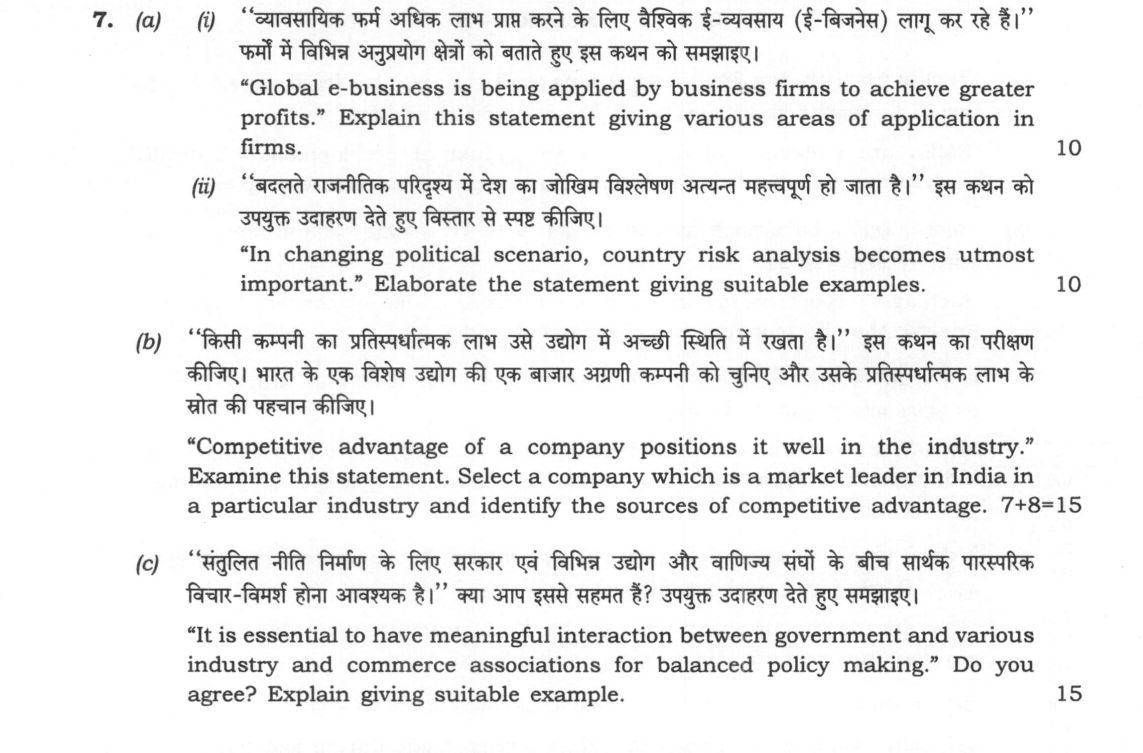
"Global e-business is being applied by business firms to achieve greater profits." Explain this statement giving various areas of application in firms. 10 marks
"In changing political scenario, country risk analysis becomes utmost important." Elaborate the statement giving suitable examples. 10 marks
"Competitive advantage of a company positions it well in the industry." Examine this statement. Select a company which is a market leader in India in a particular industry and identify the sources of competitive advantage. 7+8=15 marks
"It is essential to have meaningful interaction between government and various industry and commerce associations for balanced policy making." Do you agree? Explain giving suitable example. 15 marks
हिंदी में प्रश्न पढ़ें
"व्यावसायिक फर्म अधिक लाभ प्राप्त करने के लिए वैश्विक ई-व्यवसाय (ई-बिजनेस) लागू कर रहे हैं।" फर्मों में विभिन्न अनुप्रयोग क्षेत्रों को बताते हुए इस कथन को समझाइए। 10
"बदलते राजनीतिक परिदृश्य में देश का जोखिम विश्लेषण अत्यंत महत्वपूर्ण हो जाता है।" इस कथन को उपयुक्त उदाहरण देते हुए विस्तार से स्पष्ट कीजिए। 10
"किसी कंपनी का प्रतिस्पर्धात्मक लाभ उसे उद्योग में अच्छी स्थिति में रखता है।" इस कथन का परीक्षण कीजिए। भारत के एक विशेष उद्योग की एक बाजार अग्रणी कंपनी को चुनिए और उसके प्रतिस्पर्धात्मक लाभ के स्रोत की पहचान कीजिए। 7+8=15
"संतुलित नीति निर्माण के लिए सरकार एवं विभिन्न उद्योग और वाणिज्य संघों के बीच सार्थक पारस्परिक विचार-विमर्श होना आवश्यक है।" क्या आप इससे सहमत हैं? उपयुक्त उदाहरण देते हुए समझाइए। 15
Model answer
Written by UPSC Answer Check against this question's marking rubric, to the expected length. UPSC does not publish answers for Mains — this is one way to score well, not an official key.
Global E-Business Applications and Profit Optimization
Global e-business transforms traditional corporate value chains into scalable digital ecosystems, optimizing operational costs while expanding market reach. Firms apply e-business across multiple interconnected domains:
- Business-to-Consumer (B2C) and Business-to-Business (B2B) Platforms: Enterprises like Flipkart and IndiaMART aggregate fragmented demand and supply, eliminating intermediaries and lowering transaction costs.
- Supply Chain Digitization: Integrating IoT and cloud architectures enables end-to-end visibility, automated procurement, and predictive inventory control, substantially reducing working capital requirements.
- Customer Relationship Management (CRM) Analytics: Platforms like Zomato utilize real-time algorithmic profiling to drive hyper-personalized cross-selling, boosting customer lifetime value and retention rates.
- Digital Payment Ecosystems: Integrating multi-currency unified payment interfaces and fintech gateways accelerates cash conversion cycles and slashes cross-border payment settlement frictions. Collectively, these applications lower marginal serving costs while unlocking network effects, driving sustained profitability across global footprints.
Country Risk Analysis in a Dynamic Political Environment
Navigating cross-border commerce demands rigorous country risk analysis (CRA), as volatile geopolitical shifts and domestic policy reorientations directly impact asset security and expected returns. CRA systematically evaluates political instability, regulatory volatility, expropriation hazards, and currency convertibility constraints. Methodologies such as the PRS Group’s International Country Risk Guide (ICRG) and Euromoney country risk indices quantitatively synthesize macroeconomic fundamentals with socio-political risk factors.
Empirical evidence underlines this imperative: the sudden macroeconomic collapse and sovereign default in Sri Lanka paralyzed foreign investments and triggered severe supply chain disruptions. Similarly, regulatory unpredictability—exemplified by India's past retrospective taxation disputes involving Vodafone and Cairn Energy—highlights how sudden legislative shifts can impair enterprise valuations, deter foreign direct investment, and trigger international arbitration. Rigorous CRA enables firms to structure risk-adjusted hurdle rates, hedge currency exposures, and implement appropriate market entry strategies.
Competitive Advantage and Industry Positioning: An Examination
Competitive advantage represents a firm’s capacity to generate superior economic value relative to industry rivals. According to Michael Porter’s generic strategies and Barney’s VRIO framework (Valuable, Rare, Inimitable, Organized), a sustainable position is achieved when internal resource endowments align with external market opportunities, creating entry barriers. However, competitive advantage is not static; dynamic market conditions require continuous renewal of core competencies to prevent strategic obsolescence.
In the Indian context, Asian Paints exemplifies sustained market leadership within the decorative paints industry, maintaining over 50% market share through distinct competitive advantages:
- Direct Distribution Disintermediation: By eliminating wholesale layers, Asian Paints installed computerized tinting machines directly at over 75,000 retail dealer touchpoints. This constitutes a rare and inimitable logistics capability.
- Proprietary Demand Analytics: Deploying advanced enterprise data modeling, the company predicts micro-market consumer demand with over 90% accuracy, replenishing dealer inventory multiple times daily and achieving unmatched working capital turns.
- Supply Chain Integration and Brand Equity: Deep vertical integration, automated manufacturing plants, and enduring brand equity create substantial cost leadership and pricing power. Through these VRIO-aligned capabilities, Asian Paints positions itself structurally above industry price wars, sustaining superior return on capital employed (ROCE).
Government-Industry Collaboration for Balanced Policy Formulation
Meaningful institutional interaction between government bodies and industry commerce associations (such as CII, FICCI, and ASSOCHAM) is vital for balanced economic policymaking. Asymmetric information between policy designers and business practitioners often risks regulatory overreach or compliance bottlenecks; continuous dialogue bridges this operational gap.
Key mechanisms include tripartite consultations, regulatory sandbox frameworks in fintech, Self-Regulatory Organizations (SROs) in emerging sectors, and policy co-creation. For instance, the Department for Promotion of Industry and Internal Trade (DPIIT) operates institutional feedback loops through Udyog Bhawan consultations to refine the Startup India initiative, resulting in targeted regulatory exemptions, tax holidays, and funding support mechanisms. Similarly, continuous structured engagements between trade bodies and the GST Council have led to critical rate rationalizations, simplified invoicing workflows, and compliance recalibrations.
Conclusion
Navigating modern global commerce requires a synchronized approach: firms must leverage global e-business to expand scale, mitigate cross-border exposure via robust country risk analysis, and build durable, VRIO-aligned competitive advantages. In turn, sustaining this competitive positioning depends on an agile regulatory environment forged through structured government-industry collaboration, ensuring balanced, growth-oriented policy frameworks.
What "Examine" is asking you to do
Test the proposition the question puts to you and return a finding on how far it holds. Examine stems carry a claim, or ask whether something has happened, and expect evidence weighed both ways before the extent is stated — often with remedial measures attached.
Structure that answers it
Restate the claim as the question frames it → evidence that supports it → evidence that undercuts it → the conditions under which it holds → verdict on how far it stands
Where marks are lost
Stopping at description. An examination has to reach a finding, and “examine with justification” means the extent must be stated, not implied.
How this answer will be evaluated
Approach
Framework: Porter's Five Forces / VRIO Framework. (a) explain: definition/context > points in order > small example > short close | (b) examine: intro > 3-4 dimensions > example > balanced close | (c) discuss: intro > 3-4 dimensions > example > balanced close Full marks: Applies named frameworks, uses specific Indian examples, balanced analysis
Key points expected
- E-business areas: e-marketing, e-supply chain, e-finance
- Country risk: political stability, policy continuity, expropriation risk
- Competitive advantage: cost leadership, differentiation, focus
- Indian market leader: e.g., Tata Motors, Reliance, Infosys
- Government-industry interaction: policy consultation, stakeholder feedback, regulatory impact assessment
Evaluation rubric
Each sub-part is marked on its own, against the marks and word limit printed on the paper.
- (a) Explain e-business profit drivers and country risk analysis in political change.
explain— definition/context → points in order → small example → short close
Must cover
- List 3-4 e-business application areas
- Link e-business to profit mechanisms
- Define country risk analysis
- Provide 2 political change examples
Loses marks
- Generic definition of e-business without profit link
- Ignoring the 'political scenario' constraint
- Listing risks without analysis
Earns more
- Mention specific e-business tools (CRM, ERP)
- Cite specific political instability events
- Distinguish political from economic risk
- Mention risk mitigation strategies
Extra mark
- Reference specific recent geopolitical event
- Mention specific e-commerce platform example
- (b) Examine competitive advantage statement and identify sources for an Indian market leader. 15 marks
examine— intro → 3-4 dimensions → example → balanced close
Must cover
- Examine the statement's validity
- Select a specific Indian market leader
- Identify 3-4 sources of advantage
- Apply a named framework (e.g., VRIO)
Loses marks
- Choosing a non-market leader
- Listing advantages without framework
- Ignoring the 'examine' directive (one-sided)
Earns more
- Use Porter's Five Forces for context
- Distinguish sustainable vs temporary advantage
- Link advantage to specific industry dynamics
- Mention specific company strategy
Extra mark
- Reference specific recent strategic move
- Mention specific financial metric showing advantage
- (c) Discuss the necessity of government-industry interaction for balanced policy making. 15 marks
discuss— intro → 3-4 dimensions → example → balanced close
Must cover
- State position (agree/disagree)
- Explain benefits of interaction
- Provide a suitable example
- Discuss potential downsides/limits
Loses marks
- One-sided argument without balance
- Generic statement without example
- Ignoring the 'balanced policy making' focus
Earns more
- Mention specific policy area (e.g., GST, FDI)
- Cite specific industry association (e.g., CII, FICCI)
- Discuss 'balanced' aspect (stakeholder inclusion)
- Mention specific policy outcome
Extra mark
- Reference specific recent policy consultation
- Mention specific regulatory body involved
Practice this exact question
Write your answer and it is marked point by point against the model answer above — what you covered, what you missed, what you got wrong.
Evaluate my answer →More from Management 2024 Paper II
- Q4 (a) Discuss in brief the new information technology trends that will change the way of in…
- Q5 (a) "SMEs are backbone of any country's industrial development." Critically analyze the s…
- Q6 (a) "Removing regional imbalance of industrial development should be top priority of Indi…
- Q7 (a) (i) "Global e-business is being applied by business firms to achieve greater profits.…
- Q8 (a) "Strategic alliance helps in enhancing organizational capabilities." Explain giving e…