Paper II — Q8
(a) What are the key objectives of the latest Foreign Trade Policy of the Government of India? Explain the major schemes and…
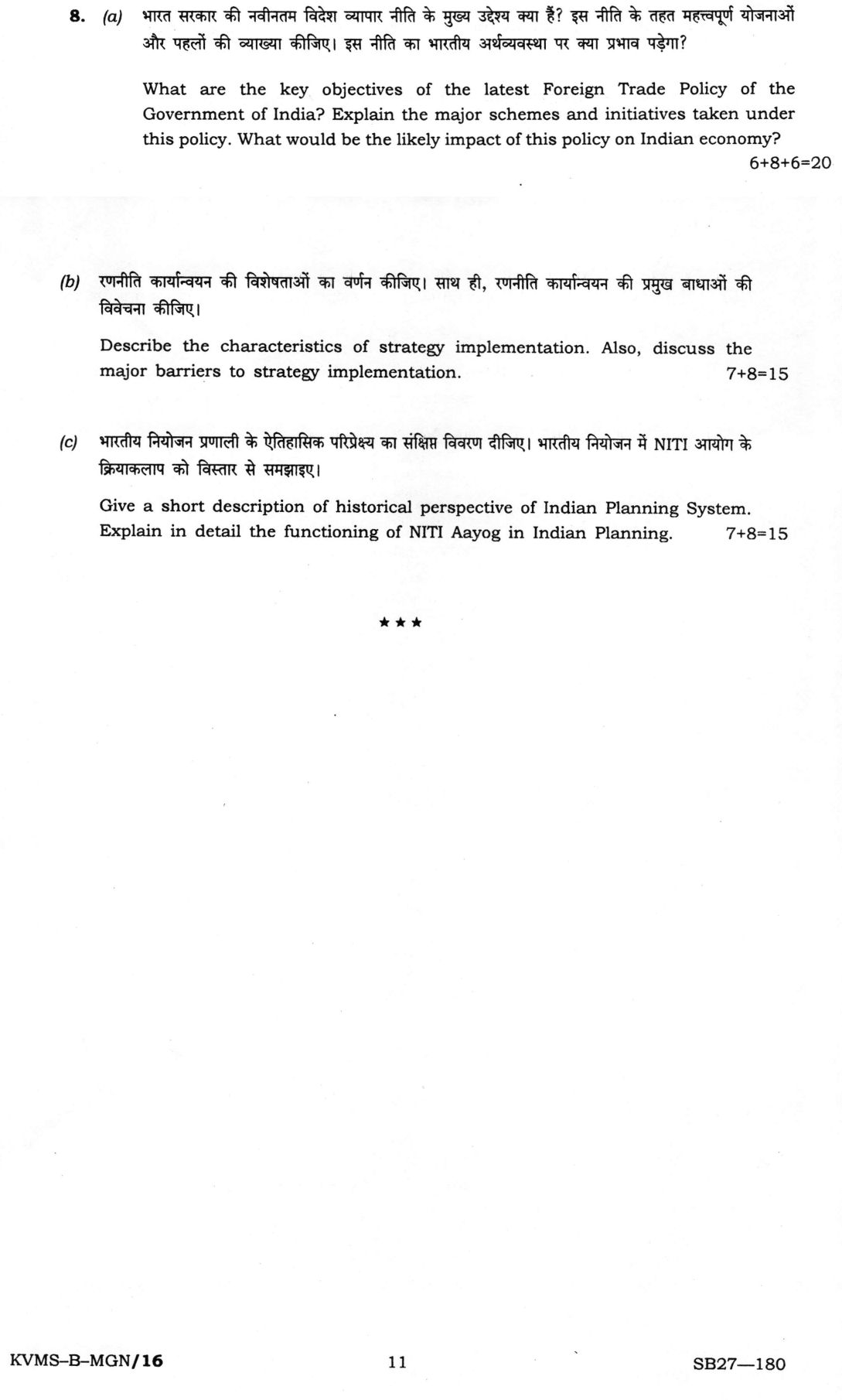
What are the key objectives of the latest Foreign Trade Policy of the Government of India? Explain the major schemes and initiatives taken under this policy. What would be the likely impact of this policy on Indian economy? 20 marks
Describe the characteristics of strategy implementation. Also, discuss the major barriers to strategy implementation. 15 marks
Give a short description of historical perspective of Indian Planning System. Explain in detail the functioning of NITI Aayog in Indian Planning. 15 marks
हिंदी में प्रश्न पढ़ें
भारत सरकार की नवीनतम विदेश व्यापार नीति के मुख्य उद्देश्य क्या हैं? इस नीति के तहत महत्त्वपूर्ण योजनाओं और पहलों की व्याख्या कीजिए। इस नीति का भारतीय अर्थव्यवस्था पर क्या प्रभाव पड़ेगा? (20 अंक)
रणनीति कार्यान्वयन की विशेषताओं का वर्णन कीजिए। साथ ही, रणनीति कार्यान्वयन की प्रमुख बाधाओं की विवेचना कीजिए। (15 अंक)
भारतीय नियोजन प्रणाली के ऐतिहासिक परिप्रेक्ष्य का संक्षिप्त विवरण दीजिए। भारतीय नियोजन में NITI आयोग के क्रियाकलाप को विस्तार से समझाइए। (15 अंक)
Model answer
Drafted with AI by UPSC Answer Check against this question's marking rubric, to the expected length. UPSC does not publish answers for Mains — this is one way to score well, not an official key. How we build rubrics and answers.
(a) Foreign Trade Policy (6 + 8 + 6 = 20 marks)
Objectives (6). The Foreign Trade Policy 2023, in force from 1 April 2023 with no fixed end date (it is updated as needed), aims to take India's exports of goods and services to US$2 trillion by 2030. Its main objectives are: to shift from an incentive-based regime to one based on remission and entitlement; to promote export growth through collaboration among exporters, states, districts, Indian missions and government; to develop districts as export hubs; to emerge as a reliable source of goods and services and to diversify markets; to ease doing business through automation and technology; and to promote e-commerce exports, the rupee in trade settlement and green, sustainable trade. It rests on four pillars: incentive to remission, export promotion through collaboration, ease of doing business with reduced transaction cost, and emerging areas such as e-commerce, developing districts as export hubs and streamlining SCOMET.
Schemes and initiatives (8). The Remission of Duties and Taxes on Exported Products (RoDTEP) and the Rebate of State and Central Taxes and Levies (RoSCTL) refund embedded taxes that are not otherwise rebated, in line with WTO rules. The Advance Authorisation and Export Promotion Capital Goods (EPCG) schemes give duty-free inputs and capital goods against an export obligation. The Districts as Export Hubs initiative builds export plans for every district. Towns of Export Excellence get common facilities, and Special Economic Zones and export-oriented units continue. A one-time amnesty scheme covers old export-obligation defaults, and recognition as Status Holders (the Star Export Houses) brings benefits. Also included are e-commerce export hubs and courier exports, rupee settlement of trade, and simplified procedures through automation. The Export Promotion Mission, approved in 2025 with about ₹25,000 crore, adds finance and market-access support for MSMEs.
Likely impact (6). Positive: export growth and diversification of goods, markets and services; more jobs, particularly in labour-intensive MSME sectors; a smaller trade deficit and better external balance; competitiveness through duty-free inputs and lower transaction costs; regional balance through district hubs; and support for Make in India and the trade agreements now being negotiated. Constraints: the gains depend on logistics costs, infrastructure, quality standards, global demand and tariff or non-tariff barriers abroad; incentives must remain WTO-compatible; and heavy reliance on remissions creates fiscal cost. Its success will be judged by export share, value addition and market diversification.
(b) Strategy implementation (7 + 8 = 15 marks)
Characteristics (7). Strategy implementation converts the formulated strategy into action, so that the organisation achieves its objectives. It is action-oriented (what and how, whereas formulation asks what and why), operational and administrative, and mostly carried out by middle and lower managers, with the top team setting direction. It is a continuous, iterative process needing coordination across functions, and it is linked with formulation through feedback. It requires the following: matching organisation structure to strategy, and allocating resources (funds, people, technology); functional policies and plans, budgets and procedures; leadership, motivation and an aligned culture; systems for information, communication and control; and change management. It calls for behavioural skills more than analytical skills, and it uses tools such as the McKinsey 7-S framework, the balanced scorecard and the Hax-Majluf approach.
Barriers (8). Major barriers are:
- Poor communication and lack of understanding of the strategy by those who execute it.
- Weak leadership commitment or lack of ownership, and lack of top-management support.
- Resistance to change from employees, from fear or comfort with the status quo.
- Misfit of structure, systems and culture with the new strategy.
- Inadequate resources (money, talent, time) and poor allocation.
- Weak coordination between departments, and conflicts of interest or politics.
- Poor planning, unrealistic objectives and lack of measurable targets.
- Lack of a motivation and reward system, and weak performance monitoring and control.
- Unexpected external change, and insufficient skills or training. Remedies include clear communication, participation, aligned incentives, training, adapting structure, and monitoring through milestones and feedback.
(c) Indian planning system (7 + 8 = 15 marks)
Historical perspective (7). Planning in India drew on the National Planning Committee (1938), the Bombay Plan (1944) and the Gandhian and People's plans. The Planning Commission was set up in March 1950 by executive resolution, with the Prime Minister as chairman, and the National Development Council (1952) approved plans. Twelve Five-Year Plans followed from 1951 to 2017: the First (1951-56) on agriculture and irrigation on the Harrod-Domar model; the Second (1956-61) on heavy industry (Mahalanobis model); the Third (1961-66), disrupted by wars, followed by three annual plans (1966-69); the Fourth to Seventh with the "garibi hatao" goal and self-reliance; two annual plans (1990-92) during the balance-of-payments crisis; the Eighth (1992-97) marking liberalisation and indicative planning; and the Ninth to Twelfth focusing on growth with social justice and, in the Twelfth, faster, sustainable and more inclusive growth. Planning moved from a command approach to an indicative one after 1991. The Planning Commission was replaced by NITI Aayog on 1 January 2015; the Twelfth Plan was the last.
Functioning of NITI Aayog (8). NITI Aayog (National Institution for Transforming India) is the government's policy think tank, a non-constitutional body set up by executive resolution. It is a think tank and does not allot funds; the finance ministry does. Its Governing Council comprises the Prime Minister (chairperson), all chief ministers and Lieutenant Governors, with a Vice-Chairperson, full-time and ex-officio members and a CEO. It promotes cooperative federalism through the Governing Council, and a bottom-up approach in which states shape policy. Functions include: a shared national vision (Strategy for New India @75, Vision 2035, and the aim of Viksit Bharat by 2047); designing long-term policy and giving technical advice to the Centre and states; monitoring and evaluating implementation, through the Development Monitoring and Evaluation Office (DMEO); and the Aspirational Districts Programme. It also runs the Atal Innovation Mission, the SDG India Index, the Composite Water Management Index, the Health, School Education and Fiscal Health Indices, the Aspirational Blocks programme, and the multidimensional poverty index. It works as a knowledge and innovation hub and a platform for resolving inter-sectoral and inter-departmental issues. Unlike the Planning Commission it does not have a Five-Year Plan mandate or a role in allocating resources, and it works through recommendation rather than control.
How this answer will be evaluated
Evaluation rubric
Each sub-part is marked on its own, against the marks and word limit printed on the paper.
- (a) (a) Latest Foreign Trade Policy: key objectives (6), major schemes and initiatives (8), likely impact on the Indian economy (6) (20). 20 marks
Must cover
- FTP 2023: US$2 trillion exports by 2030; from incentive to remission; districts as export hubs; ease of doing business
- Schemes: RoDTEP, RoSCTL, Advance Authorisation, EPCG, districts as export hubs, Status Holders, amnesty
- Impact: exports, jobs, MSMEs, trade deficit, competitiveness; constraints of logistics, global demand, WTO compatibility
- Correct dates and currency of the policy (in force from 1.4.2023, no fixed end date)
Loses marks
- Describing the repealed FTP 2015-20 or 2021-26 as the latest policy.
- Listing schemes without objectives or impact.
- Unsupported export figures.
Earns more
- Export Promotion Mission and rupee trade settlement.
- Balanced view of costs and limits.
Extra mark
- Link with trade agreements and Make in India
- (b) (b) Characteristics of strategy implementation (7) and major barriers to it (8) (15). 15 marks
Must cover
- Implementation as action-oriented, operational, continuous and cross-functional, distinct from formulation
- Requirements: structure, resources, policies, leadership and culture, systems, change management
- Barriers: communication, leadership, resistance to change, structure and culture misfit, resources, coordination, monitoring
- Remedies or frameworks such as 7-S and balanced scorecard
Loses marks
- Confusing implementation with formulation.
- Barriers listed with no explanation.
- Characteristics missing.
Earns more
- Formulation versus implementation contrasted.
- Examples of failed implementation.
Extra mark
- Hax-Majluf approach
- (c) (c) Short historical perspective of Indian planning (7); functioning of NITI Aayog in Indian planning (8) (15). 15 marks
Must cover
- Planning Commission 1950 and NDC; Five-Year Plans 1951-2017 with a plan-wise shift (heavy industry, self-reliance, liberalisation)
- Annual plans, 1991 shift to indicative planning, replacement by NITI Aayog on 1.1.2015
- NITI Aayog composition (Governing Council, Vice-Chairperson, CEO) and cooperative federalism
- Functions and initiatives: vision documents, DMEO, Aspirational Districts, Atal Innovation Mission, indices; contrast with Planning Commission
Loses marks
- Saying NITI Aayog allocates funds.
- Wrong end of the Twelfth Plan or wrong date of replacement.
- History without linking to NITI Aayog.
Earns more
- Non-constitutional status and no funding role.
- Correct plan dates and models.
Extra mark
- Viksit Bharat 2047 and Aspirational Blocks
What "Explain" is asking you to do
Make the working of something clear — what sets it off, what follows from what, and what it produces. Explain is the Commission's mechanism word: it dominates the technical papers and the “explain why” stems, where the marks sit in the causal chain and not in the label.
Structure that answers it
State what it is → the initiating condition → the chain of cause, step by step → an instance where it plays out → what the chain produces
Where marks are lost
Describing what something looks like instead of why it works that way. Naming the stages without linking them reads as description too.
Practice this exact question
Write your answer and it is marked point by point against the model answer above — what you covered, what you missed, what you got wrong.
Evaluate my answer →More from Management 2026 Paper II
- Q5 Answer each of the following questions in about 150 words : (a) Give a fair overview of r…
- Q6 (a) (i) Small-scale industries are facing tough challenges in India. Elaborate the factor…
- Q7 (a) Explain the concept of SWOT analysis. Discuss, in detail with suitable examples, the…
- Q8 (a) What are the key objectives of the latest Foreign Trade Policy of the Government of I…