Paper II — Q6
(a) (i) Small-scale industries are facing tough challenges in India. Elaborate the factors responsible for this. (10 marks) (ii)…
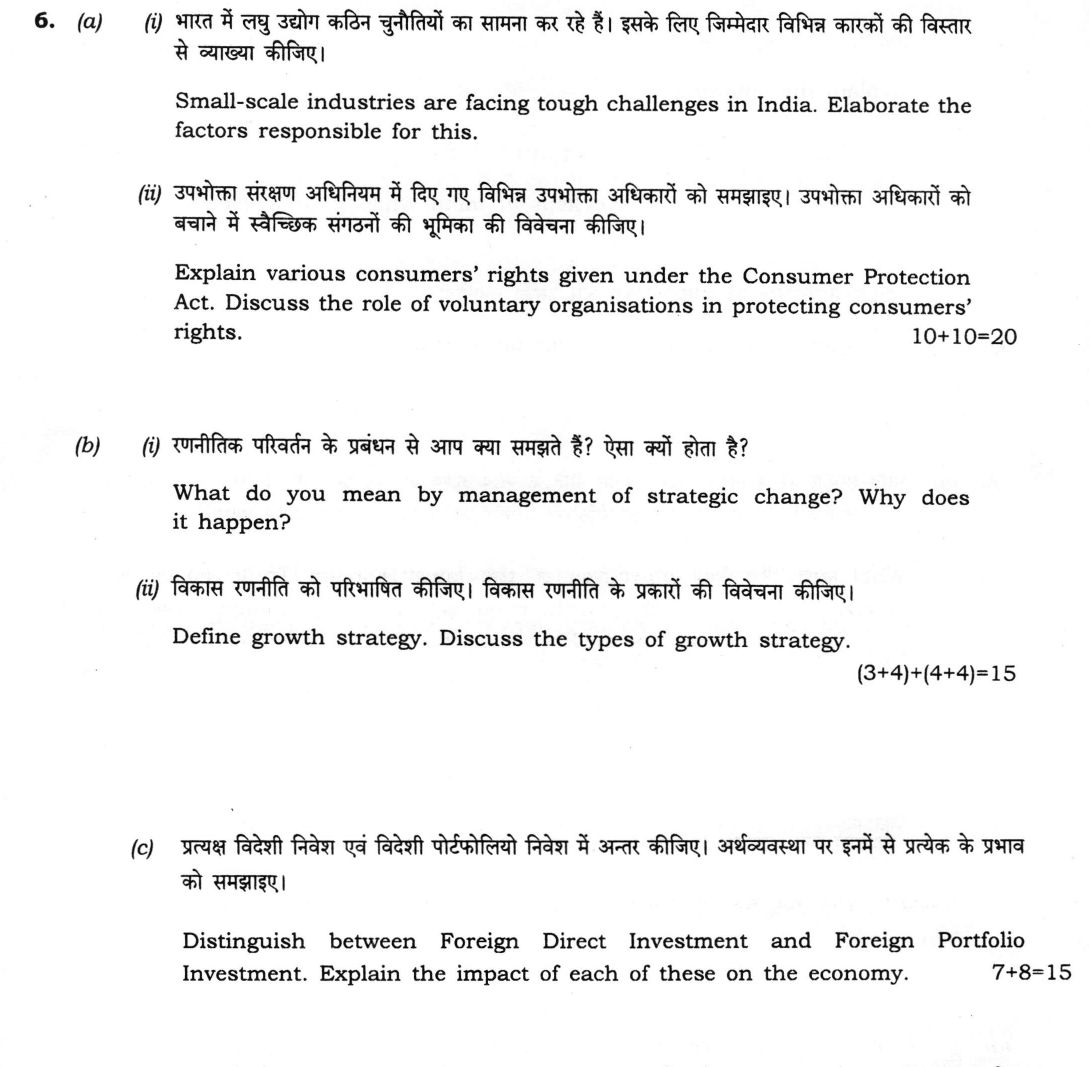
Small-scale industries are facing tough challenges in India. Elaborate the factors responsible for this. 10 marks
Explain various consumers' rights given under the Consumer Protection Act. Discuss the role of voluntary organisations in protecting consumers' rights. 10 marks
What do you mean by management of strategic change? Why does it happen? 7 marks
Define growth strategy. Discuss the types of growth strategy. 8 marks
Distinguish between Foreign Direct Investment and Foreign Portfolio Investment. Explain the impact of each of these on the economy. 15 marks
हिंदी में प्रश्न पढ़ें
भारत में लघु उद्योग कठिन चुनौतियों का सामना कर रहे हैं। इसके लिए जिम्मेदार विभिन्न कारकों की विस्तार से व्याख्या कीजिए। (10 अंक)
उपभोक्ता संरक्षण अधिनियम में दिए गए विभिन्न उपभोक्ता अधिकारों को समझाइए। उपभोक्ता अधिकारों को बचाने में स्वैच्छिक संगठनों की भूमिका की विवेचना कीजिए। (10 अंक)
रणनीतिक परिवर्तन के प्रबंधन से आप क्या समझते हैं? ऐसा क्यों होता है? (7 अंक)
विकास रणनीति को परिभाषित कीजिए। विकास रणनीति के प्रकारों की विवेचना कीजिए। (8 अंक)
प्रत्यक्ष विदेशी निवेश एवं विदेशी पोर्टफोलियो निवेश में अन्तर कीजिए। अर्थव्यवस्था पर इनमें से प्रत्येक के प्रभाव को समझाइए। (15 अंक)
Model answer
Drafted with AI by UPSC Answer Check against this question's marking rubric, to the expected length. UPSC does not publish answers for Mains — this is one way to score well, not an official key. How we build rubrics and answers.
(a)(i) Challenges faced by small-scale industries in India (10 marks)
Small industries, now micro and small enterprises under the MSMED Act, 2006, face tough challenges from several factors:
- Finance: limited access to institutional credit, high collateral demands, high interest and a lack of equity and working capital; delayed payments by large buyers lock up funds, despite the 45-day payment rule in the MSMED Act.
- Technology: obsolete machinery, low R&D, inadequate quality and design capacity, and difficulty in adopting digital technology.
- Marketing: weak branding, distribution and market information, and dependence on large buyers or middlemen.
- Raw materials and infrastructure: high input prices, irregular supply, unreliable power, transport and testing facilities.
- Competition: after liberalisation and the removal of product reservation, they face large firms and cheap imports.
- Regulation and compliance: many laws, tax compliance (GST) and inspections burden small units, with information gaps about schemes.
- Skills and management: shortage of trained labour and professional management; family-run units lack planning.
- Sickness and informality: many are unregistered, so they are outside formal credit and support, and inadequate working capital leads to sickness and closure.
(a)(ii) Consumer rights under the Consumer Protection Act and voluntary organisations (10 marks)
The Consumer Protection Act, 2019 (Section 2(9)) confers six rights: (1) the right to be protected against the marketing of goods and services hazardous to life and property (safety); (2) the right to be informed about the quality, quantity, potency, purity, standard and price of goods and services, so as to protect against unfair trade practices; (3) the right to be assured, wherever possible, of access to a variety of goods and services at competitive prices (choice); (4) the right to be heard and assured that the consumer's interests will receive due consideration at appropriate forums; (5) the right to seek redressal against unfair or restrictive trade practices or unscrupulous exploitation; and (6) the right to consumer awareness.
Role of voluntary organisations: they educate and create awareness through publications and campaigns; test and compare products and publish results; give advice, legal aid and help in filing and pursuing complaints; represent consumers before the consumer commissions, since the Act allows a recognised consumer association to file complaints, and have seats on the Central and State Consumer Protection Councils; act as watchdogs against adulteration and misleading advertising; and press for policy change. Examples are Consumer Guidance Society of India, VOICE and CERC. Limits: shortage of funds and trained staff, urban concentration, and dependence on grants.
(b)(i) Management of strategic change and why it happens (3 + 4 = 7 marks)
Management of strategic change is the process of planning, implementing and controlling changes in an organisation's strategy, structure, technology, processes and culture so that it adapts to its environment; it includes creating readiness, overcoming resistance and embedding the change (Lewin's unfreeze-change-refreeze, Kotter's steps).
Why it happens: external forces, such as technological change, new competitors, globalisation, regulation and policy shifts, changing customer preferences and economic or social change; and internal forces, such as poor performance, a new leadership or vision, growth and size, new products, changing employee expectations and resource constraints. Organisations that do not change lose fit with the environment.
(b)(ii) Growth strategy and its types (4 + 4 = 8 marks)
A growth strategy aims to raise the organisation's sales, market share, profit or scope beyond its present position, by expanding existing business or entering new ones.
Types (Ansoff and others): (1) market penetration, selling more of existing products in existing markets; (2) market development, taking existing products to new markets or segments; (3) product development, new or improved products in existing markets; (4) diversification, new products in new markets, related (concentric) or unrelated (conglomerate); (5) integration, backward or forward (vertical) and horizontal; and (6) external routes, through mergers, acquisitions, joint ventures and strategic alliances, in contrast to internal growth.
(c) FDI and FPI: difference and impact on the economy (7 + 8 = 15 marks)
Difference. Foreign direct investment is investment in a business in another country that gives the investor a lasting interest and a degree of control or influence over management, typically 10% or more of equity in India's rules, through greenfield projects or acquisitions; it is long-term, brings capital, technology and management, and is not easily withdrawn. Foreign portfolio investment is the purchase of shares, bonds and other financial securities without control, below 10% of a company's paid-up capital in India; it is short-term or speculative, highly liquid, and can be withdrawn quickly ("hot money"). Under FEMA, 1999 both are regulated, FPIs by SEBI registration.
Impact of FDI: it adds capital and fills the savings gap; transfers technology and management skills; creates jobs and infrastructure; raises exports and integrates the country into global value chains; increases competition and productivity; and gives a stable source of balance-of-payments finance. Drawbacks include profit repatriation, crowding out of local firms, dependence on foreign firms, and environmental or sector-control concerns.
Impact of FPI: it deepens and adds liquidity to stock and bond markets, improves price discovery and corporate governance, reduces the cost of capital, and helps finance the current account. Drawbacks: volatility and sudden outflows can trigger currency depreciation and market crashes (as in the 2013 taper tantrum and 2020), asset bubbles and monetary-policy constraints; and it creates no productive assets directly. Hence FDI is preferred for development, while FPI needs careful regulation.
How this answer will be evaluated
Evaluation rubric
Each sub-part is marked on its own, against the marks and word limit printed on the paper.
- (a)(i) Elaborate the factors responsible for the tough challenges faced by small-scale industries in India (10). 10 marks
Must cover
- Finance: credit access, collateral, delayed payments and working capital
- Technology and marketing weaknesses
- Infrastructure, raw materials and competition from large firms and imports
- Regulation, skills and management, sickness
Loses marks
- Confusing small-scale with MSME definitions.
- A bare list of factors.
- Only financial problems.
Earns more
- MSMED Act 2006 classification and payment rule.
- Each factor explained with its effect.
Extra mark
- Suggested remedies or government schemes
- (a)(ii) Explain the consumer rights under the Consumer Protection Act; discuss the role of voluntary organisations in protecting them (10). 10 marks
Must cover
- Six rights listed correctly (safety, information, choice, be heard, redressal, awareness), Consumer Protection Act 2019
- Role of voluntary organisations: education, testing, complaints help and legal aid, representation, watchdog
- Named organisations
- Limitations of voluntary organisations
Loses marks
- Listing the 1986 Act's rights only.
- Rights without explanation.
- No evaluation of voluntary organisations' role.
Earns more
- Section 2(9) reference and the CCPA or commissions.
- Consumer associations' right to file complaints.
Extra mark
- Comparison with the 1986 Act
- (b)(i) What is management of strategic change and why does it happen (7: 3 + 4). 7 marks
Must cover
- Definition: planning, implementing and controlling change in strategy, structure, technology and culture
- External causes (technology, competition, regulation, customers)
- Internal causes (performance, leadership, growth)
- Reference to models (Lewin, Kotter) or resistance
Loses marks
- Confusing strategic change with routine operational change.
- Only external causes.
- No definition.
Earns more
- Balance of external and internal factors.
- Illustration.
Extra mark
- Resistance to change
- (b)(ii) Define growth strategy and discuss its types (8: 4 + 4). 8 marks
Must cover
- Definition: strategy to raise sales, share, profit or scope
- Ansoff's four: penetration, market development, product development, diversification
- Integration (vertical and horizontal) and related versus unrelated diversification
- Mergers, acquisitions, alliances or joint ventures as external growth
Loses marks
- Listing stability or retrenchment as growth strategy.
- Types without definition.
- Confusing vertical and horizontal integration.
Earns more
- Illustrative example of each type.
- Internal versus external growth distinction.
Extra mark
- Growth versus stability and retrenchment
- (c) Distinguish FDI from FPI and explain the impact of each on the economy (15: 7 + 8). 15 marks
Must cover
- FDI: lasting interest and control, long-term, 10% and above in India; FPI: securities without control, short-term, below 10%
- Further points of difference (volatility, liquidity, technology, reversibility)
- Impact of FDI: capital, technology, jobs, exports, competition; drawbacks
- Impact of FPI: market depth, cost of capital, BoP; volatility, sudden stops; conclusion
Loses marks
- Treating FPI as long-term.
- Impact points reversed.
- Only definitions without impact.
Earns more
- Named episodes (2013 taper tantrum, 2020 outflows).
- FEMA and SEBI regulatory anchors.
Extra mark
- Comparative policy conclusion on preferring FDI
What "Elaborate" is asking you to do
Give the full detailed account the question has compressed into a line — every dimension of it, with specifics. Elaborate rewards completeness and detail rather than clarification or argument: the examiner is checking whether you can fill out a topic without being told what its parts are.
Structure that answers it
State the proposition → first dimension in detail → second dimension in detail → the part the statement leaves implicit → the consolidated picture
Where marks are lost
Repeating the statement at greater length instead of adding substance. Elaborate also punishes narrowness: omitting a whole dimension costs more here than anywhere else in this family.
Practice this exact question
Write your answer and it is marked point by point against the model answer above — what you covered, what you missed, what you got wrong.
Evaluate my answer →More from Management 2026 Paper II
- Q3 (a) (i) What is the meaning of positive and negative correlation? Explain with suitable e…
- Q4 (a) A clock manufacturing company is planning an assembly line to produce 195 clocks per…
- Q5 Answer each of the following questions in about 150 words : (a) Give a fair overview of r…
- Q6 (a) (i) Small-scale industries are facing tough challenges in India. Elaborate the factor…
- Q7 (a) Explain the concept of SWOT analysis. Discuss, in detail with suitable examples, the…
- Q8 (a) What are the key objectives of the latest Foreign Trade Policy of the Government of I…