Paper II — Q7
(a) Explain the concept of SWOT analysis. Discuss, in detail with suitable examples, the external and internal business…
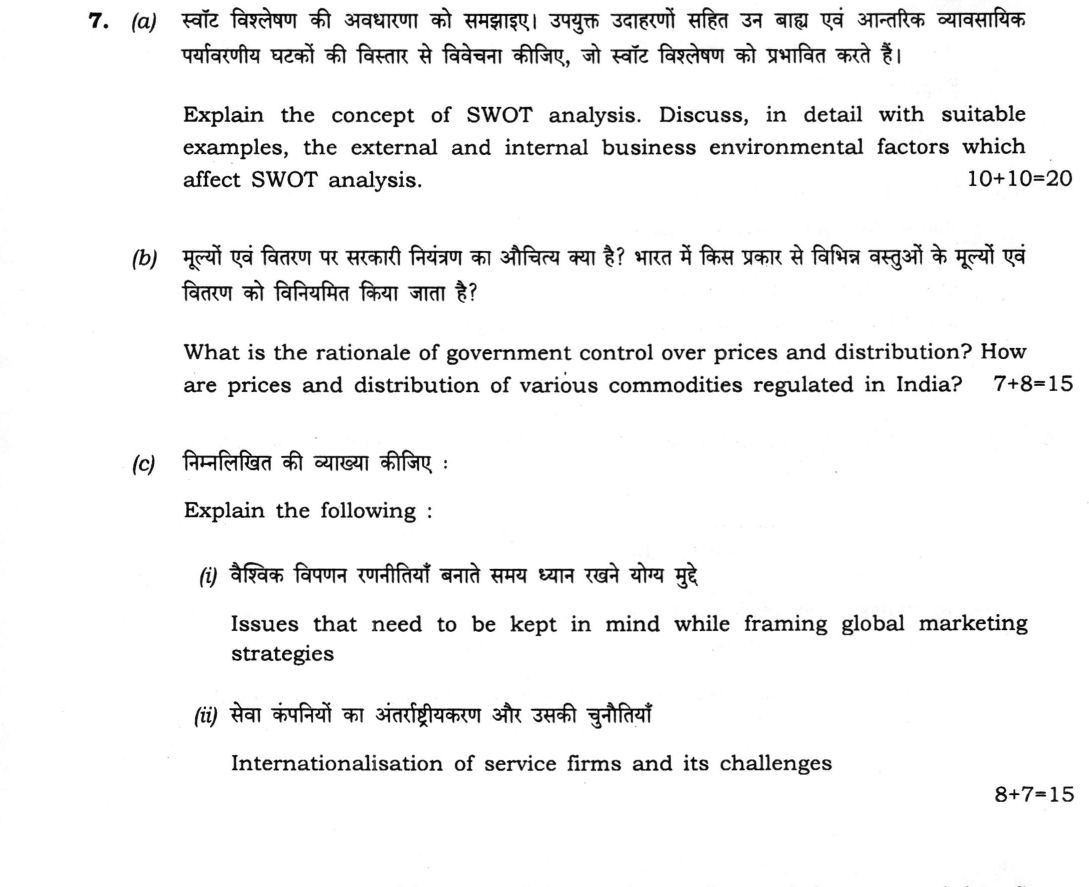
Explain the concept of SWOT analysis. Discuss, in detail with suitable examples, the external and internal business environmental factors which affect SWOT analysis. 20 marks
What is the rationale of government control over prices and distribution? How are prices and distribution of various commodities regulated in India? 15 marks
Explain the following : Issues that need to be kept in mind while framing global marketing strategies
Internationalisation of service firms and its challenges 15 marks
हिंदी में प्रश्न पढ़ें
स्वॉट विश्लेषण की अवधारणा को समझाइए। उपयुक्त उदाहरणों सहित उन बाह्य एवं आन्तरिक व्यावसायिक पर्यावरणीय घटकों की विस्तार से विवेचना कीजिए, जो स्वॉट विश्लेषण को प्रभावित करते हैं। (20 अंक)
मूल्यों एवं वितरण पर सरकारी नियंत्रण का औचित्य क्या है? भारत में किस प्रकार से विभिन्न वस्तुओं के मूल्यों एवं वितरण को विनियमित किया जाता है? (15 अंक)
निम्नलिखित की व्याख्या कीजिए : वैश्विक विपणन रणनीतियाँ बनाते समय ध्यान रखने योग्य मुद्दे
सेवा कंपनियों का अंतर्राष्ट्रीयकरण और उसकी चुनौतियाँ (15 अंक)
Model answer
Drafted with AI by UPSC Answer Check against this question's marking rubric, to the expected length. UPSC does not publish answers for Mains — this is one way to score well, not an official key. How we build rubrics and answers.
(a) SWOT analysis and the environmental factors behind it (10 + 10 = 20 marks)
Concept (10). SWOT analysis is a strategic planning tool that examines an organisation's internal Strengths and Weaknesses and the external Opportunities and Threats it faces, to match resources with the environment and formulate strategy. Strengths (a strong brand, low cost, skilled staff) are to be used, weaknesses (weak finances, outdated technology) corrected, opportunities (new markets, growing demand) exploited, and threats (competition, regulation) countered. A TOWS matrix pairs them into strategies: strengths with opportunities (growth), strengths with threats (defence), weaknesses with opportunities (turnaround) and weaknesses with threats (retrenchment). It is simple and widely used, but is subjective and static unless the factors are prioritised and updated.
Environmental factors (10).
Internal factors, giving strengths and weaknesses: financial resources and capital structure; human resources, skills, morale and leadership; marketing, brand, distribution and customer loyalty; production and operations, cost, capacity and quality; research and technology; organisation structure and culture; and management information systems. Example: Amul's strengths are its farmer-cooperative network, brand trust and procurement system; a weakness would be dependence on milk supply and price regulation.
External factors, giving opportunities and threats. The macro environment (PESTEL): political and legal (government policy, taxes, laws such as the Competition Act), economic (growth, inflation, interest rates, exchange rates, income), social and cultural (demographics, lifestyles, health awareness), technological (digitalisation, automation, e-commerce), environmental (climate, sustainability rules) and legal. The task or micro environment: customers, competitors, suppliers, substitutes and new entrants (Porter's five forces), distributors and pressure groups. Example: rising incomes and internet use are opportunities for consumer-goods firms, while new low-cost competitors and stricter regulation are threats.
(b) Price and distribution control by the government (7 + 8 = 15 marks)
Rationale (7). Markets for essential goods may fail: there can be scarcity, hoarding and black-marketing, monopoly or oligopoly power, or sudden price spikes that hurt the poor. Government control is therefore justified to: protect consumers, particularly the poor, and ensure access to essentials; curb inflation and maintain stability; prevent exploitation and unfair profiteering; ensure equitable distribution in shortage and emergencies; protect producers, such as farmers, through assured prices; regulate natural monopolies (electricity, water) and strategic goods (fuel, fertilisers); and secure social objectives such as food security. Its costs are shortages, black markets, distortions, subsidy burden and disincentives to investment.
Regulation in India (8). The Essential Commodities Act, 1955 empowers the government to control the production, supply, distribution and price of essential goods through control orders, stock limits and licensing (relaxed by the 2020 amendment for cereals, pulses, oilseeds, onion and potato except in extraordinary price rises). The Public Distribution System, under the National Food Security Act, 2013, supplies subsidised grains through fair-price shops, and the Minimum Support Price system, on the CACP's recommendations, supports farmers. The Drug Price Control Order, 2013 (NPPA) fixes ceiling prices for scheduled drugs in the National List of Essential Medicines. For fuels, petrol was deregulated in 2010 and diesel in 2014; LPG is subsidised through direct benefit transfer. The government sets the maximum retail price of urea and gives nutrient-based subsidy for other fertilisers; the Fair and Remunerative Price applies to sugarcane; electricity tariffs are regulated by the Central and State Electricity Regulatory Commissions under the Electricity Act, 2003; telecom tariffs by TRAI; and the Prevention of Black-marketing Act, 1980, the Legal Metrology Act and the Consumer Protection Act support enforcement.
(c)(i) Issues in framing global marketing strategies (8 marks)
The central issue is standardisation versus adaptation: whether to sell a uniform product, brand and message worldwide for economies of scale, or adapt to local conditions. Other issues:
- Cultural and social differences in language, tastes, religion and buying behaviour affect product design, branding and advertising.
- Political and legal environment: tariffs, non-tariff barriers, quotas, foreign-ownership limits, standards, intellectual-property protection, and political stability.
- Economic conditions: income level, exchange-rate risk, inflation and convertibility.
- Product decisions: adaptation to standards and usage, packaging and labelling, and after-sales service.
- Pricing: cost escalation, transfer pricing, dumping rules and currency fluctuations.
- Distribution: channel structure and infrastructure differ by country.
- Promotion: language, media availability and advertising restrictions.
- Choice of market and entry mode (exporting, licensing, joint venture, wholly owned subsidiary), and organisation and control of global operations, plus ethical and competitive issues.
(c)(ii) Internationalisation of service firms and its challenges (7 marks)
Services are intangible, inseparable from delivery, variable and perishable, which shapes how they go abroad. GATS identifies four modes: cross-border supply (software and BPO delivered online), consumption abroad (medical tourism, education), commercial presence (bank branches, hotels, retail) and movement of natural persons (consultants, professionals). Indian IT and BPO firms are examples.
Challenges: regulatory barriers and licensing, such as foreign-ownership caps, professional qualification recognition, and visa and work-permit limits; cultural and language differences affecting service expectations; maintaining consistent quality and standardisation across countries and dependence on skilled people; building trust and reputation with no tangible product to show; data protection and cyber-security rules; local competition and protectionism; and payment, tax and currency difficulties.
How this answer will be evaluated
Framework: SWOT Analysis
What earns full marks: Comprehensive, well-structured, with specific examples and clear distinction between concepts.
Evaluation rubric
Each sub-part is marked on its own, against the marks and word limit printed on the paper.
- (a) Explain the concept of SWOT analysis; discuss in detail with examples the external and internal business environmental factors that affect it (10 + 10 = 20). 20 marks
discuss— intro → 3-4 dimensions → example → balanced close
Must cover
- SWOT defined: internal strengths and weaknesses, external opportunities and threats; purpose and TOWS use
- Internal factors: finance, HR, marketing, operations, R&D, culture, with example
- External macro factors (PESTEL) with examples
- Micro or task environment (customers, competitors, suppliers, substitutes) and an illustrative example
Loses marks
- Placing an external factor as a strength or weakness.
- A bare list of factors with no example.
- Confusing SWOT with PESTEL only.
Earns more
- Limitations of SWOT.
- Correct classification of a factor as internal or external.
Extra mark
- TOWS matrix strategies
- (b) Rationale for government control over prices and distribution; how they are regulated in India (7 + 8 = 15). 15 marks
explain— definition/context → points in order → small example → short close
Must cover
- Rationale: market failure, hoarding, protecting poor and farmers, inflation, natural monopolies
- Costs or limits of control
- Essential Commodities Act 1955 (and 2020 amendment), PDS under NFSA 2013, MSP
- Drug price control (DPCO 2013, NPPA), fuel and fertiliser, sugar, electricity and telecom regulation
Loses marks
- Only description of one commodity.
- Obsolete claims (petrol still administered).
- Rationale missing.
Earns more
- Correct current position on petrol and diesel deregulation.
- Regulators and enforcement laws named.
Extra mark
- Balance of subsidy and market reforms
- (c) (i) Issues in framing global marketing strategies (8); (ii) internationalisation of service firms and its challenges (7) (15). 15 marks
explain— definition/context → points in order → small example → short close
Must cover
- Standardisation versus adaptation as the core issue
- Cultural, legal-political, economic factors, product, price, distribution, promotion, entry-mode decisions
- Service features and GATS four modes of internationalisation
- Challenges: regulation, quality consistency, culture, trust, people mobility, data protection
Loses marks
- Treating services as goods.
- Only listing issues without explanation.
- Confusing GATS modes.
Earns more
- Indian IT and BPO examples.
- Ethical or competitive issues.
Extra mark
- Global branding versus local branding
What "Discuss" is asking you to do
Lay the issue out from more than one side — how it arose, what is claimed for it, what is held against it, and where it now stands. UPSC attaches discuss to broad topics with several live dimensions, so coverage of the dimensions earns more than the strength of your opinion.
Structure that answers it
Set the issue up → the case as it is made → the case against → the dimension both sides leave out → where the balance now lies
Where marks are lost
Listing facts with no thread between them, or arguing one side throughout and calling it a discussion.
Practice this exact question
Write your answer and it is marked point by point against the model answer above — what you covered, what you missed, what you got wrong.
Evaluate my answer →More from Management 2026 Paper II
- Q4 (a) A clock manufacturing company is planning an assembly line to produce 195 clocks per…
- Q5 Answer each of the following questions in about 150 words : (a) Give a fair overview of r…
- Q6 (a) (i) Small-scale industries are facing tough challenges in India. Elaborate the factor…
- Q7 (a) Explain the concept of SWOT analysis. Discuss, in detail with suitable examples, the…
- Q8 (a) What are the key objectives of the latest Foreign Trade Policy of the Government of I…