Paper II — Q4
(a) A clock manufacturing company is planning an assembly line to produce 195 clocks per 8-hour shift. The following table gives…
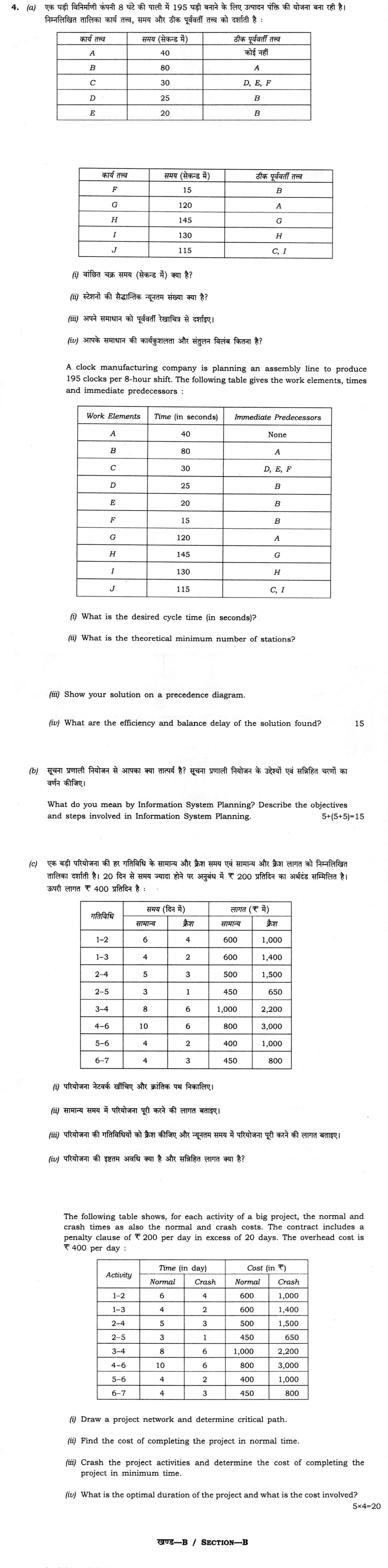
A clock manufacturing company is planning an assembly line to produce 195 clocks per 8-hour shift. The following table gives the work elements, times and immediate predecessors :
Work Elements | Time (in seconds) | Immediate Predecessors A | 40 | None B | 80 | A C | 30 | D, E, F D | 25 | B E | 20 | B F | 15 | B G | 120 | A H | 145 | G I | 130 | H J | 115 | C, I
What is the desired cycle time (in seconds)?
What is the theoretical minimum number of stations?
Show your solution on a precedence diagram.
What are the efficiency and balance delay of the solution found? 15 marks
What do you mean by Information System Planning? Describe the objectives and steps involved in Information System Planning. 5+(5+5)= 15 marks
The following table shows, for each activity of a big project, the normal and crash times as also the normal and crash costs. The contract includes a penalty clause of ₹ 200 per day in excess of 20 days. The overhead cost is ₹ 400 per day : [Table : Activity | Time (in day) Normal, Crash | Cost (in ₹) Normal, Crash 1–2 | 6 | 4 | 600 | 1,000 1–3 | 4 | 2 | 600 | 1,400 2–4 | 5 | 3 | 500 | 1,500 2–5 | 3 | 1 | 450 | 650 3–4 | 8 | 6 | 1,000 | 2,200 4–6 | 10 | 6 | 800 | 3,000 5–6 | 4 | 2 | 400 | 1,000 6–7 | 4 | 3 | 450 | 800] Draw a project network and determine critical path.
Find the cost of completing the project in normal time.
Crash the project activities and determine the cost of completing the project in minimum time.
What is the optimal duration of the project and what is the cost involved? 5×4= 20 marks
हिंदी में प्रश्न पढ़ें
एक घड़ी विनिर्माणी कंपनी 8 घंटे की पाली में 195 घड़ी बनाने के लिए उत्पादन पंक्ति की योजना बना रही है। निम्नलिखित तालिका कार्य तत्व, समय और ठीक पूर्ववर्ती तत्व को दर्शाती है :
कार्य तत्व | समय (सेकंड में) | ठीक पूर्ववर्ती तत्व A | 40 | कोई नहीं B | 80 | A C | 30 | D, E, F D | 25 | B E | 20 | B कार्य तत्व | समय (सेकण्ड में) | ठीक पूर्ववर्ती तत्व F | 15 | B G | 120 | A H | 145 | G I | 130 | H J | 115 | C, I
वांछित चक्र समय (सेकण्ड में) क्या है?
स्टेशनों की सैद्धान्तिक न्यूनतम संख्या क्या है?
अपने समाधान को पूर्ववर्ती रेखाचित्र से दर्शाइए।
आपके समाधान की कार्यकुशलता और संतुलन विलंब कितना है? (15 अंक)
सूचना प्रणाली नियोजन से आपका क्या तात्पर्य है? सूचना प्रणाली नियोजन के उद्देश्यों एवं सन्निहित चरणों का वर्णन कीजिए। (15 अंक)
निम्नलिखित सारणी एक बड़ी परियोजना की प्रत्येक गतिविधि के लिए सामान्य तथा क्रैश समय और सामान्य तथा क्रैश लागत दर्शाती है। संविदा में 20 दिनों से अधिक के लिए ₹ 200 प्रति दिन का शास्ति खंड सम्मिलित है। अधिभार लागत ₹ 400 प्रति दिन है : [सारणी : गतिविधि | समय (दिन में) सामान्य, क्रैश | लागत (₹ में) सामान्य, क्रैश 1–2 | 6 | 4 | 600 | 1,000 1–3 | 4 | 2 | 600 | 1,400 2–4 | 5 | 3 | 500 | 1,500 2–5 | 3 | 1 | 450 | 650 3–4 | 8 | 6 | 1,000 | 2,200 4–6 | 10 | 6 | 800 | 3,000 5–6 | 4 | 2 | 400 | 1,000 6–7 | 4 | 3 | 450 | 800] एक परियोजना नेटवर्क बनाइए और क्रांतिक पथ निर्धारित कीजिए।
सामान्य समय में परियोजना पूरी करने की लागत ज्ञात कीजिए।
परियोजना की गतिविधियों को क्रैश कीजिए और न्यूनतम समय में परियोजना पूरी करने की लागत निर्धारित कीजिए।
परियोजना की इष्टतम अवधि क्या है और उसमें कितनी लागत आती है? 5×4= (20 अंक)
Model answer
Drafted with AI by UPSC Answer Check against this question's marking rubric, to the expected length. UPSC does not publish answers for Mains — this is one way to score well, not an official key. How we build rubrics and answers.
(a) Assembly-line balancing for the clock (15 marks)
(i) Desired cycle time = available time/required output = (8 × 3,600 s)/195 = 28,800/195 = 147.7 seconds per clock.
(ii) Sum of the task times = 40 + 80 + 30 + 25 + 20 + 15 + 120 + 145 + 130 + 115 = 720 s. Theoretical minimum number of stations = 720/147.7 = 4.87, so 5 stations (rounded up). The longest task, H at 145 s, is within the cycle time, so the cycle time is feasible.
(iii) Assign tasks to stations without exceeding 147.7 s (whole seconds, so 147 s) while respecting the precedence relations (A precedes B and G; B precedes D, E, F; D, E, F precede C; G precedes H; H precedes I; C and I precede J), using the largest ranked positional weight first:
- Station 1: A (40), B (80), D (25) = 145 s.
- Station 2: G (120), E (20) = 140 s.
- Station 3: H (145) = 145 s.
- Station 4: I (130), F (15) = 145 s.
- Station 5: C (30), J (115) = 145 s.
Every task follows its predecessors: G, E and F come after A and B, I after H, and C and J after everything they need.

(iv) Efficiency = total task time/(number of stations × cycle time) = 720/(5 × 147.7) = 720/738.5 = 97.5%. Balance delay = 100 − 97.5 = 2.5% (idle time 18.5 s per cycle). If the actual cycle time were set at the longest station, 145 s, the efficiency would be 720/725 = 99.3%.
(b) Information system planning (5 + 5 + 5 = 15 marks)
Meaning: information system planning is the process of identifying, in line with the organisation's business strategy, the information needs, applications, data, technology and resources required, and deciding what systems to build and in which order; it produces the IS plan or portfolio linking IT with business goals.
Objectives:
- Align the information systems with business strategy and goals.
- Identify the applications and information the organisation needs and set priorities among projects.
- Allocate scarce resources (money, people, technology) efficiently and avoid duplication and incompatibility.
- Provide competitive advantage and support decision-making at all levels.
- Set an architecture for integration, and assess risks, benefits and costs.
Steps:
- Study the organisation's mission, strategy and critical success factors.
- Assess the current systems and technology (an IS audit) and the environment.
- Identify information requirements and possible new applications, through methods such as Critical Success Factors and IBM's Business Systems Planning.
- Design the target information architecture and the portfolio of projects.
- Evaluate and prioritise the projects by cost-benefit, risk and strategic value.
- Prepare the resource, budget, schedule and staffing plan.
- Implement, monitor and review the plan, revising it as the business changes.
(c) Project network, normal cost, crashing and optimum duration (5 × 4 = 20 marks)
(i) The network is drawn below. The paths are 1-2-4-6-7 = 6 + 5 + 10 + 4 = 25 days, 1-2-5-6-7 = 6 + 3 + 4 + 4 = 17 days, and 1-3-4-6-7 = 4 + 8 + 10 + 4 = 26 days. The critical path is 1-3-4-6-7, duration 26 days.

(ii) Normal time: 26 days. Direct cost = 600 + 600 + 500 + 450 + 1,000 + 800 + 400 + 450 = ₹4,800. Overhead = 26 × 400 = ₹10,400. The delay beyond 20 days is 6 days, so the penalty = 6 × 200 = ₹1,200. Total cost = ₹16,400.
(iii) Crash cost slopes, ₹ per day saved: 1-2: 200 (2 days); 1-3: 400 (2 days); 2-4: 500 (2 days); 2-5: 100 (2 days); 3-4: 600 (2 days); 4-6: 550 (4 days); 5-6: 300 (2 days); 6-7: 350 (1 day). Crash the critical path activity of least slope, keeping an eye on the second path:
- 26 to 25 days: crash 6-7 by 1 day (₹350). The path 1-2-4-6-7 is now 24 days.
- 25 to 24: crash 1-3 by 1 day (₹400). Now 1-3-4-6-7 and 1-2-4-6-7 are both critical at 24 days.
- 24 to 20: crash 4-6, common to both paths, by 4 days (₹550 a day = ₹2,200), reaching 20 days.
- 20 to 19: crash 1-3 by another day and 1-2 by 1 day (₹400 + ₹200 = ₹600).
- 19 to 18: crash 3-4 by 1 day and 1-2 by 1 day (₹600 + ₹200 = ₹800).
- 18 to 17: crash 3-4 by 1 day and 2-4 by 1 day (₹600 + ₹500 = ₹1,100).
Path 1-3-4-6-7 cannot shrink further, since 1-3, 3-4, 4-6 and 6-7 are all fully crashed: the minimum time is 17 days. The direct cost is 4,800 + 350 + 800 + 2,200 + 400 + 1,200 + 500 = ₹10,250; the overhead is 17 × 400 = ₹6,800; there is no penalty, so the total is ₹17,050.
(iv) Total cost by duration (direct + overhead + penalty): 26 days ₹16,400; 25 days ₹16,150; 24 days ₹15,950; 23 days ₹15,900; 22 days ₹15,850; 21 days ₹15,800; 20 days ₹15,750; 19 days ₹15,950; 18 days ₹16,350; 17 days ₹17,050. Up to 20 days each day of crashing costs less than the ₹600 saved (overhead ₹400 plus penalty ₹200), but beyond 20 days the penalty has ended, so the saving is only ₹400 while the cheapest crash costs ₹600. The optimal duration is 20 days, with a total cost of ₹15,750 (direct ₹7,750 plus overhead ₹8,000, no penalty).
How this answer will be evaluated
Evaluation rubric
Each sub-part is marked on its own, against the marks and word limit printed on the paper.
- (a) Assembly-line balancing for 195 clocks per 8-hour shift: cycle time, theoretical minimum stations, precedence diagram and solution, efficiency and balance delay (15). 15 marks
Must cover
- Cycle time = 28,800/195 = 147.7 s
- Total time 720 s; minimum stations = 720/147.7 = 4.87, so 5
- Feasible station assignment respecting precedence (for example A,B,D; G,E; H; I,F; C,J) with a precedence diagram
- Efficiency = 720/(5 × 147.7) = 97.5% and balance delay 2.5%
Loses marks
- Using 8 hours = 480 minutes wrongly.
- Assignment violating precedence.
- Efficiency computed on the wrong denominator.
Earns more
- Named heuristic (largest positional weight or similar).
- Idle time per cycle stated.
Extra mark
- Efficiency at the practical cycle time of 145 s
- (b) (i) Meaning of information system planning (5); (ii) objectives (5); (iii) steps (5). 15 marks
Must cover
- Meaning: aligning systems, data and resources with business strategy; produces an IS plan
- At least three objectives (strategic alignment, priorities, resource allocation, competitive advantage)
- Steps from strategy study through current-systems audit to requirements, architecture, prioritisation, resource plan and review
- Methods such as CSF or Business Systems Planning
Loses marks
- Confusing IS planning with system development life cycle.
- A list of steps with no order.
- Generic planning definition without information systems.
Earns more
- Sequenced steps with explanation.
- Link to competitive advantage.
Extra mark
- Portfolio and risk management
- (c) Project network and critical path; normal-time cost; crashing and minimum-time cost; optimal duration and cost (5 × 4 = 20). 20 marks
Must cover
- Network and critical path 1-3-4-6-7 = 26 days
- Normal cost: direct 4,800, overhead 10,400, penalty 1,200, total 16,400
- Crash slopes and step-by-step crashing to the minimum time of 17 days, total 17,050 (direct 10,250)
- Optimum: 20 days with total cost 15,750 (direct 7,750, overhead 8,000); cost table across durations
Loses marks
- Ignoring the penalty clause or overhead.
- Crashing non-critical activities.
- Stopping at minimum time as optimum.
Earns more
- Recognising second critical path and crashing the common activity 4-6.
- Penalty and overhead treated correctly.
Extra mark
- Comparison table of durations and totals
What "Prove" is asking you to do
Establish that the statement holds for every case it claims, not for one representative case. The argument must be closed: each line follows from a definition, a hypothesis, or a named theorem you are entitled to use.
Structure that answers it
Given and to prove, restated → theorem or construction to be used, named → the argument line by line → conclusion stated as proved
Where marks are lost
Testing one example, which illustrates but proves nothing. On an if and only if claim, proving one direction and stopping forfeits that half outright, and degenerate cases — zero, the empty set, the equality case — have to be disposed of rather than assumed away.
Practice this exact question
Write your answer and it is marked point by point against the model answer above — what you covered, what you missed, what you got wrong.
Evaluate my answer →More from Management 2026 Paper II
- Q1 Answer each of the following questions in about 150 words : (a) Explain parametric test a…
- Q2 (a) ABC computer company is engaged in repairs and service of computers. It is trying to…
- Q3 (a) (i) What is the meaning of positive and negative correlation? Explain with suitable e…
- Q4 (a) A clock manufacturing company is planning an assembly line to produce 195 clocks per…
- Q5 Answer each of the following questions in about 150 words : (a) Give a fair overview of r…
- Q6 (a) (i) Small-scale industries are facing tough challenges in India. Elaborate the factor…
- Q7 (a) Explain the concept of SWOT analysis. Discuss, in detail with suitable examples, the…