Paper II — Q5
(a) Give a fair overview of regulatory framework of corporate governance in India. (10 marks) (b) What do you mean by vision in…
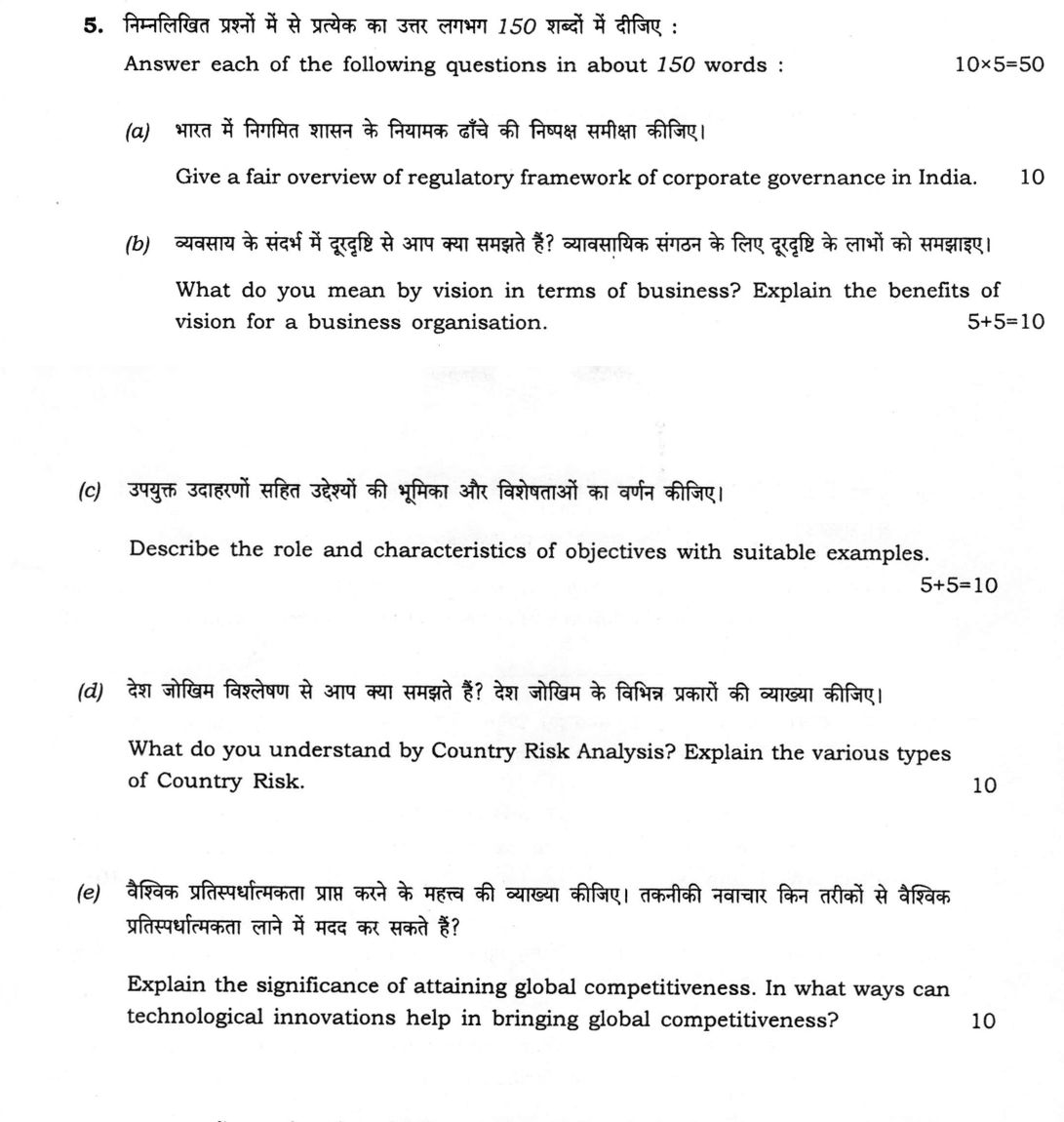
Answer each of the following questions in about 150 words :
Give a fair overview of regulatory framework of corporate governance in India. 10 marks
What do you mean by vision in terms of business? Explain the benefits of vision for a business organisation. 10 marks
Describe the role and characteristics of objectives with suitable examples. 10 marks
What do you understand by Country Risk Analysis? Explain the various types of Country Risk. 10 marks
Explain the significance of attaining global competitiveness. In what ways can technological innovations help in bringing global competitiveness? 10 marks
हिंदी में प्रश्न पढ़ें
5. निम्नलिखित प्रश्नों में से प्रत्येक का उत्तर लगभग 150 शब्दों में दीजिए :
भारत में निगमित शासन के नियामक ढाँचे की निष्पक्ष समीक्षा कीजिए। (10 अंक)
व्यवसाय के संदर्भ में दूरदृष्टि से आप क्या समझते हैं? व्यावसायिक संगठन के लिए दूरदृष्टि के लाभों को समझाइए। (10 अंक)
उपयुक्त उदाहरणों सहित उद्देश्यों की भूमिका और विशेषताओं का वर्णन कीजिए। (10 अंक)
देश जोखिम विश्लेषण से आप क्या समझते हैं? देश जोखिम के विभिन्न प्रकारों की व्याख्या कीजिए। (10 अंक)
वैश्विक प्रतिस्पर्धात्मकता प्राप्त करने के महत्त्व की व्याख्या कीजिए। तकनीकी नवाचार किन तरीकों से वैश्विक प्रतिस्पर्धात्मकता लाने में मदद कर सकते हैं? (10 अंक)
Model answer
Drafted with AI by UPSC Answer Check against this question's marking rubric, to the 150-word length. UPSC does not publish answers for Mains — this is one way to score well, not an official key. How we build rubrics and answers.
(a) Regulatory framework of corporate governance in India (10 marks)
The framework rests on statute, regulation and voluntary codes. The Companies Act, 2013 requires a minimum of one-third independent directors on the boards of listed companies, at least one woman director on prescribed companies (Section 149), an audit committee and a nomination and remuneration committee (Sections 177 and 178), a vigil mechanism, regulation of related-party transactions (Section 188), directors' duties (Section 166), CSR (Section 135), internal audit and auditor rotation, with NFRA overseeing audit quality. SEBI, through the LODR Regulations 2015 (which absorbed Clause 49 of the listing agreement), sets board composition, disclosure, committee, and related-party rules for listed entities, and guards minority shareholders and insider-trading limits. Committees (Birla 1999, Naresh Chandra 2002, Narayana Murthy 2003, Irani 2005, Uday Kotak 2017) shaped the reforms, and there is a Stewardship Code for institutional investors. Overall, the framework is comprehensive and now close to international norms; but promoter dominance, weak enforcement, and cases such as Satyam and IL&FS show that implementation and board independence remain the challenge.
(b) Vision in business (5 + 5 = 10 marks)
Meaning: a vision is a concise, aspirational statement of what an organisation wants to become or achieve in the long run, its desired future position and identity; it looks forward, while the mission states present purpose. A vision such as "a computer on every desk" describes the destination, not the route.
Benefits: (1) it gives direction and a common purpose, aligning the efforts of managers and employees; (2) it inspires and motivates, giving meaning to work; (3) it guides strategy formulation, resource allocation and decisions, and provides the base for objectives; (4) it helps in attracting talent, investors and partners by communicating identity and long-term intent; (5) it supports consistency and long-term thinking through changes in the environment, and helps distinguish the organisation from competitors.
(c) Role and characteristics of objectives (5 + 5 = 10 marks)
Role: objectives translate the mission into specific targets and give (1) direction and focus to activity; (2) a basis for planning and for policies and strategies; (3) coordination among departments; (4) motivation, since people work better towards known goals; (5) standards for performance measurement and control; and (6) legitimacy and a basis for evaluating the organisation. Example: "increase market share from 12% to 15% within two years".
Characteristics: objectives should be specific and clear; measurable (quantified where possible); time-bound; achievable yet challenging; consistent with each other and with the mission; arranged in a hierarchy (corporate, divisional, departmental); flexible and reviewable; understood and accepted by those responsible (participative). Drucker's key result areas, such as market standing, innovation, productivity, profitability and social responsibility, are the areas for setting them, and the SMART criteria give the tests.
(d) Country risk analysis and its types (10 marks)
Country risk analysis is the assessment of the risks that a firm faces in trading, investing, lending or operating in a particular foreign country, arising from that country's political, economic, financial and social environment. Firms conduct it before entry and on a continuing basis, using country ratings and indices (Euromoney, ICRG, Coface, sovereign ratings), macroeconomic indicators, expert opinion and scenario analysis, to decide on entry mode, price, insurance and exit.
Types: (1) political risk: instability, expropriation and nationalisation, war and terrorism, and changes in policy or regulation; (2) economic risk: inflation, recession, fiscal and current-account deficits and reliance on commodities; (3) financial and currency risk: exchange-rate volatility, convertibility and transfer restrictions, and sovereign default; (4) legal and regulatory risk: weak contract enforcement, tax and ownership changes; (5) social and cultural risk: labour unrest, ethnic tension and cultural difference; and (6) operational and supply-chain risk, including infrastructure and corruption.
(e) Global competitiveness and technological innovation (10 marks)
Significance: global competitiveness is the ability to sell products in world markets against the best rivals, profitably and sustainably. For a firm it means larger markets, economies of scale, lower costs, access to resources and capital, learning from rivals, resilience to import competition and survival after liberalisation. For a country it means exports, jobs, foreign exchange, FDI, higher incomes and technological upgradation, as in India's IT services and pharmaceutical exports.
Role of technological innovation: (1) process innovations such as automation, robotics and Industry 4.0 cut cost and raise quality; (2) product innovation and R&D, protected by patents, create differentiation and premium prices; (3) digital platforms, e-commerce and payments (such as UPI) widen reach and lower transaction costs; (4) data analytics, AI and IoT improve forecasting, supply-chain efficiency and customer service; (5) faster development cycles and mass customisation improve responsiveness; and (6) green technologies help meet international standards.
How this answer will be evaluated
Evaluation rubric
Each sub-part is marked on its own, against the marks and word limit printed on the paper.
- (a) Give a fair overview of the regulatory framework of corporate governance in India (10, about 150 words). 10 marks · 150 words
Must cover
- Companies Act 2013 provisions (independent directors, committees, related-party, duties, CSR)
- SEBI LODR Regulations 2015 (Clause 49 origin) and SEBI's role
- Committee history (Birla, Naresh Chandra, Murthy, Irani, Kotak) or NFRA and stewardship code
- Balanced assessment: strengths and gaps in enforcement, promoter dominance, scandal examples
Loses marks
- Only listing committees without the law.
- One-sided praise or criticism.
- Wrong Act or wrong section.
Earns more
- Specific section numbers correct.
- Both statute and regulation covered.
Extra mark
- Recent reforms such as decriminalisation or ESG disclosure
- (b) Meaning of vision in business (5) and benefits of vision (5) (10, about 150 words). 10 marks · 150 words
Must cover
- Vision defined as long-term aspirational future position; distinct from mission
- At least three benefits (direction, motivation, strategy guide, attracting stakeholders, consistency)
- Illustrative example
Loses marks
- Confusing vision with mission or objectives.
- Vision as short-term target.
- Benefits listed without explanation.
Earns more
- Explanation of each benefit, not a list.
- Link between vision, objectives and strategy.
Extra mark
- Characteristics of good vision statements
- (c) Role (5) and characteristics (5) of objectives with suitable examples (10, about 150 words). 10 marks · 150 words
Must cover
- At least three roles (direction, planning basis, coordination, motivation, control standard)
- At least four characteristics (specific, measurable, time-bound, achievable, consistent, hierarchical)
- Suitable examples of objectives
- Link to key result areas or SMART
Loses marks
- Vague objectives given as examples.
- Only roles or only characteristics.
- Confusing objectives with policies.
Earns more
- Distinction between objectives and goals or mission.
- Both role and characteristics covered equally.
Extra mark
- Management by objectives
- (d) What is country risk analysis and explain the types of country risk (10, about 150 words). 10 marks · 150 words
Must cover
- Definition and purpose of country risk analysis
- How firms assess (ratings, indicators, scenarios)
- At least four types: political, economic, financial or currency, legal, social, operational
- Illustrations for each type
Loses marks
- Confusing with only exchange-rate risk.
- Only political risk described.
- Types listed without meaning.
Earns more
- Named rating agencies or indices.
- Link to entry mode and risk mitigation.
Extra mark
- Sovereign and transfer risk
- (e) Significance of attaining global competitiveness and ways technological innovation helps (10, about 150 words). 10 marks · 150 words
Must cover
- Meaning and significance for the firm and the nation
- Process innovation and automation
- Product innovation, R&D and IP
- Digital platforms, analytics and supply-chain technologies
Loses marks
- Only significance with no technology.
- Listing technologies without competitiveness link.
- Confusing competitiveness with only exports.
Earns more
- Indian examples (IT services, pharma, UPI).
- Green or quality technologies for standards.
Extra mark
- Mass customisation
What "Discuss" is asking you to do
Lay the issue out from more than one side — how it arose, what is claimed for it, what is held against it, and where it now stands. UPSC attaches discuss to broad topics with several live dimensions, so coverage of the dimensions earns more than the strength of your opinion.
Structure that answers it
Set the issue up → the case as it is made → the case against → the dimension both sides leave out → where the balance now lies
Where marks are lost
Listing facts with no thread between them, or arguing one side throughout and calling it a discussion.
Practice this exact question
Write your answer and it is marked point by point against the model answer above — what you covered, what you missed, what you got wrong.
Evaluate my answer →More from Management 2026 Paper II
- Q2 (a) ABC computer company is engaged in repairs and service of computers. It is trying to…
- Q3 (a) (i) What is the meaning of positive and negative correlation? Explain with suitable e…
- Q4 (a) A clock manufacturing company is planning an assembly line to produce 195 clocks per…
- Q5 Answer each of the following questions in about 150 words : (a) Give a fair overview of r…
- Q6 (a) (i) Small-scale industries are facing tough challenges in India. Elaborate the factor…
- Q7 (a) Explain the concept of SWOT analysis. Discuss, in detail with suitable examples, the…
- Q8 (a) What are the key objectives of the latest Foreign Trade Policy of the Government of I…