Paper I — Q1
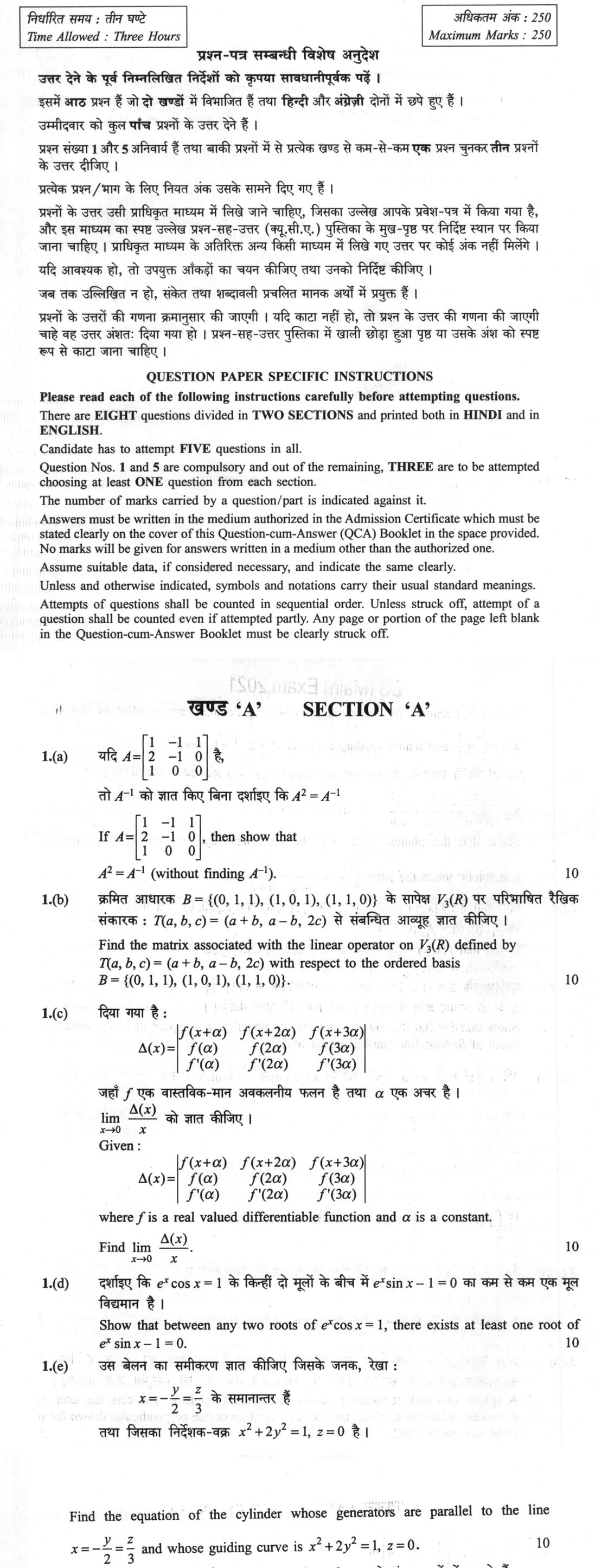
(a) If A= 1 & -1 & 1 2 & -1 & 0 1 & 0 & 0 , then show that A² = A⁻¹ (without finding A⁻¹). (10 marks) (b) Find the matrix…
If A= 1 & -1 & 1 2 & -1 & 0 1 & 0 & 0 , then show that A² = A⁻¹ (without finding A⁻¹). 10 marks
Find the matrix associated with the linear operator on V₃(R) defined by T(a, b, c) = (a+b, a-b, 2c) with respect to the ordered basis B = (0, 1, 1), (1, 0, 1), (1, 1, 0). 10 marks
Given: Δ(x)= f(x+α) & f(x+2α) & f(x+3α) f(α) & f(2α) & f(3α) f'(α) & f'(2α) & f'(3α) where f is a real valued differentiable function and α is a constant. Find displaystylelimₓ → 0 (Δ(x))/x. 10 marks
Show that between any two roots of e^x cos x = 1, there exists at least one root of e^x sin x - 1 = 0. 10 marks
Find the equation of the cylinder whose generators are parallel to the line x = -y/2 = z/3 and whose guiding curve is x² + 2y² = 1, z = 0. 10 marks
हिंदी में प्रश्न पढ़ें
यदि A= 1 & -1 & 1 2 & -1 & 0 1 & 0 & 0 है, तो A⁻¹ को ज्ञात किए बिना दर्शाइए कि A² = A⁻¹। (10 अंक)
क्रमित आधारक B = (0, 1, 1), (1, 0, 1), (1, 1, 0) के सापेक्ष V₃(R) पर परिभाषित रैखिक संकारक : T(a, b, c) = (a+b, a-b, 2c) से संबंधित आव्यूह ज्ञात कीजिए। (10 अंक)
दिया गया है : Δ(x)= f(x+α) & f(x+2α) & f(x+3α) f(α) & f(2α) & f(3α) f'(α) & f'(2α) & f'(3α) जहाँ f एक वास्तविक-मान अवकलनीय फलन है तथा α एक अचर है। displaystylelimₓ → 0 (Δ(x))/x को ज्ञात कीजिए। (10 अंक)
दर्शाइए कि e^x cos x = 1 के किन्हीं दो मूलों के बीच में e^x sin x - 1 = 0 का कम से कम एक मूल विद्यमान है। (10 अंक)
उस बेलन का समीकरण ज्ञात कीजिए जिसके जनक, रेखा : x = -y/2 = z/3 के समानांतर हैं तथा जिसका निर्देशक-वक्र x² + 2y² = 1, z = 0 है। (10 अंक)
Model answer
Written by UPSC Answer Check against this question's marking rubric, to the expected length. UPSC does not publish answers for Mains — this is one way to score well, not an official key.
(a) It is enough to prove that A³ = I, because then A² is the inverse of A.
Given A = [ 1 -1 1 2 -1 0 1 0 0 ].
Compute A²:
A² = [ 0 0 1 0 -1 2 1 -1 1 ].
Now compute A²A:
First row of A² times A gives (1,0,0). Second row gives (0,1,0). Third row gives (0,0,1).
Hence A²A = [ 1 0 0 0 1 0 0 0 1 ] = I.
Since matrix multiplication is associative, A A² = A³ = A²A = I.
Thus A²A = I and A A² = I. Therefore A² is both a left and right inverse of A. Hence
A² = A⁻¹.
---
(b) Let v₁ = (0,1,1), v₂ = (1,0,1), v₃ = (1,1,0).
For T(a,b,c) = (a+b, a-b, 2c), compute the images of the basis vectors:
T(v₁) = T(0,1,1) = (1,-1,2), T(v₂) = T(1,0,1) = (1,1,2), T(v₃) = T(1,1,0) = (2,0,0).
Now express each image as a linear combination of v₁, v₂, v₃. For any vector (x,y,z), a v₁ + b v₂ + c v₃ = (b+c, a+c, a+b).
Solving, a = (y+z-x)/2, b = (x+z-y)/2, c = (x+y-z)/2.
For T(v₁) = (1,-1,2): a = 0, b = 2, c = -1. So the first column is (0,2,-1).
For T(v₂) = (1,1,2): a = 1, b = 1, c = 0. So the second column is (1,1,0).
For T(v₃) = (2,0,0): a = -1, b = 1, c = 1. So the third column is (-1,1,1).
Therefore the required matrix is
[T]_B = [ 0 1 -1 2 1 1 -1 0 1 ].
---
(c) Let Δ(x) = | f(x+α) f(x+2α) f(x+3α) | | f(α) f(2α) f(3α) | | f'(α) f'(2α) f'(3α) |.
At x = 0, the first row becomes (f(α), f(2α), f(3α)), which is exactly the second row. Hence Δ(0) = 0.
Since f is differentiable, Δ is differentiable at x = 0. Therefore lim x→0 Δ(x)/x = Δ'(0).
Only the first row depends on x. Differentiating the determinant with respect to x, we get Δ'(0) = | f'(α) f'(2α) f'(3α) | | f(α) f(2α) f(3α) | | f'(α) f'(2α) f'(3α) |.
Here the first row and the third row are identical. Hence the determinant is zero.
Therefore
lim x→0 Δ(x)/x = 0.
---
(d) Consider φ(x) = e⁻ˣ - cos x.
The equation eˣ cos x = 1 is equivalent to cos x = e⁻ˣ, that is, φ(x) = 0.
Let a and b be any two distinct roots of eˣ cos x = 1, with a < b. Then φ(a) = 0 and φ(b) = 0.
The function φ is continuous on [a,b] and differentiable on (a,b). Therefore, by Rolle’s theorem, there exists c in (a,b) such that φ'(c) = 0.
Now φ'(x) = -e⁻ˣ + sin x.
Thus at x = c, -e⁻ᶜ + sin c = 0, so sin c = e⁻ᶜ.
Multiplying by eᶜ gives eᶜ sin c = 1, or eᶜ sin c - 1 = 0.
Hence between any two roots of eˣ cos x = 1, there exists at least one root of
eˣ sin x - 1 = 0.
---
(e) The generators are parallel to the line x = -y/2 = z/3.
Taking the common parameter as t, x = t, y = -2t, z = 3t. So a direction vector of the generators is d = (1,-2,3).
Let the guiding curve be x² + 2y² = 1, z = 0.
Take a point on the guiding curve as P = (u,v,0), where u² + 2v² = 1.
The generator through P parallel to d is (x,y,z) = (u,v,0) + λ(1,-2,3) = (u+λ, v-2λ, 3λ).
From z = 3λ, we get λ = z/3.
Hence u = x - z/3, v = y + 2z/3.
Substitute these into u² + 2v² = 1: (x - z/3)² + 2(y + 2z/3)² = 1.
Expanding, x² - 2xz/3 + z²/9 + 2y² + 8yz/3 + 8z²/9 = 1.
Since z²/9 + 8z²/9 = z², we get x² + 2y² + z² - 2xz/3 + 8yz/3 = 1.
Multiplying throughout by 3:
3x² + 6y² + 3z² - 2xz + 8yz = 3.
This is the required equation of the cylinder.
What "Prove" is asking you to do
Establish that the statement holds for every case it claims, not for one representative case. The argument must be closed: each line follows from a definition, a hypothesis, or a named theorem you are entitled to use.
Structure that answers it
Given and to prove, restated → theorem or construction to be used, named → the argument line by line → conclusion stated as proved
Where marks are lost
Testing one example, which illustrates but proves nothing. On an if and only if claim, proving one direction and stopping forfeits that half outright, and degenerate cases — zero, the empty set, the equality case — have to be disposed of rather than assumed away.
How this answer will be evaluated
Approach
(1(a)) justify: claim > 3-4 reasons > evidence > conclusion | (1(b)) calculate: given > formula > substitution > result with units > interpretation | (1(c)) calculate: given > formula > substitution > result with units > interpretation | (1(d)) justify: claim > 3-4 reasons > evidence > conclusion | (1(e)) derive: given > assumptions > stepwise derivation > result > check Full marks: All parts fully solved with correct methods and no errors.
Key points expected
- Compute A² explicitly via matrix multiplication
- Compute A³ = A² · A
- Show A³ equals the identity matrix I
- Conclude A² = A⁻¹ from A³ = I
- Apply T to each basis vector in B
- Express T(b_i) as linear combination of B
- Form columns of matrix from coefficients
- Present final 3x3 matrix
Evaluation rubric
Each sub-part is marked on its own, against the marks and word limit printed on the paper.
- (1(a)) Prove A² = A⁻¹ by showing A³ = I without calculating A⁻¹. 10 marks
justify— claim → 3-4 reasons → evidence → conclusion
Must cover
- Compute A² explicitly via matrix multiplication
- Compute A³ = A² · A
- Show A³ equals the identity matrix I
- Conclude A² = A⁻¹ from A³ = I
Loses marks
- Calculating A⁻¹ directly (violates constraint)
- Arithmetic errors in matrix multiplication
- Failing to explicitly state A³ = I
Earns more
- Correct intermediate matrix A²
- Correct intermediate matrix A³
- Explicit statement of the property used
Extra mark
- Verification of a specific entry in A³
- (1(b)) Find the matrix representation of T with respect to basis B. 10 marks
calculate— given → formula → substitution → result with units → interpretation
Must cover
- Apply T to each basis vector in B
- Express T(b_i) as linear combination of B
- Form columns of matrix from coefficients
- Present final 3x3 matrix
Loses marks
- Using standard basis instead of B
- Incorrect linear combination coefficients
- Transposing the matrix incorrectly
Earns more
- Correct T(b_1) calculation
- Correct T(b_2) calculation
- Correct T(b_3) calculation
- Correct final matrix
Extra mark
- Verification by applying matrix to a vector
- (1(c)) Evaluate the limit of Δ(x)/x as x approaches 0. 10 marks
calculate— given → formula → substitution → result with units → interpretation
Must cover
- Identify limit as 0/0 form
- Apply L'Hopital's Rule
- Differentiate determinant row-wise
- Evaluate resulting determinant at x=0
Loses marks
- Differentiating the whole determinant incorrectly
- Arithmetic errors in final determinant
- Failing to justify L'Hopital's use
Earns more
- Correct application of L'Hopital's
- Correct derivative of determinant
- Correct evaluation of final determinant
Extra mark
- Alternative method using Taylor expansion
- (1(d)) Prove existence of root of e^x sin x - 1 = 0 between roots of e^x cos x = 1. 10 marks
justify— claim → 3-4 reasons → evidence → conclusion
Must cover
- Define f(x) = e^x cos x - 1
- Define g(x) = e^x sin x - 1
- Apply Rolle's Theorem to f(x)
- Show g(x) = f'(x) has a root
Loses marks
- Failing to define f and g clearly
- Incorrect application of Rolle's Theorem
- Arithmetic errors in derivative
Earns more
- Correct definition of f and g
- Correct application of Rolle's Theorem
- Correct derivative f'(x) = g(x)
Extra mark
- Sketch of the functions
- (1(e)) Find the equation of the cylinder with given generators and guiding curve. 10 marks
derive— given → assumptions → stepwise derivation → result → check
Must cover
- Parametrize the line of generators
- Substitute into guiding curve equation
- Eliminate parameters to get cylinder equation
- Present final equation
Loses marks
- Incorrect parametrization of line
- Arithmetic errors in substitution
- Failing to eliminate parameters correctly
Earns more
- Correct parametrization of line
- Correct substitution into guiding curve
- Correct elimination of parameters
Extra mark
- Verification of a point on the cylinder
Practice this exact question
Write your answer and it is marked point by point against the model answer above — what you covered, what you missed, what you got wrong.
Evaluate my answer →More from Mathematics 2021 Paper I
- Q1 (a) If A= 1 & -1 & 1 2 & -1 & 0 1 & 0 & 0 , then show that A² = A⁻¹ (without finding A⁻¹)…
- Q2 (a) Show that the planes, which cut the cone ax² + by² + cz² = 0 in perpendicular generat…
- Q3 (a)(i) If u = x² + y², v = x² - y², where x = rcosθ, y = rsinθ, then find (∂(u,v))/(∂(r,θ…
- Q4 (a)(i) Reduce the following matrix to a row-reduced echelon form and hence also, find its…