Paper I — Q4
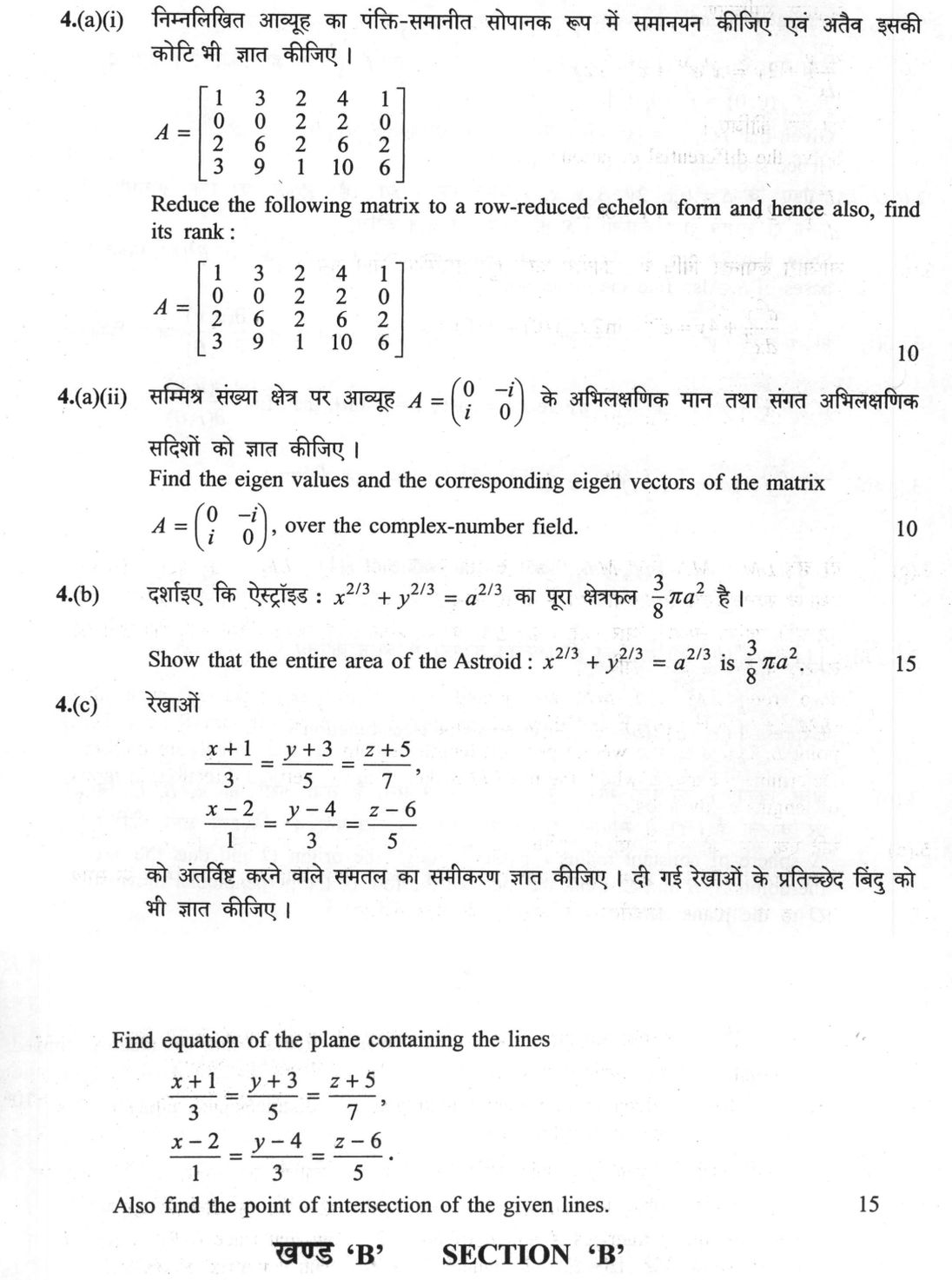
(a)(i) Reduce the following matrix to a row-reduced echelon form and hence also, find its rank: A = [1 3 2 4 1 0 0 2 2 0 2 6 2…
Reduce the following matrix to a row-reduced echelon form and hence also, find its rank:
A = [1 3 2 4 1 0 0 2 2 0 2 6 2 6 2 3 9 1 10 6] 10 marks
Find the eigen values and the corresponding eigen vectors of the matrix
A = (0 -i i 0), over the complex-number field. 10 marks
Show that the entire area of the Astroid : x^(2/3) + y^(2/3) = a^(2/3) is (3/8)πa². 15 marks
Find equation of the plane containing the lines
(x+1)/3 = (y+3)/5 = (z+5)/7,
(x-2)/1 = (y-4)/3 = (z-6)/5.
Also find the point of intersection of the given lines. 15 marks
हिंदी में प्रश्न पढ़ें
निम्नलिखित आव्यूह का पंक्ति-समानीत सोपानक रूप में समान्यन कीजिए एवं अतैव इसकी कोटि भी ज्ञात कीजिए।
A = [1 3 2 4 1 0 0 2 2 0 2 6 2 6 2 3 9 1 10 6] (10 अंक)
सम्मिश्र संख्या क्षेत्र पर आव्यूह A = (0 -i i 0) के अभिलक्षणिक मान तथा संगत अभिलक्षणिक सदिशों को ज्ञात कीजिए। (10 अंक)
दर्शाइए कि ऐस्ट्रॉइड : x^(2/3) + y^(2/3) = a^(2/3) का पूरा क्षेत्रफल (3/8)πa² है। (15 अंक)
रेखाओं
(x+1)/3 = (y+3)/5 = (z+5)/7, (x-2)/1 = (y-4)/3 = (z-6)/5
को अंतर्विष्ट करने वाले समतल का समीकरण ज्ञात कीजिए। दी गई रेखाओं के प्रतिच्छेद बिंदु को भी ज्ञात कीजिए। (15 अंक)
Model answer
Written by UPSC Answer Check against this question's marking rubric, to the expected length. UPSC does not publish answers for Mains — this is one way to score well, not an official key.
(a)(i) Let A = [1 3 2 4 1; 0 0 2 2 0; 2 6 2 6 2; 3 9 1 10 6]. Use elementary row operations. R3 ← R3 − 2R1, R4 ← R4 − 3R1 give [1 3 2 4 1; 0 0 2 2 0; 0 0 −2 −2 0; 0 0 −5 −2 3]. R3 ← R3 + R2 makes the third row zero. Divide R2 by 2: [1 3 2 4 1; 0 0 1 1 0; 0 0 0 0 0; 0 0 −5 −2 3]. Now R1 ← R1 − 2R2 and R4 ← R4 + 5R2: [1 3 0 2 1; 0 0 1 1 0; 0 0 0 0 0; 0 0 0 3 3]. Interchange rows 3 and 4, then divide the new third row by 3: [1 3 0 2 1; 0 0 1 1 0; 0 0 0 1 1; 0 0 0 0 0]. Finally R1 ← R1 − 2R3, R2 ← R2 − R3: [1 3 0 0 −1; 0 0 1 0 −1; 0 0 0 1 1; 0 0 0 0 0]. This is row-reduced echelon form. It has three non-zero rows, so rank(A) = 3.
(a)(ii) For A = (0 −i; i 0), the characteristic equation is det(A − λI) = |−λ −i; i −λ| = λ² − (−i)(i) = λ² − 1 = 0. Thus λ = 1, −1.
For λ = 1: (A − I)v = 0 gives [−1 −i; i −1][x; y] = [0; 0], so −x − iy = 0, hence x = −iy. Take y = i, then x = 1. Thus one eigenvector is (1, i)ᵀ.
For λ = −1: (A + I)v = 0 gives [1 −i; i 1][x; y] = [0; 0], so x − iy = 0, hence x = iy. Take y = 1, then x = i. Thus one eigenvector is (i, 1)ᵀ.
So the eigenpairs are λ = 1 with eigenvector (1, i)ᵀ, and λ = −1 with eigenvector (i, 1)ᵀ.
(b) The astroid is x^(2/3) + y^(2/3) = a^(2/3), a > 0. Use the parametric form x = a cos³θ, y = a sin³θ. Then x^(2/3) = a^(2/3) cos²θ, y^(2/3) = a^(2/3) sin²θ, so the equation is satisfied.
By symmetry, total area = 4 × first-quadrant area. First-quadrant area = ∫ from x=0 to a of y dx. Here dx = −3a cos²θ sinθ dθ. When x=0, θ=π/2; when x=a, θ=0. Hence A/4 = ∫ from θ=π/2 to 0 of a sin³θ · (−3a cos²θ sinθ) dθ = 3a² ∫ from 0 to π/2 of sin⁴θ cos²θ dθ.
Using the Beta integral ∫ from 0 to π/2 of sin^mθ cos^nθ dθ = Γ((m+1)/2)Γ((n+1)/2) / [2Γ((m+n+2)/2)], with m=4, n=2, ∫ from 0 to π/2 of sin⁴θ cos²θ dθ = Γ(5/2)Γ(3/2) / [2Γ(4)] = [(3√π/4)(√π/2)] / [2·6] = (3π/8)/12 = π/32.
Therefore A/4 = 3a² · π/32, so A = 4 · 3a² · π/32 = 3πa²/8. Hence the entire area is (3/8)πa².
(c) The first line is L1: (x+1)/3 = (y+3)/5 = (z+5)/7 = t. So x = −1+3t, y = −3+5t, z = −5+7t. The second line is L2: (x−2)/1 = (y−4)/3 = (z−6)/5 = s. So x = 2+s, y = 4+3s, z = 6+5s.
For intersection, equate coordinates: −1+3t = 2+s ⟹ 3t − s = 3, −3+5t = 4+3s ⟹ 5t − 3s = 7, −5+7t = 6+5s ⟹ 7t − 5s = 11. From the first two equations, s = 3t − 3. Substituting in the second: 5t − 3(3t − 3) = 7 ⟹ 5t − 9t + 9 = 7 ⟹ t = 1/2. Then s = −3/2, which also satisfies the third equation. Thus the point of intersection is x = −1 + 3/2 = 1/2, y = −3 + 5/2 = −1/2, z = −5 + 7/2 = −3/2. So the intersection point is (1/2, −1/2, −3/2).
Direction vectors of the lines are d1 = (3, 5, 7), d2 = (1, 3, 5). A normal to the required plane is d1 × d2 = (5·5 − 7·3, 7·1 − 3·5, 3·3 − 5·1) = (25 − 21, 7 − 15, 9 − 5) = (4, −8, 4) = 4(1, −2, 1). Using normal (1, −2, 1) and the point (1/2, −1/2, −3/2), the plane is 1(x − 1/2) − 2(y + 1/2) + 1(z + 3/2) = 0. Simplifying, x − 1/2 − 2y − 1 + z + 3/2 = 0, so x − 2y + z = 0. Thus the required plane is x − 2y + z = 0, and the lines intersect at (1/2, −1/2, −3/2).
What "Solve" is asking you to do
Choose the method, then carry it through to a final answer. Identifying what kind of problem this is and why that method applies is the first thing marked; a correct figure arrived at invisibly earns almost nothing.
Structure that answers it
Given data and what is required → method chosen, with the reason it applies → set-up (equation, circuit, free body, trial balance) → working, step by step → answer with units and any condition of validity
Where marks are lost
Doing the middle steps mentally and writing only the result. In mathematics papers, a further loss comes from giving a decimal where the exact value in surds or fractions was wanted, or from skipping the justification a part explicitly asks for.
How this answer will be evaluated
Approach
(a(i)) calculate: given > formula > substitution > result with units > interpretation | (a(ii)) calculate: given > formula > substitution > result with units > interpretation | (b) justify: claim > 3-4 reasons > evidence > conclusion | (c) calculate: given > formula > substitution > result with units > interpretation Full marks: All steps shown with justification; correct final answers; verification included; neat presentation.
Key points expected
- Perform elementary row operations step-by-step
- Reach row-reduced echelon form (RREF)
- State rank as number of non-zero rows
- Verify rank via pivot positions
- Set up characteristic equation det(A - λI) = 0
- Solve for eigenvalues over complex field
- Find eigenvector for each eigenvalue
- Verify Av = λv for each pair
Evaluation rubric
Each sub-part is marked on its own, against the marks and word limit printed on the paper.
- (a(i)) Row-reduced echelon form of matrix A and its rank. 10 marks
calculate— given → formula → substitution → result with units → interpretation
Must cover
- Perform elementary row operations step-by-step
- Reach row-reduced echelon form (RREF)
- State rank as number of non-zero rows
- Verify rank via pivot positions
Loses marks
- Skipping intermediate row operations
- Incorrect RREF without justification
- Rank stated without counting non-zero rows
Earns more
- Show intermediate row operation notation (Ri → Ri + kRj)
- Identify pivot columns explicitly
- Check consistency of final RREF
Extra mark
- Note if matrix is singular or full rank
- Mention nullity if computed
- (a(ii)) Eigenvalues and corresponding eigenvectors of A = [[0, -i], [i, 0]]. 10 marks
calculate— given → formula → substitution → result with units → interpretation
Must cover
- Set up characteristic equation det(A - λI) = 0
- Solve for eigenvalues over complex field
- Find eigenvector for each eigenvalue
- Verify Av = λv for each pair
Loses marks
- Ignoring complex field (real-only solutions)
- Missing eigenvector for one eigenvalue
- No verification step for Av = λv
Earns more
- Show matrix subtraction A - λI explicitly
- Normalize eigenvectors if possible
- Note if matrix is Hermitian or unitary
Extra mark
- Mention physical interpretation (e.g., spin operator)
- Check orthogonality of eigenvectors
- (b) Prove area of astroid x^(2/3) + y^(2/3) = a^(2/3) is (3/8)πa². 15 marks
justify— claim → 3-4 reasons → evidence → conclusion
Must cover
- Use parametric form x = a cos³t, y = a sin³t
- Set up area integral using Green’s theorem or symmetry
- Evaluate integral over [0, 2π] or [0, π/2] with factor 4
- Arrive at (3/8)πa² with correct algebra
Loses marks
- Using Cartesian integration without substitution
- Missing factor of 4 for symmetry
- Incorrect trigonometric integral evaluation
Earns more
- Justify parametric substitution from curve equation
- Show symmetry argument (4 quadrants)
- Verify dimensions (area ~ a²)
Extra mark
- Sketch astroid with axes and intercepts
- Mention relation to hypocycloid
- (c) Equation of plane containing two given lines and their point of intersection. 15 marks
calculate— given → formula → substitution → result with units → interpretation
Must cover
- Find direction vectors of both lines
- Compute cross product for normal vector to plane
- Use point from one line to write plane equation
- Solve parametric equations to find intersection point
Loses marks
- Using wrong point for plane equation
- Incorrect cross product calculation
- Failing to solve for intersection point
Earns more
- Verify both lines lie in the plane
- Show parametric setup for intersection
- Check if lines are coplanar (scalar triple product)
Extra mark
- Note if lines are parallel or skew
- Provide vector form of plane equation
Practice this exact question
Write your answer and it is marked point by point against the model answer above — what you covered, what you missed, what you got wrong.
Evaluate my answer →More from Mathematics 2021 Paper I
- Q1 (a) If A= 1 & -1 & 1 2 & -1 & 0 1 & 0 & 0 , then show that A² = A⁻¹ (without finding A⁻¹)…
- Q2 (a) Show that the planes, which cut the cone ax² + by² + cz² = 0 in perpendicular generat…
- Q3 (a)(i) If u = x² + y², v = x² - y², where x = rcosθ, y = rsinθ, then find (∂(u,v))/(∂(r,θ…
- Q4 (a)(i) Reduce the following matrix to a row-reduced echelon form and hence also, find its…
- Q5 Solve the differential equation: d²y/dx² + 2y = x²e^(3x) + e^x cos 2x (10 marks) Solve th…
- Q6 A heavy string, which is not of uniform density, is hung up from two points. Let T₁, T₂,…
- Q7 (a) Verify Gauss divergence theorem for F⃗ = 2x^2yî - y^2ĵ + 4xz^2k̂ taken over the reg…