Paper I — Q7
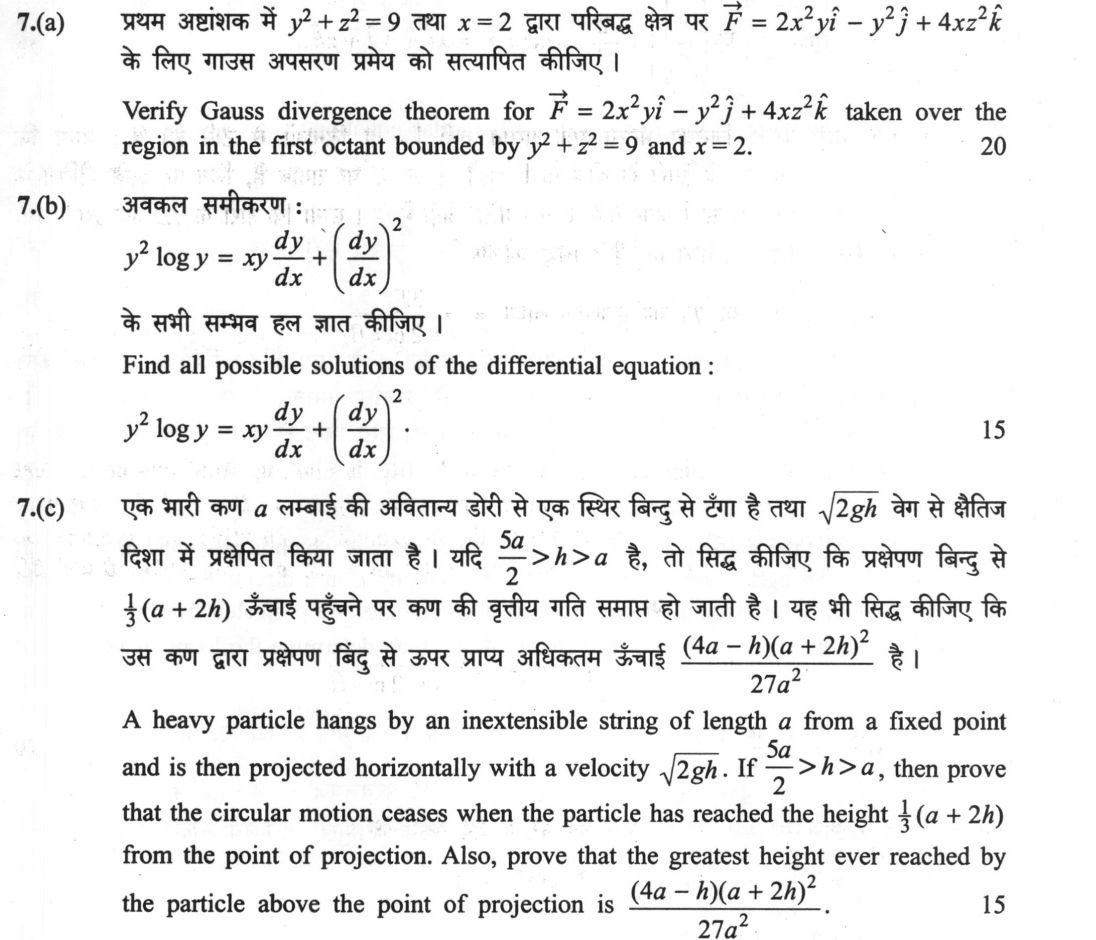
(a) Verify Gauss divergence theorem for F⃗ = 2x^2yî - y^2ĵ + 4xz^2k̂ taken over the region in the first octant bounded by y² +…
Verify Gauss divergence theorem for F⃗ = 2x^2yî - y^2ĵ + 4xz^2k̂ taken over the region in the first octant bounded by y² + z² = 9 and x = 2. 20 marks
Find all possible solutions of the differential equation: y² log y = xydy/dx + (dy/dx)². 15 marks
A heavy particle hangs by an inextensible string of length a from a fixed point and is then projected horizontally with a velocity √2gh. If 5a/2 > h > a, then prove that the circular motion ceases when the particle has reached the height 1/3(a + 2h) from the point of projection. Also, prove that the greatest height ever reached by the particle above the point of projection is ((4a-h)(a+2h)²)/(27a²). 15 marks
हिंदी में प्रश्न पढ़ें
प्रथम अष्टांश में y² + z² = 9 तथा x = 2 द्वारा परिबद्ध क्षेत्र पर F⃗ = 2x^2yî - y^2ĵ + 4xz^2k̂ के लिए गॉस अपसरण प्रमेय को सत्यापित कीजिए। (20 अंक)
अवकल समीकरण: y² log y = xydy/dx + (dy/dx)² के सभी संभव हल ज्ञात कीजिए। (15 अंक)
एक भारी कण a लम्बाई की अवितान्य डोरी से एक स्थिर बिंदु से टंगा है तथा √2gh वेग से क्षैतिज दिशा में प्रक्षेपित किया जाता है। यदि 5a/2 > h > a है, तो सिद्ध कीजिए कि प्रक्षेपण बिंदु से 1/3(a + 2h) ऊँचाई पहुँचने पर कण की वृत्तीय गति समाप्त हो जाती है। यह भी सिद्ध कीजिए कि उस कण द्वारा प्रक्षेपण बिंदु से ऊपर प्राप्य अधिकतम ऊँचाई ((4a-h)(a+2h)²)/(27a²) है। (15 अंक)
Model answer
Written by UPSC Answer Check against this question's marking rubric, to the expected length. UPSC does not publish answers for Mains — this is one way to score well, not an official key.
(a) Let F = 2x²y i − y² j + 4xz² k. The region R is the quarter cylinder 0 ≤ x ≤ 2, 0 ≤ y ≤ 3, 0 ≤ z ≤ √(9 − y²).
By Gauss divergence theorem, ∬_S F·n dS = ∭_R div F dV.
Now div F = ∂(2x²y)/∂x + ∂(−y²)/∂y + ∂(4xz²)/∂z = 4xy − 2y + 8xz.
Hence ∭_R div F dV = ∫(x=0 to 2)∫(y=0 to 3)∫(z=0 to √(9−y²)) (4xy − 2y + 8xz) dz dy dx.
Integrating in z: = ∫(x=0 to 2)∫(y=0 to 3) [(4xy − 2y)√(9−y²) + 4x(9−y²)] dy dx.
Use ∫(0 to 3) y√(9−y²) dy = 9, ∫(0 to 3) (9−y²) dy = 18.
So the y-integral becomes 4x(9) − 2(9) + 4x(18) = 108x − 18.
Therefore ∭_R div F dV = ∫(0 to 2)(108x − 18) dx = [54x² − 18x]₀² = 216 − 36 = 180.
Now compute the surface integral over the boundary.
On the cylindrical surface S₁: y² + z² = 9, y,z ≥ 0, 0 ≤ x ≤ 2. Put y = 3cosθ, z = 3sinθ, 0 ≤ θ ≤ π/2. Outward unit normal n = (0, cosθ, sinθ), dS = 3 dx dθ. Then F·n = −9cos³θ + 36x sin³θ, so ∬_S₁ F·n dS = ∫(x=0 to 2)∫(θ=0 to π/2) (−27cos³θ + 108x sin³θ) dθ dx. Since ∫(0 to π/2) cos³θ dθ = 2/3 and ∫(0 to π/2) sin³θ dθ = 2/3, this equals ∫(0 to 2)(−18 + 72x) dx = −36 + 144 = 108.
On the plane x = 2, n = i, F·n = 8y. Its surface is a quarter disk of radius 3. Thus ∬ F·n dS = 8∫∫ y dA = 8 ∫(θ=0 to π/2)∫(r=0 to 3) r sinθ · r dr dθ = 8(9)(1) = 72.
On x = 0, y = 0 and z = 0, the integrand F·n is zero, so the corresponding integrals vanish.
Thus total surface integral = 108 + 72 = 180, which equals the volume integral. Hence Gauss divergence theorem is verified.
(b) The equation is y² log y = xy dy/dx + (dy/dx)².
Since log y is real, y > 0. Let u = log y. Then dy/dx = y u′. Substituting, y²u = xy(yu′) + y²(u′)², so after division by y²: u = x u′ + (u′)².
Differentiate with respect to x: u′ = u′ + x u″ + 2u′u″, hence (x + 2u′)u″ = 0.
Case 1: u″ = 0. Then u′ = C, so u = Cx + D. Substituting in u = x u′ + (u′)² gives D = C². Hence y = e^(Cx + C²), C arbitrary.
Case 2: x + 2u′ = 0. Then u′ = −x/2, so u = −x²/4 + D. Substituting gives D = 0. Hence the singular solution is y = e^(−x²/4).
Thus all solutions are y = e^(Cx + C²) and y = e^(−x²/4).
(c) Let θ be the angle turned from the downward vertical. The height of the particle above the point of projection is y = a(1 − cosθ).
Initial speed is u = √(2gh). By energy conservation, v² = 2gh − 2ga(1 − cosθ) = 2g(h − a + a cosθ).
The radial equation is T − mg cosθ = mv²/a, so at the instant circular motion ceases, T = 0. Therefore v² = −ag cosθ.
Equating the two expressions for v²: 2g(h − a + a cosθ) = −ag cosθ, which gives cosθ = 2(a − h)/(3a).
Hence the height at which circular motion ceases is y₀ = a(1 − cosθ) = a[1 − 2(a − h)/(3a)] = (a + 2h)/3.
At this point, v² = 2g(h − a)/3, and sin²θ = 1 − 4(h − a)²/(9a²).
After the string becomes slack, the particle moves as a projectile. The additional height reached is Δy = (v sinθ)²/(2g) = (h − a)/3 · [1 − 4(h − a)²/(9a²)] = (h − a)/3 − 4(h − a)³/(27a²).
Therefore the greatest height above the point of projection is H = (a + 2h)/3 + Δy = h − 4(h − a)³/(27a²).
But 27a²h − 4(h − a)³ = (4a − h)(a + 2h)². Therefore H = [(4a − h)(a + 2h)²]/(27a²).
This proves the required greatest height. The condition 5a/2 > h > a ensures that 0 < θ < π and the string becomes slack before the particle reaches the highest point of the circle.
What "Prove" is asking you to do
Establish that the statement holds for every case it claims, not for one representative case. The argument must be closed: each line follows from a definition, a hypothesis, or a named theorem you are entitled to use.
Structure that answers it
Given and to prove, restated → theorem or construction to be used, named → the argument line by line → conclusion stated as proved
Where marks are lost
Testing one example, which illustrates but proves nothing. On an if and only if claim, proving one direction and stopping forfeits that half outright, and degenerate cases — zero, the empty set, the equality case — have to be disposed of rather than assumed away.
How this answer will be evaluated
Approach
(a) derive: given > assumptions > stepwise derivation > result > check | (b) calculate: given > formula > substitution > result with units > interpretation | (c) derive: given > assumptions > stepwise derivation > result > check Full marks: Complete, correct derivations with all steps shown and results verified.
Key points expected
- Compute divergence of F = 2x²yî - y²ĵ + 4xz²k̂
- Set up and evaluate the triple integral over the first octant region
- Evaluate the surface integral over the curved and flat surfaces
- Show that the volume integral equals the surface integral
- Identify the type of differential equation (Clairaut's or similar)
- Derive the general solution
- Find the singular solution if applicable
- State all possible solutions clearly
Evaluation rubric
Each sub-part is marked on its own, against the marks and word limit printed on the paper.
- (a) Verify Gauss divergence theorem for the given vector field over the specified region. 20 marks
derive— given → assumptions → stepwise derivation → result → check
Must cover
- Compute divergence of F = 2x²yî - y²ĵ + 4xz²k̂
- Set up and evaluate the triple integral over the first octant region
- Evaluate the surface integral over the curved and flat surfaces
- Show that the volume integral equals the surface integral
Loses marks
- Incorrect divergence calculation
- Missing or incorrect limits of integration
- Failure to show equality of volume and surface integrals
Earns more
- Correctly identifies the boundary surfaces of the region
- Uses appropriate coordinate system for integration
- Clearly separates the surface integral into components
- States Gauss divergence theorem explicitly
Extra mark
- Provides a neat diagram of the region
- Notes an alternative method for the surface integral
- (b) Find all possible solutions of the given differential equation. 15 marks
calculate— given → formula → substitution → result with units → interpretation
Must cover
- Identify the type of differential equation (Clairaut's or similar)
- Derive the general solution
- Find the singular solution if applicable
- State all possible solutions clearly
Loses marks
- Incorrect identification of the equation type
- Missing the singular solution
- Algebraic errors in the derivation
Earns more
- Correctly identifies the equation as a Clairaut's equation
- Shows the step-by-step derivation of the general solution
- Calculates the singular solution using the discriminant method
- Verifies the solutions by substitution
Extra mark
- Notes the geometric interpretation of the solutions
- Mentions the domain of validity for the solutions
- (c) Prove the height at which circular motion ceases and the greatest height reached. 15 marks
derive— given → assumptions → stepwise derivation → result → check
Must cover
- Apply conservation of energy to find velocity at any point
- Determine the condition for the string to become slack
- Prove the height 1/3(a + 2h) where circular motion ceases
- Prove the greatest height is (4a-h)(a+2h)²/27a²
Loses marks
- Incorrect application of energy conservation
- Failure to determine the condition for the string to become slack
- Algebraic errors in the final height calculation
Earns more
- Correctly sets up the energy conservation equation
- Uses the condition T = 0 for the string to become slack
- Solves the projectile motion after the string becomes slack
- Clearly states the assumptions (e.g., no air resistance)
Extra mark
- Provides a neat diagram of the motion
- Notes the physical interpretation of the results
Practice this exact question
Write your answer and it is marked point by point against the model answer above — what you covered, what you missed, what you got wrong.
Evaluate my answer →More from Mathematics 2021 Paper I
- Q4 (a)(i) Reduce the following matrix to a row-reduced echelon form and hence also, find its…
- Q5 Solve the differential equation: d²y/dx² + 2y = x²e^(3x) + e^x cos 2x (10 marks) Solve th…
- Q6 A heavy string, which is not of uniform density, is hung up from two points. Let T₁, T₂,…
- Q7 (a) Verify Gauss divergence theorem for F⃗ = 2x^2yî - y^2ĵ + 4xz^2k̂ taken over the reg…
- Q8 (a)(i) Find the orthogonal trajectories of the family of confocal conics (x²)/(a²+λ) + (y…