Paper I — Q8
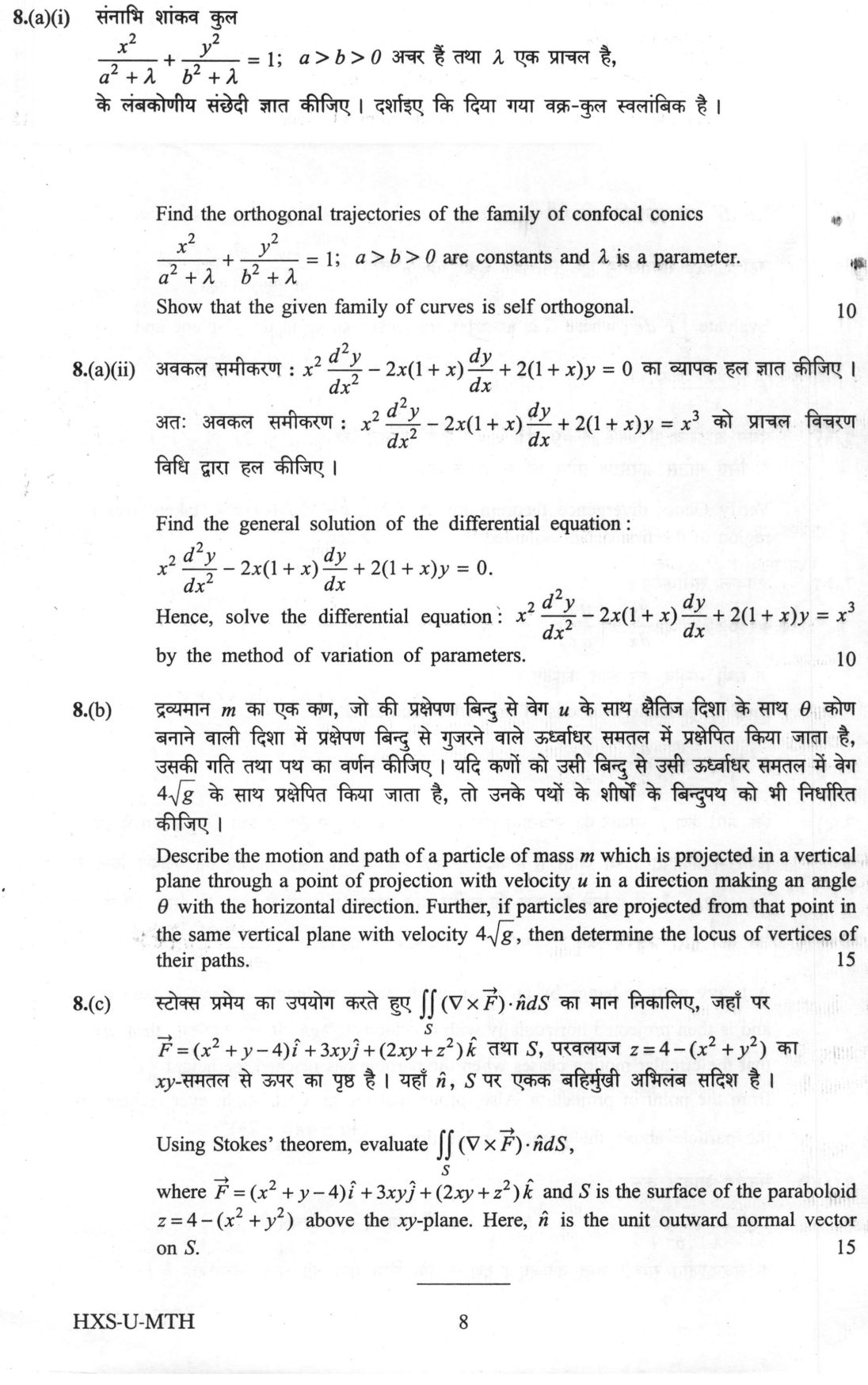
(a)(i) Find the orthogonal trajectories of the family of confocal conics (x²)/(a²+λ) + (y²)/(b²+λ) = 1; a > b > 0 are constants…
Find the orthogonal trajectories of the family of confocal conics (x²)/(a²+λ) + (y²)/(b²+λ) = 1; a > b > 0 are constants and λ is a parameter. Show that the given family of curves is self orthogonal. 10 marks
Find the general solution of the differential equation: x²(d^2y)/(dx²) - 2x(1+x)dy/dx + 2(1+x)y = 0. Hence, solve the differential equation: x²(d^2y)/(dx²) - 2x(1+x)dy/dx + 2(1+x)y = x³ by the method of variation of parameters. 10 marks
Describe the motion and path of a particle of mass m which is projected in a vertical plane through a point of projection with velocity u in a direction making an angle θ with the horizontal direction. Further, if particles are projected from that point in the same vertical plane with velocity $4√g$, then determine the locus of vertices of their paths. 15 marks
Using Stokes' theorem, evaluate displaystyle∬_S (∇ × F⃗)· n̂dS, where F⃗ = (x²+y-4)î + 3xyĵ + (2xy+z²)k̂ and S is the surface of the paraboloid z = 4-(x²+y²) above the xy-plane. Here, n̂ is the unit outward normal vector on S. 15 marks
हिंदी में प्रश्न पढ़ें
संनाभि शंकु कुल (x²)/(a²+λ) + (y²)/(b²+λ) = 1; a > b > 0 अचर हैं तथा λ एक प्राचल है, के लम्बकोणीय संघेदी ज्ञात कीजिए। दर्शाइए कि दिया गया वक्र-कुल स्वलंबिक है। (10 अंक)
अवकल समीकरण: x²(d^2y)/(dx²) - 2x(1+x)dy/dx + 2(1+x)y = 0 का व्यापक हल ज्ञात कीजिए। अतः अवकल समीकरण: x²(d^2y)/(dx²) - 2x(1+x)dy/dx + 2(1+x)y = x³ को प्राचल विचरण विधि द्वारा हल कीजिए। (10 अंक)
द्रव्यमान m का एक कण, जो कि प्रक्षेपण बिन्दु से वेग u के साथ क्षैतिज दिशा के साथ θ कोण बनाने वाली दिशा में प्रक्षेपण बिन्दु से गुजरने वाले उद्धवाधर समतल में प्रक्षेपित किया जाता है, उसकी गति तथा पथ का वर्णन कीजिए। यदि कणों को उसी बिन्दु से उसी उद्धवाधर समतल में वेग $4√g$ के साथ प्रक्षेपित किया जाता है, तो उनके पथों के शीर्षों के बिन्दुपथ को भी निर्धारित कीजिए। (15 अंक)
स्टोक्स प्रमेय का उपयोग करते हुए displaystyle∬_S (∇ × F⃗)· n̂dS का मान निकालिए, जहाँ पर F⃗ = (x²+y-4)î + 3xyĵ + (2xy+z²)k̂ तथा S, परवलयज z = 4-(x²+y²) का xy-समतल से ऊपर का पृष्ठ है। यहाँ n̂, S पर एकक बहिर्मुखी अभिलम्ब सदिश है। (15 अंक)
Model answer
Written by UPSC Answer Check against this question's marking rubric, to the expected length. UPSC does not publish answers for Mains — this is one way to score well, not an official key.
(a)(i) Let p = dy/dx. Differentiating the given confocal family
x²/(a²+λ) + y²/(b²+λ) = 1
with respect to x gives
x/(a²+λ) + y p/(b²+λ) = 0.
Put A = a²+λ, B = b²+λ. Then
x²/A + y²/B = 1, x/A + y p/B = 0.
Solving these two linear equations for 1/A and 1/B,
1/A = p/[x(xp-y)], 1/B = -1/[y(xp-y)].
Since A-B = a²-b² = c², we get
A-B = (xp-y)(x/p + y) = c².
Multiplying by p,
(xp-y)(x+y p) = c² p,
so the differential equation of the family is
xy p² + (x²-y²-c²)p - xy = 0, c²=a²-b².
For orthogonal trajectories, replace p by -1/p. This gives
xy(1/p²) + (x²-y²-c²)(-1/p) - xy = 0.
Multiplying by p² and then by -1, we recover exactly
xy p² + (x²-y²-c²)p - xy = 0.
Hence the differential equation is unchanged. Therefore the family is self-orthogonal. Its orthogonal trajectories are the same confocal family
x²/(a²+μ) + y²/(b²+μ) = 1,
where μ is a new parameter. For real branches, μ>-b² gives ellipses, and -a²<μ<-b² gives hyperbolas.
(a)(ii) First solve the homogeneous equation
x²y'' - 2x(1+x)y' + 2(1+x)y = 0.
One solution is y = x. Let y = x v. Then
y' = v+xv', y'' = 2v'+xv''.
Substitution gives
x³v'' - 2x³v' = 0,
so v'' - 2v' = 0. Hence v' = C e^(2x), and
v = C1 + C2 e^(2x).
Thus the homogeneous general solution is
y = C1 x + C2 x e^(2x).
Now solve
x²y'' - 2x(1+x)y' + 2(1+x)y = x³.
Divide by x²:
y'' - 2(1+x)/x y' + 2(1+x)/x² y = x.
Use variation of parameters with
y1 = x, y2 = x e^(2x), R = x.
Wronskian:
W = y1 y2' - y1' y2 = 2x² e^(2x).
A particular solution is
yp = -y1 ∫ y2 R/W dx + y2 ∫ y1 R/W dx.
Now
y2R/W = (x e^(2x)·x)/(2x² e^(2x)) = 1/2,
y1R/W = x²/(2x² e^(2x)) = 1/(2e^(2x)).
Therefore
yp = -x ∫ 1/2 dx + x e^(2x) ∫ 1/(2e^(2x)) dx
= -x²/2 - x/4.
The term -x/4 is already contained in C1x. Hence the general solution of the non-homogeneous equation is
y = C1 x + C2 x e^(2x) - x²/2.
(b) Take the point of projection as origin, x horizontal and y vertically upward. The equations of motion are
x = u t cosθ, y = u t sinθ - (1/2)g t².
Thus the horizontal motion has uniform velocity u cosθ, while the vertical motion has uniform acceleration -g. Eliminating t gives the path
y = x tanθ - g x²/(2u² cos²θ),
which is a parabola.
Time of flight:
T = 2u sinθ/g.
Range:
R = u² sin2θ/g.
Maximum height and vertex coordinates:
X = u² sinθ cosθ/g = u² sin2θ/(2g),
Y = u² sin²θ/(2g).
For particles projected with velocity u = 4√g, we have u² = 16g. Hence
X = 8 sin2θ, Y = 8 sin²θ.
Now
X² = 256 sin²θ cos²θ = 256(Y/8)(1-Y/8)
= 32Y - 4Y².
So
X² + 4Y² - 32Y = 0,
or
X²/64 + (Y-4)²/16 = 1.
Thus the locus of vertices is an ellipse with centre (0,4), semi-major axis 8 along X, and semi-minor axis 4 along Y.
(c) By Stokes’ theorem,
∬_S (curl F)·n dS = ∮_C F·dr,
where C is the boundary circle of the paraboloid z = 4-(x²+y²) above the xy-plane. On z = 0,
x²+y² = 4.
With outward normal upward, C is traversed counterclockwise as seen from +z. Parametrize
r(t) = 2 cos t i + 2 sin t j, 0 ≤ t ≤ 2π.
Then
dr = (-2 sin t i + 2 cos t j) dt.
On C,
F = (x²+y-4)i + 3xy j + (2xy+z²)k.
With x = 2 cos t, y = 2 sin t, z = 0,
F·dr = [(4 cos²t + 2 sin t - 4)(-2 sin t) + (12 cos t sin t)(2 cos t)] dt.
Thus
F·dr = (16 cos²t sin t - 4 sin²t + 8 sin t) dt.
Hence
∮_C F·dr = ∫_0^(2π) (16 cos²t sin t - 4 sin²t + 8 sin t) dt.
Now
∫_0^(2π) cos²t sin t dt = 0, ∫_0^(2π) sin t dt = 0,
and
∫_0^(2π) sin²t dt = π.
Therefore
∮_C F·dr = -4π.
So
∬_S (curl F)·n dS = -4π.
What "Solve" is asking you to do
Choose the method, then carry it through to a final answer. Identifying what kind of problem this is and why that method applies is the first thing marked; a correct figure arrived at invisibly earns almost nothing.
Structure that answers it
Given data and what is required → method chosen, with the reason it applies → set-up (equation, circuit, free body, trial balance) → working, step by step → answer with units and any condition of validity
Where marks are lost
Doing the middle steps mentally and writing only the result. In mathematics papers, a further loss comes from giving a decimal where the exact value in surds or fractions was wanted, or from skipping the justification a part explicitly asks for.
How this answer will be evaluated
Approach
(a(i)) derive: given > assumptions > stepwise derivation > result > check | (a(ii)) derive: given > assumptions > stepwise derivation > result > check | (b) describe: define > structure or process in order > labelled diagram > significance | (c) calculate: given > formula > substitution > result with units > interpretation Full marks: Complete derivations with all steps shown, correct final answers, verification included, clear notation
Key points expected
- Differentiate conic equation to find dy/dx
- Substitute dy/dx = -dx/dy for orthogonal trajectories
- Solve resulting differential equation for trajectories
- Show trajectories are confocal conics with parameter -λ
- Solve homogeneous equation x²y'' - 2x(1+x)y' + 2(1+x)y = 0
- Identify two linearly independent solutions y₁, y₂
- Apply variation of parameters method correctly
- Solve for u₁', u₂' and integrate to find particular solution
Evaluation rubric
Each sub-part is marked on its own, against the marks and word limit printed on the paper.
- (a(i)) Derive orthogonal trajectories of confocal conics and prove self-orthogonality. 10 marks
derive— given → assumptions → stepwise derivation → result → check
Must cover
- Differentiate conic equation to find dy/dx
- Substitute dy/dx = -dx/dy for orthogonal trajectories
- Solve resulting differential equation for trajectories
- Show trajectories are confocal conics with parameter -λ
Loses marks
- Skips differentiation step
- Fails to substitute for orthogonal slope
- Does not explicitly show self-orthogonality
Earns more
- Explicitly states a > b > 0 condition
- Verifies orthogonality by product of slopes = -1
- Identifies trajectories as hyperbolas/ellipses
Extra mark
- Sketches confocal family showing orthogonality
- (a(ii)) Find general solution of homogeneous ODE, then solve non-homogeneous via variation of parameters. 10 marks
derive— given → assumptions → stepwise derivation → result → check
Must cover
- Solve homogeneous equation x²y'' - 2x(1+x)y' + 2(1+x)y = 0
- Identify two linearly independent solutions y₁, y₂
- Apply variation of parameters method correctly
- Solve for u₁', u₂' and integrate to find particular solution
Loses marks
- Incorrect homogeneous solution
- Skips Wronskian or variation setup
- Algebraic errors in integration
Earns more
- States Wronskian calculation explicitly
- Verifies final solution satisfies original ODE
- Shows intermediate integration steps clearly
Extra mark
- Notes alternative method (e.g., undetermined coefficients if applicable)
- (b) Describe projectile motion and determine locus of vertices for velocity 4√g. 15 marks
describe— define → structure or process in order → labelled diagram → significance
Must cover
- Derive equations of motion x(t), y(t) for projectile
- Find vertex coordinates (h, k) in terms of u, θ
- Substitute u = 4√g into vertex equations
- Eliminate θ to find locus equation of vertices
Loses marks
- Incorrect vertex formula
- Fails to eliminate parameter θ
- Does not substitute u = 4√g correctly
Earns more
- Includes diagram of projectile path with vertex marked
- States assumptions (no air resistance, constant g)
- Verifies locus is a parabola
Extra mark
- Discusses physical significance of locus
- Notes maximum range condition
- (c) Evaluate surface integral of curl F using Stokes' theorem. 15 marks
calculate— given → formula → substitution → result with units → interpretation
Must cover
- State Stokes' theorem: ∬(∇×F)·n̂dS = ∮F·dr
- Identify boundary curve C of paraboloid surface
- Parametrize boundary curve C (circle x²+y²=4, z=0)
- Evaluate line integral ∮F·dr over C
Loses marks
- Incorrect boundary curve identification
- Wrong parametrization of C
- Algebraic errors in line integral evaluation
Earns more
- Correctly identifies C as circle of radius 2 in xy-plane
- Shows parametrization r(t) = (2cos t, 2sin t, 0)
- Calculates F·dr explicitly before integrating
Extra mark
- Verifies result using direct surface integral
- Notes orientation of curve matches normal
Practice this exact question
Write your answer and it is marked point by point against the model answer above — what you covered, what you missed, what you got wrong.
Evaluate my answer →More from Mathematics 2021 Paper I
- Q5 Solve the differential equation: d²y/dx² + 2y = x²e^(3x) + e^x cos 2x (10 marks) Solve th…
- Q6 A heavy string, which is not of uniform density, is hung up from two points. Let T₁, T₂,…
- Q7 (a) Verify Gauss divergence theorem for F⃗ = 2x^2yî - y^2ĵ + 4xz^2k̂ taken over the reg…
- Q8 (a)(i) Find the orthogonal trajectories of the family of confocal conics (x²)/(a²+λ) + (y…