Paper I — Q5
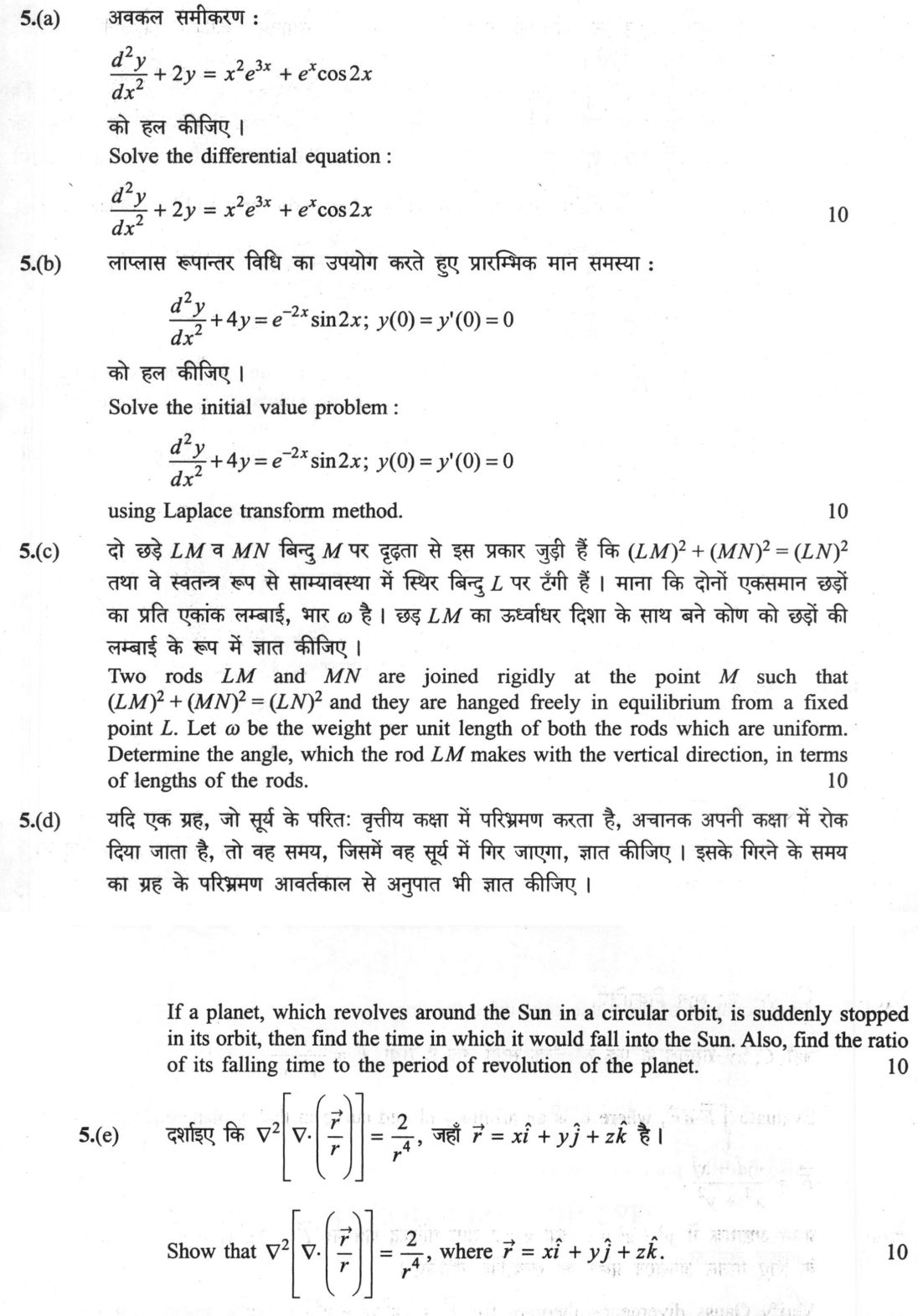
Solve the differential equation: d²y/dx² + 2y = x²e^(3x) + e^x cos 2x (10 marks) Solve the initial value problem: d²y/dx² + 4y =…
Solve the differential equation: d²y/dx² + 2y = x²e^(3x) + e^x cos 2x 10 marks
Solve the initial value problem: d²y/dx² + 4y = e^(-2x) sin 2x; y(0) = y'(0) = 0 using Laplace transform method. 10 marks
Two rods LM and MN are joined rigidly at the point M such that (LM)² + (MN)² = (LN)² and they are hanged freely in equilibrium from a fixed point L. Let ω be the weight per unit length of both the rods which are uniform. Determine the angle, which the rod LM makes with the vertical direction, in terms of lengths of the rods. 10 marks
If a planet, which revolves around the Sun in a circular orbit, is suddenly stopped in its orbit, then find the time in which it would fall into the Sun. Also, find the ratio of its falling time to the period of revolution of the planet. 10 marks
Show that ∇²[∇·(r⃗/r)] = 2/r⁴, where r⃗ = xî + yĵ + zk̂. 10 marks
हिंदी में प्रश्न पढ़ें
अवकल समीकरण: d²y/dx² + 2y = x²e^(3x) + e^x cos 2x को हल कीजिए। 10 marks
लाप्लास रूपान्तर विधि का उपयोग करते हुए प्रारम्भिक मान समस्या: d²y/dx² + 4y = e^(-2x) sin 2x; y(0) = y'(0) = 0 को हल कीजिए। 10 marks
दो छड़ें LM व MN बिन्दु M पर दृढ़ता से इस प्रकार जुड़ी हैं कि (LM)² + (MN)² = (LN)² तथा वे स्वतन्त्र रूप से साम्यावस्था में स्थिर बिन्दु L पर टंगी हैं। माना कि दोनों एकसमान छड़ों का प्रति एकांक लम्बाई, भार ω है। छड़ LM का उद्वधर दिशा के साथ बने कोण को छड़ों की लम्बाई के रूप में ज्ञात कीजिए। 10 marks
यदि एक ग्रह, जो सूर्य के परितः वृत्तीय कक्षा में परिभ्रमण करता है, अचानक अपनी कक्षा में रोक दिया जाता है, तो वह समय, जिसमे वह सूर्य में गिर जाएगा, ज्ञात कीजिए। इसके गिरने के समय का ग्रह के परिभ्रमण आवर्तकाल से अनुपात भी ज्ञात कीजिए। 10 marks
दर्शाइए कि ∇²[∇·(r⃗/r)] = 2/r⁴, जहाँ r⃗ = xî + yĵ + zk̂ है। 10 marks
Model answer
Written by UPSC Answer Check against this question's marking rubric, to the expected length. UPSC does not publish answers for Mains — this is one way to score well, not an official key.
(a) d²y/dx² + 2y = x²e^(3x) + e^x cos 2x. Homogeneous equation: m²+2=0 ⇒ m=±i√2, so y_h = C₁ cos(√2 x)+C₂ sin(√2 x).
For x²e^(3x), let y_p1 = e^(3x)(a x²+b x+c). Then (D²+2)y_p1 = e^(3x)[D²+6D+11](a x²+b x+c) = e^(3x)[11a x²+(12a+11b)x+(2a+6b+11c)]. Comparing with x²e^(3x): a=1/11, b=-12/121, c=50/1331.
For e^x cos 2x, use Re e^((1+2i)x). Since (1+2i)²+2=-1+4i, y_p2 = Re[e^((1+2i)x)/(-1+4i)] = e^x(4 sin 2x - cos 2x)/17.
Hence y = C₁ cos(√2 x)+C₂ sin(√2 x)+ e^(3x)(x²/11 -12x/121 +50/1331)+ e^x(4 sin 2x - cos 2x)/17.
(b) Let Y(s)=L{y(x)}. Since y(0)=y'(0)=0, L{y''}=s²Y. Thus (s²+4)Y = L{e^(-2x) sin 2x} = 2/((s+2)²+4). So Y = 2/[(s²+4)(s²+4s+8)].
Partial fractions give Y = (-s/10+1/10)/(s²+4) + (s/10+3/10)/(s²+4s+8). Now L⁻¹{(1-s)/(10(s²+4))} = (1/20) sin 2x - (1/10) cos 2x. Also, writing s²+4s+8=(s+2)²+4, L⁻¹{(s/10+3/10)/(s²+4s+8)} = e^(-2x)(1/10 cos 2x +1/20 sin 2x). Therefore y = -1/10 cos 2x +1/20 sin 2x + e^(-2x)(1/10 cos 2x +1/20 sin 2x).
(c) Let LM=a and MN=b. The condition a²+b²=LN² makes triangle LMN right-angled at M, so LM ⟂ MN. Let θ be the angle LM makes with the vertical.
Take L as origin, vertical downward as y-axis. Then M=(a sin θ, a cos θ). The midpoint of LM is (a/2 sin θ, a/2 cos θ). The rod MN is perpendicular to LM; choose its direction as (-cos θ, sin θ). Its midpoint has x-coordinate a sin θ - (b/2) cos θ.
For equilibrium about the hinge L, the centre of mass must lie vertically below L, so total x-moment is zero: a(a/2 sin θ)+b(a sin θ - b/2 cos θ)=0. Thus (a²/2+ab) sin θ = (b²/2) cos θ, so tan θ = b²/(a²+2ab). Hence θ = tan⁻¹[b²/(a²+2ab)].
(d) Let R be the circular orbit radius and μ=GM_sun. When stopped, the planet falls radially with initial speed zero at r=R. By energy conservation, (1/2)(dr/dt)² - μ/r = -μ/R. Thus dr/dt = -√(2μ(1/r-1/R)). Therefore t_fall = ∫₀^R dr / √(2μ(1/r-1/R)) = √(R/(2μ)) ∫₀^R √(r/(R-r)) dr. Put r=R sin²θ. Then ∫₀^R √(r/(R-r)) dr = πR/2. So t_fall = πR^(3/2)/(2√(2μ)) = π/(2√2) √(R³/μ). The orbital period is T = 2π√(R³/μ). Hence t_fall/T = 1/(4√2). So the falling time is π/(2√2) √(R³/GM_sun) and the required ratio is 1/(4√2).
(e) Let r=|r⃗|=√(x²+y²+z²). Then r⃗/r = r̂. Using divergence, ∇·(r⃗/r)=3/r + r⃗·∇(1/r)=3/r - r²/r³=2/r. Therefore ∇²[∇·(r⃗/r)] = 2∇²(1/r)=0 for r>0, since ∇²(1/r)=0. Thus the identity as printed is not correct. The identity that gives 2/r⁴ is ∇²(1/r²)=2/r⁴, equivalently ∇²[∇·(r⃗/r²)]=2/r⁴, because ∇·(r⃗/r²)=1/r². So there is a likely typographical omission of a square on r in the denominator.
What "Solve" is asking you to do
Choose the method, then carry it through to a final answer. Identifying what kind of problem this is and why that method applies is the first thing marked; a correct figure arrived at invisibly earns almost nothing.
Structure that answers it
Given data and what is required → method chosen, with the reason it applies → set-up (equation, circuit, free body, trial balance) → working, step by step → answer with units and any condition of validity
Where marks are lost
Doing the middle steps mentally and writing only the result. In mathematics papers, a further loss comes from giving a decimal where the exact value in surds or fractions was wanted, or from skipping the justification a part explicitly asks for.
How this answer will be evaluated
Approach
(a) derive: given > assumptions > stepwise derivation > result > check | (b) derive: given > assumptions > stepwise derivation > result > check | (c) derive: given > assumptions > stepwise derivation > result > check | (d) derive: given > assumptions > stepwise derivation > result > check | (e) derive: given > assumptions > stepwise derivation > result > check Full marks: Complete stepwise derivations with all intermediate steps shown, correct application of named theorems/methods, and verification where appropriate.
Key points expected
- Find complementary function (CF) from auxiliary equation m²+2=0
- Compute particular integral (PI) for x²e³ˣ term
- Compute PI for eˣcos2x term using operator method
- Combine CF and both PI terms for general solution
- Apply Laplace transform to both sides of ODE
- Use initial conditions y(0)=y'(0)=0 correctly
- Solve for Y(s) in s-domain
- Apply inverse Laplace transform to find y(x)
Evaluation rubric
Each sub-part is marked on its own, against the marks and word limit printed on the paper.
- (a) Complete solution of the second-order linear ODE with variable coefficients. 10 marks
derive— given → assumptions → stepwise derivation → result → check
Must cover
- Find complementary function (CF) from auxiliary equation m²+2=0
- Compute particular integral (PI) for x²e³ˣ term
- Compute PI for eˣcos2x term using operator method
- Combine CF and both PI terms for general solution
Loses marks
- Incorrect auxiliary equation roots
- Missing one of the two PI terms
- Algebraic errors in operator method
Earns more
- Correct application of 1/f(D) to polynomial times exponential
- Correct handling of complex roots for trigonometric PI
Extra mark
- Verification by substituting solution back into ODE
- (b) Solution of IVP using Laplace transform method. 10 marks
derive— given → assumptions → stepwise derivation → result → check
Must cover
- Apply Laplace transform to both sides of ODE
- Use initial conditions y(0)=y'(0)=0 correctly
- Solve for Y(s) in s-domain
- Apply inverse Laplace transform to find y(x)
Loses marks
- Incorrect application of Laplace transform to derivatives
- Failure to use initial conditions
- Errors in inverse transform
Earns more
- Correct partial fraction decomposition
- Proper use of standard Laplace transform pairs
Extra mark
- Verification that solution satisfies initial conditions
- (c) Determine angle of rod LM with vertical in equilibrium. 10 marks
derive— given → assumptions → stepwise derivation → result → check
Must cover
- Identify right-angled triangle LMN from given condition
- Calculate center of mass of the two-rod system
- Apply equilibrium condition: COM lies vertically below L
- Derive angle in terms of rod lengths
Loses marks
- Incorrect identification of triangle geometry
- Wrong COM calculation for uniform rods
- Failure to apply equilibrium condition correctly
Earns more
- Correct calculation of individual rod centers of mass
- Proper use of torque balance or COM geometry
Extra mark
- Neat diagram showing the system and angles
- (d) Find time to fall into Sun and ratio to orbital period. 10 marks
derive— given → assumptions → stepwise derivation → result → check
Must cover
- Set up equation of motion under inverse-square gravity
- Solve for time to fall from orbital radius to center
- Calculate orbital period for circular orbit
- Find ratio of falling time to orbital period
Loses marks
- Incorrect gravitational force setup
- Errors in time integration
- Wrong orbital period formula
Earns more
- Correct use of Kepler's third law or energy conservation
- Proper integration for radial fall time
Extra mark
- Mention of degenerate elliptical orbit interpretation
- (e) Prove the vector identity for the given field. 10 marks
derive— given → assumptions → stepwise derivation → result → check
Must cover
- Compute divergence ∇·(r⃗/r) first
- Apply Laplacian ∇² to the resulting scalar field
- Show intermediate steps of differentiation
- Arrive at final result 2/r⁴
Loses marks
- Incorrect divergence calculation
- Errors in applying Laplacian operator
- Algebraic mistakes in simplification
Earns more
- Correct use of vector calculus identities
- Proper handling of r = |r⃗| in derivatives
Extra mark
- Alternative method using spherical coordinates
Practice this exact question
Write your answer and it is marked point by point against the model answer above — what you covered, what you missed, what you got wrong.
Evaluate my answer →More from Mathematics 2021 Paper I
- Q2 (a) Show that the planes, which cut the cone ax² + by² + cz² = 0 in perpendicular generat…
- Q3 (a)(i) If u = x² + y², v = x² - y², where x = rcosθ, y = rsinθ, then find (∂(u,v))/(∂(r,θ…
- Q4 (a)(i) Reduce the following matrix to a row-reduced echelon form and hence also, find its…
- Q5 Solve the differential equation: d²y/dx² + 2y = x²e^(3x) + e^x cos 2x (10 marks) Solve th…
- Q6 A heavy string, which is not of uniform density, is hung up from two points. Let T₁, T₂,…
- Q7 (a) Verify Gauss divergence theorem for F⃗ = 2x^2yî - y^2ĵ + 4xz^2k̂ taken over the reg…
- Q8 (a)(i) Find the orthogonal trajectories of the family of confocal conics (x²)/(a²+λ) + (y…