Paper I — Q6
A heavy string, which is not of uniform density, is hung up from two points. Let T₁, T₂, T₃ be the tensions at the intermediate…
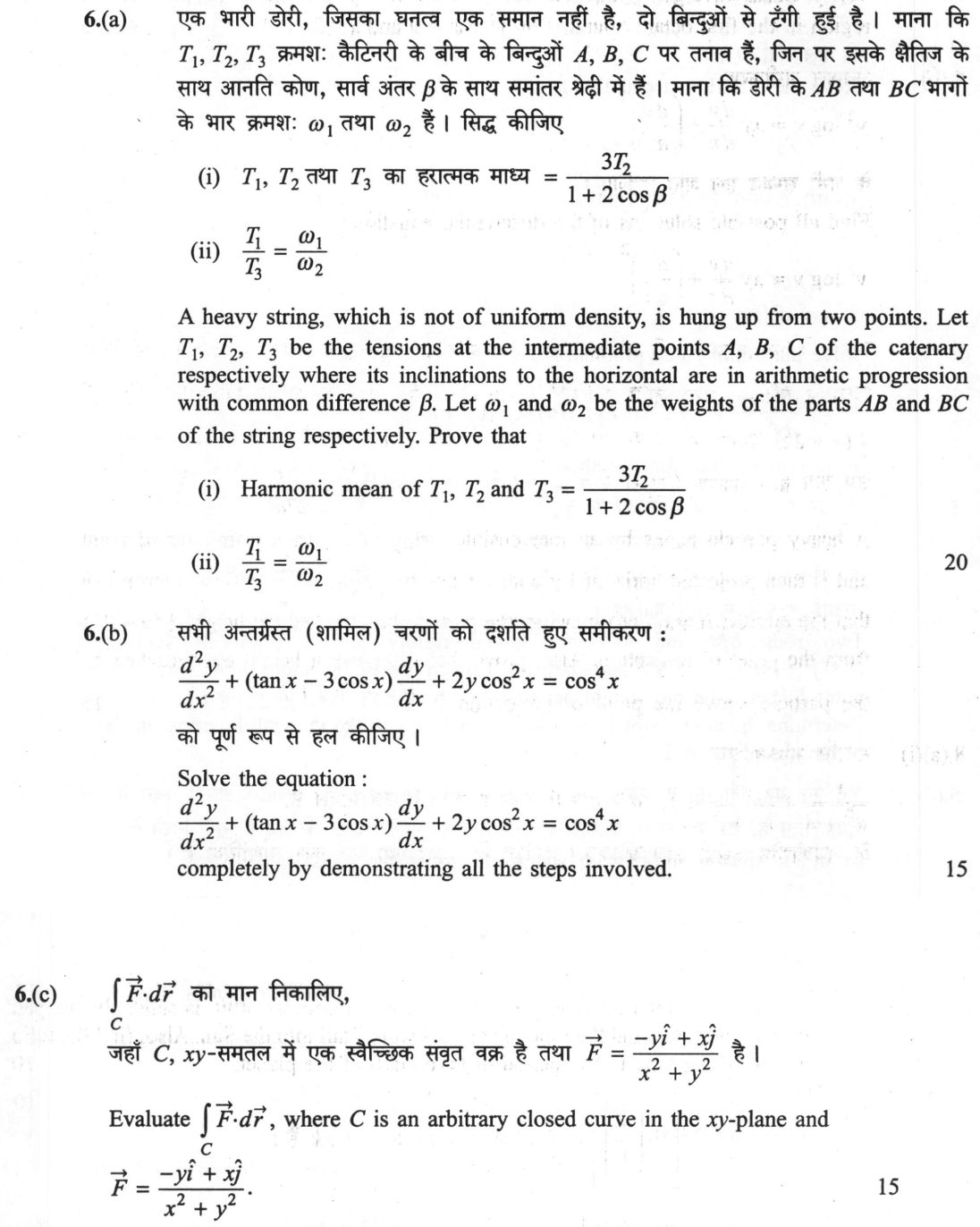
A heavy string, which is not of uniform density, is hung up from two points. Let T₁, T₂, T₃ be the tensions at the intermediate points A, B, C of the catenary respectively where its inclinations to the horizontal are in arithmetic progression with common difference β. Let ω₁ and ω₂ be the weights of the parts AB and BC of the string respectively. Prove that (i) Harmonic mean of T₁, T₂ and T₃ = 3T₂/(1 + 2cos β) (ii) T₁/T₃ = ω₁/ω₂ 20 marks
Solve the equation: d²y/dx² + (tan x - 3cos x)dy/dx + 2y cos²x = cos⁴x completely by demonstrating all the steps involved. 15 marks
Evaluate ∫_C F⃗ · dr⃗, where C is an arbitrary closed curve in the xy-plane and F⃗ = (-yî + xĵ)/(x² + y²). 15 marks
हिंदी में प्रश्न पढ़ें
एक भारी डोरी, जिसका घनत्व एक समान नहीं है, दो बिन्दुओं से टंगी हुई है। माना कि T₁, T₂, T₃ क्रमशः कैटिनरी के बीच के बिन्दुओं A, B, C पर तनाव हैं, जिन पर इसके क्षैतिज के साथ आनति कोण, सार्व अंतर β के साथ समांतर श्रेढ़ी में हैं। माना कि डोरी के AB तथा BC भागों के भार क्रमशः ω₁ तथा ω₂ हैं। सिद्ध कीजिए (i) T₁, T₂ तथा T₃ का हरात्मक माध्य = 3T₂/(1 + 2cos β) (ii) T₁/T₃ = ω₁/ω₂ 20 marks
सभी अंतरस्थ (शामिल) चरणों को दर्शाते हुए समीकरण: d²y/dx² + (tan x - 3cos x)dy/dx + 2y cos²x = cos⁴x को पूर्ण रूप से हल कीजिए। 15 marks
∫_C F⃗ · dr⃗ का मान निकालिए, जहाँ C, xy-समतल में एक सैच्छिक संयुक्त वक्र है तथा F⃗ = (-yî + xĵ)/(x² + y²) है। 15 marks
Model answer
Written by UPSC Answer Check against this question's marking rubric, to the expected length. UPSC does not publish answers for Mains — this is one way to score well, not an official key.
(a) (i) Let the inclinations of the string at A, B, C be θ−β, θ, θ+β respectively. For a flexible heavy string, the horizontal component of tension is constant. Let this constant be H. Then T₁ cos(θ−β) = T₂ cos θ = T₃ cos(θ+β) = H. Hence T₁ = H sec(θ−β), T₂ = H sec θ, T₃ = H sec(θ+β).
The harmonic mean of T₁, T₂, T₃ is HM = 3 / (1/T₁ + 1/T₂ + 1/T₃) = 3H / [cos(θ−β) + cos θ + cos(θ+β)].
Now cos(θ−β) + cos(θ+β) = 2 cos θ cos β, so cos(θ−β) + cos θ + cos(θ+β) = cos θ(1 + 2 cos β). Therefore HM = 3H / [cos θ(1 + 2 cos β)] = 3T₂/(1 + 2 cos β).
Hence (i) is proved.
(a) (ii) For equilibrium of segment AB, vertical forces give ω₁ = T₂ sin θ − T₁ sin(θ−β). Since T sin ψ = H tan ψ, ω₁ = H[tan θ − tan(θ−β)].
For segment BC, ω₂ = H[tan(θ+β) − tan θ].
Using tan u − tan v = sin(u−v)/(cos u cos v), tan θ − tan(θ−β) = sin β / [cos θ cos(θ−β)], tan(θ+β) − tan θ = sin β / [cos θ cos(θ+β)]. Thus ω₁/ω₂ = cos(θ+β)/cos(θ−β).
But T₁/T₃ = [H sec(θ−β)]/[H sec(θ+β)] = cos(θ+β)/cos(θ−β). Therefore T₁/T₃ = ω₁/ω₂.
(b) Solve d²y/dx² + (tan x − 3 cos x)dy/dx + 2y cos²x = cos⁴x.
Put t = sin x and write Y(t) = y(x). Then dt/dx = cos x, so dy/dx = cos x Y′(t), d²y/dx² = cos²x Y″(t) − sin x Y′(t).
Substitute into the equation: cos²x Y″ − sin x Y′ + (tan x − 3 cos x)cos x Y′ + 2 cos²x Y = cos⁴x.
Since tan x cos x = sin x, this becomes cos²x Y″ − sin x Y′ + sin x Y′ − 3 cos²x Y′ + 2 cos²x Y = cos⁴x, so cos²x Y″ − 3 cos²x Y′ + 2 cos²x Y = cos⁴x.
Divide by cos²x: Y″ − 3Y′ + 2Y = cos²x = 1 − sin²x = 1 − t².
The homogeneous equation is Y″ − 3Y′ + 2Y = 0, with characteristic equation r² − 3r + 2 = 0, giving r = 1, 2. Thus Y_h = C₁e^t + C₂e^(2t).
For a particular integral, try Y_p = At² + Bt + C. Then Y_p″ − 3Y_p′ + 2Y_p = 2A − 3(2At + B) + 2(At² + Bt + C) = 2At² + (−6A + 2B)t + (2A − 3B + 2C).
Compare with 1 − t²: 2A = −1, so A = −1/2. −6A + 2B = 0, so 3 + 2B = 0, giving B = −3/2. 2A − 3B + 2C = 1, so −1 + 9/2 + 2C = 1, giving C = −5/4.
Therefore Y_p = −(1/2)t² − (3/2)t − 5/4.
Hence Y = C₁e^t + C₂e^(2t) − (1/2)t² − (3/2)t − 5/4.
Replacing t by sin x, y = C₁e^(sin x) + C₂e^(2 sin x) − (1/2)sin²x − (3/2)sin x − 5/4. This is valid on intervals where cos x ≠ 0.
(c) Let x = r cos θ, y = r sin θ. Then F⃗ · dr⃗ = [(−y)dx + x dy]/(x² + y²).
But −y dx + x dy = r² dθ, and x² + y² = r². Therefore F⃗ · dr⃗ = dθ.
Thus ∫_C F⃗ · dr⃗ = ∫_C dθ, which is the total change in the polar angle θ along C.
For a closed curve C not passing through the origin, ∫_C F⃗ · dr⃗ = 2π n(C,0), where n(C,0) is the winding number of C about the origin.
In particular:
- If C does not enclose the origin, the integral is 0.
- If C is a simple closed curve enclosing the origin once anticlockwise, the integral is 2π.
- If C encloses the origin once clockwise, the integral is −2π. If C passes through the origin, F⃗ is undefined there, so the integral is not defined in the ordinary sense.
What "Solve" is asking you to do
Choose the method, then carry it through to a final answer. Identifying what kind of problem this is and why that method applies is the first thing marked; a correct figure arrived at invisibly earns almost nothing.
Structure that answers it
Given data and what is required → method chosen, with the reason it applies → set-up (equation, circuit, free body, trial balance) → working, step by step → answer with units and any condition of validity
Where marks are lost
Doing the middle steps mentally and writing only the result. In mathematics papers, a further loss comes from giving a decimal where the exact value in surds or fractions was wanted, or from skipping the justification a part explicitly asks for.
How this answer will be evaluated
Approach
(a) derive: given > assumptions > stepwise derivation > result > check | (b) calculate: given > formula > substitution > result with units > interpretation | (c) calculate: given > formula > substitution > result with units > interpretation Full marks: Complete, rigorous derivations with all steps shown and verified.
Key points expected
- Resolve forces at points A, B, C to form equilibrium equations
- Use horizontal tension constancy to relate T1, T2, T3
- Apply arithmetic progression of inclinations to derive harmonic mean
- Relate vertical force balance to weights w1 and w2
- Identify the equation as a linear ODE with variable coefficients
- Find the complementary function (homogeneous solution)
- Find the particular integral for the non-homogeneous term
- Combine to state the general solution
Evaluation rubric
Each sub-part is marked on its own, against the marks and word limit printed on the paper.
- (a) Prove the two relations for tensions and weights of a non-uniform heavy string. 20 marks
derive— given → assumptions → stepwise derivation → result → check
Must cover
- Resolve forces at points A, B, C to form equilibrium equations
- Use horizontal tension constancy to relate T1, T2, T3
- Apply arithmetic progression of inclinations to derive harmonic mean
- Relate vertical force balance to weights w1 and w2
Loses marks
- Assumes uniform density contrary to the problem statement
- Skips the force resolution steps and jumps to the final formula
- Fails to justify the use of the arithmetic progression condition
Earns more
- Explicitly states horizontal tension is constant
- Clearly defines angles of inclination at A, B, C
- Shows step-by-step algebraic manipulation for part (i)
- Verifies the final ratio for part (ii)
Extra mark
- Includes a neat free-body diagram of the string segments
- (b) Solve the given second-order linear differential equation completely. 15 marks
calculate— given → formula → substitution → result with units → interpretation
Must cover
- Identify the equation as a linear ODE with variable coefficients
- Find the complementary function (homogeneous solution)
- Find the particular integral for the non-homogeneous term
- Combine to state the general solution
Loses marks
- Treats the equation as having constant coefficients
- Fails to find the complete general solution (missing C.F. or P.I.)
- Makes algebraic errors in the integration steps
Earns more
- Uses a valid method like variation of parameters or undetermined coefficients
- Clearly separates the homogeneous and particular solution steps
- Shows the integration steps for the particular integral
- Verifies the solution by substitution
Extra mark
- Notes an alternative method briefly
- (c) Evaluate the line integral of the given vector field over an arbitrary closed curve. 15 marks
calculate— given → formula → substitution → result with units → interpretation
Must cover
- Identify the vector field F and the curve C
- Apply Green's Theorem to convert the line integral to a double integral
- Evaluate the double integral over the region enclosed by C
- State the final value of the integral
Loses marks
- Attempts direct line integration without using Green's Theorem
- Fails to account for the singularity at the origin
- Makes errors in the partial derivative calculations
Earns more
- Explicitly states Green's Theorem
- Correctly computes the partial derivatives for the curl
- Handles the singularity at the origin if applicable
- Clearly defines the region of integration
Extra mark
- Mentions the physical interpretation of the result (circulation)
Practice this exact question
Write your answer and it is marked point by point against the model answer above — what you covered, what you missed, what you got wrong.
Evaluate my answer →More from Mathematics 2021 Paper I
- Q3 (a)(i) If u = x² + y², v = x² - y², where x = rcosθ, y = rsinθ, then find (∂(u,v))/(∂(r,θ…
- Q4 (a)(i) Reduce the following matrix to a row-reduced echelon form and hence also, find its…
- Q5 Solve the differential equation: d²y/dx² + 2y = x²e^(3x) + e^x cos 2x (10 marks) Solve th…
- Q6 A heavy string, which is not of uniform density, is hung up from two points. Let T₁, T₂,…
- Q7 (a) Verify Gauss divergence theorem for F⃗ = 2x^2yî - y^2ĵ + 4xz^2k̂ taken over the reg…
- Q8 (a)(i) Find the orthogonal trajectories of the family of confocal conics (x²)/(a²+λ) + (y…