Paper I — Q2
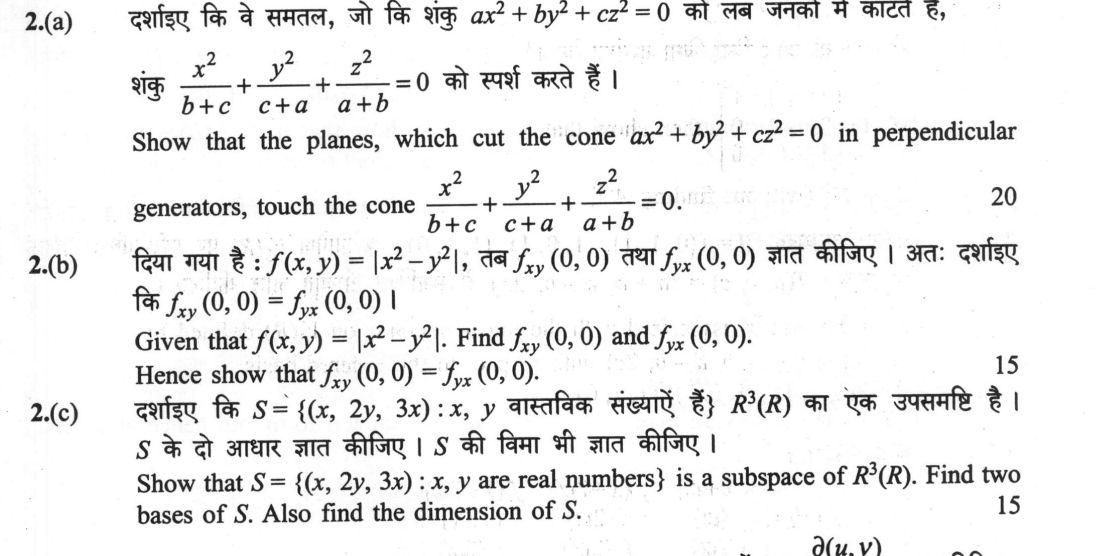
(a) Show that the planes, which cut the cone ax² + by² + cz² = 0 in perpendicular generators, touch the cone (x²)/(b+c) +…
Show that the planes, which cut the cone ax² + by² + cz² = 0 in perpendicular generators, touch the cone (x²)/(b+c) + (y²)/(c+a) + (z²)/(a+b) = 0. 20 marks
Given that f(x,y) = |x² - y²|. Find f_xy(0,0) and f_yx(0,0). Hence show that f_xy(0,0) = f_yx(0,0). 15 marks
Show that S = (x, 2y, 3x) : x, y are real numbers is a subspace of R³(R). Find two bases of S. Also find the dimension of S. 15 marks
हिंदी में प्रश्न पढ़ें
दर्शाइए कि वे समतल, जो कि शंकु ax² + by² + cz² = 0 को लंब जनकों में काटते हैं, शंकु (x²)/(b+c) + (y²)/(c+a) + (z²)/(a+b) = 0 को स्पर्श करते हैं। (20 अंक)
दिया गया है : f(x,y) = |x² - y²|, तब f_xy(0,0) तथा f_yx(0,0) ज्ञात कीजिए। अतः दर्शाइए कि f_xy(0,0) = f_yx(0,0)। (15 अंक)
दर्शाइए कि S = (x, 2y, 3x) : x, y वास्तविक संख्याएँ हैं R³(R) का एक उपसमष्टि है। S के दो आधार ज्ञात कीजिए। S की विमा भी ज्ञात कीजिए। (15 अंक)
What "Prove" is asking you to do
Establish that the statement holds for every case it claims, not for one representative case. The argument must be closed: each line follows from a definition, a hypothesis, or a named theorem you are entitled to use.
Structure that answers it
Given and to prove, restated → theorem or construction to be used, named → the argument line by line → conclusion stated as proved
Where marks are lost
Testing one example, which illustrates but proves nothing. On an if and only if claim, proving one direction and stopping forfeits that half outright, and degenerate cases — zero, the empty set, the equality case — have to be disposed of rather than assumed away.
How this answer will be evaluated
Approach
(a) justify: claim > 3-4 reasons > evidence > conclusion | (b) calculate: given > formula > substitution > result with units > interpretation | (c) justify: claim > 3-4 reasons > evidence > conclusion Full marks: Complete derivations with all steps shown, correct results, and clear justification.
Key points expected
- Equation of pair of generators of the cone
- Condition for generators to be perpendicular
- Equation of the plane passing through the generators
- Condition for the plane to touch the cone
- Definition of f_xy(0,0) as a limit
- Definition of f_yx(0,0) as a limit
- Evaluation of the limits using the absolute value
- Comparison of the two results
Evaluation rubric
Each sub-part is marked on its own, against the marks and word limit printed on the paper.
- (a) Prove that planes cutting the cone in perpendicular generators touch the specified cone. 20 marks
justify— claim → 3-4 reasons → evidence → conclusion
Must cover
- Equation of pair of generators of the cone
- Condition for generators to be perpendicular
- Equation of the plane passing through the generators
- Condition for the plane to touch the cone
Loses marks
- Assuming the result without derivation
- Incorrect condition for perpendicular generators
- Algebraic errors in the final equation
Earns more
- Use of direction cosines for perpendicularity
- Substitution of plane equation into cone equation
- Discriminant set to zero for tangency
Extra mark
- Geometric interpretation of the result
- (b) Compute f_xy(0,0) and f_yx(0,0) for f(x,y) = |x² - y²| and show they are equal. 15 marks
calculate— given → formula → substitution → result with units → interpretation
Must cover
- Definition of f_xy(0,0) as a limit
- Definition of f_yx(0,0) as a limit
- Evaluation of the limits using the absolute value
- Comparison of the two results
Loses marks
- Differentiating |x² - y²| directly without limits
- Incorrect limit evaluation
- Failing to show the equality
Earns more
- Explicit handling of the sign of x² - y²
- Step-by-step limit evaluation
Extra mark
- Note on continuity of mixed partials
- (c) Show S is a subspace of R³, find two bases, and determine the dimension. 15 marks
justify— claim → 3-4 reasons → evidence → conclusion
Must cover
- Verification of closure under addition
- Verification of closure under scalar multiplication
- Identification of two distinct bases for S
- Determination of the dimension of S
Loses marks
- Missing one of the subspace axioms
- Providing only one basis
- Incorrect dimension calculation
Earns more
- Explicit statement of the subspace axioms
- Clear presentation of the basis vectors
Extra mark
- Geometric description of S as a plane
Model answer coming soon
Every evaluation on this site is marked against a verified model answer. This question's answer is still being written; evaluation opens the moment it lands.
More from Mathematics 2021 Paper I
- Q1 (a) If A= 1 & -1 & 1 2 & -1 & 0 1 & 0 & 0 , then show that A² = A⁻¹ (without finding A⁻¹)…
- Q2 (a) Show that the planes, which cut the cone ax² + by² + cz² = 0 in perpendicular generat…
- Q3 (a)(i) If u = x² + y², v = x² - y², where x = rcosθ, y = rsinθ, then find (∂(u,v))/(∂(r,θ…
- Q4 (a)(i) Reduce the following matrix to a row-reduced echelon form and hence also, find its…
- Q5 Solve the differential equation: d²y/dx² + 2y = x²e^(3x) + e^x cos 2x (10 marks) Solve th…