Paper I — Q3
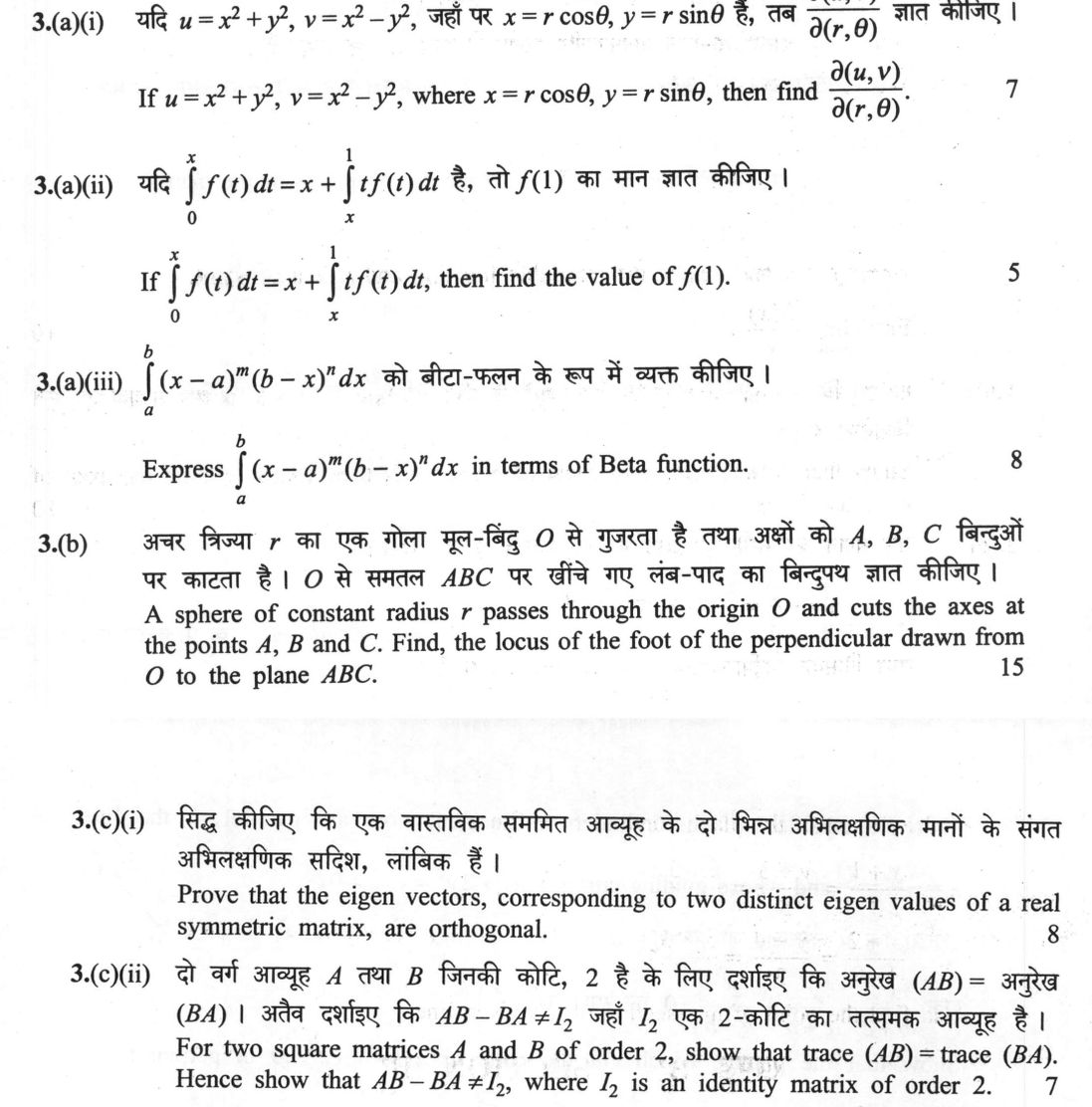
(a)(i) If u = x² + y², v = x² - y², where x = rcosθ, y = rsinθ, then find (∂(u,v))/(∂(r,θ)). (7 marks) (a)(ii) If ∫limits₀^x…
If u = x² + y², v = x² - y², where x = rcosθ, y = rsinθ, then find (∂(u,v))/(∂(r,θ)). 7 marks
If ∫limits₀^x f(t) dt = x + ∫limitsₓ¹ tf(t) dt, then find the value of f(1). 5 marks
Express ∫limitsₐ^b (x-a)^m (b-x)ⁿ dx in terms of Beta function. 8 marks
A sphere of constant radius r passes through the origin O and cuts the axes at the points A, B and C. Find, the locus of the foot of the perpendicular drawn from O to the plane ABC. 15 marks
Prove that the eigen vectors, corresponding to two distinct eigen values of a real symmetric matrix, are orthogonal. 8 marks
For two square matrices A and B of order 2, show that trace (AB) = trace (BA). Hence show that AB - BA ≠ I₂, where I₂ is an identity matrix of order 2. 7 marks
हिंदी में प्रश्न पढ़ें
यदि u = x² + y², v = x² - y², जहाँ पर x = rcosθ, y = rsinθ है, तब (∂(u,v))/(∂(r,θ)) ज्ञात कीजिए। (7 अंक)
यदि ∫limits₀^x f(t) dt = x + ∫limitsₓ¹ tf(t) dt है, तो f(1) का मान ज्ञात कीजिए। (5 अंक)
∫limitsₐ^b (x-a)^m (b-x)ⁿ dx को बीटा-फलन के रूप में व्यक्त कीजिए। (8 अंक)
अचर त्रिज्या r का एक गोला मूल-बिंदु O से गुजरता है तथा अक्षों को A, B, C बिंदुओं पर काटता है। O से समतल ABC पर खींचे गए लंब-पाद का बिंदुपथ ज्ञात कीजिए। (15 अंक)
सिद्ध कीजिए कि एक वास्तविक सममित आव्यूह के दो भिन्न अभिलक्षणिक मानों के संगत अभिलक्षणिक सदिश, लंबिक हैं। (8 अंक)
दो वर्ग आव्यूह A तथा B जिनकी कोटि, 2 है के लिए दर्शाइए कि अनुरेख (AB) = अनुरेख (BA)। अतैव दर्शाइए कि AB - BA ≠ I₂ जहाँ I₂ एक 2-कोटि का तत्समक आव्यूह है। (7 अंक)
Model answer
Written by UPSC Answer Check against this question's marking rubric, to the expected length. UPSC does not publish answers for Mains — this is one way to score well, not an official key.
(a)(i) Put x = r cosθ, y = r sinθ. Then
u = x² + y² = r²,
v = x² − y² = r²(cos²θ − sin²θ) = r² cos2θ.
By the Jacobian formula,
∂u/∂r = 2r, ∂u/∂θ = 0,
∂v/∂r = 2r cos2θ, ∂v/∂θ = −2r² sin2θ.
Hence
∂(u,v)/∂(r,θ) =
| 2r 0 | | 2r cos2θ −2r² sin2θ |
= (2r)(−2r² sin2θ) − 0
= −4r³ sin2θ = −8r³ sinθ cosθ.
Answer: ∂(u,v)/∂(r,θ) = −4r³ sin2θ = −8r³ sinθ cosθ.
(a)(ii) Assume f is continuous so that Leibniz rule applies. Differentiate both sides with respect to x:
d/dx ∫₀ˣ f(t)dt = f(x).
Also,
d/dx [x + ∫ₓ¹ t f(t)dt] = 1 − x f(x).
Therefore,
f(x) = 1 − x f(x),
so
(1 + x)f(x) = 1.
Putting x = 1,
2f(1) = 1, hence f(1) = 1/2.
Answer: f(1) = 1/2.
(a)(iii) Use the substitution
x = a + (b − a)t, so dx = (b − a)dt.
When x = a, t = 0; when x = b, t = 1. Then
x − a = (b − a)t, b − x = (b − a)(1 − t).
Thus
∫ₐᵇ (x − a)^m (b − x)^n dx
= ∫₀¹ [(b − a)t]^m [(b − a)(1 − t)]^n (b − a)dt
= (b − a)^(m+n+1) ∫₀¹ t^m (1 − t)^n dt.
By definition of the Beta function,
∫₀¹ t^m (1 − t)^n dt = B(m + 1, n + 1).
Therefore,
Answer: ∫ₐᵇ (x − a)^m (b − x)^n dx = (b − a)^(m+n+1) B(m + 1, n + 1), valid for m > −1, n > −1.
(b) Let the centre of the sphere be (α, β, γ). Since the sphere has radius r and passes through the origin O,
α² + β² + γ² = r².
Its equation is
x² + y² + z² − 2αx − 2βy − 2γz = 0.
On the x-axis, y = z = 0, so
x² − 2αx = 0, hence x = 0 or x = 2α.
Thus A = (2α, 0, 0). Similarly,
B = (0, 2β, 0), C = (0, 0, 2γ).
The plane ABC has intercept form
X/(2α) + Y/(2β) + Z/(2γ) = 1.
Its normal vector is
N = (1/(2α), 1/(2β), 1/(2γ)).
Let P = (X, Y, Z) be the foot of the perpendicular from O to the plane ABC. For the plane N·R = 1, the foot from the origin is
P = N/|N|².
Let
D = |N|² = 1/(4α²) + 1/(4β²) + 1/(4γ²).
Then
X = (1/(2α))/D, Y = (1/(2β))/D, Z = (1/(2γ))/D.
Hence
α = 1/(2XD), β = 1/(2YD), γ = 1/(2ZD).
Also |P|² = 1/D, so
D = 1/(X² + Y² + Z²).
Therefore,
α = (X² + Y² + Z²)/(2X),
β = (X² + Y² + Z²)/(2Y),
γ = (X² + Y² + Z²)/(2Z).
Substitute into α² + β² + γ² = r²:
[(X² + Y² + Z²)/(2X)]² + [(X² + Y² + Z²)/(2Y)]² + [(X² + Y² + Z²)/(2Z)]² = r².
So
(X² + Y² + Z²)²/4 · (1/X² + 1/Y² + 1/Z²) = r².
Thus
Answer: locus is (X² + Y² + Z²)²(1/X² + 1/Y² + 1/Z²) = 4r², or equivalently (X² + Y² + Z²)²(Y²Z² + Z²X² + X²Y²) = 4r²X²Y²Z².
(c)(i) Let A be a real symmetric matrix. Let x and y be eigenvectors corresponding to distinct eigenvalues λ and μ:
A x = λx, A y = μy, λ ≠ μ.
Since A is symmetric,
(Ax)·y = x·(Ay).
But (Ax)·y = (λx)·y = λ(x·y), and x·(Ay) = x·(μy) = μ(x·y).
Hence
λ(x·y) = μ(x·y),
so
(λ − μ)(x·y) = 0.
Since λ ≠ μ, we get x·y = 0.
Answer: the eigenvectors corresponding to distinct eigenvalues are orthogonal.
(c)(ii) Let A = (aᵢⱼ), B = (bᵢⱼ), i, j = 1, 2. Then
trace(AB) = a₁₁b₁₁ + a₁₂b₂₁ + a₂₁b₁₂ + a₂₂b₂₂.
Similarly,
trace(BA) = b₁₁a₁₁ + b₁₂a₂₁ + b₂₁a₁₂ + b₂₂a₂₂.
The two sums are identical because scalar products commute. Hence
trace(AB) = trace(BA).
Now suppose, if possible, AB − BA = I₂. Taking trace,
trace(AB − BA) = trace(I₂).
But
trace(AB − BA) = trace(AB) − trace(BA) = 0,
while trace(I₂) = 1 + 1 = 2.
Thus 0 = 2, impossible.
Answer: trace(AB) = trace(BA); hence AB − BA ≠ I₂.
What "Solve" is asking you to do
Choose the method, then carry it through to a final answer. Identifying what kind of problem this is and why that method applies is the first thing marked; a correct figure arrived at invisibly earns almost nothing.
Structure that answers it
Given data and what is required → method chosen, with the reason it applies → set-up (equation, circuit, free body, trial balance) → working, step by step → answer with units and any condition of validity
Where marks are lost
Doing the middle steps mentally and writing only the result. In mathematics papers, a further loss comes from giving a decimal where the exact value in surds or fractions was wanted, or from skipping the justification a part explicitly asks for.
How this answer will be evaluated
Approach
(a(i)) calculate: given > formula > substitution > result with units > interpretation | (a(ii)) calculate: given > formula > substitution > result with units > interpretation | (a(iii)) derive: given > assumptions > stepwise derivation > result > check | (b) derive: given > assumptions > stepwise derivation > result > check | (c(i)) justify: claim > 3-4 reasons > evidence > conclusion | (c(ii)) justify: claim > 3-4 reasons > evidence > conclusion Full marks: Complete stepwise derivations with all justifications, correct final results, and verification steps.
Key points expected
- Compute partial derivatives ∂u/∂x, ∂u/∂y, ∂v/∂x, ∂v/∂y
- Compute partial derivatives ∂x/∂r, ∂x/∂θ, ∂y/∂r, ∂y/∂θ
- Apply chain rule to find ∂(u,v)/∂(x,y) and ∂(x,y)/∂(r,θ)
- Multiply determinants to obtain final Jacobian value
- Differentiate both sides with respect to x
- Apply Leibniz rule for variable limits of integration
- Substitute x=1 into the resulting differential equation
- Solve for f(1) using the boundary condition
Evaluation rubric
Each sub-part is marked on its own, against the marks and word limit printed on the paper.
- (a(i)) Compute the Jacobian determinant ∂(u,v)/∂(r,θ) using the chain rule. 7 marks
calculate— given → formula → substitution → result with units → interpretation
Must cover
- Compute partial derivatives ∂u/∂x, ∂u/∂y, ∂v/∂x, ∂v/∂y
- Compute partial derivatives ∂x/∂r, ∂x/∂θ, ∂y/∂r, ∂y/∂θ
- Apply chain rule to find ∂(u,v)/∂(x,y) and ∂(x,y)/∂(r,θ)
- Multiply determinants to obtain final Jacobian value
Loses marks
- Skipping intermediate partial derivative steps
- Incorrect application of chain rule for Jacobians
Earns more
- Explicitly state the Jacobian chain rule formula
- Show intermediate determinant calculations clearly
Extra mark
- Verify result using direct substitution of x,y in u,v
- (a(ii)) Find the value of f(1) from the given integral equation. 5 marks
calculate— given → formula → substitution → result with units → interpretation
Must cover
- Differentiate both sides with respect to x
- Apply Leibniz rule for variable limits of integration
- Substitute x=1 into the resulting differential equation
- Solve for f(1) using the boundary condition
Loses marks
- Incorrect application of Leibniz rule for variable limits
- Failing to substitute x=1 correctly
Earns more
- State Leibniz rule explicitly before applying
- Show the step where f(x) terms cancel or simplify
Extra mark
- Verify the solution by substituting back into original equation
- (a(iii)) Express the integral in terms of the Beta function. 8 marks
derive— given → assumptions → stepwise derivation → result → check
Must cover
- Perform substitution t = (x-a)/(b-a) to transform limits
- Express dx in terms of dt and simplify the integrand
- Identify the resulting form as Beta(m+1, n+1)
- State the final answer as (b-a)^(m+n+1) B(m+1, n+1)
Loses marks
- Incorrect substitution leading to wrong Beta function arguments
- Failing to account for the (b-a) factor in the final answer
Earns more
- Show the substitution steps clearly with limits transformation
- State the definition of Beta function used
Extra mark
- Mention the relationship B(m,n) = Γ(m)Γ(n)/Γ(m+n)
- (b) Find the locus of the foot of the perpendicular from O to plane ABC. 15 marks
derive— given → assumptions → stepwise derivation → result → check
Must cover
- Use sphere condition a² + b² + c² = 4r² (diameter property)
- Find foot of perpendicular from O to plane using formula
Loses marks
- Incorrect sphere condition or missing the 4r² factor
- Failing to eliminate parameters to get the locus equation
Earns more
- Justify why a² + b² + c² = 4r² using sphere geometry
- Show the foot of perpendicular formula derivation
Extra mark
- Provide a neat 3D diagram showing sphere, axes, and plane ABC
- (c(i)) Prove eigenvectors for distinct eigenvalues of real symmetric matrix are orthogonal. 8 marks
justify— claim → 3-4 reasons → evidence → conclusion
Must cover
- Let Ax = λx and Ay = μy with λ ≠ μ
- Use symmetry: xᵀAx = (Ax)ᵀx = λxᵀx
- Show xᵀAy = μxᵀy and (Ax)ᵀy = λxᵀy
- Conclude (λ - μ)xᵀy = 0, so xᵀy = 0
Loses marks
- Failing to use the symmetry property A = Aᵀ
- Incorrect algebraic manipulation in the proof
Earns more
- State the spectral theorem for real symmetric matrices
- Clearly define the inner product notation used
Extra mark
- Mention that this generalizes to Hermitian matrices in complex case
- (c(ii)) Show trace(AB) = trace(BA) and AB - BA ≠ I₂. 7 marks
justify— claim → 3-4 reasons → evidence → conclusion
Must cover
- Write A and B as 2x2 matrices with explicit entries
- Compute AB and BA element-wise
- Show trace(AB) = a₁₁b₁₁ + a₁₂b₂₁ + a₂₁b₁₂ + a₂₂b₂₂
Loses marks
- Failing to show the explicit matrix multiplication
- Incorrect trace calculation or missing the contradiction step
Earns more
- Use general n×n case for trace equality before specializing to 2×2
- Clearly state the contradiction argument for AB - BA ≠ I₂
Extra mark
- Mention that trace is cyclic: trace(ABC) = trace(BCA) = trace(CAB)
Practice this exact question
Write your answer and it is marked point by point against the model answer above — what you covered, what you missed, what you got wrong.
Evaluate my answer →More from Mathematics 2021 Paper I
- Q1 (a) If A= 1 & -1 & 1 2 & -1 & 0 1 & 0 & 0 , then show that A² = A⁻¹ (without finding A⁻¹)…
- Q2 (a) Show that the planes, which cut the cone ax² + by² + cz² = 0 in perpendicular generat…
- Q3 (a)(i) If u = x² + y², v = x² - y², where x = rcosθ, y = rsinθ, then find (∂(u,v))/(∂(r,θ…
- Q4 (a)(i) Reduce the following matrix to a row-reduced echelon form and hence also, find its…
- Q5 Solve the differential equation: d²y/dx² + 2y = x²e^(3x) + e^x cos 2x (10 marks) Solve th…
- Q6 A heavy string, which is not of uniform density, is hung up from two points. Let T₁, T₂,…