Paper II — Q1
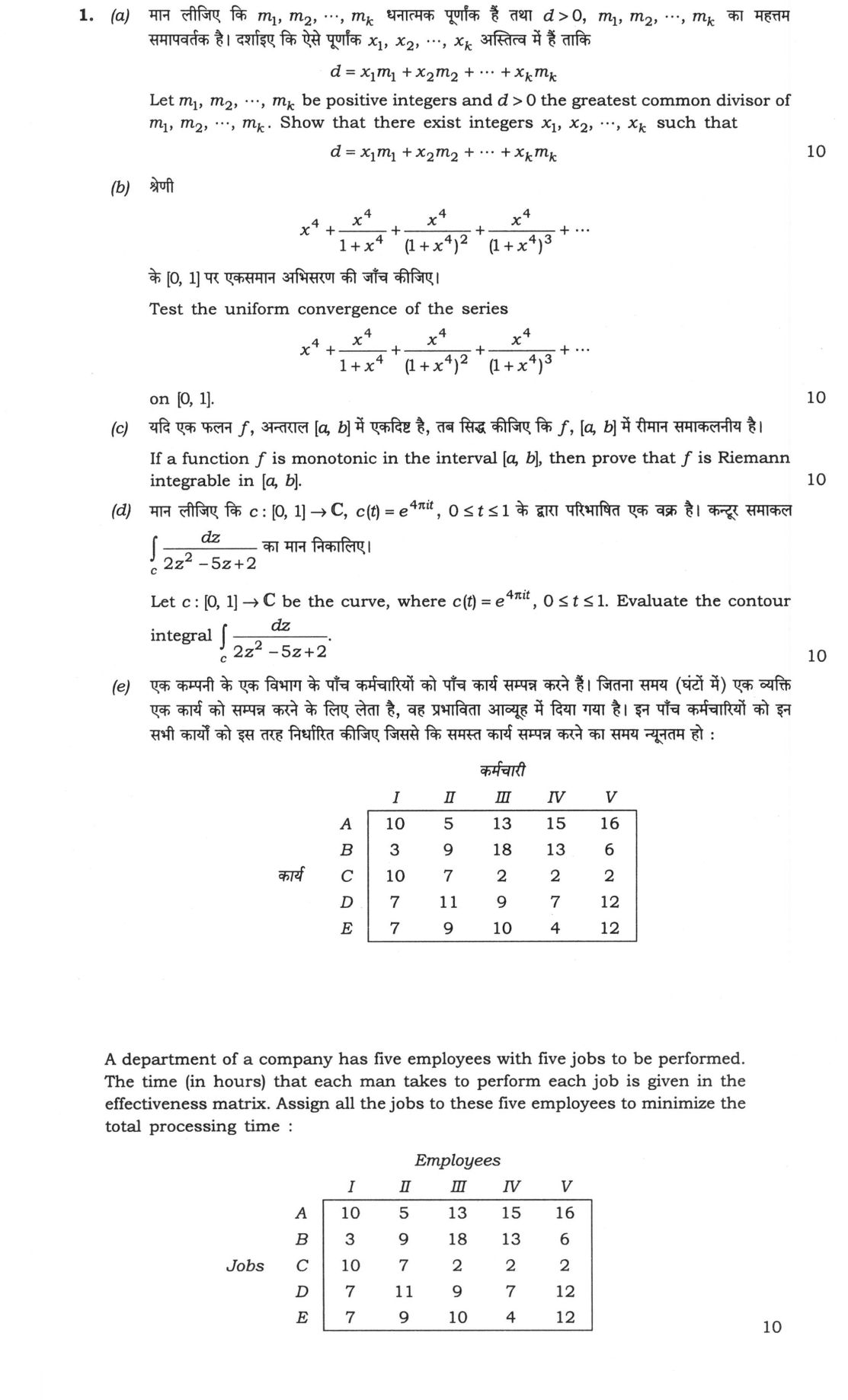
(a) Let m₁, m₂, …, mₖ be positive integers and d > 0 the greatest common divisor of m₁, m₂, …, mₖ. Show that there exist integers…
Let m₁, m₂, …, mₖ be positive integers and d > 0 the greatest common divisor of m₁, m₂, …, mₖ. Show that there exist integers x₁, x₂, …, xₖ such that d = x_1m₁ + x_2m₂ + … + x_kmₖ 10 marks
Test the uniform convergence of the series x⁴ + (x⁴)/(1+x⁴) + (x⁴)/((1+x⁴)²) + (x⁴)/((1+x⁴)³) + … on [0, 1]. 10 marks
If a function f is monotonic in the interval [a, b], then prove that f is Riemann integrable in [a, b]. 10 marks
Let c : [0, 1] → C be the curve, where c(t) = e⁴π it, 0 ≤ t ≤ 1. Evaluate the contour integraldisplaystyle∫_c dz/(2z² - 5z + 2). 10 marks
A department of a company has five employees with five jobs to be performed. The time (in hours) that each man takes to perform each job is given in the effectiveness matrix. Assign all the jobs to these five employees to minimize the total processing time:
Employees I II III IV V A 10 5 13 15 16 B 3 9 18 13 6 Jobs C 10 7 2 2 2 D 7 11 9 7 12 E 7 9 10 4 12
10 marks
हिंदी में प्रश्न पढ़ें
मान लीजिए कि m₁, m₂, …, mₖ धनात्मक पूर्णांक हैं तथा d > 0, m₁, m₂, …, mₖ का महत्तम समापवर्तक है। दर्शाइए कि ऐसे पूर्णांक x₁, x₂, …, xₖ अस्तित्व में हैं ताकि d = x_1m₁ + x_2m₂ + … + x_kmₖ (10 अंक)
श्रेणी x⁴ + (x⁴)/(1+x⁴) + (x⁴)/((1+x⁴)²) + (x⁴)/((1+x⁴)³) + … के [0, 1] पर एकसमान अभिसरण की जाँच कीजिए। (10 अंक)
यदि एक फलन f, अन्तराल [a, b] में एकदिशे है, तब सिद्ध कीजिए कि f, [a, b] में रीमान समाकलनीय है। (10 अंक)
मान लीजिए कि c : [0, 1] → C, c(t) = e⁴π it, 0 ≤ t ≤ 1 के द्वारा परिभाषित एक वक्र है। कन्टूर समाकल ∫_c dz/(2z² - 5z + 2) का मान निकालिए। (10 अंक)
एक कम्पनी के एक विभाग के पाँच कर्मचारियों को पाँच कार्य सम्पन्न करने हैं। जितना समय (घंटों में) एक व्यक्ति एक कार्य को सम्पन्न करने के लिए लेता है, वह प्रभाविता आव्यूह में दिया गया है। इन पाँच कर्मचारियों को इन सभी कार्यों को इस तरह निर्धारित कीजिए जिससे कि समस्त कार्य सम्पन्न करने का समय न्यूनतम हो :
कर्मचारी
| I | II | III | IV | V | |
|---|---|---|---|---|---|
| A | 10 | 5 | 13 | 15 | 16 |
| B | 3 | 9 | 18 | 13 | 6 |
| C | 10 | 7 | 2 | 2 | 2 |
| D | 7 | 11 | 9 | 7 | 12 |
| E | 7 | 9 | 10 | 4 | 12 |
कार्य
(10 अंक)
Model answer
Written by UPSC Answer Check against this question's marking rubric, to the expected length. UPSC does not publish answers for Mains — this is one way to score well, not an official key.
(a) Let d = gcd(m₁,m₂,…,mₖ). Use Bézout’s identity for two integers: if g = gcd(a,b), then there exist integers u,v such that g = ua + vb.
Prove by induction on k. For k=1, d = m₁, so d = 1·m₁. Assume the result for k−1 integers. Let g = gcd(m₁,m₂,…,mₖ₋₁). By induction, there exist integers y₁,y₂,…,yₖ₋₁ such that g = y₁m₁ + y₂m₂ + … + yₖ₋₁mₖ₋₁.
Now d = gcd(m₁,m₂,…,mₖ) = gcd(g,mₖ). By Bézout’s identity applied to g and mₖ, there exist integers r,s such that d = rg + smₖ.
Substituting, d = r(y₁m₁ + y₂m₂ + … + yₖ₋₁mₖ₋₁) + smₖ = (ry₁)m₁ + (ry₂)m₂ + … + (ryₖ₋₁)mₖ₋₁ + smₖ.
Take x₁ = ry₁, x₂ = ry₂, …, xₖ₋₁ = ryₖ₋₁, xₖ = s. Then d = x₁m₁ + x₂m₂ + … + xₖmₖ.
(b) The series is x⁴ + x⁴/(1+x⁴) + x⁴/(1+x⁴)² + x⁴/(1+x⁴)³ + …
For x > 0, put q = 1/(1+x⁴). Then the terms are x⁴qʳ, r = 0,1,2,… The n-th partial sum is Sₙ = x⁴(1 + q + q² + … + qⁿ) = x⁴(1 − qⁿ⁺¹)/(1 − q).
Since 1 − q = 1 − 1/(1+x⁴) = x⁴/(1+x⁴), we get Sₙ = (1+x⁴)(1 − qⁿ⁺¹) = 1 + x⁴ − (1+x⁴)qⁿ⁺¹ = 1 + x⁴ − 1/(1+x⁴)ⁿ.
Hence, for x > 0, lim Sₙ(x) = 1 + x⁴. At x = 0, every term is 0, so the sum is 0. Thus the pointwise limit is S(x) = 0 for x = 0, and S(x) = 1 + x⁴ for x > 0.
Now for x > 0, |Sₙ(x) − S(x)| = 1/(1+x⁴)ⁿ. At x = 0, this difference is 0. But as x → 0⁺, 1/(1+x⁴)ⁿ → 1. Therefore sup over [0,1] of |Sₙ(x) − S(x)| = 1 for every n. This does not tend to 0 as n → ∞. Hence the convergence is not uniform on [0,1].
Equivalently, the partial sums are continuous on [0,1], but the pointwise limit S(x) is discontinuous at x = 0, so uniform convergence is impossible.
(c) Assume first that f is monotonically increasing on [a,b]. Since f is monotone, it is bounded on [a,b], with f(a) ≤ f(x) ≤ f(b).
Let P = {a = x₀ < x₁ < x₂ < … < xₙ = b} be any partition of [a,b]. On each subinterval [xᵢ₋₁,xᵢ], because f is increasing, mᵢ = inf f = f(xᵢ₋₁), Mᵢ = sup f = f(xᵢ). Therefore U(P,f) − L(P,f) = sum over i=1 to n of (Mᵢ − mᵢ)Δxᵢ = sum over i=1 to n of (f(xᵢ) − f(xᵢ₋₁))Δxᵢ.
Let ‖P‖ = max Δxᵢ. Then U(P,f) − L(P,f) ≤ ‖P‖ · sum over i=1 to n of (f(xᵢ) − f(xᵢ₋₁)) = ‖P‖(f(b) − f(a)).
If f(b) = f(a), then f is constant, hence Riemann integrable. Otherwise f(b) − f(a) > 0. Given ε > 0, choose a partition P with ‖P‖ < ε/(f(b) − f(a)). Then U(P,f) − L(P,f) < ε. By Riemann’s criterion, f is Riemann integrable on [a,b].
If f is monotonically decreasing, apply the same argument to −f, which is increasing. Hence a monotonic function on [a,b] is always Riemann integrable. Therefore f is Riemann integrable in [a,b].
(d) Factor the denominator: 2z² − 5z + 2 = (2z − 1)(z − 2) = 2(z − 1/2)(z − 2). So the poles are z = 1/2 and z = 2.
The curve is c(t) = e⁴πit, 0 ≤ t ≤ 1. This is the unit circle traversed twice counterclockwise. The point z = 1/2 lies inside the unit circle, so its winding number is 2. The point z = 2 lies outside the unit circle, so its winding number is 0.
Compute the residue at z = 1/2: Res(1/(2z² − 5z + 2), 1/2) = lim as z → 1/2 of (z − 1/2)/(2(z − 1/2)(z − 2)) = 1/(2(1/2 − 2)) = 1/(2(−3/2)) = −1/3.
By the residue theorem, integral along c of dz/(2z² − 5z + 2) = 2πi · 2 · (−1/3) = −4πi/3.
Therefore the value of the contour integral is −4πi/3.
(e) Use the Hungarian method. The cost matrix is:
A: 10 5 13 15 16 B: 3 9 18 13 6 C: 10 7 2 2 2 D: 7 11 9 7 12 E: 7 9 10 4 12
Row minima are 5,3,2,7,4. Subtract them from the respective rows. The reduced matrix is:
A: 5 0 8 10 11 B: 0 6 15 10 3 C: 8 5 0 0 0 D: 0 4 2 0 5 E: 3 5 6 0 8
The column minima are all 0, so the matrix remains unchanged. A maximum matching of zeros has size 4, for example A-II, B-I, C-III, D-IV. Thus no perfect zero assignment exists.
A minimum cover of all zeros is given by columns I, II, IV and row C. The uncovered entries lie in rows A, B, D, E and columns III, V. The smallest uncovered entry is 2, at D-III. Subtract 2 from all uncovered entries and add 2 at intersections of covered rows and covered columns. The new matrix is:
A: 5 0 6 10 9 B: 0 6 13 10 1 C: 10 7 0 2 0 D: 0 4 0 0 3 E: 3 5 4 0 6
Now a perfect zero assignment exists: A → II, B → I, C → V, D → III, E → IV.
Using the original matrix, the costs are: A-II = 5, B-I = 3, C-V = 2, D-III = 9, E-IV = 4.
Hence the minimum total processing time is 5 + 3 + 2 + 9 + 4 = 23 hours.
Optimal assignment: A → II, B → I, C → V, D → III, E → IV; minimum total processing time = 23 hours.
What "Solve" is asking you to do
Choose the method, then carry it through to a final answer. Identifying what kind of problem this is and why that method applies is the first thing marked; a correct figure arrived at invisibly earns almost nothing.
Structure that answers it
Given data and what is required → method chosen, with the reason it applies → set-up (equation, circuit, free body, trial balance) → working, step by step → answer with units and any condition of validity
Where marks are lost
Doing the middle steps mentally and writing only the result. In mathematics papers, a further loss comes from giving a decimal where the exact value in surds or fractions was wanted, or from skipping the justification a part explicitly asks for.
How this answer will be evaluated
Approach
(a) justify: claim > 3-4 reasons > evidence > conclusion | (b) evaluate: criteria > evidence > balanced judgment | (c) justify: claim > 3-4 reasons > evidence > conclusion | (d) calculate: given > formula > substitution > result with units > interpretation | (e) calculate: given > formula > substitution > result with units > interpretation Full marks: Rigorous proofs, correct calculations, clear steps, no errors.
Key points expected
- State Bezout's identity for two integers
- Apply induction to extend to k integers
- Define d as gcd(m1, ..., mk)
- Show d is a linear combination of mi
- Identify series as geometric with ratio r = 1/(1+x^4)
- Find supremum of |r| on [0, 1]
- Apply Weierstrass M-test or uniform convergence test
- Conclude convergence based on sup |r| < 1
Evaluation rubric
Each sub-part is marked on its own, against the marks and word limit printed on the paper.
- (a) Prove the existence of integer coefficients for the GCD. 10 marks
justify— claim → 3-4 reasons → evidence → conclusion
Must cover
- State Bezout's identity for two integers
- Apply induction to extend to k integers
- Define d as gcd(m1, ..., mk)
- Show d is a linear combination of mi
Loses marks
- Assuming result without proof
- Confusing GCD with LCM
Earns more
- Explicit induction step from k-1 to k
- Verification for base case k=2
Extra mark
- Mention of Euclidean algorithm
- (b) Determine uniform convergence of the series on [0, 1]. 10 marks
evaluate— criteria → evidence → balanced judgment
Must cover
- Identify series as geometric with ratio r = 1/(1+x^4)
- Find supremum of |r| on [0, 1]
- Apply Weierstrass M-test or uniform convergence test
- Conclude convergence based on sup |r| < 1
Loses marks
- Testing only pointwise convergence
- Incorrect identification of ratio r
Earns more
- Explicit calculation of sup |r| = 1/2
- Comparison with a convergent series
Extra mark
- Mention of Abel's theorem
- (c) Prove Riemann integrability of a monotonic function. 10 marks
justify— claim → 3-4 reasons → evidence → conclusion
Must cover
- Define Riemann integrability via upper/lower sums
- Use monotonicity to bound oscillation
- Show difference U(f,P) - L(f,P) < epsilon
- Conclude integrability
Loses marks
- Assuming continuity
- Failing to bound the difference of sums
Earns more
- Explicit construction of partition P
- Use of boundedness of monotonic function
Extra mark
- Mention of Lebesgue's criterion
- (d) Evaluate the contour integral over the unit circle. 10 marks
calculate— given → formula → substitution → result with units → interpretation
Must cover
- Identify c(t) as unit circle |z|=1
- Find poles of 1/(2z^2 - 5z + 2)
- Determine which poles lie inside the contour
- Apply Cauchy's Residue Theorem
Loses marks
- Incorrect identification of poles
- Forgetting the 2πi factor
Earns more
- Explicit calculation of residues
- Partial fraction decomposition
Extra mark
- Sketch of the contour and poles
- (e) Assign jobs to employees to minimize total time. 10 marks
calculate— given → formula → substitution → result with units → interpretation
Must cover
- Apply Hungarian method (row/column reduction)
- Find minimum number of lines to cover zeros
- Adjust matrix if lines < n
- Make optimal assignment and calculate total time
Loses marks
- Skipping reduction steps
- Incorrect final assignment
Earns more
- Step-by-step reduction of the matrix
- Verification of optimality
Extra mark
- Alternative assignment with same cost
Practice this exact question
Write your answer and it is marked point by point against the model answer above — what you covered, what you missed, what you got wrong.
Evaluate my answer →More from Mathematics 2021 Paper II
- Q1 (a) Let m₁, m₂, …, mₖ be positive integers and d > 0 the greatest common divisor of m₁, m…
- Q2 (a) Find the maximum and minimum values of f(x) = x³ - 9x² + 26x - 24 for 0 ≤ x ≤ 1. (15…
- Q3 (a) Let f be an entire function whose Taylor series expansion with centre z = 0 has infin…
- Q4 (a) Show that there are infinitely many subgroups of the additive group Q of rational num…