Paper II — Q2
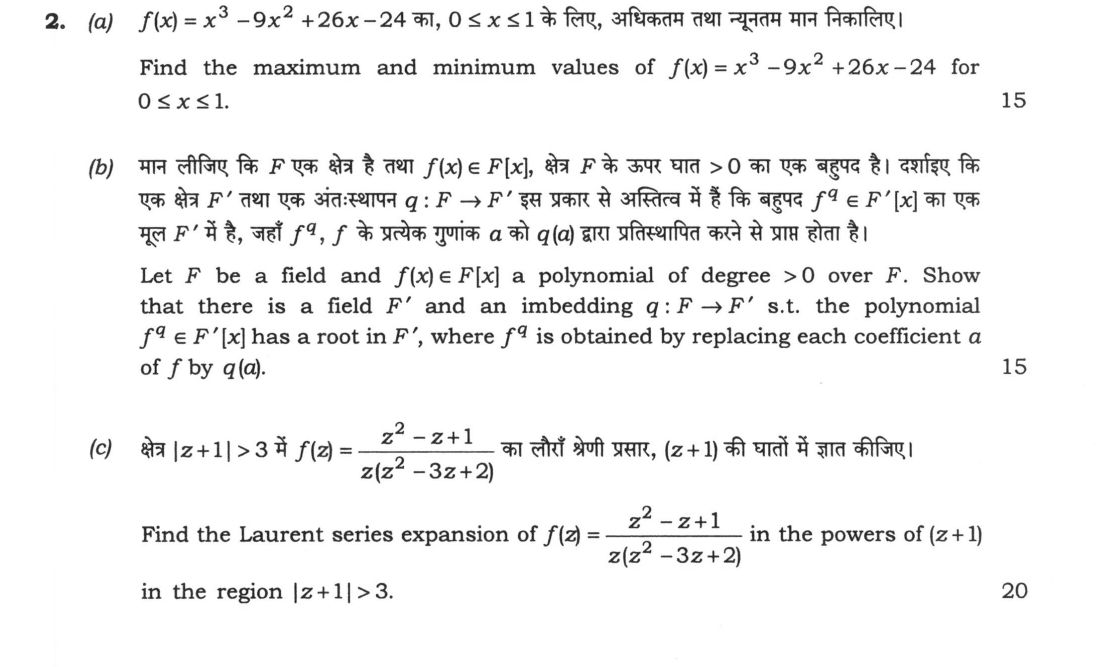
(a) Find the maximum and minimum values of f(x) = x³ - 9x² + 26x - 24 for 0 ≤ x ≤ 1. (15 marks) (b) Let F be a field and f(x) ∈…
Find the maximum and minimum values of f(x) = x³ - 9x² + 26x - 24 for 0 ≤ x ≤ 1. 15 marks
Let F be a field and f(x) ∈ F[x] a polynomial of degree > 0 over F. Show that there is a field F' and an imbedding q : F → F' s.t. the polynomial f^q ∈ F'[x] has a root in F', where f^q is obtained by replacing each coefficient a of f by q(a). 15 marks
Find the Laurent series expansion of f(z) = (z² - z + 1)/[z(z² - 3z + 2)] in the powers of (z+1) in the region |z+1| > 3. 20 marks
हिंदी में प्रश्न पढ़ें
f(x) = x³ - 9x² + 26x - 24 का, 0 ≤ x ≤ 1 के लिए, अधिकतम तथा न्यूनतम मान निकालिए। (15 अंक)
मान लीजिए कि F एक क्षेत्र है तथा f(x) ∈ F[x], क्षेत्र F के ऊपर घात > 0 का एक बहुपद है। दर्शाइए कि एक क्षेत्र F' तथा एक अंतःस्थापन q : F → F' इस प्रकार से अस्तित्व में है कि बहुपद f^q ∈ F'[x] का एक मूल F' में है, जहाँ f^q, f के प्रत्येक गुणांक a को q(a) द्वारा प्रतिस्थापित करने से प्राप्त होता है। (15 अंक)
क्षेत्र |z+1| > 3 में f(z) = (z² - z + 1)/[z(z² - 3z + 2)] का लॉरें श्रेणी प्रसार, (z+1) की घातों में ज्ञात कीजिए। (20 अंक)
Model answer
Written by UPSC Answer Check against this question's marking rubric, to the expected length. UPSC does not publish answers for Mains — this is one way to score well, not an official key.
(a) Let f(x) = x³ − 9x² + 26x − 24, 0 ≤ x ≤ 1.
Differentiate: f′(x) = 3x² − 18x + 26.
For stationary points, solve f′(x) = 0: 3x² − 18x + 26 = 0 x = [18 ± √(18² − 4·3·26)]/(2·3) = [18 ± √(324 − 312)]/6 = [18 ± √12]/6 = [18 ± 2√3]/6 = 3 ± √3/3.
Now √3/3 ≈ 0.577, so the smaller root is 3 − √3/3 ≈ 2.423, which is greater than 1. Hence there is no stationary point in [0, 1].
Also f′(0) = 26 > 0, and f′ is continuous on [0, 1], so f′(x) > 0 throughout [0, 1]. Therefore f is strictly increasing on [0, 1].
Thus the minimum occurs at x = 0 and the maximum at x = 1.
f(0) = 0 − 0 + 0 − 24 = −24. f(1) = 1 − 9 + 26 − 24 = −6.
Final answer: minimum value = −24 at x = 0; maximum value = −6 at x = 1.
(b) Use Kronecker’s extension theorem.
Since F[x] is a unique factorisation domain, every polynomial of positive degree has an irreducible factor. Let p(x) be a monic irreducible factor of f(x) in F[x]. Thus p(x) divides f(x).
Consider the quotient ring F′ = F[x]/(p(x)).
Because p(x) is irreducible in F[x], the principal ideal (p(x)) is maximal. Hence F′ is a field.
Define q : F → F′ by q(a) = a + (p(x)). This is a ring homomorphism. Its kernel is the ideal of all a ∈ F such that a ∈ (p(x)). Since p(x) has positive degree, no nonzero constant polynomial belongs to (p(x)). Hence q(a) = 0 implies a = 0. Therefore q is injective, so q is an imbedding of F into F′.
Let α = x + (p(x)) ∈ F′.
Write p(x) = a₀ + a₁x + ⋯ + aₙxⁿ, with aᵢ ∈ F. The polynomial p^q ∈ F′[x] is obtained by replacing each coefficient aᵢ by q(aᵢ). Then p^q(α) = q(a₀) + q(a₁)α + ⋯ + q(aₙ)αⁿ = (a₀ + (p)) + (a₁ + (p))(x + (p)) + ⋯ + (aₙ + (p))(x + (p))ⁿ = a₀ + a₁x + ⋯ + aₙxⁿ + (p) = p(x) + (p) = 0.
Thus α is a root of p^q in F′.
Since p(x) divides f(x), write f(x) = p(x)h(x) with h(x) ∈ F[x]. Applying q to coefficients gives f^q = p^q h^q. Therefore f^q(α) = p^q(α)h^q(α) = 0.
Hence f^q has a root in the field F′.
Final answer: such a field F′ and imbedding q always exist by the Kronecker extension construction.
(c) Let f(z) = (z² − z + 1)/[z(z² − 3z + 2)].
Factor the denominator: z² − 3z + 2 = (z − 1)(z − 2). So f(z) = (z² − z + 1)/[z(z − 1)(z − 2)].
Resolve into partial fractions: f(z) = A/z + B/(z − 1) + C/(z − 2).
Using cover-up: A = [(z² − z + 1)/((z − 1)(z − 2))] at z = 0 = 1/2. B = [(z² − z + 1)/(z(z − 2))] at z = 1 = 1/[1·(−1)] = −1. C = [(z² − z + 1)/(z(z − 1))] at z = 2 = 3/[2·1] = 3/2.
Thus f(z) = 1/(2z) − 1/(z − 1) + 3/[2(z − 2)].
Put w = z + 1, so z = w − 1. We need the Laurent expansion in powers of w in |w| > 3.
Now 1/(2z) = 1/[2(w − 1)] = 1/(2w) · 1/(1 − 1/w) = ∑ₙ₌₀∞ 1/(2w^(n+1)).
Also −1/(z − 1) = −1/(w − 2) = −1/w · 1/(1 − 2/w) = −∑ₙ₌₀∞ 2ⁿ/w^(n+1).
And 3/[2(z − 2)] = 3/[2(w − 3)] = 3/(2w) · 1/(1 − 3/w) = ∑ₙ₌₀∞ (3/2)·3ⁿ/w^(n+1).
Therefore, for |w| > 3, f(z) = ∑ₙ₌₀∞ [1/2 − 2ⁿ + (3/2)3ⁿ]/w^(n+1).
Put k = n + 1, so k ≥ 1. Then the coefficient of 1/wᵏ is (1 + 3ᵏ)/2 − 2^(k−1).
Hence f(z) = ∑ₖ₌₁∞ [ (1 + 3ᵏ)/2 − 2^(k−1) ]/(z + 1)ᵏ, valid for |z + 1| > 3.
Final answer: f(z) = ∑ₖ₌₁∞ [ (1 + 3ᵏ)/2 − 2^(k−1) ]/(z + 1)ᵏ, |z + 1| > 3.
What "Solve" is asking you to do
Choose the method, then carry it through to a final answer. Identifying what kind of problem this is and why that method applies is the first thing marked; a correct figure arrived at invisibly earns almost nothing.
Structure that answers it
Given data and what is required → method chosen, with the reason it applies → set-up (equation, circuit, free body, trial balance) → working, step by step → answer with units and any condition of validity
Where marks are lost
Doing the middle steps mentally and writing only the result. In mathematics papers, a further loss comes from giving a decimal where the exact value in surds or fractions was wanted, or from skipping the justification a part explicitly asks for.
How this answer will be evaluated
Approach
(a) calculate: given > formula > substitution > result with units > interpretation | (b) justify: claim > 3-4 reasons > evidence > conclusion | (c) derive: given > assumptions > stepwise derivation > result > check Full marks: Rigorous step-by-step derivation with all justifications and checks.
Key points expected
- Compute derivative f'(x) and set to zero
- Identify critical points within 0 ≤ x ≤ 1
- Evaluate f(x) at critical points and endpoints
- Compare values to identify global max and min
- Construct F' as a quotient ring F[x]/(f(x))
- Prove F' is a field (requires f to be irreducible)
- Define the embedding q: F → F' explicitly
- Show the image of x in F' is a root of f^q
Evaluation rubric
Each sub-part is marked on its own, against the marks and word limit printed on the paper.
- (a) Determine max/min values of f(x) on the closed interval [0, 1]. 15 marks
calculate— given → formula → substitution → result with units → interpretation
Must cover
- Compute derivative f'(x) and set to zero
- Identify critical points within 0 ≤ x ≤ 1
- Evaluate f(x) at critical points and endpoints
- Compare values to identify global max and min
Loses marks
- Ignoring the interval boundaries (0 and 1)
- Failing to check if critical points lie in [0, 1]
Earns more
- Explicitly state the closed interval [0, 1]
- Verify the second derivative test or sign change
Extra mark
- Sketch of the function's behavior on the interval
- (b) Prove existence of a field extension containing a root of f(x). 15 marks
justify— claim → 3-4 reasons → evidence → conclusion
Must cover
- Construct F' as a quotient ring F[x]/(f(x))
- Prove F' is a field (requires f to be irreducible)
- Define the embedding q: F → F' explicitly
- Show the image of x in F' is a root of f^q
Loses marks
- Assuming F' exists without construction
- Failing to prove F' is a field
Earns more
- Mentioning the need for f to be irreducible
- Defining the equivalence classes in the quotient ring
Extra mark
- Brief note on the case where f is reducible
- (c) Find the Laurent series of f(z) in powers of (z+1) for |z+1| > 3. 20 marks
derive— given → assumptions → stepwise derivation → result → check
Must cover
- Perform partial fraction decomposition of f(z)
- Substitute w = z+1 to shift the expansion center
- Expand each term using geometric series for |w| > 3
- Combine terms to form the final Laurent series
Loses marks
- Expanding in powers of z instead of (z+1)
- Using the wrong geometric series expansion (|w| < 3)
Earns more
- Explicitly stating the region of convergence |z+1| > 3
- Showing the geometric series formula used
Extra mark
- Identifying the principal part of the Laurent series
Practice this exact question
Write your answer and it is marked point by point against the model answer above — what you covered, what you missed, what you got wrong.
Evaluate my answer →More from Mathematics 2021 Paper II
- Q1 (a) Let m₁, m₂, …, mₖ be positive integers and d > 0 the greatest common divisor of m₁, m…
- Q2 (a) Find the maximum and minimum values of f(x) = x³ - 9x² + 26x - 24 for 0 ≤ x ≤ 1. (15…
- Q3 (a) Let f be an entire function whose Taylor series expansion with centre z = 0 has infin…
- Q4 (a) Show that there are infinitely many subgroups of the additive group Q of rational num…
- Q5 (a) Obtain the partial differential equation by eliminating arbitrary function f from the…