Paper II — Q6
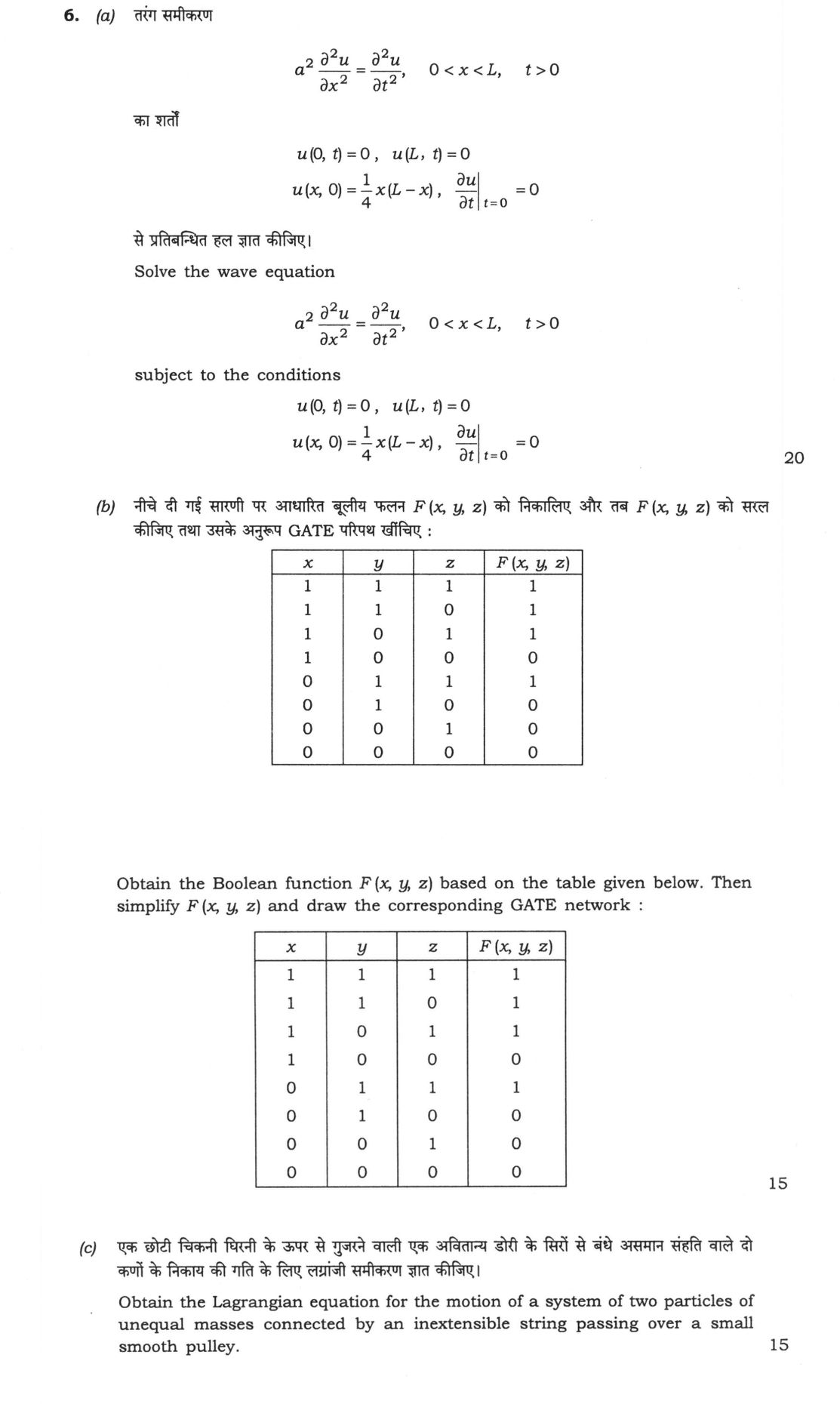
(a) Solve the wave equation a²∂²u/∂x² = ∂²u/∂t², 0<x<L, t>0 subject to the conditions u(0,t)=0, u(L,t)=0 u(x,0)=(1/4)x(L-x)…
Solve the wave equation
a²∂²u/∂x² = ∂²u/∂t², 0<x<L, t>0
subject to the conditions
u(0,t)=0, u(L,t)=0 u(x,0)=(1/4)x(L-x), ∂u/∂t|ₜ₌₀=0 20 marks
Obtain the Boolean function F(x, y, z) based on the table given below. Then simplify F(x, y, z) and draw the corresponding GATE network:
| x | y | z | F(x, y, z) | |
|---|---|---|---|---|
| 1 | 1 | 1 | 1 | |
| 1 | 1 | 0 | 1 | |
| 1 | 0 | 1 | 1 | |
| 1 | 0 | 0 | 0 | |
| 0 | 1 | 1 | 1 | |
| 0 | 1 | 0 | 0 | |
| 0 | 0 | 1 | 0 | |
| 0 | 0 | 0 | 0 | (15 marks) |
Obtain the Lagrangian equation for the motion of a system of two particles of unequal masses connected by an inextensible string passing over a small smooth pulley. 15 marks
हिंदी में प्रश्न पढ़ें
तरंग समीकरण
a²∂²u/∂x² = ∂²u/∂t², 0<x<L, t>0
का शर्तों
u(0,t)=0, u(L,t)=0 u(x,0)=(1/4)x(L-x), ∂u/∂t|ₜ₌₀=0
से प्रतिबंधित हल प्राप्त कीजिए। (20 अंक)
नीचे दी गई सारणी पर आधारित बूलियन फलन F(x,y,z) को निकालिए और तब F(x,y,z) को सरल कीजिए तथा उसके अनुरूप GATE परिपथ खींचिए :
| x | y | z | F(x,y,z) | |
|---|---|---|---|---|
| 1 | 1 | 1 | 1 | |
| 1 | 1 | 0 | 1 | |
| 1 | 0 | 1 | 1 | |
| 1 | 0 | 0 | 0 | |
| 0 | 1 | 1 | 1 | |
| 0 | 1 | 0 | 0 | |
| 0 | 0 | 1 | 0 | |
| 0 | 0 | 0 | 0 | (15 अंक) |
एक छोटी चिकनी घिरनी के ऊपर से गुजरने वाली एक अवितान्य डोरी के सिरों से बंधे असमान संहति वाले दो कणों के निकाय की गति के लिए लग्रांजी समीकरण प्राप्त कीजिए। (15 अंक)
The figure this question refers to, in words
The question paper is a scan and the diagram did not survive as text. This is the figure as read from the original page — every component, value and label — so the question can be worked from the text below.
(b) Table with four columns: x, y, z, F(x, y, z) Row 1: 1, 1, 1, 1 Row 2: 1, 1, 0, 1 Row 3: 1, 0, 1, 1 Row 4: 1, 0, 0, 0 Row 5: 0, 1, 1, 1 Row 6: 0, 1, 0, 0 Row 7: 0, 0, 1, 0 Row 8: 0, 0, 0, 0
(b) Table with 4 columns and 8 data rows: x, y, z, F(x, y, z) 1, 1, 1, 1 1, 1, 0, 1 1, 0, 1, 1 1, 0, 0, 0 0, 1, 1, 1 0, 1, 0, 0 0, 0, 1, 0 0, 0, 0, 0
Model answer
Written by UPSC Answer Check against this question's marking rubric, to the expected length. UPSC does not publish answers for Mains — this is one way to score well, not an official key.
(a) Let u(x,t)=X(x)T(t). Substituting in a²∂²u/∂x²=∂²u/∂t² gives
a²X''T=XT'', hence X''/X=T''/(a²T)=−λ², say.
Thus X''+λ²X=0 and T''+a²λ²T=0.
The boundary conditions u(0,t)=0, u(L,t)=0 give X(0)=X(L)=0. For X''+λ²X=0,
X(x)=A cos(λx)+B sin(λx).
X(0)=0 gives A=0. X(L)=0 gives B sin(λL)=0. For a non-trivial solution,
sin(λL)=0, so λL=nπ, n=1,2,3,...
Therefore λₙ=nπ/L and Xₙ(x)=sin(nπx/L).
For Tₙ, Tₙ''+a²λₙ²Tₙ=0, so
Tₙ(t)=Cₙ cos(aλₙt)+Dₙ sin(aλₙt).
Since ∂u/∂t at t=0 is 0, Tₙ'(0)=0, hence Dₙ=0. Therefore
u(x,t)=Σ over n=1,2,... Aₙ sin(nπx/L) cos(a nπ t/L).
Using u(x,0)=x(L−x)/4,
Σ Aₙ sin(nπx/L)=x(L−x)/4.
By the Fourier sine coefficient formula,
Aₙ=(2/L)∫ from 0 to L (x(L−x)/4) sin(nπx/L) dx.
Let k=nπ/L. Then
Aₙ=(1/(2L))[L∫ from 0 to L x sin(kx) dx−∫ from 0 to L x² sin(kx) dx].
Now
∫ from 0 to L x sin(kx) dx = L²(−1)^(n+1)/(nπ),
and
∫ from 0 to L x² sin(kx) dx = L³(−1)^(n+1)/(nπ)+2L³((−1)^n−1)/(n³π³).
Hence
L∫x sin(kx) dx−∫x² sin(kx) dx =2L³(1−(−1)^n)/(n³π³).
Thus
Aₙ=L²(1−(−1)^n)/(n³π³).
So Aₙ=0 for even n, and Aₙ=2L²/(n³π³) for odd n. Therefore
u(x,t)=Σ over n=1,3,5,... [2L²/(n³π³)] sin(nπx/L) cos(a nπ t/L).
Equivalently,
u(x,t)=Σ over m=0 to ∞ [2L²/((2m+1)³π³)] sin((2m+1)πx/L) cos(a(2m+1)πt/L).
(b) From the table, F=1 for the minterms
111, 110, 101, 011.
Thus
F=xyz+xyz'+xy'z+x'yz.
Using a K-map, adjacent pairs give:
xyz+xyz'=xy,
xyz+xy'z=xz,
xyz+x'yz=yz.
Therefore the simplified Boolean function is
F(x,y,z)=xy+xz+yz.
This is the majority function: it is 1 when at least two of x,y,z are 1.
Gate network: use three 2-input AND gates and OR them.
- x and y enter AND₁, giving xy.
- x and z enter AND₂, giving xz.
- y and z enter AND₃, giving yz.
- The outputs xy, xz, yz enter an OR gate, giving F=xy+xz+yz.
If only 2-input OR gates are available, combine as F=(xy+xz)+yz.
(c) Let the masses be m₁ and m₂, with m₁≠m₂. Let x be the downward displacement of m₁ from a fixed reference. Since the string is inextensible and the pulley is small and smooth, m₂ moves upward by the same distance x. Hence both masses have speed magnitude dx/dt.
The kinetic energy is
T=(1/2)m₁(dx/dt)²+(1/2)m₂(dx/dt)²=(1/2)(m₁+m₂)(dx/dt)².
Taking the pulley level as zero and ignoring constants, if m₁ moves down by x, its height decreases by x, while m₂ moves up by x. Thus
V=m₁g(h₀−x)+m₂g(h₀+x)=constant+(m₂−m₁)gx.
So, ignoring the constant,
L=T−V=(1/2)(m₁+m₂)(dx/dt)²+(m₁−m₂)gx.
Lagrange’s equation is
d/dt(∂L/∂(dx/dt))−∂L/∂x=0.
Here
∂L/∂(dx/dt)=(m₁+m₂)(dx/dt),
so
d/dt(∂L/∂(dx/dt))=(m₁+m₂)(d²x/dt²).
Also
∂L/∂x=(m₁−m₂)g.
Therefore
(m₁+m₂)(d²x/dt²)−(m₁−m₂)g=0,
or
(m₁+m₂)(d²x/dt²)=(m₁−m₂)g .
Thus the acceleration is
d²x/dt²=((m₁−m₂)/(m₁+m₂))g,
directed downward for m₁. If m₁>m₂, m₁ accelerates downward; if m₂>m₁, the acceleration is upward for m₁. If m₁=m₂, the system remains in equilibrium.
What "Solve" is asking you to do
Choose the method, then carry it through to a final answer. Identifying what kind of problem this is and why that method applies is the first thing marked; a correct figure arrived at invisibly earns almost nothing.
Structure that answers it
Given data and what is required → method chosen, with the reason it applies → set-up (equation, circuit, free body, trial balance) → working, step by step → answer with units and any condition of validity
Where marks are lost
Doing the middle steps mentally and writing only the result. In mathematics papers, a further loss comes from giving a decimal where the exact value in surds or fractions was wanted, or from skipping the justification a part explicitly asks for.
How this answer will be evaluated
Approach
(a) derive: given > assumptions > stepwise derivation > result > check | (b) calculate: given > formula > substitution > result with units > interpretation | (c) derive: given > assumptions > stepwise derivation > result > check Full marks: Complete derivations with all steps shown, correct final results, and clear diagrams where required.
Key points expected
- Apply separation of variables to find eigenfunctions sin(nπx/L)
- Solve for time-dependent part T_n(t) using initial velocity condition
- Compute Fourier sine coefficients for initial displacement (1/4)x(L-x)
- State final series solution u(x,t) with specific coefficients
- Identify minterms from the truth table (m1, m2, m3, m5, m7)
- Use Karnaugh map or Boolean algebra to simplify the function
- Derive the simplified expression (e.g., x + yz)
- Draw the logic gate network for the simplified expression
Evaluation rubric
Each sub-part is marked on its own, against the marks and word limit printed on the paper.
- (a) Solution to the 1D wave equation with given boundary and initial conditions. 20 marks
derive— given → assumptions → stepwise derivation → result → check
Must cover
- Apply separation of variables to find eigenfunctions sin(nπx/L)
- Solve for time-dependent part T_n(t) using initial velocity condition
- Compute Fourier sine coefficients for initial displacement (1/4)x(L-x)
- State final series solution u(x,t) with specific coefficients
Loses marks
- Skipping the calculation of Fourier coefficients
- Failing to apply the zero initial velocity condition
- Incorrect eigenvalues for the spatial part
Earns more
- Explicitly state orthogonality of sine functions
- Show integration steps for coefficient calculation
- Verify boundary conditions are satisfied by the solution
Extra mark
- Mention physical interpretation of the standing wave modes
- (b) Simplified Boolean function F(x,y,z) and its corresponding gate network. 15 marks
calculate— given → formula → substitution → result with units → interpretation
Must cover
- Identify minterms from the truth table (m1, m2, m3, m5, m7)
- Use Karnaugh map or Boolean algebra to simplify the function
- Derive the simplified expression (e.g., x + yz)
- Draw the logic gate network for the simplified expression
Loses marks
- Incorrect minterm identification from the table
- Failing to simplify the Boolean expression
- Gate diagram not matching the derived expression
Earns more
- Show the K-map grouping clearly
- Label inputs and output on the gate diagram
- Verify the simplified function against the truth table
Extra mark
- Mention alternative gate implementations (e.g., NAND only)
- (c) Lagrangian equation of motion for two unequal masses on a pulley. 15 marks
derive— given → assumptions → stepwise derivation → result → check
Must cover
- Define generalized coordinate (e.g., displacement x of one mass)
- Express Kinetic Energy (T) and Potential Energy (V) in terms of x
- Formulate the Lagrangian L = T - V
- Apply Euler-Lagrange equation to find the equation of motion
Loses marks
- Incorrect expression for potential energy change
- Failing to account for the constraint in the Lagrangian
- Algebraic errors in the Euler-Lagrange derivation
Earns more
- Clearly define the coordinate system and reference level
- Show the constraint relation between the two masses
- State the final equation in standard form (e.g., (m1+m2)x'' = (m1-m2)g)
Extra mark
- Mention the physical meaning of the effective mass
Practice this exact question
Write your answer and it is marked point by point against the model answer above — what you covered, what you missed, what you got wrong.
Evaluate my answer →More from Mathematics 2021 Paper II
- Q3 (a) Let f be an entire function whose Taylor series expansion with centre z = 0 has infin…
- Q4 (a) Show that there are infinitely many subgroups of the additive group Q of rational num…
- Q5 (a) Obtain the partial differential equation by eliminating arbitrary function f from the…
- Q6 (a) Solve the wave equation a²∂²u/∂x² = ∂²u/∂t², 0<x<L, t>0 subject to the conditions u(0…
- Q7 (a) Find the general solution of the partial differential equation (D² - D'² - 3D + 3D')z…
- Q8 (a) Find a complete integral of the partial differential equation p = (z + qy)² by using…