Paper II — Q3
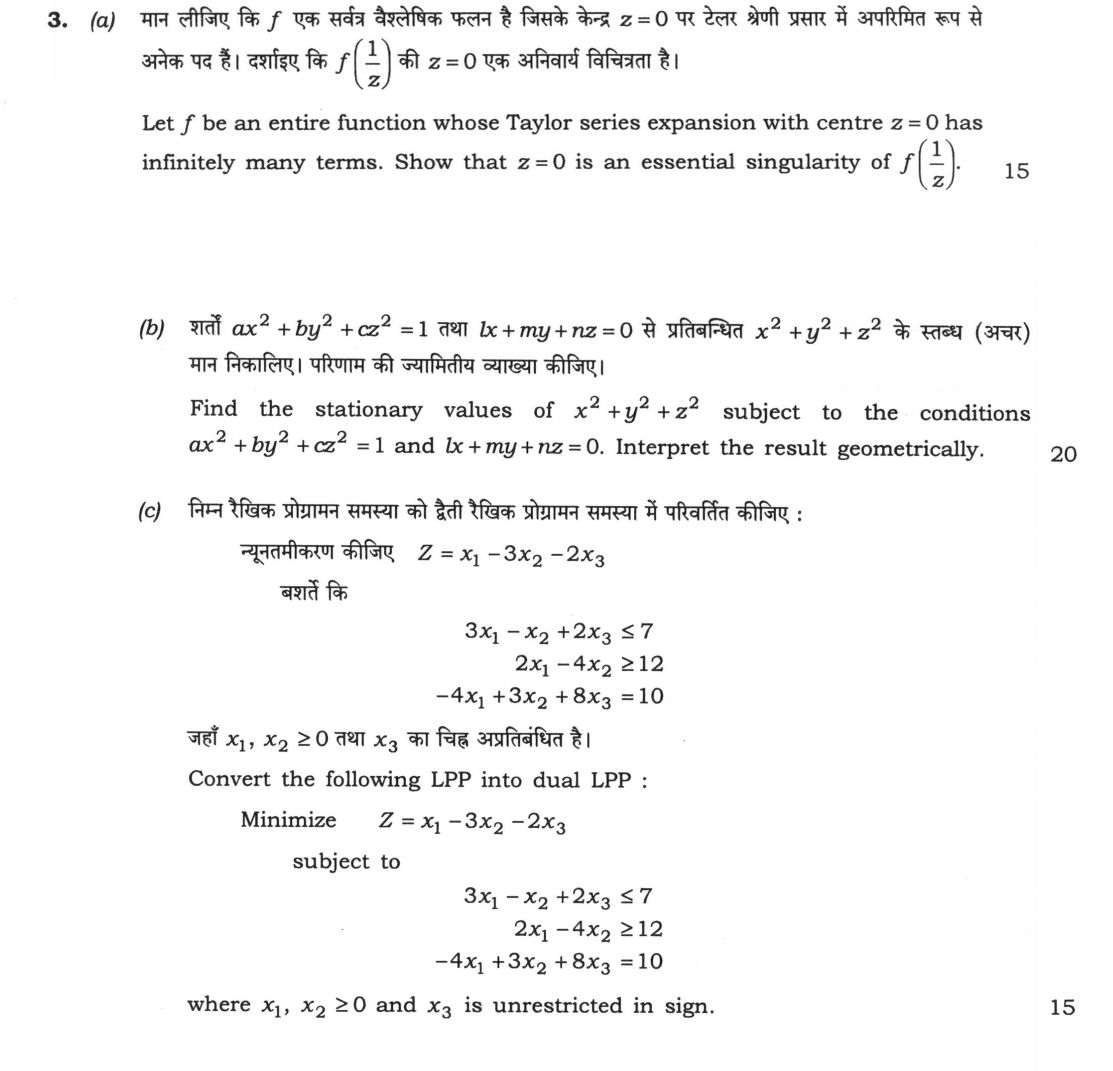
(a) Let f be an entire function whose Taylor series expansion with centre z = 0 has infinitely many terms. Show that z = 0 is an…
Let f be an entire function whose Taylor series expansion with centre z = 0 has infinitely many terms. Show that z = 0 is an essential singularity of f(1/z). 15 marks
Find the stationary values of x² + y² + z² subject to the conditions ax² + by² + cz² = 1 and lx + my + nz = 0. Interpret the result geometrically. 20 marks
Convert the following LPP into dual LPP : Minimize Z = x₁ - 3x₂ - 2x₃ subject to 3x₁ - x₂ + 2x₃ ≤ 7 2x₁ - 4x₂ ≥ 12 -4x₁ + 3x₂ + 8x₃ = 10 where x₁, x₂ ≥ 0 and x₃ is unrestricted in sign. 15 marks
हिंदी में प्रश्न पढ़ें
मान लीजिए कि f एक सर्वत्र वैश्लेषिक फलन है जिसके केन्द्र z = 0 पर टेलर श्रेणी प्रसार में अपरिमित रूप से अनेक पद हैं। दर्शाइए कि f(1/z) की z = 0 एक अनिवार्य विचित्रता है। (15 अंक)
शर्तों ax² + by² + cz² = 1 तथा lx + my + nz = 0 से प्रतिबंधित x² + y² + z² के स्थाय (अचर) मान निकालिए। परिणाम की ज्यामितीय व्याख्या कीजिए। (20 अंक)
निम्न रैखिक प्रोग्राम समस्या को द्वैती रैखिक प्रोग्राम समस्या में परिवर्तित कीजिए : न्यूनतमीकरण कीजिए Z = x₁ - 3x₂ - 2x₃ बशर्ते कि 3x₁ - x₂ + 2x₃ ≤ 7 2x₁ - 4x₂ ≥ 12 -4x₁ + 3x₂ + 8x₃ = 10 जहाँ x₁, x₂ ≥ 0 तथा x₃ का चिह्न अप्रतिबंधित है। (15 अंक)
Model answer
Written by UPSC Answer Check against this question's marking rubric, to the expected length. UPSC does not publish answers for Mains — this is one way to score well, not an official key.
(a) Let the Taylor expansion of f about z=0 be f(w) = Σₙ₌₀^∞ aₙ wⁿ, where infinitely many aₙ (n≥1) are non-zero. For z≠0, g(z) = f(1/z) = Σₙ₌₀^∞ aₙ z⁻ⁿ. This is the Laurent expansion of g at z=0. If z=0 were a removable singularity, the principal part would be absent, so aₙ=0 for every n≥1, contrary to hypothesis. If z=0 were a pole of order m, the principal part would contain only finitely many negative powers, so aₙ=0 for all n>m, again a contradiction. Hence z=0 is neither removable nor a pole. Therefore z=0 is an essential singularity of f(1/z). Final: z=0 is an essential singularity.
(b) Let S=x²+y²+z², with constraints G=ax²+by²+cz²−1=0, H=lx+my+nz=0. By Lagrange multipliers, take L = S − λG − 2νH. Then ∂L/∂x=0 ⇒ (1−λa)x=νl, ∂L/∂y=0 ⇒ (1−λb)y=νm, ∂L/∂z=0 ⇒ (1−λc)z=νn. Multiply these by x,y,z respectively and add: S − λ(ax²+by²+cz²) = ν(lx+my+nz)=0. Since ax²+by²+cz²=1 and lx+my+nz=0, S=λ. Thus the stationary value of S is λ.
Let A=diag(a,b,c), r=(x,y,z)ᵀ, q=(l,m,n)ᵀ. The equations are (I−λA)r = νq, q·r=0. Eliminating r gives the solvability condition qᵀ adj(I−λA) q=0, that is, l²(1−λb)(1−λc)+m²(1−λc)(1−λa)+n²(1−λa)(1−λb)=0. Expanding, with P=l²+m²+n², Q=l²(b+c)+m²(c+a)+n²(a+b), R=l²bc+m²ca+n²ab, we get P − λQ + λ²R = 0. Hence the stationary values are λ = [Q ± √(Q²−4PR)]/(2R), if R≠0. If R=0, then λ=P/Q (non-degenerate case). Since S=λ, these λ are the stationary values of x²+y²+z².
Geometrically, the intersection of the plane lx+my+nz=0 with the quadric ax²+by²+cz²=1 is a central conic. Its principal axes meet the conic at points where the distance from the origin is stationary. Thus the non-negative roots λ give the squares of the semiaxes of this conic; the semiaxis lengths are √λ. For a,b,c>0 the conic is an ellipse and both relevant roots are positive.
(c) Primal LPP: Minimize Z = x₁ − 3x₂ − 2x₃ subject to 3x₁ − x₂ + 2x₃ ≤ 7, 2x₁ − 4x₂ ≥ 12, −4x₁ + 3x₂ + 8x₃ = 10, x₁,x₂ ≥ 0, x₃ unrestricted.
Let dual variables be y₁ for the first constraint, y₂ for the second, y₃ for the equality. Since the primal is a minimization problem:
- y₁ ≤ 0 for the ≤ constraint,
- y₂ ≥ 0 for the ≥ constraint,
- y₃ unrestricted for the equality.
The dual is therefore Maximize W = 7y₁ + 12y₂ + 10y₃ subject to 3y₁ + 2y₂ − 4y₃ ≤ 1 (for x₁ ≥ 0), −y₁ − 4y₂ + 3y₃ ≤ −3 (for x₂ ≥ 0), 2y₁ + 8y₃ = −2 (for x₃ unrestricted), with y₁ ≤ 0, y₂ ≥ 0, y₃ unrestricted.
Equivalently, putting u₁=−y₁ ≥ 0, the dual becomes Maximize W = −7u₁ + 12y₂ + 10y₃ subject to −3u₁ + 2y₂ − 4y₃ ≤ 1, u₁ − 4y₂ + 3y₃ ≤ −3, −2u₁ + 8y₃ = −2, u₁ ≥ 0, y₂ ≥ 0, y₃ unrestricted.
What "Prove" is asking you to do
Establish that the statement holds for every case it claims, not for one representative case. The argument must be closed: each line follows from a definition, a hypothesis, or a named theorem you are entitled to use.
Structure that answers it
Given and to prove, restated → theorem or construction to be used, named → the argument line by line → conclusion stated as proved
Where marks are lost
Testing one example, which illustrates but proves nothing. On an if and only if claim, proving one direction and stopping forfeits that half outright, and degenerate cases — zero, the empty set, the equality case — have to be disposed of rather than assumed away.
How this answer will be evaluated
Approach
(a) justify: claim > 3-4 reasons > evidence > conclusion | (b) calculate: given > formula > substitution > result with units > interpretation | (c) derive: given > assumptions > stepwise derivation > result > check Full marks: Rigorous proofs with all steps shown, correct geometric interpretation, and flawless dual conversion.
Key points expected
- State definition of essential singularity
- Write Laurent series of f(1/z) at z=0
- Show principal part has infinitely many terms
- Conclude singularity is essential
- Set up Lagrangian with two multipliers
- Derive system of linear equations for x, y, z
- Solve for stationary values of x²+y²+z²
- Provide geometric interpretation of result
Evaluation rubric
Each sub-part is marked on its own, against the marks and word limit printed on the paper.
- (a) Prove z=0 is an essential singularity of f(1/z) given f is entire with infinite Taylor series. 15 marks
justify— claim → 3-4 reasons → evidence → conclusion
Must cover
- State definition of essential singularity
- Write Laurent series of f(1/z) at z=0
- Show principal part has infinitely many terms
- Conclude singularity is essential
Loses marks
- Confusing removable singularity with essential
- Failing to link infinite Taylor terms to Laurent series
Earns more
- Explicitly state f is not a polynomial
- Reference Casorati-Weierstrass theorem
Extra mark
- Mention Picard's Great Theorem
- (b) Find stationary values of x²+y²+z² subject to two constraints and interpret geometrically. 20 marks
calculate— given → formula → substitution → result with units → interpretation
Must cover
- Set up Lagrangian with two multipliers
- Derive system of linear equations for x, y, z
- Solve for stationary values of x²+y²+z²
- Provide geometric interpretation of result
Loses marks
- Using only one Lagrange multiplier
- Algebraic errors in solving the system
Earns more
- Identify constraints as ellipsoid and plane
- Interpret values as max/min distance from origin
Extra mark
- Sketch of ellipsoid intersected by plane
- (c) Convert the given minimization LPP into its dual LPP. 15 marks
derive— given → assumptions → stepwise derivation → result → check
Must cover
- Identify dual variables for each constraint
- Handle unrestricted variable x3 correctly
- Convert inequality directions for dual constraints
- State the dual objective function
Loses marks
- Incorrect sign for dual variable corresponding to equality constraint
- Failing to split unrestricted variable x3
Earns more
- Explicitly state sign restrictions on dual variables
- Show standard form conversion steps
Extra mark
- Verification via weak duality theorem
Practice this exact question
Write your answer and it is marked point by point against the model answer above — what you covered, what you missed, what you got wrong.
Evaluate my answer →More from Mathematics 2021 Paper II
- Q1 (a) Let m₁, m₂, …, mₖ be positive integers and d > 0 the greatest common divisor of m₁, m…
- Q2 (a) Find the maximum and minimum values of f(x) = x³ - 9x² + 26x - 24 for 0 ≤ x ≤ 1. (15…
- Q3 (a) Let f be an entire function whose Taylor series expansion with centre z = 0 has infin…
- Q4 (a) Show that there are infinitely many subgroups of the additive group Q of rational num…
- Q5 (a) Obtain the partial differential equation by eliminating arbitrary function f from the…
- Q6 (a) Solve the wave equation a²∂²u/∂x² = ∂²u/∂t², 0<x<L, t>0 subject to the conditions u(0…