Paper II — Q4
(a) Show that there are infinitely many subgroups of the additive group Q of rational numbers. (15 marks) (b) Using contour…
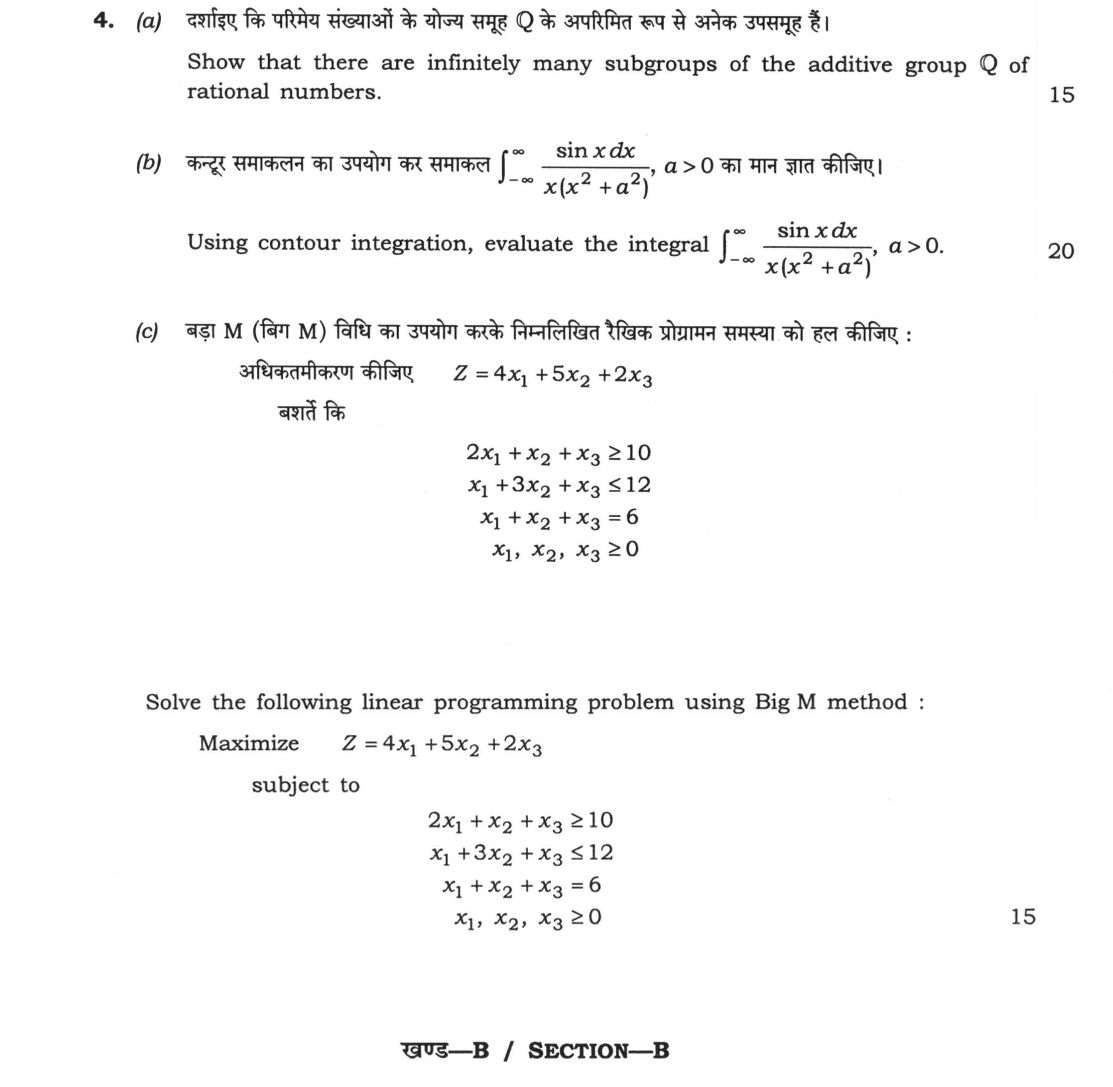
Show that there are infinitely many subgroups of the additive group Q of rational numbers. 15 marks
Using contour integration, evaluate the integral ∫₋∞^∞ (sin x dx)/(x(x²+a²)), a > 0. 20 marks
Solve the following linear programming problem using Big M method : Maximize Z = 4x₁ + 5x₂ + 2x₃ subject to 2x₁ + x₂ + x₃ ≥ 10, x₁ + 3x₂ + x₃ ≤ 12, x₁ + x₂ + x₃ = 6, x₁, x₂, x₃ ≥ 0. 15 marks
हिंदी में प्रश्न पढ़ें
दर्शाइए कि परिमेय संख्याओं के योज्य समूह Q के अपरिमित रूप से अनेक उपसमूह हैं। (15 अंक)
कंटूर समाकलन का उपयोग कर समाकलन ∫₋∞^∞ (sin x dx)/(x(x²+a²)), a > 0 का मान ज्ञात कीजिए। (20 अंक)
बड़ा M (बिग M) विधि का उपयोग करके निम्नलिखित रैखिक प्रोग्राम समस्या को हल कीजिए : अधिकतमीकरण कीजिए Z = 4x₁ + 5x₂ + 2x₃ बशर्ते कि 2x₁ + x₂ + x₃ ≥ 10,x₁ + 3x₂ + x₃ ≤ 12,x₁ + x₂ + x₃ = 6,x₁, x₂, x₃ ≥ 0। (15 अंक)
Model answer
Written by UPSC Answer Check against this question's marking rubric, to the expected length. UPSC does not publish answers for Mains — this is one way to score well, not an official key.
(a) For each n∈ℕ define Hₙ = { m/n! : m∈ℤ }. This is an additive subgroup of ℚ because m/n! + k/n! = (m+k)/n! ∈ Hₙ, and −m/n! ∈ Hₙ.
Now Hₙ ⊂ Hₙ₊₁ since m/n! = m(n+1)/(n+1)! ∈ Hₙ₊₁. The inclusion is strict: 1/(n+1)! ∈ Hₙ₊₁, but if 1/(n+1)! = m/n!, then m = 1/(n+1), not an integer. Hence Hₙ ≠ Hₙ₊₁. Thus H₁, H₂, H₃, … are infinitely many distinct subgroups of ℚ. Final: ℚ has infinitely many subgroups.
(b) Let I = ∫ from −∞ to ∞ of sin x/[x(x²+a²)] dx, a>0. At x=0 the integrand has a removable singularity, since sin x/x → 1.
Use partial fractions: 1/[x(x²+a²)] = 1/(a²x) − x/[a²(x²+a²)].
Hence I = (1/a²)I₁ − (1/a²)I₂, where I₁ = ∫ from −∞ to ∞ of sin x/x dx, I₂ = ∫ from −∞ to ∞ of x sin x/(x²+a²) dx.
For I₁, the standard contour-integration result is I₁ = π.
For I₂, let F(t) = ∫ from −∞ to ∞ of e^(itx)/(x²+a²) dx, t≥0. The upper semicircle encloses the pole z=ia. Its residue is Res(e^(itz)/(z²+a²), ia) = e^(it·ia)/(2ia) = e^(−at)/(2ia). So by the residue theorem, F(t) = 2πi · e^(−at)/(2ia) = (π/a)e^(−at). Thus F′(t) = −π e^(−at). Also, F′(t) = ∫ from −∞ to ∞ of i x e^(itx)/(x²+a²) dx. Since the odd cosine part integrates to zero, F′(t) = −∫ from −∞ to ∞ of x sin(tx)/(x²+a²) dx. At t=1, this gives F′(1) = −I₂. Therefore −I₂ = −π e^(−a), so I₂ = π e^(−a).
Hence I = (1/a²)(π − π e^(−a)) = π(1 − e^(−a))/a². Final: ∫ from −∞ to ∞ of sin x/[x(x²+a²)] dx = π(1 − e^(−a))/a², a>0.
(c) Standard form using Big M: Maximize Z = 4x₁ + 5x₂ + 2x₃ − M A₁ − M A₂ subject to 2x₁ + x₂ + x₃ − s₁ + A₁ = 10, x₁ + 3x₂ + x₃ + s₂ = 12, x₁ + x₂ + x₃ + A₂ = 6, all variables ≥ 0.
Initial basis: A₁=10, s₂=12, A₂=6. Eliminating A₁,A₂ from Z gives Z = (4+3M)x₁ + (5+2M)x₂ + (2+2M)x₃ − M s₁ − 16M. For M>1, the largest coefficient is that of x₁. Ratios are 10/2=5, 12/1=12, 6/1=6, so A₁ leaves.
After pivoting on x₁: x₁ + (1/2)x₂ + (1/2)x₃ − (1/2)s₁ + (1/2)A₁ = 5, (5/2)x₂ + (1/2)x₃ + (1/2)s₁ + s₂ − (1/2)A₁ = 7, (1/2)x₂ + (1/2)x₃ + (1/2)s₁ − (1/2)A₁ + A₂ = 1, and Z = 20 − M + ((6+M)/2)x₂ + (M/2)x₃ + ((4+M)/2)s₁ − ((4+3M)/2)A₁. Now x₂ has the largest coefficient. Ratios are 5/(1/2)=10, 7/(5/2)=14/5, 1/(1/2)=2, so A₂ leaves.
After pivoting on x₂: x₁ − s₁ + A₁ − A₂ = 4, −2x₃ − 2s₁ + s₂ + 2A₁ − 5A₂ = 2, x₂ + x₃ + s₁ − A₁ + 2A₂ = 2, and Z = 26 − 3x₃ − s₁ − (M−1)A₁ − (M+6)A₂. For M>1, all coefficients in this Z-expression are non-positive, so no further improvement is possible.
Set nonbasic variables x₃ = s₁ = A₁ = A₂ = 0. Then x₁ = 4, x₂ = 2, s₂ = 2. Thus Z = 4(4) + 5(2) + 2(0) = 26.
Final: x₁=4, x₂=2, x₃=0; Maximum Z=26.
What "Solve" is asking you to do
Choose the method, then carry it through to a final answer. Identifying what kind of problem this is and why that method applies is the first thing marked; a correct figure arrived at invisibly earns almost nothing.
Structure that answers it
Given data and what is required → method chosen, with the reason it applies → set-up (equation, circuit, free body, trial balance) → working, step by step → answer with units and any condition of validity
Where marks are lost
Doing the middle steps mentally and writing only the result. In mathematics papers, a further loss comes from giving a decimal where the exact value in surds or fractions was wanted, or from skipping the justification a part explicitly asks for.
How this answer will be evaluated
Approach
(a) justify: claim > 3-4 reasons > evidence > conclusion | (b) calculate: given > formula > substitution > result with units > interpretation | (c) calculate: given > formula > substitution > result with units > interpretation Full marks: Rigorous proofs, correct contour setup, and error-free simplex iterations.
Key points expected
- Define subgroup test for additive group Q
- Construct family of subgroups (e.g., nZ or Z[1/n])
- Prove each constructed set is a subgroup
- Demonstrate distinctness for infinitely many parameters
- Define complex function f(z) = e^(iz)/(z(z^2+a^2))
- Specify contour (e.g., upper semi-circle with indentation)
- Calculate residue at z = ia
- Apply Residue Theorem and take real part
Evaluation rubric
Each sub-part is marked on its own, against the marks and word limit printed on the paper.
- (a) Prove the existence of infinitely many subgroups of (Q, +). 15 marks
justify— claim → 3-4 reasons → evidence → conclusion
Must cover
- Define subgroup test for additive group Q
- Construct family of subgroups (e.g., nZ or Z[1/n])
- Prove each constructed set is a subgroup
- Demonstrate distinctness for infinitely many parameters
Loses marks
- Claiming infinite subgroups without construction
- Confusing subgroups with elements
Earns more
- Explicit verification of closure and inverses
- Mention of Z[1/n] as a specific example
Extra mark
- Reference to Q being a divisible group
- (b) Evaluate the integral using contour integration. 20 marks
calculate— given → formula → substitution → result with units → interpretation
Must cover
- Define complex function f(z) = e^(iz)/(z(z^2+a^2))
- Specify contour (e.g., upper semi-circle with indentation)
- Calculate residue at z = ia
- Apply Residue Theorem and take real part
Loses marks
- Missing residue calculation
- Incorrect contour orientation
Earns more
- Justification of vanishing arc integral (Jordan's Lemma)
- Handling of singularity at z=0 via indentation
Extra mark
- Alternative contour choice noted
- (c) Solve the LPP using the Big M method. 15 marks
calculate— given → formula → substitution → result with units → interpretation
Must cover
- Convert constraints to standard form with slack/surplus/artificial vars
- Formulate objective function with -M penalties
- Perform simplex iterations to optimality
- State final values of x1, x2, x3 and Z
Loses marks
- Incorrect standard form conversion
- Arithmetic errors in simplex table
Earns more
- Correct identification of artificial variables
- Clear simplex tableau presentation
Extra mark
- Verification of solution in original constraints
Practice this exact question
Write your answer and it is marked point by point against the model answer above — what you covered, what you missed, what you got wrong.
Evaluate my answer →More from Mathematics 2021 Paper II
- Q1 (a) Let m₁, m₂, …, mₖ be positive integers and d > 0 the greatest common divisor of m₁, m…
- Q2 (a) Find the maximum and minimum values of f(x) = x³ - 9x² + 26x - 24 for 0 ≤ x ≤ 1. (15…
- Q3 (a) Let f be an entire function whose Taylor series expansion with centre z = 0 has infin…
- Q4 (a) Show that there are infinitely many subgroups of the additive group Q of rational num…
- Q5 (a) Obtain the partial differential equation by eliminating arbitrary function f from the…
- Q6 (a) Solve the wave equation a²∂²u/∂x² = ∂²u/∂t², 0<x<L, t>0 subject to the conditions u(0…
- Q7 (a) Find the general solution of the partial differential equation (D² - D'² - 3D + 3D')z…