Paper II — Q7
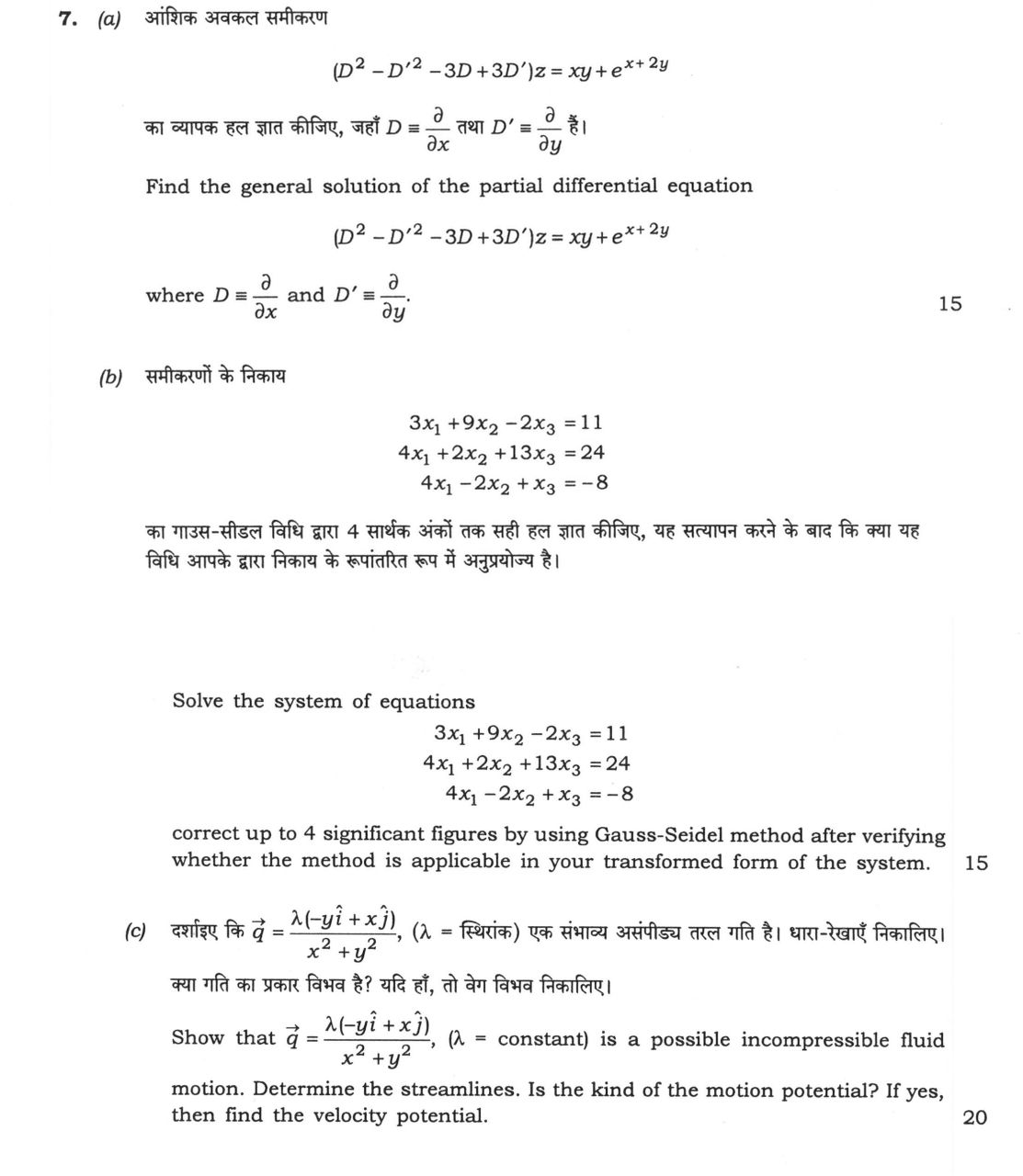
(a) Find the general solution of the partial differential equation (D² - D'² - 3D + 3D')z = xy + e^(x+2y) where D ≡ ∂/∂x and D' ≡…
Find the general solution of the partial differential equation (D² - D'² - 3D + 3D')z = xy + e^(x+2y) where D ≡ ∂/∂x and D' ≡ ∂/∂y. 15 marks
Solve the system of equations 3x₁ + 9x₂ - 2x₃ = 11 4x₁ + 2x₂ + 13x₃ = 24 4x₁ - 2x₂ + x₃ = -8 correct up to 4 significant figures by using Gauss-Seidel method after verifying whether the method is applicable in your transformed form of the system. 15 marks
Show that q⃗ = λ(-yî + xĵ)/(x² + y²), (λ = constant) is a possible incompressible fluid motion. Determine the streamlines. Is the kind of the motion potential? If yes, then find the velocity potential. 20 marks
हिंदी में प्रश्न पढ़ें
आंशिक अवकल समीकरण (D² - D'² - 3D + 3D')z = xy + e^(x+2y) का व्यापक हल प्राप्त कीजिए, जहाँ D ≡ ∂/∂x तथा D' ≡ ∂/∂y है। 15 अंक
समीकरणों के निकाय 3x₁ + 9x₂ - 2x₃ = 11 4x₁ + 2x₂ + 13x₃ = 24 4x₁ - 2x₂ + x₃ = -8 का गॉस-सीडल विधि द्वारा 4 सार्थक अंकों तक सही हल प्राप्त कीजिए, यह सत्यापन करने के बाद कि क्या यह विधि आपके द्वारा निकाय के रूपांतरित रूप में अनुप्रयोज्य है। 15 अंक
दर्शाइए कि q⃗ = λ(-yî + xĵ)/(x² + y²), (λ = स्थिरांक) एक संभाव्य असंपीड्य तरल गति है। धारा-रेखाएँ निकालिए। क्या गति का प्रकार विभव है? यदि हाँ, तो वेग विभव निकालिए। 20 अंक
Model answer
Written by UPSC Answer Check against this question's marking rubric, to the expected length. UPSC does not publish answers for Mains — this is one way to score well, not an official key.
(a) Use the standard constant-coefficient PDE method: complementary function plus particular integrals. Let L = D² - D'² - 3D + 3D' = (D - D')(D + D' - 3). For the complementary function, (D - D')z = 0 gives φ(x + y), and (D + D' - 3)z = 0 gives e^(3x)ψ(y - x). Hence z_c = φ(x + y) + e^(3x)ψ(y - x).
For e^(x+2y), the operator value is 1 - 4 - 3 + 6 = 0, so use the resonance trial z₁ = (Ax + B)e^(x+2y). Then Dz₁ = (Ax + A + B)e^(x+2y), D²z₁ = (Ax + 2A + B)e^(x+2y), D'z₁ = 2(Ax + B)e^(x+2y), D'²z₁ = 4(Ax + B)e^(x+2y), so Lz₁ = -A e^(x+2y). Take A = -1, B = 0, giving z₁ = -x e^(x+2y).
For xy, since the factors commute, put w = (D - D')z₂ and solve (D + D' - 3)w = xy. Let w = Axy + Bx + Cy + E. Then (D + D' - 3)w = -3Axy + (A - 3B)x + (A - 3C)y + (B + C - 3E). Equating with xy gives A = -1/3, B = C = -1/9, E = -2/27, so w = -1/3 xy - 1/9 x - 1/9 y - 2/27.
Now solve (D - D')z₂ = w. Try z₂ = axy² + by³ + cxy + dy² + gx + hy. Then Dz₂ - D'z₂ = -2axy + (a - 3b)y² - cx + (c - 2d)y + (g - h). Equating with w gives a = 1/6, b = 1/18, c = d = 1/9, g - h = -2/27; choose h = 0, g = -2/27. Hence z₂ = 1/6 xy² + 1/18 y³ + 1/9 xy + 1/9 y² - 2/27 x.
General solution: z = φ(x + y) + e^(3x)ψ(y - x) - x e^(x+2y) + 1/6 xy² + 1/18 y³ + 1/9 xy + 1/9 y² - 2/27 x.
(b) Use the Gauss-Seidel method. The original system is not strictly diagonally dominant. Reorder the equations as 4x₁ - 2x₂ + x₃ = -8 3x₁ + 9x₂ - 2x₃ = 11 4x₁ + 2x₂ + 13x₃ = 24. The transformed matrix is strictly diagonally dominant: 4 > 2 + 1, 9 > 3 + 2, 13 > 4 + 2, so the Gauss-Seidel convergence theorem applies. Solving for diagonal variables, x₁ = -2 + 1/2 x₂ - 1/4 x₃, x₂ = (11 - 3x₁ + 2x₃)/9, x₃ = (24 - 4x₁ - 2x₂)/13. Gauss-Seidel uses the latest available values in each sweep. Start from x₁ = x₂ = x₃ = 0.
- k=1: x₁ = -2.000, x₂ = 1.889, x₃ = 2.171
- k=2: x₁ = -1.598, x₂ = 2.237, x₃ = 1.994
- k=3: x₁ = -1.380, x₂ = 2.125, x₃ = 1.944
- k=4: x₁ = -1.423, x₂ = 2.129, x₃ = 1.957
- k=5: x₁ = -1.425, x₂ = 2.132, x₃ = 1.957
- k=6: x₁ = -1.423, x₂ = 2.131, x₃ = 1.956
- k=7: x₁ = -1.423, x₂ = 2.131, x₃ = 1.956 The values are stable to four significant figures. Solution: x₁ = -1.423, x₂ = 2.131, x₃ = 1.956.
(c) Use the incompressibility condition ∇·q⃗ = 0. Write q⃗ = u î + v ĵ, with u = -λ y/(x² + y²) and v = λ x/(x² + y²). Let r² = x² + y². Then ∂u/∂x = 2λ xy/r⁴, ∂v/∂y = -2λ xy/r⁴, so ∇·q⃗ = 0 for r ≠ 0. The motion is incompressible away from the singular origin. If x and y are in metres and q⃗ is in m s⁻¹, λ has units m² s⁻¹.
For λ ≠ 0, streamlines satisfy dy/dx = v/u = -x/y. Hence y dy = -x dx, so x dx + y dy = 0 and x² + y² = K. The streamlines are circles centred at the origin; K has units m². If λ = 0, the fluid is at rest. A stream function is ψ = -λ ln(r/r₀) + constant, where r₀ is a reference length, since ∂ψ/∂y = u and -∂ψ/∂x = v.
Use the irrotational condition ∂v/∂x = ∂u/∂y. The scalar curl is ∂v/∂x = λ(y² - x²)/r⁴, ∂u/∂y = λ(y² - x²)/r⁴, so ∂v/∂x - ∂u/∂y = 0 for r ≠ 0. Thus the motion is irrotational and potential on any simply connected region excluding the origin. Since ∂/∂x [λ arctan(y/x)] = -λ y/r², ∂/∂y [λ arctan(y/x)] = λ x/r², velocity potential: Φ = λ arctan(y/x) + C, or Φ = λθ + C, where θ is a chosen polar angle. It has units m² s⁻¹. It is not single-valued on the whole punctured plane; the circulation around the origin is 2πλ.
What "Solve" is asking you to do
Choose the method, then carry it through to a final answer. Identifying what kind of problem this is and why that method applies is the first thing marked; a correct figure arrived at invisibly earns almost nothing.
Structure that answers it
Given data and what is required → method chosen, with the reason it applies → set-up (equation, circuit, free body, trial balance) → working, step by step → answer with units and any condition of validity
Where marks are lost
Doing the middle steps mentally and writing only the result. In mathematics papers, a further loss comes from giving a decimal where the exact value in surds or fractions was wanted, or from skipping the justification a part explicitly asks for.
How this answer will be evaluated
Approach
Framework: UPSC Mathematics Paper 2. (a) derive: given > assumptions > stepwise derivation > result > check | (b) calculate: given > formula > substitution > result with units > interpretation | (c) derive: given > assumptions > stepwise derivation > result > check Full marks: Rigorous derivation with all steps, correct factorization, and verified convergence.
Key points expected
- Factorize operator (D-D')(D+D'-3)
- Derive Complementary Function (CF) from auxiliary equation
- Calculate Particular Integral (PI) for xy and e^(x+2y)
- State final solution z = CF + PI
- Verify diagonal dominance for applicability
- Show iterative formulae for x1, x2, x3
- Perform iterations until convergence to 4 sig figs
- State final values of x1, x2, x3
Evaluation rubric
Each sub-part is marked on its own, against the marks and word limit printed on the paper.
- (a) General solution of the linear PDE with constant coefficients. 15 marks
derive— given → assumptions → stepwise derivation → result → check
Must cover
- Factorize operator (D-D')(D+D'-3)
- Derive Complementary Function (CF) from auxiliary equation
- Calculate Particular Integral (PI) for xy and e^(x+2y)
- State final solution z = CF + PI
Loses marks
- Incorrect factorization of the operator
- Missing the CF or PI component
Earns more
- Correct application of 1/f(D,D') rules
- Explicit handling of the e^(x+2y) term
Extra mark
- Verification of PI by substitution
- (b) Solution of the system via Gauss-Seidel to 4 significant figures. 15 marks
calculate— given → formula → substitution → result with units → interpretation
Must cover
- Verify diagonal dominance for applicability
- Show iterative formulae for x1, x2, x3
- Perform iterations until convergence to 4 sig figs
- State final values of x1, x2, x3
Loses marks
- Failure to verify diagonal dominance
- Stopping iterations before 4 sig figs
Earns more
- Tabular presentation of iterations
- Explicit check of convergence criteria
Extra mark
- Comparison with exact solution
- (c) Analysis of incompressibility, streamlines, and potential flow. 20 marks
derive— given → assumptions → stepwise derivation → result → check
Must cover
- Prove incompressibility via divergence (∇·q = 0)
- Derive streamlines (x² + y² = C)
- Test for potential flow via curl (∇×q = 0)
- Find velocity potential φ if applicable
Loses marks
- Incorrect divergence calculation
- Failing to check for potential flow
Earns more
- Correct identification of irrotationality
- Integration steps for potential φ
Extra mark
- Sketch of the streamline pattern
Practice this exact question
Write your answer and it is marked point by point against the model answer above — what you covered, what you missed, what you got wrong.
Evaluate my answer →More from Mathematics 2021 Paper II
- Q4 (a) Show that there are infinitely many subgroups of the additive group Q of rational num…
- Q5 (a) Obtain the partial differential equation by eliminating arbitrary function f from the…
- Q6 (a) Solve the wave equation a²∂²u/∂x² = ∂²u/∂t², 0<x<L, t>0 subject to the conditions u(0…
- Q7 (a) Find the general solution of the partial differential equation (D² - D'² - 3D + 3D')z…
- Q8 (a) Find a complete integral of the partial differential equation p = (z + qy)² by using…