Paper II — Q5
(a) Obtain the partial differential equation by eliminating arbitrary function f from the equation f(x+y+z, x²+y²+z²) = 0. (10…
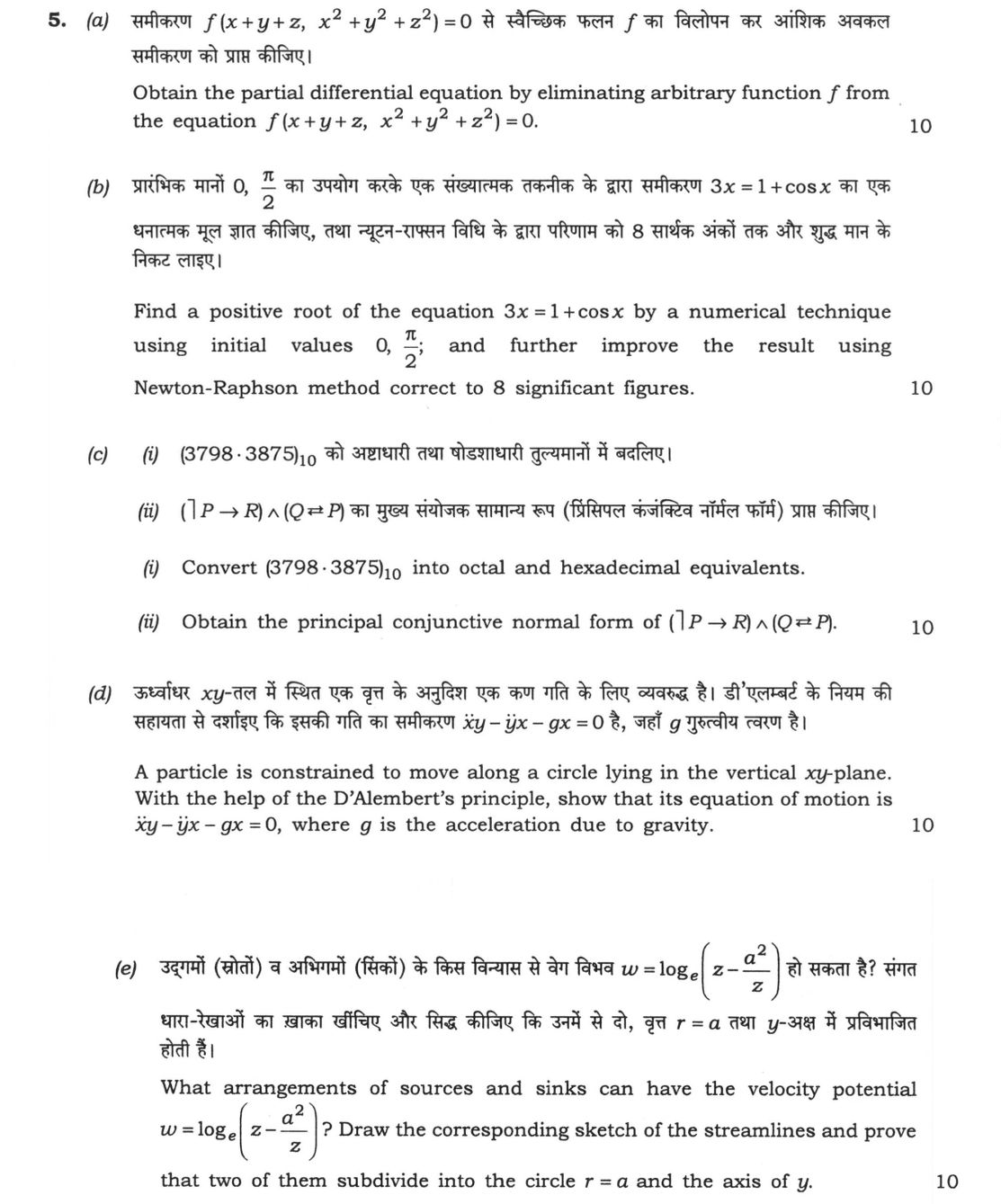
Obtain the partial differential equation by eliminating arbitrary function f from the equation f(x+y+z, x²+y²+z²) = 0. 10 marks
Find a positive root of the equation 3x = 1+cosx by a numerical technique using initial values 0, π/2; and further improve the result using Newton-Raphson method correct to 8 significant figures. 10 marks
Convert (3798·3875)₁₀ into octal and hexadecimal equivalents.
Obtain the principal conjunctive normal form of (⌐P → R) ∧ (Q ⇔ P). 10 marks
A particle is constrained to move along a circle lying in the vertical xy-plane. With the help of the D'Alembert's principle, show that its equation of motion is ẍy - ÿx - gx = 0, where g is the acceleration due to gravity. 10 marks
What arrangements of sources and sinks can have the velocity potential w=logₑ(z-a²/z)? Draw the corresponding sketch of the streamlines and prove that two of them subdivide into the circle r=a and the axis of y. 10 marks
हिंदी में प्रश्न पढ़ें
समीकरण f(x+y+z, x²+y²+z²) = 0 से स्वेच्छिक फलन f का विलोपन कर आंशिक अवकल समीकरण को प्राप्त कीजिए। (10 अंक)
प्रारंभिक मानों 0, π/2 का उपयोग करके एक संख्यात्मक तकनीक के द्वारा समीकरण 3x = 1+cosx का एक धनात्मक मूल ज्ञात कीजिए, तथा न्यूटन-राप्सन विधि के द्वारा परिणाम को 8 सार्थक अंकों तक और शुद्ध मान के निकट लाइए। (10 अंक)
(3798·3875)₁₀ को अष्टाधारी तथा षोडशाधारी तुल्यमानों में बदलिए।
(⌐P → R) ∧ (Q ⇔ P) का मुख्य संयोजक सामान्य रूप (प्रिंसिपल कंजक्टिव नॉर्मल फॉर्म) प्राप्त कीजिए। (10 अंक)
उर्ध्वाधर xy-तल में स्थित एक वृत्त के अनुदिश एक कण गति के लिए बंधक है। डी'एलंबर्ट के नियम की सहायता से दर्शाइए कि इसकी गति का समीकरण ẍy - ÿx - gx = 0 है, जहाँ g गुरुत्वीय त्वरण है। (10 अंक)
उदगमों (स्रोतों) व अभिगमों (सिंकों) के किस विन्यास से वेग विभव w=logₑ(z-a²/z) हो सकता है? संगत धारा-रेखाओं का खाका खींचिए और सिद्ध कीजिए कि उनमें से दो, वृत्त r=a तथा y-अक्ष में प्रतिभाजित होती हैं। (10 अंक)
What "Solve" is asking you to do
Choose the method, then carry it through to a final answer. Identifying what kind of problem this is and why that method applies is the first thing marked; a correct figure arrived at invisibly earns almost nothing.
Structure that answers it
Given data and what is required → method chosen, with the reason it applies → set-up (equation, circuit, free body, trial balance) → working, step by step → answer with units and any condition of validity
Where marks are lost
Doing the middle steps mentally and writing only the result. In mathematics papers, a further loss comes from giving a decimal where the exact value in surds or fractions was wanted, or from skipping the justification a part explicitly asks for.
How this answer will be evaluated
Approach
Framework: UPSC Mathematics Paper 2. (a) derive: given > assumptions > stepwise derivation > result > check | (b) calculate: given > formula > substitution > result with units > interpretation | (c(i)) calculate: given > formula > substitution > result with units > interpretation | (c(ii)) derive: given > assumptions > stepwise derivation > result > check | (d) derive: given > assumptions > stepwise derivation > result > check | (e) explain: definition/context > points in order > small example > short close Full marks: Complete derivations with all steps, correct results, and clear presentation.
Key points expected
- Define u=x+y+z, v=x²+y²+z²
- Differentiate w.r.t x and y
- Eliminate f_u and f_v
- State final PDE
- Apply initial numerical technique (e.g., Bisection)
- State Newton-Raphson formula
- Show iterative steps
- Result to 8 significant figures
Evaluation rubric
Each sub-part is marked on its own, against the marks and word limit printed on the paper.
- (a) PDE by eliminating arbitrary function f from f(x+y+z, x²+y²+z²)=0. 10 marks
derive— given → assumptions → stepwise derivation → result → check
Must cover
- Define u=x+y+z, v=x²+y²+z²
- Differentiate w.r.t x and y
- Eliminate f_u and f_v
- State final PDE
Loses marks
- Missing intermediate derivatives
- Incorrect elimination of f
Earns more
- Correct chain rule application
- Clear notation for partials
Extra mark
- Verification of result
- (b) Positive root of 3x=1+cosx using initial 0, π/2 and Newton-Raphson to 8 sig figs. 10 marks
calculate— given → formula → substitution → result with units → interpretation
Must cover
- Apply initial numerical technique (e.g., Bisection)
- State Newton-Raphson formula
- Show iterative steps
- Result to 8 significant figures
Loses marks
- Skipping Newton-Raphson steps
- Insufficient precision
Earns more
- Convergence check
- Clear tabulation of iterations
Extra mark
- Error analysis
- (c(i)) Convert (3798.3875)₁₀ to octal and hexadecimal.
calculate— given → formula → substitution → result with units → interpretation
Must cover
- Integer part conversion
- Fractional part conversion
- Correct base-8 and base-16 values
Loses marks
- Arithmetic errors in base conversion
- Missing fractional part
Earns more
- Step-by-step division/multiplication
Extra mark
- Verification by reverse conversion
- (c(ii)) Principal conjunctive normal form of (¬P→R)∧(Q⇔P).
derive— given → assumptions → stepwise derivation → result → check
Must cover
- Truth table or logical equivalence
- Identify maxterms
- Write PCNF in standard form
Loses marks
- Incorrect maxterm identification
- Missing logical equivalences
Earns more
- Clear logical steps
- Correct maxterm notation
Extra mark
- Alternative derivation method
- (d) Equation of motion ẍy-ÿx-gx=0 using D'Alembert's principle. 10 marks
derive— given → assumptions → stepwise derivation → result → check
Must cover
- State D'Alembert's principle
- Define constraint forces
- Derive equation stepwise
- Show final form ẍy-ÿx-gx=0
Loses marks
- Missing D'Alembert's principle statement
- Incorrect force balance
Earns more
- Clear free-body diagram
- Correct application of constraint
Extra mark
- Physical interpretation of terms
- (e) Source/sink arrangements for w=logₑ(z-a²/z) and streamline sketch. 10 marks
explain— definition/context → points in order → small example → short close
Must cover
- Identify source/sink locations
- Sketch streamlines
- Prove r=a and y-axis as streamlines
Loses marks
- Missing streamline sketch
- Incorrect source/sink identification
Earns more
- Clear sketch with labels
- Correct identification of singularities
Extra mark
- Physical interpretation of flow
Model answer coming soon
Every evaluation on this site is marked against a verified model answer. This question's answer is still being written; evaluation opens the moment it lands.
More from Mathematics 2021 Paper II
- Q2 (a) Find the maximum and minimum values of f(x) = x³ - 9x² + 26x - 24 for 0 ≤ x ≤ 1. (15…
- Q3 (a) Let f be an entire function whose Taylor series expansion with centre z = 0 has infin…
- Q4 (a) Show that there are infinitely many subgroups of the additive group Q of rational num…
- Q5 (a) Obtain the partial differential equation by eliminating arbitrary function f from the…
- Q6 (a) Solve the wave equation a²∂²u/∂x² = ∂²u/∂t², 0<x<L, t>0 subject to the conditions u(0…
- Q7 (a) Find the general solution of the partial differential equation (D² - D'² - 3D + 3D')z…
- Q8 (a) Find a complete integral of the partial differential equation p = (z + qy)² by using…