Paper II — Q8
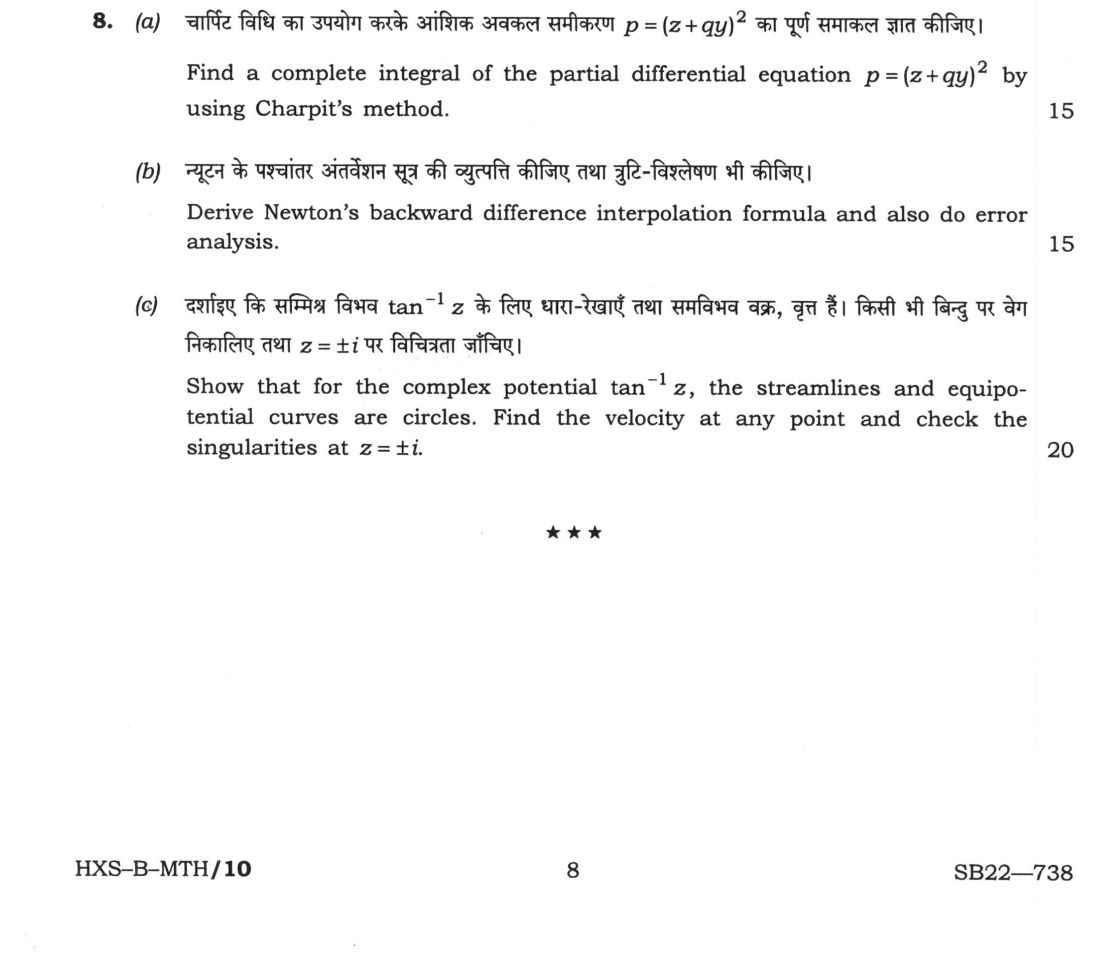
(a) Find a complete integral of the partial differential equation p = (z + qy)² by using Charpit's method. 15 marks (b) Derive…
Find a complete integral of the partial differential equation p = (z + qy)² by using Charpit's method. 15 marks
Derive Newton's backward difference interpolation formula and also do error analysis. 15 marks
Show that for the complex potential tan⁻¹z, the streamlines and equipotential curves are circles. Find the velocity at any point and check the singularities at z = ±i. 20 marks
हिंदी में प्रश्न पढ़ें
चारपिट विधि का उपयोग करके आंशिक अवकल समीकरण p = (z + qy)² का पूर्ण समाकल प्राप्त कीजिए। 15 अंक
न्यूटन के पश्चातर अंतर्वेशन सूत्र की व्युत्पत्ति कीजिए तथा त्रुटि-विश्लेषण भी कीजिए। 15 अंक
दर्शाइए कि सम्मिश्र विभव tan⁻¹z के लिए धारा-रेखाएँ तथा समविभव वक्र, वृत्त हैं। किसी भी बिंदु पर वेग निकालिए तथा z = ±i पर विचित्रता जाँचिए। 20 अंक
Model answer
Written by UPSC Answer Check against this question's marking rubric, to the expected length. UPSC does not publish answers for Mains — this is one way to score well, not an official key.
(a) Let p = ∂z/∂x and q = ∂z/∂y. Put F = p − (z + qy)² = 0.
By Charpit’s method, dx/F_p = dy/F_q = dz/(pF_p + qF_q) = −dp/(F_x + pF_z) = −dq/(F_y + qF_z).
Here F_p = 1, F_q = −2y(z+qy), F_z = −2(z+qy), F_y = −2q(z+qy). Let w = z + qy. Then the system gives dp/dx = 2pw, dq/dx = 4qw, dy/dx = −2yw.
Hence d(py)/dx = y dp/dx + p dy/dx = y(2pw) + p(−2yw) = 0. So py = a, a constant. Therefore p = a/y.
Also F = 0 gives w² = p = a/y, so w = ε√(a/y), ε = ±1.
Now dz = p dx + q dy. Since q = w/y − z/y, dz = (a/y) dx + [ε√(a/y)/y − z/y] dy. Multiplying by y: y dz + z dy = a dx + ε√a y⁻¹ᐟ² dy, that is, d(yz) = a dx + ε√a y⁻¹ᐟ² dy.
Integrating, yz = ax + 2ε√a √y + b. Thus the complete integral is z = (ax + b)/y + 2ε√(a/y), ε = ±1, where a and b are arbitrary constants and y ≠ 0. The case a = 0 gives z = b/y.
(b) Let the equally spaced points be x₀, x₁, …, xₙ with spacing h. Define the backward difference operator ∇fₙ = fₙ − fₙ₋₁, ∇ʳfₙ = ∇(∇ʳ⁻¹fₙ).
Put x = xₙ + uh, u = (x − xₙ)/h. Newton’s backward difference interpolation formula is Pₙ(x) = fₙ + u∇fₙ + u(u+1)/2! ∇²fₙ + u(u+1)(u+2)/3! ∇³fₙ + … + u(u+1)…(u+r−1)/r! ∇ʳfₙ + … up to r = n.
To derive it, at x = xₙ₋ₖ we have u = −k. In the r-th term, the product u(u+1)…(u+r−1) vanishes for r > k. For r ≤ k, it equals (−1)ʳ C(k,r). Hence the r-th term contributes (−1)ʳ C(k,r)∇ʳfₙ, and Σ_r=0^k (−1)ʳ C(k,r)∇ʳfₙ = (1 − ∇)ᵏ fₙ = fₙ₋ₖ, so the polynomial matches all given values.
For error analysis, if f is sufficiently smooth, f ∈ C⁽ⁿ⁺¹⁾ on the interval, then f(x) − Pₙ(x) = h⁽ⁿ⁺¹⁾ u(u+1)(u+2)…(u+n)/(n+1)! f⁽ⁿ⁺¹⁾(ξ), for some ξ in the interval containing the nodes. Therefore |f(x) − Pₙ(x)| ≤ |u(u+1)…(u+n)| h⁽ⁿ⁺¹⁾/(n+1)! max |f⁽ⁿ⁺¹⁾|. If f is a polynomial of degree ≤ n, the error is zero.
(c) Let the complex potential be W = φ + iψ = tan⁻¹ z. Then z = tan(φ + iψ). Using tan(φ + iψ) = [sin 2φ + i sinh 2ψ]/[cos 2φ + cosh 2ψ], we get x = sin 2φ/(cos 2φ + cosh 2ψ), y = sinh 2ψ/(cos 2φ + cosh 2ψ).
For equipotentials, take φ = C. Put A = cos 2C, B = sin 2C. Then x = B/(A + cosh 2ψ), y = sinh 2ψ/(A + cosh 2ψ). Eliminating ψ gives (x + A/B)² + y² = 1/B², B ≠ 0. Thus equipotential curves are circles with centre (−cot 2C, 0) and radius |cosec 2C|. For B = 0, they reduce to the line x = 0, a circle of infinite radius.
For streamlines, take ψ = C. Put A = cosh 2C, B = sinh 2C. Then x = sin 2φ/(cos 2φ + A), y = B/(cos 2φ + A). Eliminating φ gives x² + (y − A/B)² = 1/B², B ≠ 0. Thus streamlines are circles with centre (0, coth 2C) and radius |cosech 2C|. For B = 0, this gives the line y = 0.
The complex velocity is defined by u − iv = dW/dz = 1/(1 + z²). Hence u − iv = 1/(1 + z²). Writing z = x + iy, u = (1 + x² − y²)/D, v = 2xy/D, where D = (1 + x² − y²)² + 4x²y². The speed is |u − iv| = 1/√D.
At z = ±i, 1 + z² = 0. Thus dW/dz has simple poles, so the velocity becomes infinite. Also W = tan⁻¹ z has branch points at z = i and z = −i, so these are singularities of the complex potential and must be excluded from the regular flow region.
What "Solve" is asking you to do
Choose the method, then carry it through to a final answer. Identifying what kind of problem this is and why that method applies is the first thing marked; a correct figure arrived at invisibly earns almost nothing.
Structure that answers it
Given data and what is required → method chosen, with the reason it applies → set-up (equation, circuit, free body, trial balance) → working, step by step → answer with units and any condition of validity
Where marks are lost
Doing the middle steps mentally and writing only the result. In mathematics papers, a further loss comes from giving a decimal where the exact value in surds or fractions was wanted, or from skipping the justification a part explicitly asks for.
How this answer will be evaluated
Approach
(a) calculate: given > formula > substitution > result with units > interpretation | (b) derive: given > assumptions > stepwise derivation > result > check | (c) justify: claim > 3-4 reasons > evidence > conclusion Full marks: Complete, rigorous derivations with all steps shown and verified.
Key points expected
- State Charpit's auxiliary equations for F(x,y,z,p,q)=0
- Identify the subsidiary relation between p and q
- Integrate to find p and q in terms of constants
- Substitute into dz = p dx + q dy to find z
- Define backward difference operator ∇ and its powers
- Derive the interpolation formula using Taylor series
- State the formula in terms of ∇f(x_n)
- Derive the error term involving (n+1)th difference
Evaluation rubric
Each sub-part is marked on its own, against the marks and word limit printed on the paper.
- (a) Complete integral of PDE p = (z + qy)² via Charpit's method. 15 marks
calculate— given → formula → substitution → result with units → interpretation
Must cover
- State Charpit's auxiliary equations for F(x,y,z,p,q)=0
- Identify the subsidiary relation between p and q
- Integrate to find p and q in terms of constants
- Substitute into dz = p dx + q dy to find z
Loses marks
- Skipping the derivation of subsidiary equations
- Incorrect integration of the auxiliary system
Earns more
- Explicitly defines p = ∂z/∂x and q = ∂z/∂y
- Verifies the final solution satisfies the original PDE
Extra mark
- Alternative method noted briefly
- (b) Derivation of Newton's backward difference formula and error analysis. 15 marks
derive— given → assumptions → stepwise derivation → result → check
Must cover
- Define backward difference operator ∇ and its powers
- Derive the interpolation formula using Taylor series
- State the formula in terms of ∇f(x_n)
- Derive the error term involving (n+1)th difference
Loses marks
- Writing the formula without derivation steps
- Omitting the error analysis part
Earns more
- Shows the relationship between forward and backward operators
- States the condition for the formula's validity
Extra mark
- Neat figure illustrating the data points
- (c) Show streamlines/equipotentials of tan⁻¹z are circles; find velocity and singularities. 20 marks
justify— claim → 3-4 reasons → evidence → conclusion
Must cover
- Express tan⁻¹z in terms of real and imaginary parts
- Show equations for streamlines and equipotentials are circles
- Calculate velocity using w'(z) = 1/(1+z²)
- Identify singularities at z = ±i and their nature
Loses marks
- Failing to show the curves are circles explicitly
- Incorrect calculation of the derivative w'(z)
Earns more
- Sketches the circular streamlines and equipotentials
- Explains the physical significance of the singularities
Extra mark
- Alternative method for finding the velocity
Practice this exact question
Write your answer and it is marked point by point against the model answer above — what you covered, what you missed, what you got wrong.
Evaluate my answer →More from Mathematics 2021 Paper II
- Q5 (a) Obtain the partial differential equation by eliminating arbitrary function f from the…
- Q6 (a) Solve the wave equation a²∂²u/∂x² = ∂²u/∂t², 0<x<L, t>0 subject to the conditions u(0…
- Q7 (a) Find the general solution of the partial differential equation (D² - D'² - 3D + 3D')z…
- Q8 (a) Find a complete integral of the partial differential equation p = (z + qy)² by using…