Paper I — Q1
(a) Prove that any set of n linearly independent vectors in a vector space V of dimension n constitutes a basis for V. 10 (b)…
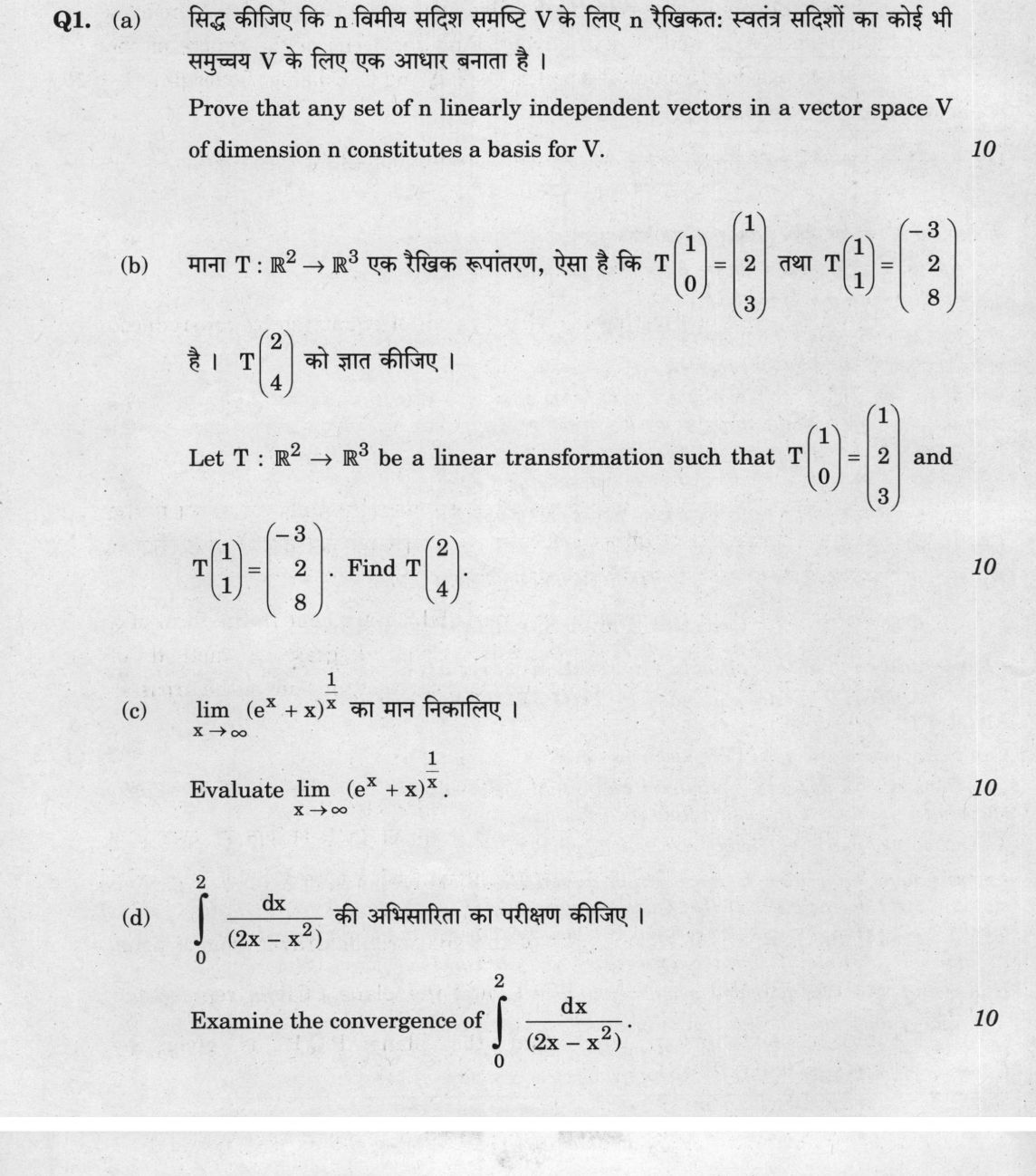
Prove that any set of n linearly independent vectors in a vector space V of dimension n constitutes a basis for V. 10 marks
Let T : ℝ² → ℝ³ be a linear transformation such that T 1 0 = 1 2 3 and T 1 1 = -3 2 8 . Find T 2 4 . 10 marks
Evaluate limlimitsₓ → ∞ (e^x + x)¹/x. 10 marks
Examine the convergence of ∫limits₀² dx/((2x - x²)). 10 marks
A variable plane passes through a fixed point (a, b, c) and meets the axes at points A, B and C respectively. Find the locus of the centre of the sphere passing through the points O, A, B and C, O being the origin. 10 marks
हिंदी में प्रश्न पढ़ें
सिद्ध कीजिए कि n विमीय सदिश समष्टि V के लिए n रैखिकतः स्वतंत्र सदिशों का कोई भी समुच्चय V के लिए एक आधार बनता है। 10
माना T : ℝ² → ℝ³ एक रैखिक रूपांतरण, ऐसा है कि T 1 0 = 1 2 3 तथा T 1 1 = -3 2 8 है। T 2 4 को ज्ञात कीजिए। 10
limlimitsₓ → ∞ (e^x + x)¹/x का मान निकालिए। 10
∫limits₀² dx/((2x - x²)) की अभिसारिता का परीक्षण कीजिए। 10
एक चर समतल एक स्थिर बिंदु (a, b, c) से गुजरता है तथा अक्षों को क्रमशः A, B व C बिंदुओं पर मिलता है । बिंदुओं O, A, B तथा C से गुजरते हुए गोले के केंद्र का बिंदुपथ ज्ञात कीजिए, जहाँ O मूल-बिंदु है । 10
Model answer
Written by UPSC Answer Check against this question's marking rubric, to the expected length. UPSC does not publish answers for Mains — this is one way to score well, not an official key.
(a) Let V be a finite-dimensional vector space over a field F with dim V = n. Let S = {v₁, v₂, ..., vₙ} be a linearly independent set in V. We must prove that S spans V; then S will be a basis.
Suppose, on the contrary, that S does not span V. Then there exists a vector w ∈ V such that w ∉ span(S). Consider the set S ∪ {w}. We claim it is linearly independent. Let c₁v₁ + c₂v₂ + ... + cₙvₙ + cw = 0. If c ≠ 0, then w = −(c₁/c)v₁ − (c₂/c)v₂ − ... − (cₙ/c)vₙ, so w ∈ span(S), a contradiction. Hence c = 0. The equation then becomes c₁v₁ + c₂v₂ + ... + cₙvₙ = 0. Since S is linearly independent, c₁ = c₂ = ... = cₙ = 0. Thus S ∪ {w} is linearly independent.
But S ∪ {w} contains n + 1 linearly independent vectors. By the dimension theorem, in an n-dimensional vector space no linearly independent set can contain more than n vectors. This is a contradiction. Therefore S must span V.
Since S is linearly independent and spans V, S is a basis for V. Hence any set of n linearly independent vectors in an n-dimensional vector space V is a basis of V.
Final answer: S is a basis of V.
(b) Let e₁ = (1, 0) and e₂ = (0, 1) in ℝ². The given data are T(e₁) = T(1, 0) = (1, 2, 3), T(1, 1) = T(e₁ + e₂) = (−3, 2, 8). By linearity, T(e₁ + e₂) = T(e₁) + T(e₂). Therefore T(e₂) = T(e₁ + e₂) − T(e₁) = (−3, 2, 8) − (1, 2, 3) = (−4, 0, 5).
Now (2, 4) = 2e₁ + 4e₂. Hence, again using linearity, T(2, 4) = 2T(e₁) + 4T(e₂) = 2(1, 2, 3) + 4(−4, 0, 5) = (2, 4, 6) + (−16, 0, 20) = (−14, 4, 26).
Final answer: T(2, 4) = (−14, 4, 26).
(c) Let L = lim (x → ∞) (eˣ + x)^(1/x). For x > 0, eˣ + x > 0, so we may take logarithms. Put y = (eˣ + x)^(1/x). Then ln y = (1/x) ln(eˣ + x). Now eˣ + x = eˣ(1 + x e⁻ˣ), so ln(eˣ + x) = ln(eˣ) + ln(1 + x e⁻ˣ) = x + ln(1 + x e⁻ˣ). Therefore ln y = 1 + [ln(1 + x e⁻ˣ)]/x.
As x → ∞, we have x e⁻ˣ → 0. Using the standard limit ln(1 + t) ~ t as t → 0, ln(1 + x e⁻ˣ) ~ x e⁻ˣ. Thus [ln(1 + x e⁻ˣ)]/x ~ e⁻ˣ → 0. Hence ln y → 1. By continuity of the exponential function, y → e¹ = e.
Final answer: lim (x → ∞) (eˣ + x)^(1/x) = e.
(d) We examine I = ∫₀² dx/(2x − x²). The denominator is 2x − x² = x(2 − x). Thus the integrand has singularities at both endpoints x = 0 and x = 2. The integral is improper at both ends.
First consider the behaviour near x = 0. For 0 < x ≤ 1, 2 − x ≤ 2, so x(2 − x) ≤ 2x. Therefore 1/[x(2 − x)] ≥ 1/(2x). But ∫₀¹ dx/(2x) diverges to +∞ because ∫ dx/x diverges near 0. Hence by the comparison test, the part of the integral near x = 0 diverges.
Similarly, near x = 2, put t = 2 − x. Then for small t > 0, 2x − x² = x(2 − x) = (2 − t)t ≤ 2t, so 1/[x(2 − x)] ≥ 1/(2t). Again ∫₀^δ dt/(2t) diverges to +∞. Hence the part near x = 2 also diverges.
For completeness, using partial fractions, 1/[x(2 − x)] = (1/2)(1/x + 1/(2 − x)). So an antiderivative is F(x) = (1/2) ln(x/(2 − x)). Then ∫_ε^(2−δ) dx/(2x − x²) = F(2 − δ) − F(ε) = (1/2) ln(((2 − δ)(2 − ε))/(δε)). As ε → 0⁺ and δ → 0⁺, the expression ln(1/(δε)) tends to +∞. Therefore the improper integral does not converge.
Final answer: The integral diverges to +∞; it is not convergent.
(e) Let the variable plane meet the coordinate axes at A = (α, 0, 0), B = (0, β, 0), C = (0, 0, γ), where α, β, γ are nonzero. The equation of the plane in intercept form is X/α + Y/β + Z/γ = 1. Since the plane passes through the fixed point (a, b, c), a/α + b/β + c/γ = 1. (1)
Let the centre of the sphere through O, A, B, C be P = (x, y, z). Since the sphere passes through O = (0, 0, 0) and A = (α, 0, 0), the centre is equidistant from O and A: x² + y² + z² = (x − α)² + y² + z². This gives x² = x² − 2αx + α², so 2αx = α², hence x = α/2, that is, α = 2x.
Similarly, equidistance from O and B gives y = β/2, that is, β = 2y, and equidistance from O and C gives z = γ/2, that is, γ = 2z.
Substitute α = 2x, β = 2y, γ = 2z into (1): a/(2x) + b/(2y) + c/(2z) = 1. Multiplying by 2, a/x + b/y + c/z = 2.
Thus the locus of the centre (x, y, z) of the sphere is a/x + b/y + c/z = 2, with xyz ≠ 0. Equivalently, multiplying by xyz, a yz + b zx + c xy = 2xyz.
Final answer: The locus is a/x + b/y + c/z = 2, or equivalently a yz + b zx + c xy = 2xyz.
What "Prove" is asking you to do
Establish that the statement holds for every case it claims, not for one representative case. The argument must be closed: each line follows from a definition, a hypothesis, or a named theorem you are entitled to use.
Structure that answers it
Given and to prove, restated → theorem or construction to be used, named → the argument line by line → conclusion stated as proved
Where marks are lost
Testing one example, which illustrates but proves nothing. On an if and only if claim, proving one direction and stopping forfeits that half outright, and degenerate cases — zero, the empty set, the equality case — have to be disposed of rather than assumed away.
How this answer will be evaluated
Approach
(a) justify: claim > 3-4 reasons > evidence > conclusion | (b) calculate: given > formula > substitution > result with units > interpretation | (c) calculate: given > formula > substitution > result with units > interpretation | (d) examine: intro > how/why with reasoning > evidence > conclusion Full marks: Rigorous proofs and calculations with all steps justified and no arithmetic errors.
Key points expected
- State definition of basis (independent + spanning)
- Prove the set spans V using dimension argument
- Reference the theorem: independent set in n-dim space is basis
- Express (2, 4) as a linear combination of given vectors
- Apply linearity property T(ax+by) = aT(x) + bT(y)
- Perform the vector addition and scalar multiplication correctly
- Identify the indeterminate form 1^infinity
- Apply logarithmic transformation to simplify the expression
Evaluation rubric
Each sub-part is marked on its own, against the marks and word limit printed on the paper.
- (a) Proof that n linearly independent vectors in an n-dimensional space form a basis. 10 marks
justify— claim → 3-4 reasons → evidence → conclusion
Must cover
- State definition of basis (independent + spanning)
- Prove the set spans V using dimension argument
- Reference the theorem: independent set in n-dim space is basis
Loses marks
- Assumes spanning without proof
- Confuses dimension of subspace with dimension of V
Earns more
- Explicitly states linear independence is given
- Uses the property that max independent set size is n
Extra mark
- Mentions the rank-nullity theorem as an alternative perspective
- (b) Determine the image of vector (2, 4) under the linear transformation T. 10 marks
calculate— given → formula → substitution → result with units → interpretation
Must cover
- Express (2, 4) as a linear combination of given vectors
- Apply linearity property T(ax+by) = aT(x) + bT(y)
- Perform the vector addition and scalar multiplication correctly
Loses marks
- Incorrectly assumes T is an isometry or preserves length
- Arithmetic error in the final vector sum
Earns more
- Solves for coefficients explicitly (e.g., via matrix or substitution)
- Verifies the linear combination sums to (2, 4)
Extra mark
- Constructs the full 3x2 transformation matrix
- (c) Evaluate the limit of (e^x + x)^(1/x) as x approaches infinity. 10 marks
calculate— given → formula → substitution → result with units → interpretation
Must cover
- Identify the indeterminate form 1^infinity
- Apply logarithmic transformation to simplify the expression
- Use L'Hopital's rule or standard limits to evaluate the log-limit
Loses marks
- Directly substituting infinity without transformation
- Incorrect application of L'Hopital's rule
Earns more
- Correctly identifies e^x as the dominant term
- Shows the step where x/x^2 or similar terms vanish
Extra mark
- Mentions the general limit form lim (1 + f(x))^g(x)
- (d) Determine if the integral of 1/(2x - x^2) from 0 to 2 converges. 10 marks
examine— intro → how/why with reasoning → evidence → conclusion
Must cover
- Identify the singularity at x = 2 (denominator becomes 0)
- Classify the integral as improper due to the singularity
- Evaluate the limit of the integral as the upper bound approaches 2
Loses marks
- Treating it as a proper Riemann integral
- Ignoring the singularity at the upper limit
Earns more
- Uses partial fraction decomposition for integration
- Explicitly shows the logarithmic divergence (ln(0))
Extra mark
- Sketches the graph to visualize the vertical asymptote
Practice this exact question
Write your answer and it is marked point by point against the model answer above — what you covered, what you missed, what you got wrong.
Evaluate my answer →More from Mathematics 2022 Paper I
- Q1 (a) Prove that any set of n linearly independent vectors in a vector space V of dimension…
- Q2 (a) Find all solutions to the following system of equations by row-reduced method : x₁ +…
- Q3 (a) Let the set P = x y z middle| l x - y - z = 0 and 2x - y + z = 0 be the collection of…
- Q4 (a) Find a linear map T : R² → R² which rotates each vector of R² by an angle θ. Also, pr…