Paper I — Q4
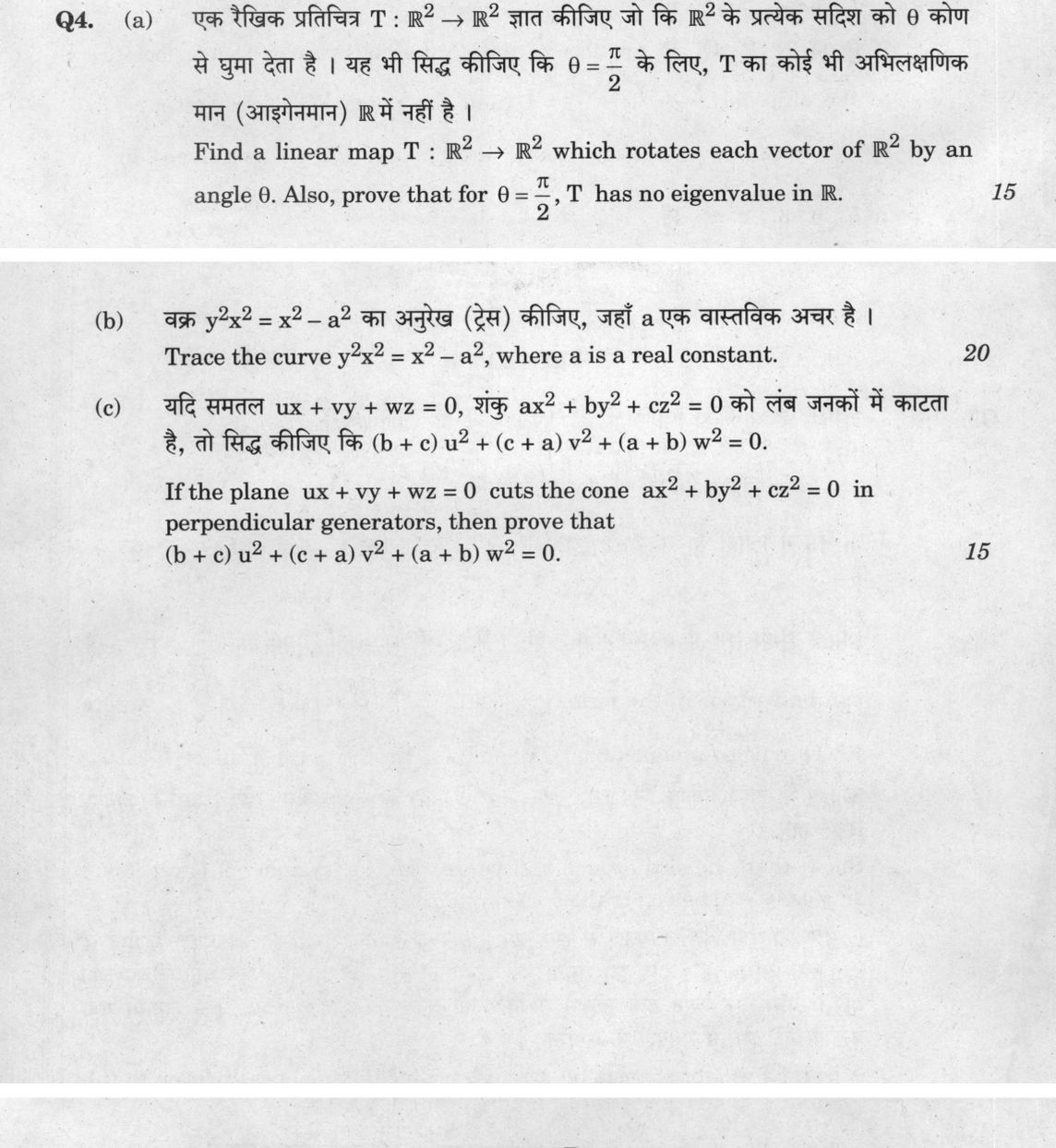
(a) Find a linear map T : R² → R² which rotates each vector of R² by an angle θ. Also, prove that for θ = (π)/2, T has no…
Find a linear map T : R² → R² which rotates each vector of R² by an angle θ. Also, prove that for θ = (π)/2, T has no eigenvalue in R. 15 marks
Trace the curve y²x² = x² – a², where a is a real constant. 20 marks
If the plane ux + vy + wz = 0 cuts the cone ax² + by² + cz² = 0 in perpendicular generators, then prove that (b + c) u² + (c + a) v² + (a + b) w² = 0. 15 marks
हिंदी में प्रश्न पढ़ें
एक रैखिक प्रतिचित्र T : R² → R² ज्ञात कीजिए जो कि R² के प्रत्येक सदिश को θ कोण से घुमा देता है । यह भी सिद्ध कीजिए कि θ = (π)/2 के लिए, T का कोई भी अभिलक्षणिक मान (आइगेनमान) R में नहीं है । 15
वक्र y²x² = x² – a² का अनुरेख (ट्रेस) कीजिए, जहाँ a एक वास्तविक अचर है । 20
यदि समतल ux + vy + wz = 0, शंकु ax² + by² + cz² = 0 को लंब जनकों में काटता है, तो सिद्ध कीजिए कि (b + c) u² + (c + a) v² + (a + b) w² = 0. 15 marks
Model answer
Written by UPSC Answer Check against this question's marking rubric, to the expected length. UPSC does not publish answers for Mains — this is one way to score well, not an official key.
Part (a). A rotation through θ sends e₁=(1,0) to (cosθ,sinθ) and e₂=(0,1) to (−sinθ,cosθ). Hence T(x,y)=(x cosθ−y sinθ, x sinθ+y cosθ), so its matrix is [[cosθ,−sinθ],[sinθ,cosθ]]. To verify linearity, for vectors (x₁,y₁),(x₂,y₂) and scalar λ, T((x₁,y₁)+(x₂,y₂))=T(x₁+x₂,y₁+y₂)=T(x₁,y₁)+T(x₂,y₂), and T(λx,λy)=λT(x,y), because both coordinates are linear combinations of x and y. For θ=π/2, T(x,y)=(−y,x), with matrix A=[[0,−1],[1,0]]. The characteristic equation is det(A−λI)=λ²+1=0, giving λ=±i. Since no root is real, T has no eigenvalue in R.
Part (b). If a=0, the equation becomes x²(y²−1)=0, so the locus is the y-axis x=0 together with the lines y=±1. Assume now a≠0. Since x²y²≥0, we must have x²≥a²; hence |x|≥|a| and x≠0. The curve can be written as y²=1−a²/x²=(x²−a²)/x². It is symmetric about both axes because only x² and y² occur. It meets the x-axis where y=0, giving x=±a, and has no y-intercept. The region |x|<|a| is empty. As |x|→∞, y²→1, so y=±1 are horizontal asymptotes; there is no vertical asymptote because y remains finite. For |x|>|a|, 0<y²<1, so the branches lie between the asymptotes and begin at (±a,0). Differentiating implicitly, 2xy²+2x²yy′=2x, so, for x≠0, y²+x yy′=1 and y′=(1−y²)/(xy). Using y²=1−a²/x² gives y′=a²/(x³y). At (a,0) and (−a,0) the derivative is infinite; the tangents are the vertical lines x=a and x=−a. Also, from y²=(x²−a²)/x², on x>|a| the quantity y² increases from 0 to 1, while on x<−|a| it decreases from 1 to 0 as x moves toward −|a|; this fixes the opening of the arcs. Thus, for a>0, four branches appear: from (a,0) they go into the first and fourth quadrants and approach y=1 and y=−1 as x→∞; from (−a,0) they go into the second and third quadrants and approach y=±1 as x→−∞. For a<0 the same picture occurs with intercepts at x=±|a|. The sketch is two symmetric pairs of open arcs, one on each side of the y-axis, bounded by the horizontal asymptotes.
Part (c). Let p=(u,v,w)≠(0,0,0) and A=diag(a,b,c). A generator of the cone lying in the plane pᵀr=0 has direction vector r=(l,m,n) satisfying rᵀAr=0 and pᵀr=0. Choose an orthonormal basis e₁,e₂ of the plane P=p⊥, and write a unit generator direction as r=αe₁+βe₂; α and β are its direction cosines in P. Substituting this parametric form into rᵀAr=0 gives the homogeneous quadratic B₁₁α²+2B₁₂αβ+B₂₂β²=0, where Bᵢⱼ=eᵢᵀAeⱼ. This is the elimination of the scale factor from the two defining equations. Putting t=α/β, the two generators correspond to the two roots t₁,t₂ of B₁₁t²+2B₁₂t+B₂₂=0; if B₁₁=0, use the reciprocal parameter and the same final condition follows. Their direction vectors in the orthonormal basis are (t₁,1) and (t₂,1); if their full direction cosines are (l₁,m₁,n₁) and (l₂,m₂,n₂), perpendicularity means l₁l₂+m₁m₂+n₁n₂=0, which in this basis is t₁t₂+1=0. By Vieta, t₁t₂=B₂₂/B₁₁; hence perpendicularity is equivalent to B₁₁+B₂₂=0. But B₁₁+B₂₂ is the trace of the restriction of A to P. If n=p/‖p‖ is the unit normal to P, then e₁,e₂,n form an orthonormal basis of R³, so B₁₁+B₂₂=tr(A)−nᵀAn=(a+b+c)−(au²+bv²+cw²)/(u²+v²+w²). Here tr(A)=a+b+c, and nᵀAn=(au²+bv²+cw²)/(u²+v²+w²) because n=(u,v,w)/‖p‖. Setting this equal to zero gives (a+b+c)(u²+v²+w²)−(au²+bv²+cw²)=0, which simplifies to (b+c)u²+(c+a)v²+(a+b)w²=0. This is the required condition.
What "Trace" is asking you to do
Follow a development through in sequence, showing what carried each stage into the next. The sequence may be historical, or in the science papers an anatomical or physiological pathway followed from origin to destination.
Structure that answers it
Point of origin → stage, with what moved it on → next stage → the turning point → where it ends and what it had become
Where marks are lost
Dates or stations listed in order with nothing joining them; the marks are on the connecting steps, not on the sequence itself.
How this answer will be evaluated
Approach
(a) derive: given > assumptions > stepwise derivation > result > check | (b) trace: start point > the stages in sequence > end point > what changed | (c) justify: claim > 3-4 reasons > evidence > conclusion Full marks: Complete derivations with all steps, correct results, and clear justification
Key points expected
- Matrix T = [[cosθ, -sinθ], [sinθ, cosθ]]
- Characteristic polynomial det(T-λI) = 0
- Substitute θ=π/2 to get λ²+1=0
- Conclude roots are imaginary, not in R
- Domain analysis: x² ≥ a² (x ≥ a or x ≤ -a)
- Symmetry about x and y axes
- Asymptotes: y = ±1/x
- Sketch showing branches in quadrants I, II, III, IV
Evaluation rubric
Each sub-part is marked on its own, against the marks and word limit printed on the paper.
- (a) Matrix for rotation and proof of no real eigenvalues for θ=π/2 15 marks
derive— given → assumptions → stepwise derivation → result → check
Must cover
- Matrix T = [[cosθ, -sinθ], [sinθ, cosθ]]
- Characteristic polynomial det(T-λI) = 0
- Substitute θ=π/2 to get λ²+1=0
- Conclude roots are imaginary, not in R
Loses marks
- Missing characteristic equation step
- Assuming eigenvalues without proof
Earns more
- Geometric interpretation of rotation
- Explicit calculation of determinant
Extra mark
- Mention of complex eigenvalues ±i
- (b) Complete analysis of curve y²x² = x² - a² 20 marks
trace— start point → the stages in sequence → end point → what changed
Must cover
- Domain analysis: x² ≥ a² (x ≥ a or x ≤ -a)
- Symmetry about x and y axes
- Asymptotes: y = ±1/x
- Sketch showing branches in quadrants I, II, III, IV
Loses marks
- Ignoring domain restrictions
- Missing asymptotes
Earns more
- Behavior as x → ±∞
- Behavior as x → ±a
Extra mark
- Neat, labelled diagram
- (c) Proof of condition for perpendicular generators 15 marks
justify— claim → 3-4 reasons → evidence → conclusion
Must cover
- Substitute plane equation into cone equation
- Derive condition for perpendicular lines
- Apply condition to get (b+c)u² + (c+a)v² + (a+b)w² = 0
Loses marks
- Skipping substitution step
- Incorrect application of perpendicularity condition
Earns more
- Clear statement of perpendicularity condition
- Step-by-step algebraic manipulation
Extra mark
- Alternative method noted
Practice this exact question
Write your answer and it is marked point by point against the model answer above — what you covered, what you missed, what you got wrong.
Evaluate my answer →More from Mathematics 2022 Paper I
- Q1 (a) Prove that any set of n linearly independent vectors in a vector space V of dimension…
- Q2 (a) Find all solutions to the following system of equations by row-reduced method : x₁ +…
- Q3 (a) Let the set P = x y z middle| l x - y - z = 0 and 2x - y + z = 0 be the collection of…
- Q4 (a) Find a linear map T : R² → R² which rotates each vector of R² by an angle θ. Also, pr…
- Q5 (a) Show that the general solution of the differential equation dy/dx + Py = Q can be wri…
- Q6 (a) A cable of weight w per unit length and length 2lhangs from two points P and Q in the…
- Q7 (a) Verify Stokes' theorem for F⃗ = xî + z^2ĵ + y^2k̂ over the plane surface : x + y +…