Paper I — Q6
(a) A cable of weight w per unit length and length 2lhangs from two points P and Q in the same horizontal line. Show that the…
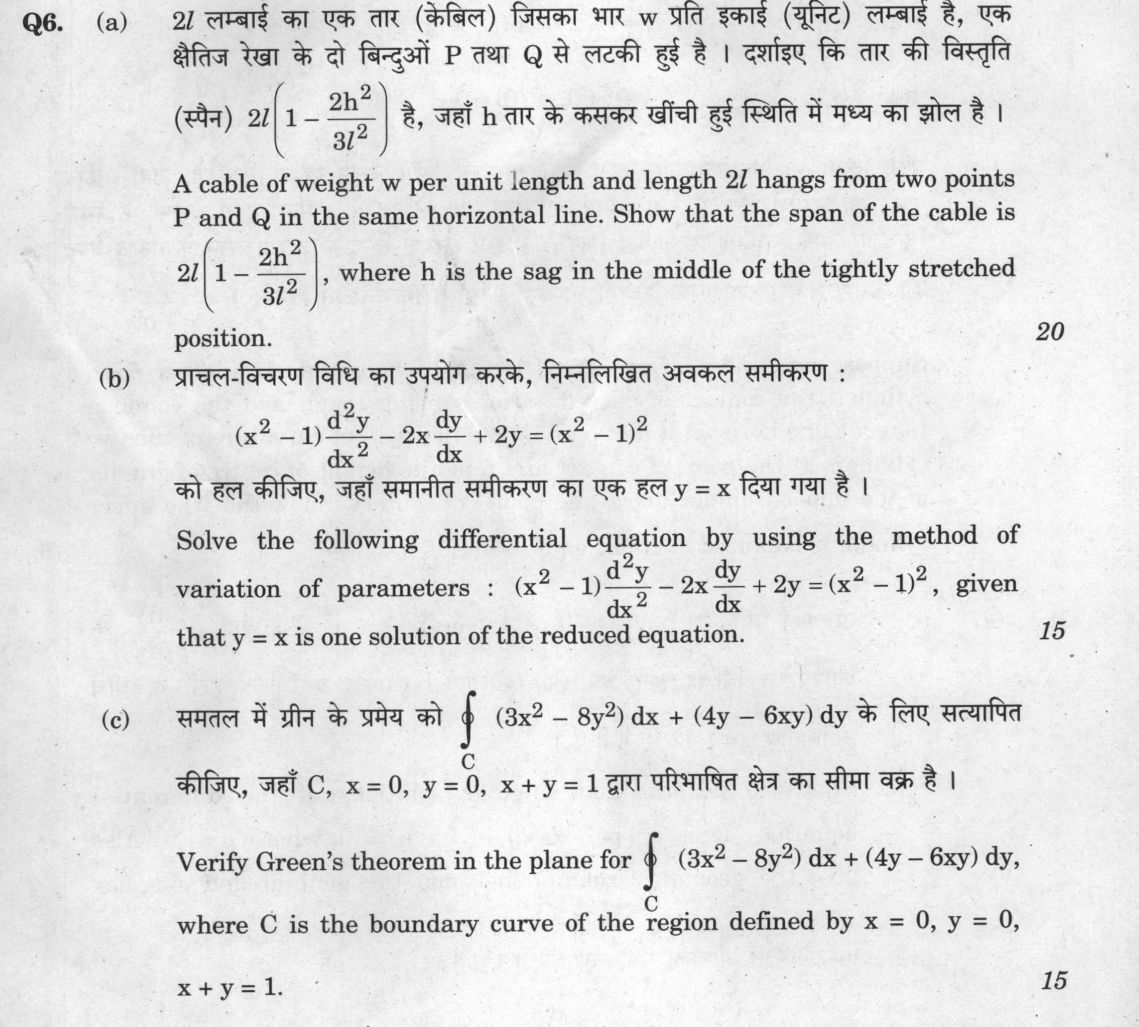
A cable of weight w per unit length and length 2lhangs from two points P and Q in the same horizontal line. Show that the span of the cable is2l(1 - (2h²)/(3l²)), whereh is the sag in the middle of the tightly stretched position. 20 marks
Solve the following differential equation by using the method of variation of parameters : (x² - 1)(d^2y)/(dx²) - 2xdy/dx + 2y = (x² - 1)², given that y = x is one solution of the reduced equation. 15 marks
Verify Green's theorem in the plane for displaystyle∮_C (3x² - 8y²) dx + (4y - 6xy) dy, where C is the boundary curve of the region defined by x = 0, y = 0, x + y = 1. 15 marks
हिंदी में प्रश्न पढ़ें
2lलम्बाई का एक तार (केबल) जिसका भारwप्रति इकाई (यूनिट) लम्बाई है, एक क्षैतिज रेखा के दो बिन्दुओं P तथा Q से लटकी हुई है। दर्शाइए कि तार की विस्तृति (स्पैन)2l(1 - (2h²)/(3l²))है, जहाँh तार के कसकर खींची हुई स्थिति में मध्य का झोल है। 20
प्राचल-विचरण विधि का उपयोग करके, निम्नलिखित अवकल समीकरण : (x² - 1)(d^2y)/(dx²) - 2xdy/dx + 2y = (x² - 1)² को हल कीजिए, जहाँ समानीत समीकरण का एक हल y = x दिया गया है। 15
समतल में ग्रीन के प्रमेय को displaystyle∮_C (3x² - 8y²) dx + (4y - 6xy) dy के लिए सत्यापित कीजिए, जहाँ C, x = 0, y = 0, x + y = 1 द्वारा परिभाषित क्षेत्र का सीमा वक्र है। 15
Model answer
Written by UPSC Answer Check against this question's marking rubric, to the expected length. UPSC does not publish answers for Mains — this is one way to score well, not an official key.
(a) Let S be the span. For a uniform cable, the catenary is y = c cosh(x/c), where c = T₀/w. Put u = S/(2c). Then the length is 2l = 2c sinh u, so 2l = S(sinh u/u). The middle sag is h = c(cosh u − 1), so h = S(cosh u − 1)/(2u).
For a tightly stretched cable u is small. Use expansions: sinh u/u = 1 + u²/6 + … (cosh u − 1)/(2u) = u/4 + u³/48 + … Hence u ≈ 4h/S. Therefore 2l ≈ S[1 + (4h/S)²/6] = S + 8h²/(3S). Thus S + 8h²/(3S) = 2l, so S² − 2lS + 8h²/3 = 0. Taking the larger root, S = l + √(l² − 8h²/3) = l + l(1 − 4h²/(3l²) + …) ≈ 2l − 4h²/(3l) = 2l(1 − 2h²/(3l²)). This proves the required span formula for h << l. The weight w cancels; all lengths are in the same unit.
(b) The reduced equation is (x² − 1)y″ − 2xy′ + 2y = 0. Given y₁ = x. Let y = xv. Then y′ = v + xv′, y″ = 2v′ + xv″. Substitution gives x(x² − 1)v″ − 2v′ = 0. Put p = v′. Then dp/p = 2 dx/[x(x² − 1)] = (−2/x + 1/(x−1) + 1/(x+1)) dx. Integrating, p = C(x² − 1)/x² = C(1 − 1/x²). So v = C(x + 1/x) + C₂, and hence a second independent solution is y₂ = x(x + 1/x) = x² + 1. Thus y_h = c₁x + c₂(x² + 1).
Write the equation in standard form: y″ − (2x/(x² − 1))y′ + (2/(x² − 1))y = x² − 1. Here R = x² − 1, y₁ = x, y₂ = x² + 1. The Wronskian is W = y₁y₂′ − y₁′y₂ = x(2x) − 1(x² + 1) = x² − 1. By variation of parameters, y_p = −y₁∫ y₂R/W dx + y₂∫ y₁R/W dx = −x∫(x² + 1)dx + (x² + 1)∫x dx = −x(x³/3 + x) + (x² + 1)(x²/2) = x⁴/6 − x²/2. Therefore y = c₁x + c₂(x² + 1) + x⁴/6 − x²/2, valid for x ≠ ±1.
(c) Green’s theorem states ∮_C (P dx + Q dy) = ∬_D (∂Q/∂x − ∂P/∂y)dA for positively oriented C. Here P = 3x² − 8y², Q = 4y − 6xy. So ∂Q/∂x = −6y, ∂P/∂y = −16y, and ∂Q/∂x − ∂P/∂y = 10y. The region D is the triangle with vertices (0,0), (1,0), (0,1). Hence ∬_D 10y dA = 10∫₀¹∫₀^1−x y dy dx = 5∫₀¹(1 − x)² dx = 5/3.
Now compute the line integral along C in the positive direction.
- C₁: y = 0, x from 0 to 1. ∫ 3x² dx = 1.
- C₂: x + y = 1 from (1,0) to (0,1). Let x = 1 − t, y = t, t from 0 to 1. Then dx = −dt, dy = dt, P = 3(1 − t)² − 8t² = 3 − 6t − 5t², Q = 4t − 6(1 − t)t = −2t + 6t². Thus ∫(P dx + Q dy) = ∫₀¹(Q − P)dt = ∫₀¹(4t + 11t² − 3)dt = 8/3.
- C₃: x = 0, y from 1 to 0. ∫ 4y dy = −2.
Therefore ∮_C (P dx + Q dy) = 1 + 8/3 − 2 = 5/3. This equals the double integral, so Green’s theorem is verified.
What "Prove" is asking you to do
Establish that the statement holds for every case it claims, not for one representative case. The argument must be closed: each line follows from a definition, a hypothesis, or a named theorem you are entitled to use.
Structure that answers it
Given and to prove, restated → theorem or construction to be used, named → the argument line by line → conclusion stated as proved
Where marks are lost
Testing one example, which illustrates but proves nothing. On an if and only if claim, proving one direction and stopping forfeits that half outright, and degenerate cases — zero, the empty set, the equality case — have to be disposed of rather than assumed away.
How this answer will be evaluated
Approach
(a) derive: given > assumptions > stepwise derivation > result > check | (b) calculate: given > formula > substitution > result with units > interpretation | (c) calculate: given > formula > substitution > result with units > interpretation Full marks: Complete derivations with all steps, correct final results, and clear diagrams.
Key points expected
- State catenary equation y = c cosh(x/c)
- Relate length 2l to span 2a and sag h
- Apply Taylor expansion for cosh(x/c)
- Solve for span in terms of l and h
- Find second solution y2 using reduction of order
- Compute Wronskian W(y1, y2)
- Set up and solve integrals for u1, u2
- State general solution y = y1u1 + y2u2
Evaluation rubric
Each sub-part is marked on its own, against the marks and word limit printed on the paper.
- (a) Derive the span formula for a hanging cable using catenary properties. 20 marks
derive— given → assumptions → stepwise derivation → result → check
Must cover
- State catenary equation y = c cosh(x/c)
- Relate length 2l to span 2a and sag h
- Apply Taylor expansion for cosh(x/c)
- Solve for span in terms of l and h
Loses marks
- Skipping Taylor expansion step
- Confusing arc length with span
Earns more
- Neat diagram of cable with P, Q, sag h
- Explicit definition of parameter c
Extra mark
- Mention parabolic approximation validity
- (b) Solve the ODE using variation of parameters given one solution. 15 marks
calculate— given → formula → substitution → result with units → interpretation
Must cover
- Find second solution y2 using reduction of order
- Compute Wronskian W(y1, y2)
- Set up and solve integrals for u1, u2
- State general solution y = y1u1 + y2u2
Loses marks
- Incorrect Wronskian calculation
- Missing particular solution terms
Earns more
- Verification of y=x as solution
- Clear identification of P(x) and Q(x)
Extra mark
- Check solution by substitution
- (c) Verify Green's theorem by computing both line and double integrals. 15 marks
calculate— given → formula → substitution → result with units → interpretation
Must cover
- Compute line integral over all 3 segments
- Compute double integral over triangular region
- Show both integrals yield equal values
- Define P and Q components correctly
Loses marks
- Incorrect limits of integration
- Missing one boundary segment
Earns more
- Neat diagram of triangular region
- Parametrization of each boundary segment
Extra mark
- Explicit statement of Green's theorem
Practice this exact question
Write your answer and it is marked point by point against the model answer above — what you covered, what you missed, what you got wrong.
Evaluate my answer →More from Mathematics 2022 Paper I
- Q3 (a) Let the set P = x y z middle| l x - y - z = 0 and 2x - y + z = 0 be the collection of…
- Q4 (a) Find a linear map T : R² → R² which rotates each vector of R² by an angle θ. Also, pr…
- Q5 (a) Show that the general solution of the differential equation dy/dx + Py = Q can be wri…
- Q6 (a) A cable of weight w per unit length and length 2lhangs from two points P and Q in the…
- Q7 (a) Verify Stokes' theorem for F⃗ = xî + z^2ĵ + y^2k̂ over the plane surface : x + y +…
- Q8 (a) (i) Find the general and singular solutions of the differential equation : (x² - a²)p…