Paper I — Q5
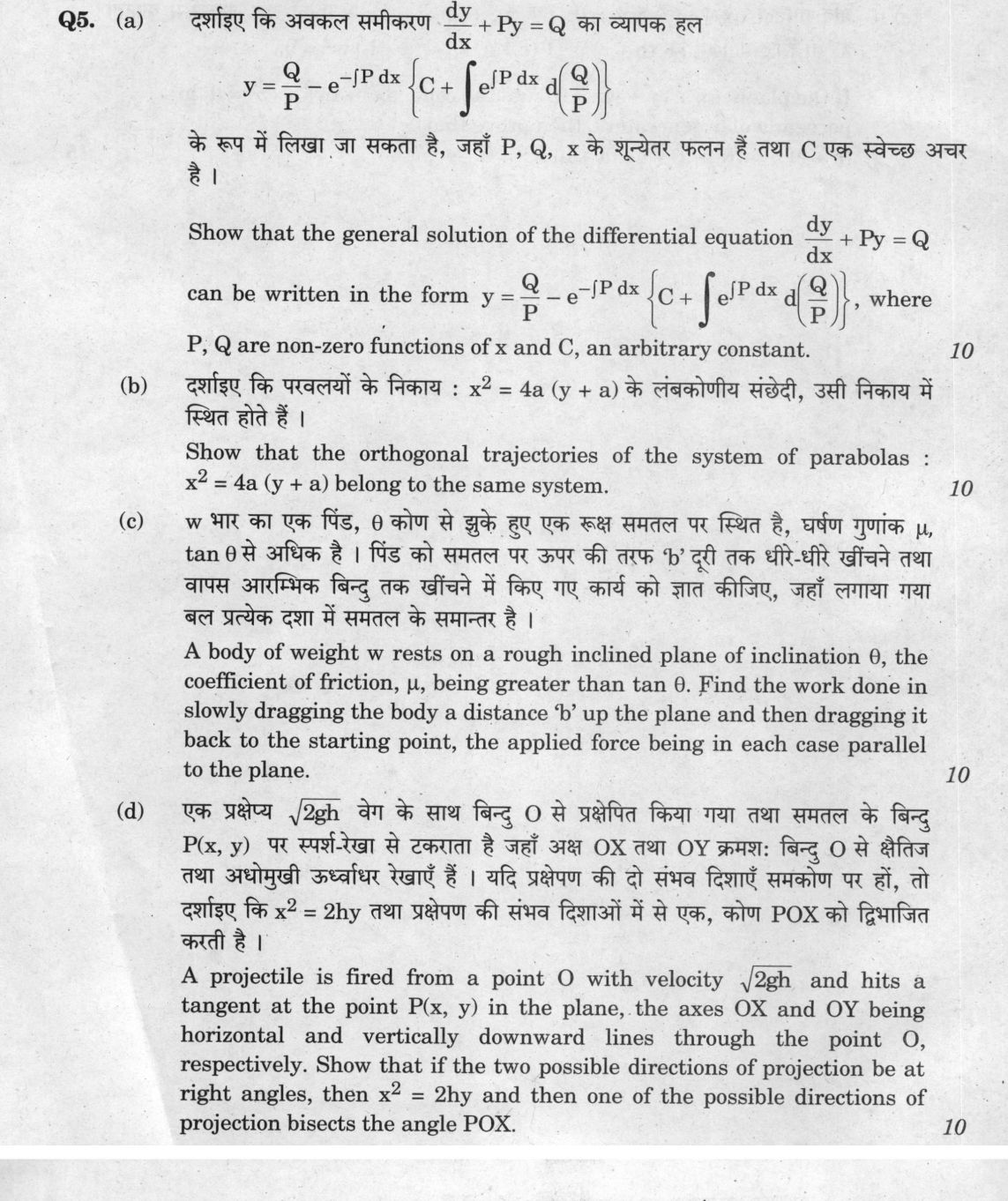
(a) Show that the general solution of the differential equation dy/dx + Py = Q can be written in the form y = Q/P - e⁻∫ P dxC + ∫…
Show that the general solution of the differential equation dy/dx + Py = Q can be written in the form y = Q/P - e⁻∫ P dxC + ∫ e^∫ P dx d(Q/P), where P, Q are non-zero functions of x and C, an arbitrary constant. 10 marks
Show that the orthogonal trajectories of the system of parabolas : x² = 4a(y + a) belong to the same system. 10 marks
A body of weight w rests on a rough inclined plane of inclination θ, the coefficient of friction, μ, being greater than tan θ. Find the work done in slowly dragging the body a distance 'b' up the plane and then dragging it back to the starting point, the applied force being in each case parallel to the plane. 10 marks
A projectile is fired from a point O with velocity √2gh and hits a tangent at the point P(x, y) in the plane, the axes OX and OY being horizontal and vertically downward lines through the point O, respectively. Show that if the two possible directions of projection be at right angles, then x² = 2hy and then one of the possible directions of projection bisects the angle POX. 10 marks
Show that A⃗ = (6xy + z³)î + (3x² - z)ĵ + (3xz² - y)k̂ is irrotational. Also find φ such that A⃗ = ∇φ. 10 marks
हिंदी में प्रश्न पढ़ें
दर्शाइए कि अवकल समीकरण dy/dx + Py = Q का व्यापक हल y = Q/P - e⁻∫ P dxC + ∫ e^∫ P dx d(Q/P) के रूप में लिखा जा सकता है, जहाँ P, Q, x के शून्येतर फलन हैं तथा C एक स्वेच्छ अचर है। 10
दर्शाइए कि परवलयों के निकाय : x² = 4a(y + a) के लंबकोणीय संहेडी, उसी निकाय में स्थित होते हैं। 10
w भार का एक पिंड, θ कोण से झुके हुए एक रूक्ष समतल पर स्थित है, घर्षण गुणांक μ, tan θ से अधिक है। पिंड को समतल पर ऊपर की तरफ 'b' दूरी तक धीरे-धीरे खींचने तथा वापस आरंभिक बिंदु तक खींचने में किए गए कार्य को ज्ञात कीजिए, जहाँ लगाया गया बल प्रत्येक दशा में समतल के समांतर है। 10
एक प्रक्षेप्य √2gh वेग के साथ बिंदु O से प्रक्षेपित किया गया तथा समतल के बिंदु P(x, y) पर स्पर्शरेखा से टकराता है जहाँ अक्ष OX तथा OY क्रमशः बिंदु O से क्षैतिज तथा अधोमुखी उर्ध्वाधर रेखाएँ हैं। यदि प्रक्षेपण की दो संभव दिशाएँ समकोण पर हों, तो दर्शाइए कि x² = 2hy तथा प्रक्षेपण की संभव दिशाओं में से एक, कोण POX को द्विभाजित करती है। 10
दर्शाइए कि A⃗ = (6xy + z³)î + (3x² - z)ĵ + (3xz² - y)k̂ अघूर्णी है। φ को भी ज्ञात कीजिए जबकि A⃗ = ∇φ। 10
Model answer
Written by UPSC Answer Check against this question's marking rubric, to the expected length. UPSC does not publish answers for Mains — this is one way to score well, not an official key.
(a) Let I = ∫ P dx. The equation is dy/dx + P y = Q. Using the integrating-factor method, multiply by exp(I):
exp(I) dy/dx + P y exp(I) = Q exp(I).
Since d(exp(I))/dx = P exp(I),
d/dx (y exp(I)) = Q exp(I).
Integrating,
y exp(I) = C + ∫ Q exp(I) dx.
Hence
y = exp(-I) [C + ∫ Q exp(I) dx].
Now Q exp(I) dx = (Q/P) d(exp(I)), because d(exp(I)) = P exp(I) dx. Therefore, by integration by parts,
∫ Q exp(I) dx = ∫ (Q/P) d(exp(I)) = (Q/P) exp(I) - ∫ exp(I) d(Q/P).
Substituting,
y = exp(-I) [C + (Q/P) exp(I) - ∫ exp(I) d(Q/P)].
Thus
y = Q/P + C exp(-I) - exp(-I) ∫ exp(I) d(Q/P).
Since C is arbitrary, replace C by -C. Hence
y = Q/P - exp(-I) [C + ∫ exp(I) d(Q/P)],
that is,
y = Q/P - e^(-∫ P dx) [C + ∫ e^(∫ P dx) d(Q/P)].
This is the required form. The result requires P ≠ 0 so that Q/P is defined.
Final answer: y = Q/P - e^(-∫ P dx) [C + ∫ e^(∫ P dx) d(Q/P)].
(b) The system of parabolas is
x² = 4a(y + a).
Differentiate with respect to x:
2x = 4a dy/dx.
Let p = dy/dx. Then
a = x/(2p).
Substitute this value of a into the original equation:
x² = 4 (x/(2p)) (y + x/(2p)).
Therefore,
x² = 2xy/p + x²/p².
Multiplying by p²,
x² p² = 2xy p + x².
Dividing by x²,
p² = (2y/x) p + 1.
Thus the differential equation of the given system is
p² - (2y/x) p - 1 = 0.
For an orthogonal trajectory, the slope m satisfies m = -1/p, i.e. p = -1/m. Substitute this into the differential equation:
1/m² = (2y/x)(-1/m) + 1.
Multiplying by m²,
1 = -(2y/x) m + m².
Hence
m² - (2y/x) m - 1 = 0.
This is exactly the same differential equation as the original system. Therefore the orthogonal trajectories satisfy the same differential equation and hence belong to the same family of parabolas, possibly with a different parameter.
Final answer: The orthogonal trajectories belong to the same system x² = 4a(y + a).
(c) Let the weight of the body be w. On the inclined plane of inclination θ, the normal reaction is
N = w cosθ.
Hence the limiting friction is
F_f = μ N = μ w cosθ.
It is given that μ > tanθ, so
μ cosθ > sinθ.
While dragging the body up the plane, friction acts down the plane. Therefore the applied force up the plane is
F₁ = w sinθ + μ w cosθ.
Work done in dragging it a distance b up the plane is
W₁ = F₁ b = w b (sinθ + μ cosθ).
While dragging it back down the plane, friction acts up the plane. Since μ cosθ > sinθ, the applied force must act down the plane to overcome the excess friction. Thus
F₂ = μ w cosθ - w sinθ.
Work done in dragging it back a distance b down the plane is
W₂ = F₂ b = w b (μ cosθ - sinθ).
Total work done by the applied force is
W = W₁ + W₂ = w b (sinθ + μ cosθ) + w b (μ cosθ - sinθ).
Therefore,
W = 2 μ w b cosθ.
The gravitational work cancels over the upward and downward journeys, while friction opposes motion in both directions.
Final answer: W = 2 μ w b cosθ. Units: joule if w is in newton and b in metre.
(d) Let the projectile speed be
u = √(2gh).
Measure θ positive below OX (the direction of OY), and write m = tanθ. Since OY is vertically downward, the equations of motion are
x = u cosθ t,
y = u sinθ t + (1/2) g t².
Eliminating t = x/(u cosθ),
y = x tanθ + (g x²)/(2u²) sec²θ.
Since sec²θ = 1 + tan²θ,
y = x m + (g x²)/(2u²) (1 + m²).
But u² = 2gh, so
g/(2u²) = g/(4gh) = 1/(4h).
Hence
y = x m + (x²/(4h)) (1 + m²).
Multiplying by 4h,
4h y = 4h x m + x² + x² m².
Thus
x² m² + 4h x m + x² - 4h y = 0.
This quadratic in m gives the two possible directions of projection. If their directions are at right angles, then
m₁ m₂ = -1.
The product of the roots of the quadratic is
m₁ m₂ = (x² - 4h y)/x².
Therefore,
(x² - 4h y)/x² = -1.
So
x² - 4h y = -x²,
which gives
2x² = 4h y,
and hence
x² = 2h y.
Now let φ = ∠POX. Since P = (x, y),
tanφ = y/x.
Using x² = 2h y, we get
tanφ = y/x = x/(2h).
Let t = tan(φ/2). Then
tanφ = 2t/(1 - t²).
Thus
2t/(1 - t²) = x/(2h).
Cross-multiplying,
4h t = x(1 - t²) = x - x t²,
so
x t² + 4h t - x = 0.
But under x² = 2h y, the projectile quadratic becomes
x² m² + 4h x m + x² - 4h y = 0.
Substitute 4h y = 2x²:
x² m² + 4h x m - x² = 0.
Dividing by x,
x m² + 4h m - x = 0.
This is the same quadratic as the one satisfied by t = tan(φ/2). Therefore one possible value of m is tan(φ/2). Hence one possible direction of projection makes angle φ/2 with OX, i.e. it bisects ∠POX.
Final answer: x² = 2h y, and one possible direction of projection bisects ∠POX.
(e) For the vector field
A = (6xy + z³) i + (3x² - z) j + (3xz² - y) k,
compute ∇ × A. Its components are:
(∇ × A)_x = ∂A_z/∂y - ∂A_y/∂z.
Here
∂A_z/∂y = ∂/∂y (3xz² - y) = -1,
and
∂A_y/∂z = ∂/∂z (3x² - z) = -1.
Thus
(∇ × A)_x = -1 - (-1) = 0.
Next,
(∇ × A)_y = ∂A_x/∂z - ∂A_z/∂x.
Now
∂A_x/∂z = ∂/∂z (6xy + z³) = 3z²,
and
∂A_z/∂x = ∂/∂x (3xz² - y) = 3z².
Hence
(∇ × A)_y = 3z² - 3z² = 0.
Finally,
(∇ × A)_z = ∂A_y/∂x - ∂A_x/∂y.
Now
∂A_y/∂x = ∂/∂x (3x² - z) = 6x,
and
∂A_x/∂y = ∂/∂y (6xy + z³) = 6x.
Therefore,
(∇ × A)_z = 6x - 6x = 0.
Thus
∇ × A = 0.
So A is irrotational.
Now find φ such that
A = ∇φ.
Thus
∂φ/∂x = 6xy + z³.
Integrating with respect to x,
φ = 3x² y + x z³ + f(y, z).
Differentiate with respect to y:
∂φ/∂y = 3x² + ∂f/∂y.
But this must equal A_y = 3x² - z. Hence
∂f/∂y = -z.
Integrating with respect to y,
f = -y z + g(z).
So
φ = 3x² y + x z³ - y z + g(z).
Differentiate with respect to z:
∂φ/∂z = 3x z² - y + g'(z).
This must equal A_z = 3x z² - y. Therefore,
g'(z) = 0,
so g(z) = C, a constant.
Hence
φ = 3x² y + x z³ - y z + C.
Final answer: A is irrotational, and φ = 3x² y + x z³ - y z + C.
What "Prove" is asking you to do
Establish that the statement holds for every case it claims, not for one representative case. The argument must be closed: each line follows from a definition, a hypothesis, or a named theorem you are entitled to use.
Structure that answers it
Given and to prove, restated → theorem or construction to be used, named → the argument line by line → conclusion stated as proved
Where marks are lost
Testing one example, which illustrates but proves nothing. On an if and only if claim, proving one direction and stopping forfeits that half outright, and degenerate cases — zero, the empty set, the equality case — have to be disposed of rather than assumed away.
How this answer will be evaluated
Approach
(a) derive: given > assumptions > stepwise derivation > result > check | (b) derive: given > assumptions > stepwise derivation > result > check | (c) calculate: given > formula > substitution > result with units > interpretation | (d) derive: given > assumptions > stepwise derivation > result > check | (e) derive: given > assumptions > stepwise derivation > result > check Full marks: Complete derivations with all steps shown, correct final results, and clear justifications.
Key points expected
- Identifies the equation as linear first-order ODE
- Calculates the integrating factor e^∫P dx
- Integrates the product of IF and Q
- Differentiates the given equation to find dy/dx
- Eliminates the parameter 'a' to get the differential equation
- Replaces dy/dx with -dx/dy for orthogonal trajectories
- Solves the new ODE to show it matches the original system
- Draws a free body diagram for the body
Evaluation rubric
Each sub-part is marked on its own, against the marks and word limit printed on the paper.
- (a) Derive the general solution of the linear differential equation dy/dx + Py = Q. 10 marks
derive— given → assumptions → stepwise derivation → result → check
Must cover
- Identifies the equation as linear first-order ODE
- Calculates the integrating factor e^∫P dx
- Integrates the product of IF and Q
Loses marks
- Skipping the derivation of the integrating factor
- Failing to show the specific rearrangement to the required form
Earns more
- Explicitly states the standard solution form first
- Shows the algebraic manipulation to isolate y
Extra mark
- Verifies the result by differentiating
- (b) Show that the orthogonal trajectories of x² = 4a(y + a) are the same system. 10 marks
derive— given → assumptions → stepwise derivation → result → check
Must cover
- Differentiates the given equation to find dy/dx
- Eliminates the parameter 'a' to get the differential equation
- Replaces dy/dx with -dx/dy for orthogonal trajectories
- Solves the new ODE to show it matches the original system
Loses marks
- Failing to eliminate the parameter 'a' correctly
- Using the wrong slope for orthogonal trajectories
Earns more
- Clearly states the condition for orthogonal trajectories
- Shows the substitution of -a for a in the final step
Extra mark
- Sketches the family of parabolas and their orthogonal trajectories
- (c) Calculate the work done in dragging a body up and down a rough inclined plane. 10 marks
calculate— given → formula → substitution → result with units → interpretation
Must cover
- Draws a free body diagram for the body
- Calculates the applied force for upward motion
- Calculates the applied force for downward motion
- Computes total work as sum of work in both directions
Loses marks
- Ignoring the change in friction direction
- Calculating work for only one direction
Earns more
- Explicitly states the friction force direction in each case
- Uses the condition μ > tan θ to justify motion
Extra mark
- Notes that work done against friction is always positive
- (d) Show that x² = 2hy and one direction bisects angle POX for perpendicular projections. 10 marks
derive— given → assumptions → stepwise derivation → result → check
Must cover
- Writes the trajectory equation for the projectile
- Applies the condition that the two angles are perpendicular
- Derives the relation x² = 2hy from the condition
- Proves that one angle of projection bisects angle POX
Loses marks
- Failing to use the perpendicularity condition correctly
- Skipping the proof of the angle bisection
Earns more
- Uses the property that product of tangents is -1
- Clearly defines the angles of projection
Extra mark
- Provides a geometric diagram illustrating the angle bisection
- (e) Show that the vector field is irrotational and find the potential function φ. 10 marks
derive— given → assumptions → stepwise derivation → result → check
Must cover
- Calculates the curl of the vector field A
- Shows that the curl is the zero vector
- Integrates the components to find φ
- Verifies that ∇φ equals the original vector field A
Loses marks
- Making errors in partial differentiation for the curl
- Failing to verify the final potential function
Earns more
- States the condition for a field to be irrotational
- Shows the integration steps clearly for each component
Extra mark
- Mentions that the field is conservative
Practice this exact question
Write your answer and it is marked point by point against the model answer above — what you covered, what you missed, what you got wrong.
Evaluate my answer →More from Mathematics 2022 Paper I
- Q2 (a) Find all solutions to the following system of equations by row-reduced method : x₁ +…
- Q3 (a) Let the set P = x y z middle| l x - y - z = 0 and 2x - y + z = 0 be the collection of…
- Q4 (a) Find a linear map T : R² → R² which rotates each vector of R² by an angle θ. Also, pr…
- Q5 (a) Show that the general solution of the differential equation dy/dx + Py = Q can be wri…
- Q6 (a) A cable of weight w per unit length and length 2lhangs from two points P and Q in the…
- Q7 (a) Verify Stokes' theorem for F⃗ = xî + z^2ĵ + y^2k̂ over the plane surface : x + y +…
- Q8 (a) (i) Find the general and singular solutions of the differential equation : (x² - a²)p…