Paper I — Q2
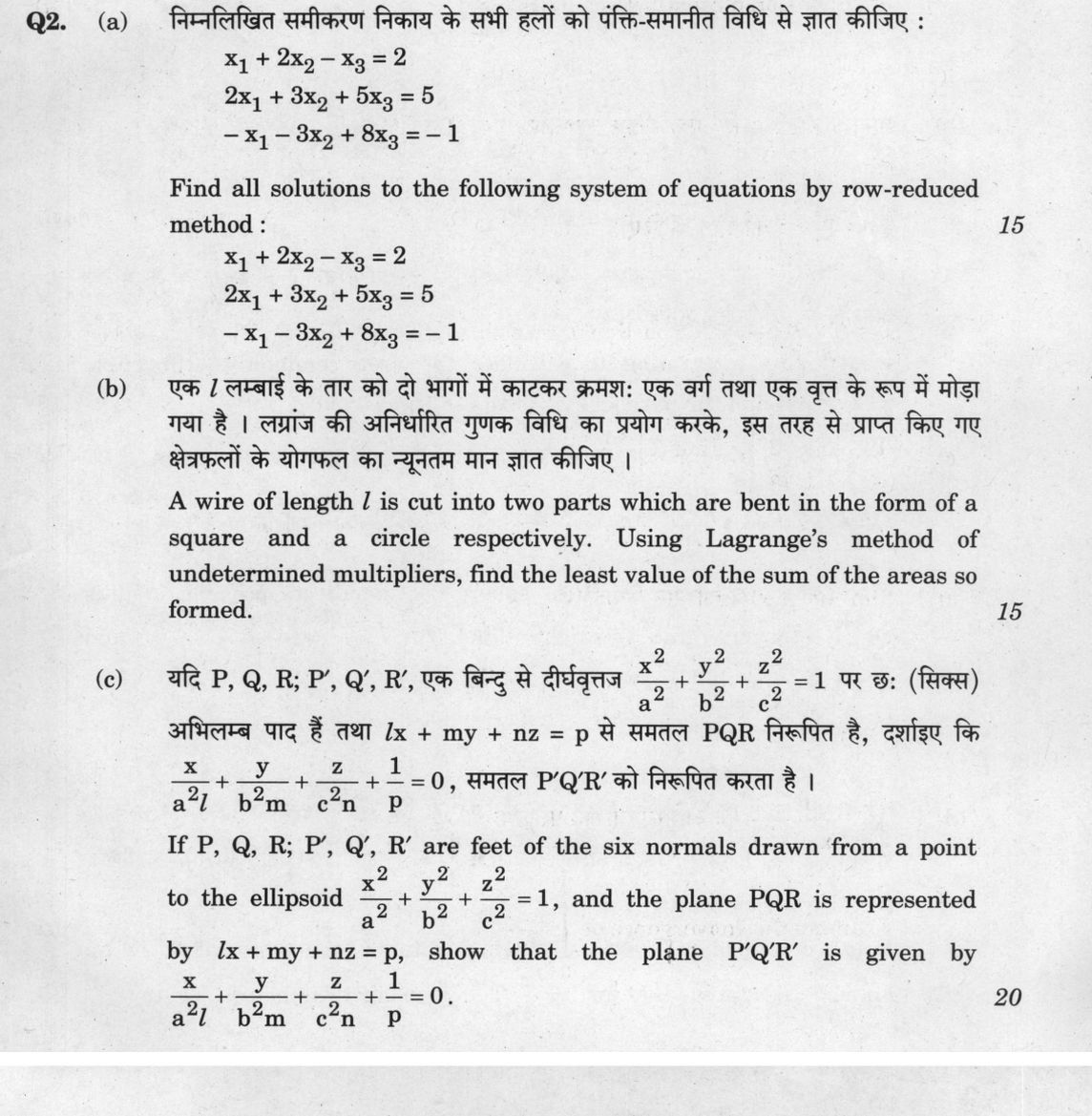
(a) Find all solutions to the following system of equations by row-reduced method : x₁ + 2x₂ − x₃ = 2, 2x₁ + 3x₂ + 5x₃ = 5, − x₁…
Find all solutions to the following system of equations by row-reduced method : x₁ + 2x₂ − x₃ = 2, 2x₁ + 3x₂ + 5x₃ = 5, − x₁ − 3x₂ + 8x₃ = − 1. 15 marks
A wire of length l is cut into two parts which are bent in the form of a square and a circle respectively. Using Lagrange's method of undetermined multipliers, find the least value of the sum of the areas so formed. 15 marks
If P, Q, R; P', Q', R' are feet of the six normals drawn from a point to the ellipsoid x²/a² + y²/b² + z²/c² = 1, and the plane PQR is represented by lx + my + nz = p, show that the plane P'Q'R' is given by x/a²l + y/b²m + z/c²n + 1/p = 0. 20 marks
हिंदी में प्रश्न पढ़ें
निम्नलिखित समीकरण निकाय के सभी हलों को पंक्ति-समानित विधि से ज्ञात कीजिए : x₁ + 2x₂ − x₃ = 2, 2x₁ + 3x₂ + 5x₃ = 5, − x₁ − 3x₂ + 8x₃ = − 1. 15 marks
एक l लम्बाई के तार को दो भागों में काटकर क्रमशः एक वर्ग तथा एक वृत्त के रूप में मोड़ा गया है । लग्रांज की अनिर्धारित गुणक विधि का प्रयोग करके, इस तरह से प्राप्त किए गए क्षेत्रफलों के योगफल का न्यूनतम मान ज्ञात कीजिए । 15
यदि P, Q, R; P', Q', R', एक बिंदु से दीर्घवृत्तज x²/a² + y²/b² + z²/c² = 1 पर छः (सिक्स) अभिलंब पाद हैं तथा lx + my + nz = p से समतल PQR निरूपित है, दर्शाइए कि x/a²l + y/b²m + z/c²n + 1/p = 0, समतल P'Q'R' को निरूपित करता है । 20
Model answer
Written by UPSC Answer Check against this question's marking rubric, to the expected length. UPSC does not publish answers for Mains — this is one way to score well, not an official key.
(a) The system is x₁+2x₂−x₃=2, 2x₁+3x₂+5x₃=5, −x₁−3x₂+8x₃=−1.
Augmented matrix: [1 2 −1 | 2] [2 3 5 | 5] [−1 −3 8 | −1]
Use row-reduced method. R₂→R₂−2R₁, R₃→R₃+R₁:
[1 2 −1 | 2] [0 −1 7 | 1] [0 −1 7 | 1]
R₃→R₃−R₂:
[1 2 −1 | 2] [0 −1 7 | 1] [0 0 0 | 0]
R₂→−R₂:
[1 2 −1 | 2] [0 1 −7 | −1] [0 0 0 | 0]
R₁→R₁−2R₂:
[1 0 13 | 4] [0 1 −7 | −1] [0 0 0 | 0]
Hence x₁+13x₃=4 and x₂−7x₃=−1. Let x₃=t, t∈ℝ. Then x₁=4−13t, x₂=−1+7t, x₃=t.
Final answer: (x₁,x₂,x₃)=(4−13t, −1+7t, t), t∈ℝ.
(b) Let the length used for the square be x and for the circle be y. Then x+y=l. Area of square = (x/4)²=x²/16. If y is circumference of circle, radius = y/(2π), so area = y²/(4π). Minimise A=x²/16 + y²/(4π) subject to x+y=l.
Using Lagrange multiplier λ, take F=x²/16 + y²/(4π)+λ(x+y−l).
Then ∂F/∂x=x/8+λ=0 ⟹ λ=−x/8, ∂F/∂y=y/(2π)+λ=0 ⟹ λ=−y/(2π).
Thus x/8=y/(2π) ⟹ y=πx/4.
Using x+y=l: x+πx/4=l ⟹ x=4l/(π+4), y=πl/(π+4).
Minimum area: A=x²/16+y²/(4π) = [16l²/(π+4)²]/16 + [π²l²/(π+4)²]/(4π) = l²/(π+4)² + πl²/[4(π+4)²] = (π+4)l²/[4(π+4)²] = l²/[4(π+4)].
Final answer: minimum sum of areas = l²/[4(π+4)] square units.
(c) Let A=a², B=b², C=c². Let the fixed point from which the six normals are drawn be (α,β,γ). At a foot (x,y,z), the normal direction is proportional to (x/A, y/B, z/C). Since (α,β,γ) lies on this normal, for a parameter μ, α=x(1+μ/A), β=y(1+μ/B), γ=z(1+μ/C), so x=αA/(A+μ), y=βB/(B+μ), z=γC/(C+μ).
The six normal feet correspond to the six roots μ₁,μ₂,…,μ₆ of α²A/(A+μ)² + β²B/(B+μ)² + γ²C/(C+μ)² = 1. Let P,Q,R correspond to μ₁,μ₂,μ₃. Their plane is lx+my+nz=p.
Substituting x,y,z in terms of μ and multiplying by (A+μ)(B+μ)(C+μ), define R(μ)=lαA(B+μ)(C+μ)+mβB(A+μ)(C+μ) +nγC(A+μ)(B+μ)−p(A+μ)(B+μ)(C+μ). Since μ₁,μ₂,μ₃ are roots, R(μ)=−p(μ−μ₁)(μ−μ₂)(μ−μ₃).
Putting μ=−A gives lαA(B−A)(C−A)=p(A+μ₁)(A+μ₂)(A+μ₃). (1)
Similarly, mβB(A−B)(C−B)=p(B+μ₁)(B+μ₂)(B+μ₃), (2) nγC(A−C)(B−C)=p(C+μ₁)(C+μ₂)(C+μ₃). (3)
Now consider the polynomial corresponding to the proposed plane x/(A l)+y/(B m)+z/(C n)+1/p=0:
S(μ)=α/l(B+μ)(C+μ)+β/m(A+μ)(C+μ) +γ/n(A+μ)(B+μ)+(1/p)(A+μ)(B+μ)(C+μ).
Its leading coefficient is 1/p.
From the normal equation, multiplying by (A+μ)²(B+μ)²(C+μ)², the resulting degree-six polynomial has roots μ₁,…,μ₆ and leading coefficient −1. Evaluating at μ=−A gives (A+μ₁)(A+μ₂)…(A+μ₆)=−α²A(B−A)²(C−A)². Using (1), (A+μ₄)(A+μ₅)(A+μ₆)=−pα(B−A)(C−A)/l.
Hence S(−A)=α(B−A)(C−A)/l =(1/p)(−A−μ₄)(−A−μ₅)(−A−μ₆).
Similarly, using (2) and (3), S(−B)=(1/p)(−B−μ₄)(−B−μ₅)(−B−μ₆), S(−C)=(1/p)(−C−μ₄)(−C−μ₅)(−C−μ₆).
Both S(μ) and T(μ)=(1/p)(μ−μ₄)(μ−μ₅)(μ−μ₆) are cubics with the same leading coefficient 1/p and agree at the three distinct points μ=−A,−B,−C (for the non-degenerate case; otherwise use continuity). Hence S(μ)=T(μ). Thus S(μ)=0 for μ=μ₄,μ₅,μ₆, so P',Q',R' lie on x/(a²l)+y/(b²m)+z/(c²n)+1/p=0.
Final answer: P'Q'R' is x/(a²l)+y/(b²m)+z/(c²n)+1/p=0, provided l,m,n,p≠0.
What "Solve" is asking you to do
Choose the method, then carry it through to a final answer. Identifying what kind of problem this is and why that method applies is the first thing marked; a correct figure arrived at invisibly earns almost nothing.
Structure that answers it
Given data and what is required → method chosen, with the reason it applies → set-up (equation, circuit, free body, trial balance) → working, step by step → answer with units and any condition of validity
Where marks are lost
Doing the middle steps mentally and writing only the result. In mathematics papers, a further loss comes from giving a decimal where the exact value in surds or fractions was wanted, or from skipping the justification a part explicitly asks for.
How this answer will be evaluated
Approach
(a) calculate: given > formula > substitution > result with units > interpretation | (b) calculate: given > formula > substitution > result with units > interpretation | (c) justify: claim > 3-4 reasons > evidence > conclusion Full marks: Complete, stepwise derivations with all justifications and checks.
Key points expected
- Form the augmented matrix of the system
- Perform row operations to reach RREF
- State the unique solution for x1, x2, x3
- Verify the solution in the original equations
- Define variables for side and radius
- State the constraint 4s + 2πr = l
- Form Lagrangian with multiplier λ
- Solve ∂L/∂s = 0 and ∂L/∂r = 0
Evaluation rubric
Each sub-part is marked on its own, against the marks and word limit printed on the paper.
- (a) Solve the 3x3 linear system using the row-reduced method. 15 marks
calculate— given → formula → substitution → result with units → interpretation
Must cover
- Form the augmented matrix of the system
- Perform row operations to reach RREF
- State the unique solution for x1, x2, x3
- Verify the solution in the original equations
Loses marks
- Skipping intermediate row-reduction steps
- Arithmetic errors in matrix entries
Earns more
- Explicitly label each row operation (e.g., R2 -> R2 - 2R1)
- Check for consistency before solving
Extra mark
- Alternative solution via Cramer's rule noted briefly
- (b) Minimize the sum of areas of a square and circle formed from a wire of length l. 15 marks
calculate— given → formula → substitution → result with units → interpretation
Must cover
- Define variables for side and radius
- State the constraint 4s + 2πr = l
- Form Lagrangian with multiplier λ
- Solve ∂L/∂s = 0 and ∂L/∂r = 0
Loses marks
- Incorrect area formulas for square or circle
- Failing to use the constraint in the Lagrangian
Earns more
- Calculate the minimum value of the sum of areas
- Verify the second-order condition for a minimum
Extra mark
- Comparison with the maximum area case
- (c) Prove the equation of the plane P'Q'R' for the ellipsoid normals. 20 marks
justify— claim → 3-4 reasons → evidence → conclusion
Must cover
- State the normal condition for the ellipsoid
- Relate the feet of normals to the point
- Use the given plane equation lx + my + nz = p
- Derive the equation for the plane P'Q'R'
Loses marks
- Skipping the derivation of the normal condition
- Incorrect algebraic manipulation of the plane equation
Earns more
- Explicitly define the coordinates of P, Q, R, P', Q', R'
- Show the symmetry between the two planes
Extra mark
- Geometric interpretation of the two planes
Practice this exact question
Write your answer and it is marked point by point against the model answer above — what you covered, what you missed, what you got wrong.
Evaluate my answer →More from Mathematics 2022 Paper I
- Q1 (a) Prove that any set of n linearly independent vectors in a vector space V of dimension…
- Q2 (a) Find all solutions to the following system of equations by row-reduced method : x₁ +…
- Q3 (a) Let the set P = x y z middle| l x - y - z = 0 and 2x - y + z = 0 be the collection of…
- Q4 (a) Find a linear map T : R² → R² which rotates each vector of R² by an angle θ. Also, pr…
- Q5 (a) Show that the general solution of the differential equation dy/dx + Py = Q can be wri…