Paper I — Q7
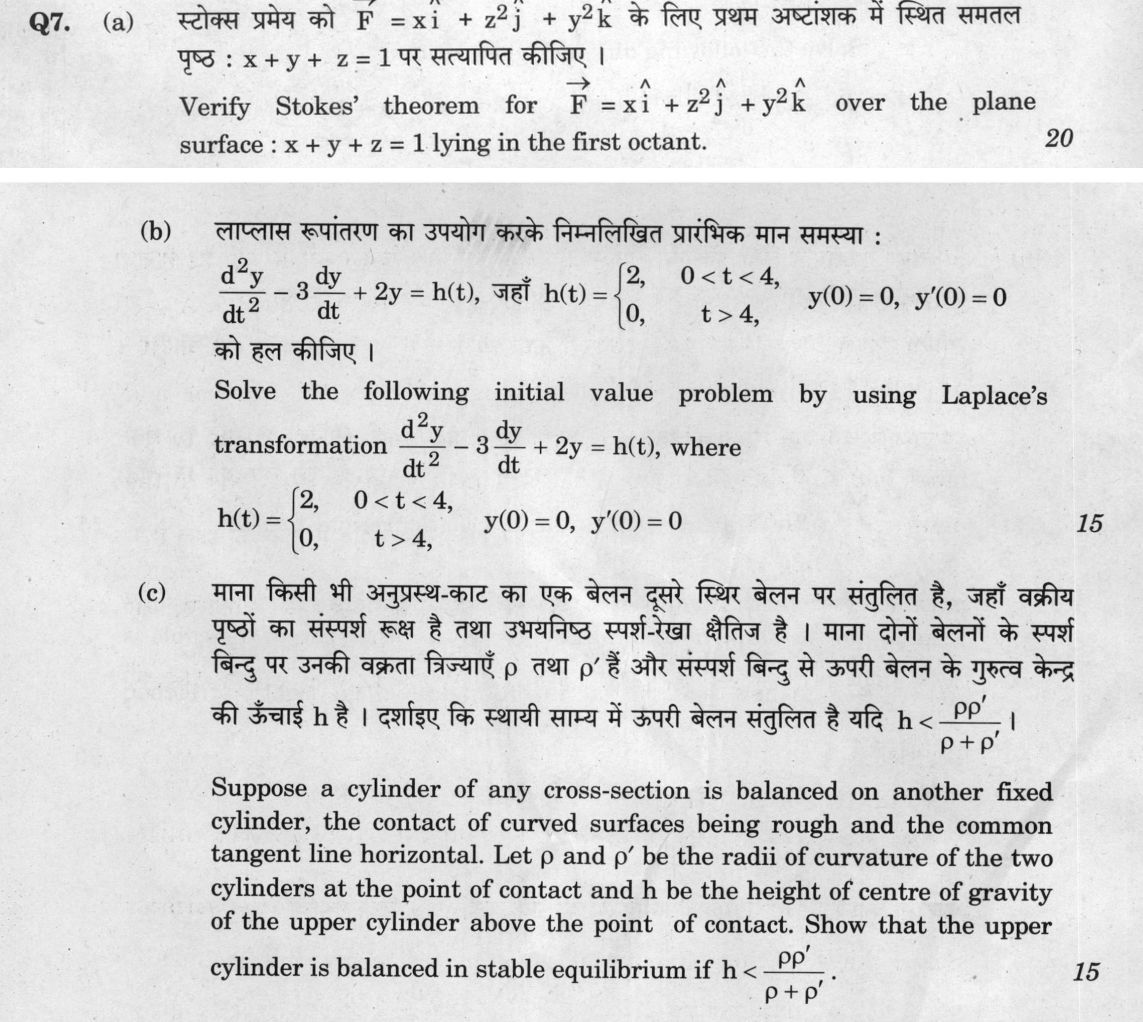
(a) Verify Stokes' theorem for F⃗ = xî + z^2ĵ + y^2k̂ over the plane surface : x + y + z = 1 lying in the first octant. 20 (b)…
Verify Stokes' theorem for F⃗ = xî + z^2ĵ + y^2k̂ over the plane surface : x + y + z = 1 lying in the first octant. 20 marks
Solve the following initial value problem by using Laplace's transformation (d^2y)/(dt²) - 3dy/dt + 2y = h(t), where h(t) = 2, & 0 < t < 4, 0, & t > 4, y(0) = 0, y'(0) = 0 15
Suppose a cylinder of any cross-section is balanced on another fixed cylinder, the contact of curved surfaces being rough and the common tangent line horizontal. Let ρ and ρ' be the radii of curvature of the two cylinders at the point of contact and h be the height of centre of gravity of the upper cylinder above the point of contact. Show that the upper cylinder is balanced in stable equilibrium if h < (ρρ')/(ρ+ρ'). 15 marks
हिंदी में प्रश्न पढ़ें
स्टोक्स प्रमेय को F⃗ = xî + z^2ĵ + y^2k̂ के लिए प्रथम अष्टांशक में स्थित समतल पृष्ठ : x + y + z = 1 पर सत्यापित कीजिए। 20
लाप्लास रूपांतरण का उपयोग करके निम्नलिखित प्रारंभिक मान समस्या : (d^2y)/(dt²) - 3dy/dt + 2y = h(t), जहाँ h(t) = 2, & 0 < t < 4, 0, & t > 4, y(0) = 0, y'(0) = 0 को हल कीजिए । 15
माना किसी भी अनुप्रस्थ-काट का एक बेलन दूसरे स्थिर बेलन पर संतुलित है, जहाँ वक्रीय पृष्ठों का संपर्श रूक्ष है तथा उभयनिष्ठ स्पर्श-रेखा क्षैतिज है । माना दोनों बेलनों के स्पर्श बिंदु पर उनकी वक्रता त्रिज्याएं ρ तथा ρ' हैं और संपर्श बिंदु से ऊपरी बेलन के गुरुत्व केंद्र की ऊँचाई h है । दर्शाइए कि स्थायी साम्य में ऊपरी बेलन संतुलित है यदि h < (ρρ')/(ρ+ρ') । 15
Model answer
Written by UPSC Answer Check against this question's marking rubric, to the expected length. UPSC does not publish answers for Mains — this is one way to score well, not an official key.
(a) Let F = x i + z² j + y² k. By Stokes’ theorem, ∫_C F·dr = ∬_S (∇×F)·n dS, with the boundary orientation chosen by the right-hand rule.
First compute ∇×F: ∇×F = (∂R/∂y − ∂Q/∂z)i + (∂P/∂z − ∂R/∂x)j + (∂Q/∂x − ∂P/∂y)k = (2y − 2z)i + 0j + 0k = 2(y − z)i.
The surface is x + y + z = 1, first octant. Take the upward normal. Since z = 1 − x − y, the vector area element is N dxdy = (1, 1, 1) dxdy. Hence ∬_S (∇×F)·n dS = ∬_D 2(y − z) dxdy, where D: x ≥ 0, y ≥ 0, x + y ≤ 1. Using z = 1 − x − y, 2(y − z) = 2[y − (1 − x − y)] = 2(x + 2y − 1). Thus ∬_S = ∫_0^1 ∫_0^(1−x) 2(x + 2y − 1) dy dx. Inner integral: 2[(x − 1)y + y²]_0^(1−x) = 2[(x − 1)(1 − x) + (1 − x)²] = 2[−(1 − x)² + (1 − x)²] = 0. So the surface integral is 0.
Boundary C has vertices A(1,0,0), B(0,1,0), C(0,0,1), oriented A→B→C→A for the upward normal.
On AB: x = 1 − t, y = t, z = 0, t: 0→1. ∫_AB F·dr = ∫_0^1 −(1 − t) dt = −1/2.
On BC: x = 0, y = 1 − t, z = t, t: 0→1. ∫_BC F·dr = ∫_0^1 [t²(−1) + (1 − t)²] dt = ∫_0^1 (1 − 2t) dt = 0.
On CA: y = 0, x = t, z = 1 − t, t: 0→1. ∫_CA F·dr = ∫_0^1 t dt = 1/2.
Therefore ∫_C F·dr = −1/2 + 0 + 1/2 = 0. This equals the surface integral, so Stokes’ theorem is verified.
(b) Let Y(s) = L{y(t)}. Since h(t) = 2[u(t) − u(t − 4)], H(s) = L{h(t)} = 2/s − 2e^(−4s)/s. Using Laplace transformation and y(0) = y′(0) = 0: (s² − 3s + 2)Y = H(s) => (s − 1)(s − 2)Y = 2(1 − e^(−4s))/s. Hence Y(s) = 2(1 − e^(−4s))/[s(s − 1)(s − 2)]. Now 1/[s(s − 1)(s − 2)] = 1/(2s) − 1/(s − 1) + 1/[2(s − 2)]. So Y(s) = (1 − e^(−4s))[1/s − 2/(s − 1) + 1/(s − 2)]. Inverse transform: L⁻¹{1/s − 2/(s − 1) + 1/(s − 2)} = 1 − 2e^t + e^(2t). By the second shifting theorem, y(t) = 1 − 2e^t + e^(2t) − u(t − 4)[1 − 2e^(t−4) + e^(2(t−4))]. Thus For 0 ≤ t < 4, y(t) = 1 − 2e^t + e^(2t) = (e^t − 1)². For t > 4, y(t) = 1 − 2e^t + e^(2t) − 1 + 2e^(t−4) − e^(2t−8) = e^(2t) − 2e^t + 2e^(t−4) − e^(2t−8).
(c) Let the lower fixed cylinder have radius of curvature ρ′ at the contact, and the upper cylinder have radius of curvature ρ. Let the upper cylinder roll through a small angle α of contact along the fixed lower surface. The normal at contact turns through α, and the lower arc length is s = ρ′α.
For rolling without slipping, the upper cylinder rotates through φ, where the velocity of the contact point on the upper cylinder is zero. At the initial instant, the centre of curvature of the upper cylinder is distant ρ from contact, and that of the lower is ρ′. Differentiating the contact geometry gives φ′ = −((ρ + ρ′)/ρ)α′, so φ = −((ρ + ρ′)/ρ)α.
Let G be the centre of gravity of the upper cylinder, initially height h above the contact. Relative to the upper centre of curvature, the vector to G has vertical component h − ρ. After the small roll, the height of G above the fixed lower centre is y_G = (ρ + ρ′)cosα + (h − ρ)cosφ. Initially, y_G(0) = ρ′ + h. Expanding for small α: y_G − y_G(0) = −1/2[(ρ + ρ′) + (h − ρ)((ρ + ρ′)/ρ)²]α² + higher powers. For stable equilibrium, the potential energy must increase for small displacement, so the coefficient of α² must be negative: (ρ + ρ′) + (h − ρ)((ρ + ρ′)/ρ)² < 0. Simplifying, (ρ + ρ′)[1 + (h − ρ)(ρ + ρ′)/ρ²] < 0 => ρ² + (h − ρ)(ρ + ρ′) < 0 => h(ρ + ρ′) < ρρ′. Hence the upper cylinder is in stable equilibrium if h < ρρ′/(ρ + ρ′).
What "Verify" is asking you to do
Compute both sides independently and show they agree. Verification is neither a derivation nor a fresh solution — the result is already given, so the marks lie in the two computations being carried out separately and then compared in words.
Structure that answers it
The claim, restated → one side computed in full → the other side computed in full → the two compared → verdict stated
Where marks are lost
Evaluating one side and asserting the other follows. Equally costly is finishing both and never writing the closing line that the theorem or test is verified, and not checking that the surface, region or data actually satisfies the conditions the theorem requires.
How this answer will be evaluated
Approach
Framework: UPSC Mathematics Paper 1. (a) derive: given > assumptions > stepwise derivation > result > check | (b) calculate: given > formula > substitution > result with units > interpretation | (c) justify: claim > 3-4 reasons > evidence > conclusion Full marks: Complete, rigorous derivations with all steps shown and correct final results.
Key points expected
- Define boundary curve C in first octant
- Compute line integral ∮ F · dr
- Compute surface integral ∬ (∇ × F) · n̂ dS
- Show both integrals yield the same value
- Apply Laplace transform to the differential equation
- Represent h(t) using unit step functions
- Solve for Y(s) in the s-domain
- Perform inverse Laplace transform to find y(t)
Evaluation rubric
Each sub-part is marked on its own, against the marks and word limit printed on the paper.
- (a) Prove equality of line integral over boundary and surface integral of curl over the plane. 20 marks
derive— given → assumptions → stepwise derivation → result → check
Must cover
- Define boundary curve C in first octant
- Compute line integral ∮ F · dr
- Compute surface integral ∬ (∇ × F) · n̂ dS
- Show both integrals yield the same value
Loses marks
- Incorrect orientation of the boundary curve
- Arithmetic errors in the integration steps
Earns more
- Correct parameterization of the boundary
- Explicit calculation of the curl vector
- Correct determination of the normal vector n̂
Extra mark
- Neat sketch of the triangular surface and boundary
- (b) Find y(t) for the given ODE using Laplace transforms. 15 marks
calculate— given → formula → substitution → result with units → interpretation
Must cover
- Apply Laplace transform to the differential equation
- Represent h(t) using unit step functions
- Solve for Y(s) in the s-domain
- Perform inverse Laplace transform to find y(t)
Loses marks
- Incorrect transform of the piecewise function h(t)
- Failure to apply initial conditions y(0)=0, y'(0)=0
Earns more
- Correct use of the second shifting theorem
- Partial fraction decomposition of Y(s)
Extra mark
- Verification of the solution by substitution
- (c) Derive the condition for stable equilibrium of the upper cylinder. 15 marks
justify— claim → 3-4 reasons → evidence → conclusion
Must cover
- Define the geometry of the two cylinders
- Express the height of the center of gravity
- Analyze the change in height for a small displacement
- Derive the inequality h < ρρ'/(ρ+ρ')
Loses marks
- Incorrect geometric relationship between the radii and displacement
- Failure to relate the height change to the stability condition
Earns more
- Use of the condition for stable equilibrium (minimum potential energy)
- Clear geometric derivation of the displacement
Extra mark
- Neat diagram showing the cylinders and displacement
Practice this exact question
Write your answer and it is marked point by point against the model answer above — what you covered, what you missed, what you got wrong.
Evaluate my answer →More from Mathematics 2022 Paper I
- Q4 (a) Find a linear map T : R² → R² which rotates each vector of R² by an angle θ. Also, pr…
- Q5 (a) Show that the general solution of the differential equation dy/dx + Py = Q can be wri…
- Q6 (a) A cable of weight w per unit length and length 2lhangs from two points P and Q in the…
- Q7 (a) Verify Stokes' theorem for F⃗ = xî + z^2ĵ + y^2k̂ over the plane surface : x + y +…
- Q8 (a) (i) Find the general and singular solutions of the differential equation : (x² - a²)p…