Paper I — Q8
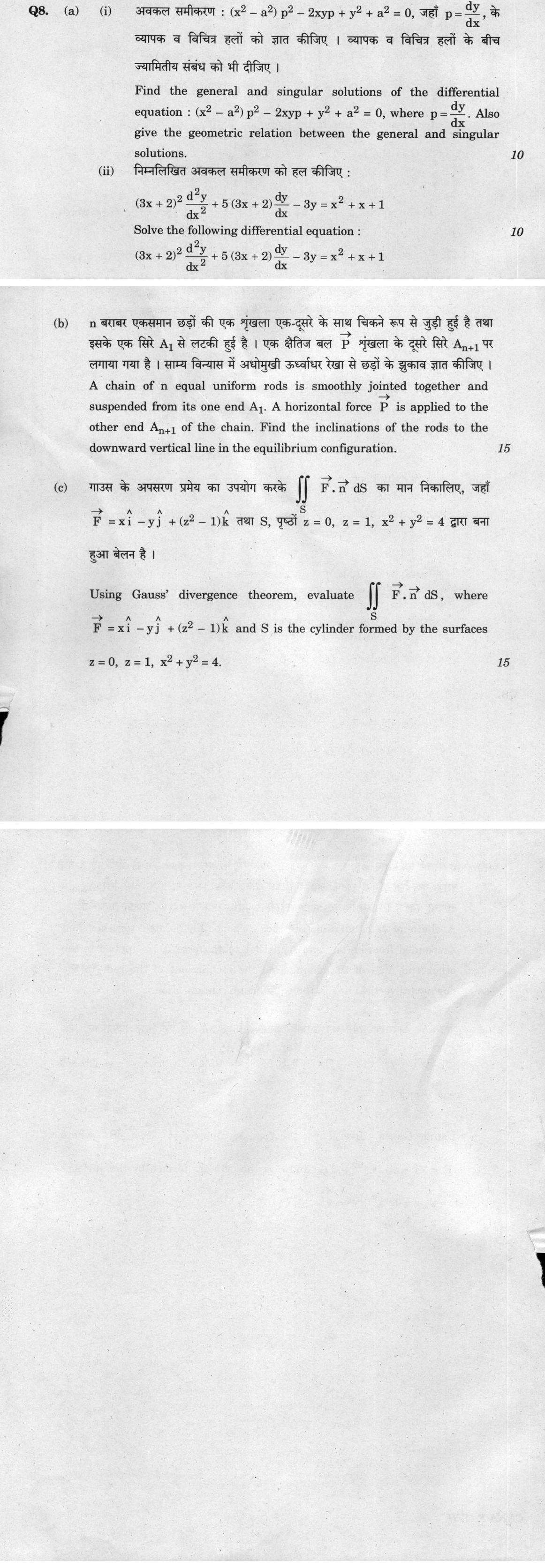
(a) (i) Find the general and singular solutions of the differential equation : (x² - a²)p² - 2xyp + y² + a² = 0, where p = dy/dx…
Find the general and singular solutions of the differential equation : (x² - a²)p² - 2xyp + y² + a² = 0, where p = dy/dx. Also give the geometric relation between the general and singular solutions. 10 marks
Solve the following differential equation : (3x + 2)²(d^2y)/(dx²) + 5(3x + 2)dy/dx - 3y = x² + x + 1 10
A chain of n equal uniform rods is smoothly jointed together and suspended from its one end A₁. A horizontal force P⃗ is applied to the other end Aₙ₊₁ of the chain. Find the inclinations of the rods to the downward vertical line in the equilibrium configuration. 15 marks
Using Gauss' divergence theorem, evaluate ∬limits_S F⃗.n⃗ dS, where F⃗ = xî - yĵ + (z²-1)k̂ and S is the cylinder formed by the surfaces z = 0, z = 1, x² + y² = 4. 15 marks
हिंदी में प्रश्न पढ़ें
अवकल समीकरण : (x² - a²)p² - 2xyp + y² + a² = 0, जहाँ p = dy/dx, के व्यापक व विचित्र हलों को ज्ञात कीजिए । व्यापक व विचित्र हलों के बीच ज्यामितीय संबंध को भी दीजिए । 10
निम्नलिखित अवकल समीकरण को हल कीजिए : (3x + 2)²(d^2y)/(dx²) + 5(3x + 2)dy/dx - 3y = x² + x + 1 10
n बराबर एकसमान छड़ों की एक श्रृंखला एक-दूसरे के साथ चिकने रूप से जुड़ी हुई है तथा इसके एक सिरे A₁ से लटकी हुई है । एक क्षैतिज बल P⃗ श्रृंखला के दूसरे सिरे Aₙ₊₁ पर लगाया गया है । साम्य विन्यास में अधोमुखी उद्वाधर रेखा से छड़ों के झुकाव ज्ञात कीजिए । 15
गॉस के अपसरण प्रमेय का उपयोग करके ∬limits_S F⃗.n⃗ dS का मान निकालिए, जहाँ F⃗ = xî - yĵ + (z²-1)k̂ तथा S, पृष्ठों z = 0, z = 1, x² + y² = 4 द्वारा बना हुआ बेलन है । 15
Model answer
Written by UPSC Answer Check against this question's marking rubric, to the expected length. UPSC does not publish answers for Mains — this is one way to score well, not an official key.
(a)(i) Write p = dy/dx. The equation is
(x² − a²)p² − 2xy p + y² + a² = 0.
Completing a square gives
(xp − y)² = a²(p² − 1),
so y = xp ± a√(p² − 1).
This is a Clairaut-type equation. Taking p = c constant gives the general solution
y = cx ± a√(c² − 1),
or equivalently
(y − cx)² = a²(c² − 1).
This is the family of straight lines. For real solutions, |c| ≥ 1.
For the singular solution, use the envelope condition. Let
F(x,y,c) = (y − cx)² − a²(c² − 1) = 0.
Then
∂F/∂c = −2x(y − cx) − 2a²c = 0,
so
c(x² − a²) = xy.
Eliminating c from this equation and F = 0 gives
y² = x² − a².
Hence the singular solution is
y² = x² − a², with |x| ≥ |a| for real curves.
Geometrically, the singular curve y² = x² − a² is the envelope of the family of straight lines (y − cx)² = a²(c² − 1); every line of the general solution is tangent to this hyperbola.
(a)(ii) Put t = 3x + 2. Then
d/dx = 3 d/dt, d²/dx² = 9 d²/dt²,
and x = (t − 2)/3. The equation becomes
9t² d²y/dt² + 15t dy/dt − 3y = x² + x + 1.
Now
x² + x + 1 = ((t − 2)/3)² + (t − 2)/3 + 1 = (t² − t + 7)/9.
Thus
9t²y″ + 15t y′ − 3y = (t² − t + 7)/9.
This is a Cauchy–Euler equation. For the homogeneous part, put y = tᵐ. Then
9m(m − 1) + 15m − 3 = 0
⇒ 3m² + 2m − 1 = 0
⇒ m = 1/3, −1.
Hence
y_h = C₁t^(1/3) + C₂t⁻¹.
For a particular integral, try
y_p = At² + Bt + C.
Then
y_p′ = 2At + B, y_p″ = 2A.
Substitution gives
9t²(2A) + 15t(2At + B) − 3(At² + Bt + C) = 45A t² + 12B t − 3C.
Comparing with (t² − t + 7)/9,
45A = 1/9 ⇒ A = 1/405,
12B = −1/9 ⇒ B = −1/108,
−3C = 7/9 ⇒ C = −7/27.
Therefore
y_p = t²/405 − t/108 − 7/27.
Putting t = 3x + 2, the general solution is
y = C₁(3x + 2)^(1/3) + C₂/(3x + 2) + (3x + 2)²/405 − (3x + 2)/108 − 7/27.
The solution is valid on intervals not containing x = −2/3.
(b) Let each rod have length l and weight W. Number the rods from the top as i = 1, 2, …, n. Let θᵢ be the inclination of the i-th rod to the downward vertical, positive in the direction of the horizontal force P at the lower end Aₙ₊₁.
Use the principle of virtual work. If x is the horizontal displacement of the lower end and y_mid is the vertical downward displacement of the midpoint of a rod, then for equilibrium
P δx + W Σ δy_mid = 0.
For the i-th rod,
∂x/∂θᵢ = l cos θᵢ.
Also, the rods below the i-th rod contribute their weights through the joint, and the midpoint of the i-th rod contributes half its weight. Hence
∂(Σ y_mid)/∂θᵢ = −l(n − i + 1/2) sin θᵢ.
Thus the equilibrium condition is
P l cos θᵢ − W l(n − i + 1/2) sin θᵢ = 0.
Therefore
tan θᵢ = P/[W(n − i + 1/2)].
Equivalently, if the r-th rod is counted from the bottom, r = 1, 2, …, n, then
tan θᵣ = P/[W(r − 1/2)] = 2P/[(2r − 1)W].
So the inclinations are
θᵢ = arctan[2P/((2(n − i + 1) − 1)W)], i = 1, 2, …, n,
where θᵢ is measured from the downward vertical toward the direction of P. The bottom rod is most inclined and the top rod least inclined.
(c) By Gauss’ divergence theorem,
∬_S F·n dS = ∭_V (∇·F) dV,
where V is the solid cylinder x² + y² ≤ 4, 0 ≤ z ≤ 1, and n is the outward normal to the closed surface S.
Now
F = x i − y j + (z² − 1) k.
Hence
∇·F = ∂x/∂x + ∂(−y)/∂y + ∂(z² − 1)/∂z = 1 − 1 + 2z = 2z.
Therefore
∬_S F·n dS = ∭_V 2z dV.
Using cylindrical coordinates,
∭_V 2z dV = 2 ∫₀¹ z dz ∬_x²+y²≤4 dxdy.
The area of the disk x² + y² ≤ 4 is π(2²) = 4π, and
∫₀¹ z dz = 1/2.
Thus
∬_S F·n dS = 2 · (1/2) · 4π = 4π.
Final answer: 4π.
What "Solve" is asking you to do
Choose the method, then carry it through to a final answer. Identifying what kind of problem this is and why that method applies is the first thing marked; a correct figure arrived at invisibly earns almost nothing.
Structure that answers it
Given data and what is required → method chosen, with the reason it applies → set-up (equation, circuit, free body, trial balance) → working, step by step → answer with units and any condition of validity
Where marks are lost
Doing the middle steps mentally and writing only the result. In mathematics papers, a further loss comes from giving a decimal where the exact value in surds or fractions was wanted, or from skipping the justification a part explicitly asks for.
How this answer will be evaluated
Approach
(a(i)) derive: given > assumptions > stepwise derivation > result > check | (a(ii)) derive: given > assumptions > stepwise derivation > result > check | (b) derive: given > assumptions > stepwise derivation > result > check | (c) calculate: given > formula > substitution > result with units > interpretation Full marks: Rigorous derivation with all steps, correct final answers, and clear geometric/physical interpretation.
Key points expected
- Identify equation as Clairaut's form
- Derive general solution y = cx + f(c)
- Derive singular solution via p-discriminant
- State geometric relation (envelope)
- Apply substitution t = 3x + 2
- Solve the resulting constant coefficient ODE
- Find complementary function
- Find particular integral
Evaluation rubric
Each sub-part is marked on its own, against the marks and word limit printed on the paper.
- (a(i)) General and singular solutions of the differential equation and their geometric relation. 10 marks
derive— given → assumptions → stepwise derivation → result → check
Must cover
- Identify equation as Clairaut's form
- Derive general solution y = cx + f(c)
- Derive singular solution via p-discriminant
- State geometric relation (envelope)
Loses marks
- Missing singular solution
- Incorrect geometric interpretation
Earns more
- Correct algebraic manipulation of p
- Verification of singular solution
Extra mark
- Sketch of the envelope
- (a(ii)) Solution of the second-order linear differential equation. 10 marks
derive— given → assumptions → stepwise derivation → result → check
Must cover
- Apply substitution t = 3x + 2
- Solve the resulting constant coefficient ODE
- Find complementary function
- Find particular integral
Loses marks
- Incorrect substitution
- Missing particular integral
Earns more
- Correct transformation of derivatives
- Final answer in terms of x
Extra mark
- Alternative method noted
- (b) Inclinations of the rods to the vertical in equilibrium. 15 marks
derive— given → assumptions → stepwise derivation → result → check
Must cover
- Free body diagram of the chain
- Equilibrium of forces at each joint
- Derive expression for tan(theta_i)
- General formula for the n-th rod
Loses marks
- Missing free body diagram
- Incorrect force balance
Earns more
- Clear definition of angles
- Step-by-step force resolution
Extra mark
- Neat diagram of the chain
- (c) Evaluation of the surface integral using Gauss' divergence theorem. 15 marks
calculate— given → formula → substitution → result with units → interpretation
Must cover
- State Gauss' divergence theorem
- Calculate divergence of vector F
- Set up the triple integral limits
- Evaluate the integral to get final value
Loses marks
- Incorrect divergence calculation
- Wrong limits of integration
Earns more
- Correct identification of volume V
- Accurate integration steps
Extra mark
- Sketch of the cylinder
Practice this exact question
Write your answer and it is marked point by point against the model answer above — what you covered, what you missed, what you got wrong.
Evaluate my answer →More from Mathematics 2022 Paper I
- Q5 (a) Show that the general solution of the differential equation dy/dx + Py = Q can be wri…
- Q6 (a) A cable of weight w per unit length and length 2lhangs from two points P and Q in the…
- Q7 (a) Verify Stokes' theorem for F⃗ = xî + z^2ĵ + y^2k̂ over the plane surface : x + y +…
- Q8 (a) (i) Find the general and singular solutions of the differential equation : (x² - a²)p…