Paper I — Q3
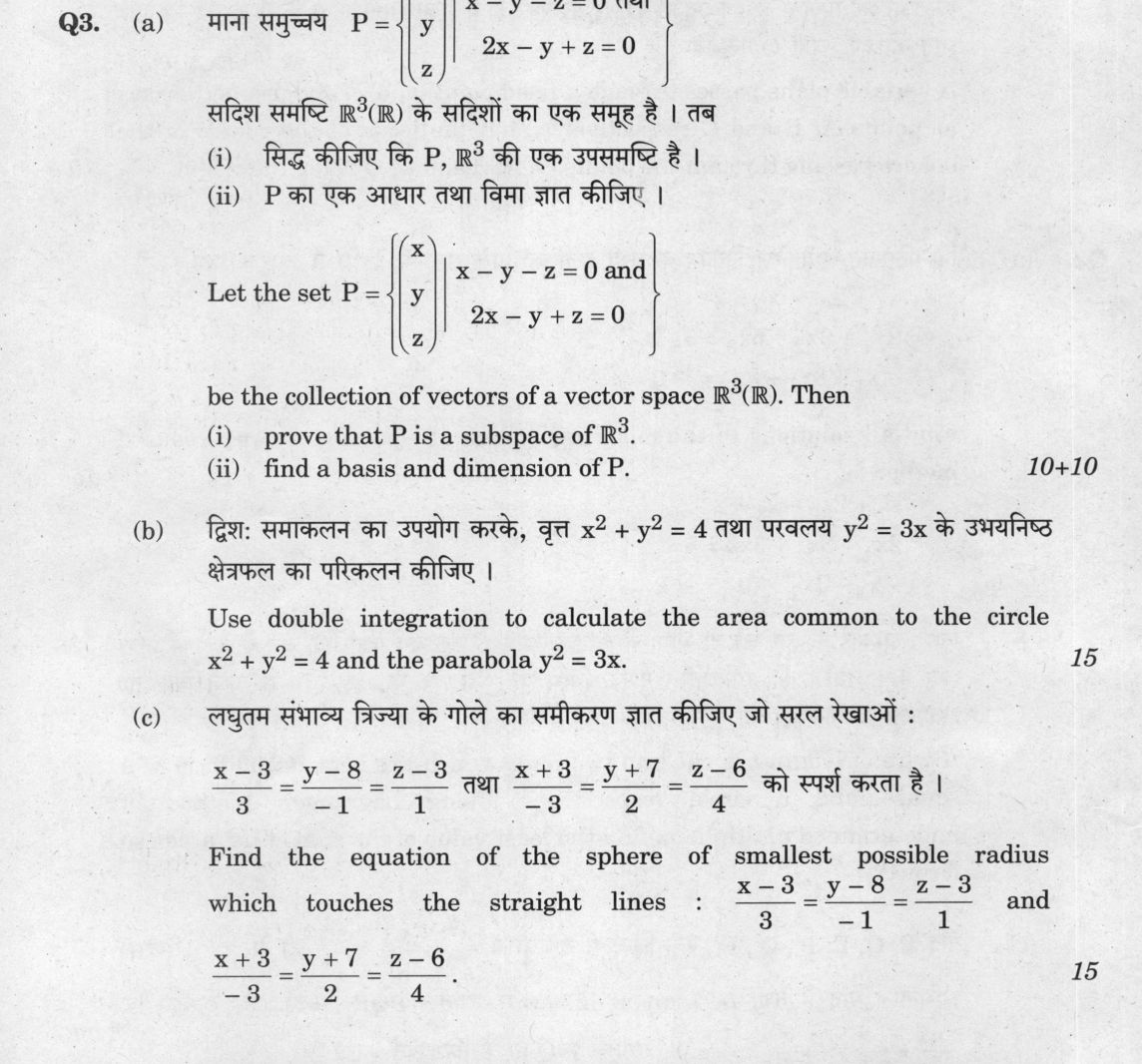
(a) Let the set P = x y z middle| l x - y - z = 0 and 2x - y + z = 0 be the collection of vectors of a vector space R³(R)…
Let the set P = x y z middle| l x - y - z = 0 and 2x - y + z = 0 be the collection of vectors of a vector space R³(R). Then (i) prove that P is a subspace of R³. (ii) find a basis and dimension of P. 10+10
Use double integration to calculate the area common to the circle x² + y² = 4 and the parabola y² = 3x. 15 marks
Find the equation of the sphere of smallest possible radius which touches the straight lines : (x-3)/3 = (y-8)/(-1) = (z-3)/1 and (x+3)/(-3) = (y+7)/2 = (z-6)/4. 15 marks
हिंदी में प्रश्न पढ़ें
माना समुच्चय P = x y z middle| l x - y - z = 0 तथा 2x - y + z = 0 सदिश समष्टि R³(R) के सदिशों का एक समुह है । तब (i) सिद्ध कीजिए कि P, R³ की एक उपसमष्टि है । (ii) P का एक आधार तथा विमा ज्ञात कीजिए । 10+10
दिशा: समाकलन का उपयोग करके, वृत्त x² + y² = 4 तथा परवलय y² = 3x के उभयनिष्ठ क्षेत्रफल का परिकलन कीजिए । 15
लघुतम संभाव्य त्रिज्या के गोले का समीकरण ज्ञात कीजिए जो सरल रेखाओं : (x-3)/3 = (y-8)/(-1) = (z-3)/1 तथा (x+3)/(-3) = (y+7)/2 = (z-6)/4 को स्पर्श करता है । 15
Model answer
Written by UPSC Answer Check against this question's marking rubric, to the expected length. UPSC does not publish answers for Mains — this is one way to score well, not an official key.
(a) (i) Define T: ℝ³ → ℝ² by T(x, y, z) = (x − y − z, 2x − y + z). Then T is linear, and P = {v ∈ ℝ³ : T(v) = (0, 0)}. Take u = (x₁, y₁, z₁) ∈ P and v = (x₂, y₂, z₂) ∈ P, and let α, β ∈ ℝ. Since u, v ∈ P, x₁ − y₁ − z₁ = 0, 2x₁ − y₁ + z₁ = 0, x₂ − y₂ − z₂ = 0, 2x₂ − y₂ + z₂ = 0. Then for αu + βv = (αx₁+βx₂, αy₁+βy₂, αz₁+βz₂), (αx₁+βx₂) − (αy₁+βy₂) − (αz₁+βz₂) = α(x₁−y₁−z₁) + β(x₂−y₂−z₂) = 0. Similarly, 2(αx₁+βx₂) − (αy₁+βy₂) + (αz₁+βz₂) = α(2x₁−y₁+z₁) + β(2x₂−y₂+z₂) = 0. Also (0, 0, 0) ∈ P. Hence P is non-empty and closed under addition and scalar multiplication. Therefore P is a subspace of ℝ³(ℝ).
(a) (ii) Solve the two equations: x − y − z = 0, so y = x − z. Substitute into 2x − y + z = 0: 2x − (x − z) + z = x + 2z = 0, so x = −2z. Then y = x − z = −2z − z = −3z. Thus every vector of P is (x, y, z) = (−2z, −3z, z) = z(−2, −3, 1). So a basis is {(−2, −3, 1)}. Hence dim P = 1.
(b) Find intersections of x² + y² = 4 and y² = 3x. Substituting y² = 3x in the circle: x² + 3x = 4, so x² + 3x − 4 = 0 = (x + 4)(x − 1). Since y² = 3x requires x ≥ 0, x = 1, and then y² = 3, so y = ±√3.
The common region lies inside both curves. For 0 ≤ x ≤ 1, the smaller vertical bound is from the parabola, |y| ≤ √(3x). For 1 ≤ x ≤ 2, the smaller vertical bound is from the circle, |y| ≤ √(4 − x²). By symmetry about the x-axis, A = 2∫ from 0 to 1 √(3x) dx + 2∫ from 1 to 2 √(4 − x²) dx.
First, 2∫ from 0 to 1 √(3x) dx = 2√3 · (2/3) = 4√3/3. Next, 2∫ from 1 to 2 √(4 − x²) dx = [x√(4 − x²) + 4 arcsin(x/2)] from 1 to 2 = (0 + 4·π/2) − (√3 + 4·π/6) = 2π − √3 − 2π/3 = 4π/3 − √3. Therefore A = 4√3/3 + 4π/3 − √3 = (4π + √3)/3. Hence the common area is (4π + √3)/3 square units.
(c) Let L₁: (x−3)/3 = (y−8)/(−1) = (z−3)/1 = t, L₂: (x+3)/(−3) = (y+7)/2 = (z−6)/4 = s. Then points on the lines are A(t) = (3+3t, 8−t, 3+t), B(s) = (−3−3s, −7+2s, 6+4s). Their direction vectors are u = (3, −1, 1), v = (−3, 2, 4).
For the common perpendicular, w = B(s) − A(t) must satisfy w·u = 0 and w·v = 0. Now w = (−6−3s−3t, −15+2s+t, 3+4s−t). Thus w·u = −7s − 11t = 0, w·v = 29s + 7t = 0. Solving, 7s + 11t = 0 and 29s + 7t = 0 gives t = 0 and s = 0.
So the closest points are A(0) = (3, 8, 3), B(0) = (−3, −7, 6). The shortest distance between the lines is d = |B(0) − A(0)| = |(−6, −15, 3)| = √(36 + 225 + 9) = √270 = 3√30.
For any sphere touching both lines, if its radius is r, the distance between the two points of contact is at most 2r. Since the shortest distance between the lines is d, we need d ≤ 2r, so r ≥ d/2. Equality is achieved when the centre is the midpoint of the common perpendicular segment. Hence the smallest radius is r = d/2 = 3√30/2.
The centre is the midpoint of A(0) and B(0): M = ((3−3)/2, (8−7)/2, (3+6)/2) = (0, 1/2, 9/2). Therefore the required sphere is x² + (y − 1/2)² + (z − 9/2)² = (3√30/2)² = 135/2. So the equation is x² + (y − 1/2)² + (z − 9/2)² = 135/2.
What "Solve" is asking you to do
Choose the method, then carry it through to a final answer. Identifying what kind of problem this is and why that method applies is the first thing marked; a correct figure arrived at invisibly earns almost nothing.
Structure that answers it
Given data and what is required → method chosen, with the reason it applies → set-up (equation, circuit, free body, trial balance) → working, step by step → answer with units and any condition of validity
Where marks are lost
Doing the middle steps mentally and writing only the result. In mathematics papers, a further loss comes from giving a decimal where the exact value in surds or fractions was wanted, or from skipping the justification a part explicitly asks for.
How this answer will be evaluated
Approach
Framework: Linear Algebra & Multivariable Calculus. (a) derive: given > assumptions > stepwise derivation > result > check | (b) derive: given > assumptions > stepwise derivation > result > check | (c) derive: given > assumptions > stepwise derivation > result > check Full marks: Rigorous proofs, correct calculations, clear geometric insight
Key points expected
- Subspace axioms verification
- System of linear equations solution
- Intersection points calculation
- Double integral setup and evaluation
- Common perpendicular to skew lines
- Sphere center and radius determination
Evaluation rubric
Each sub-part is marked on its own, against the marks and word limit printed on the paper.
- (a) Prove subspace properties and determine basis/dimension of P. 10 marks
derive— given → assumptions → stepwise derivation → result → check
Must cover
- Verify closure under addition and scalar multiplication
- Solve system x-y-z=0, 2x-y+z=0
- Express solution in parametric vector form
- Identify basis vectors and dimension
Loses marks
- Claiming subspace without checking axioms
- Incorrect basis vectors
Earns more
- Explicit check for zero vector inclusion
- Matrix row reduction steps shown
Extra mark
- Geometric interpretation as line of intersection
- (b) Calculate common area using double integration. 15 marks
derive— given → assumptions → stepwise derivation → result → check
Must cover
- Find intersection points of circle and parabola
- Sketch region and define integration limits
- Set up double integral for area
- Evaluate integral to find final area
Loses marks
- Incorrect intersection points
- Wrong integration limits
Earns more
- Use of symmetry to simplify calculation
- Clear labeling of integration regions
Extra mark
- Alternative method using polar coordinates
- (c) Find equation of smallest sphere touching two lines. 15 marks
derive— given → assumptions → stepwise derivation → result → check
Must cover
- Identify direction vectors of both lines
- Find common perpendicular between lines
- Determine center of sphere on common perpendicular
- Calculate radius and write sphere equation
Loses marks
- Ignoring common perpendicular condition
- Incorrect center calculation
Earns more
- Vector cross product for common perpendicular
- Verification of tangency condition
Extra mark
- Geometric diagram of lines and sphere
Practice this exact question
Write your answer and it is marked point by point against the model answer above — what you covered, what you missed, what you got wrong.
Evaluate my answer →More from Mathematics 2022 Paper I
- Q1 (a) Prove that any set of n linearly independent vectors in a vector space V of dimension…
- Q2 (a) Find all solutions to the following system of equations by row-reduced method : x₁ +…
- Q3 (a) Let the set P = x y z middle| l x - y - z = 0 and 2x - y + z = 0 be the collection of…
- Q4 (a) Find a linear map T : R² → R² which rotates each vector of R² by an angle θ. Also, pr…
- Q5 (a) Show that the general solution of the differential equation dy/dx + Py = Q can be wri…
- Q6 (a) A cable of weight w per unit length and length 2lhangs from two points P and Q in the…