Paper II — Q1
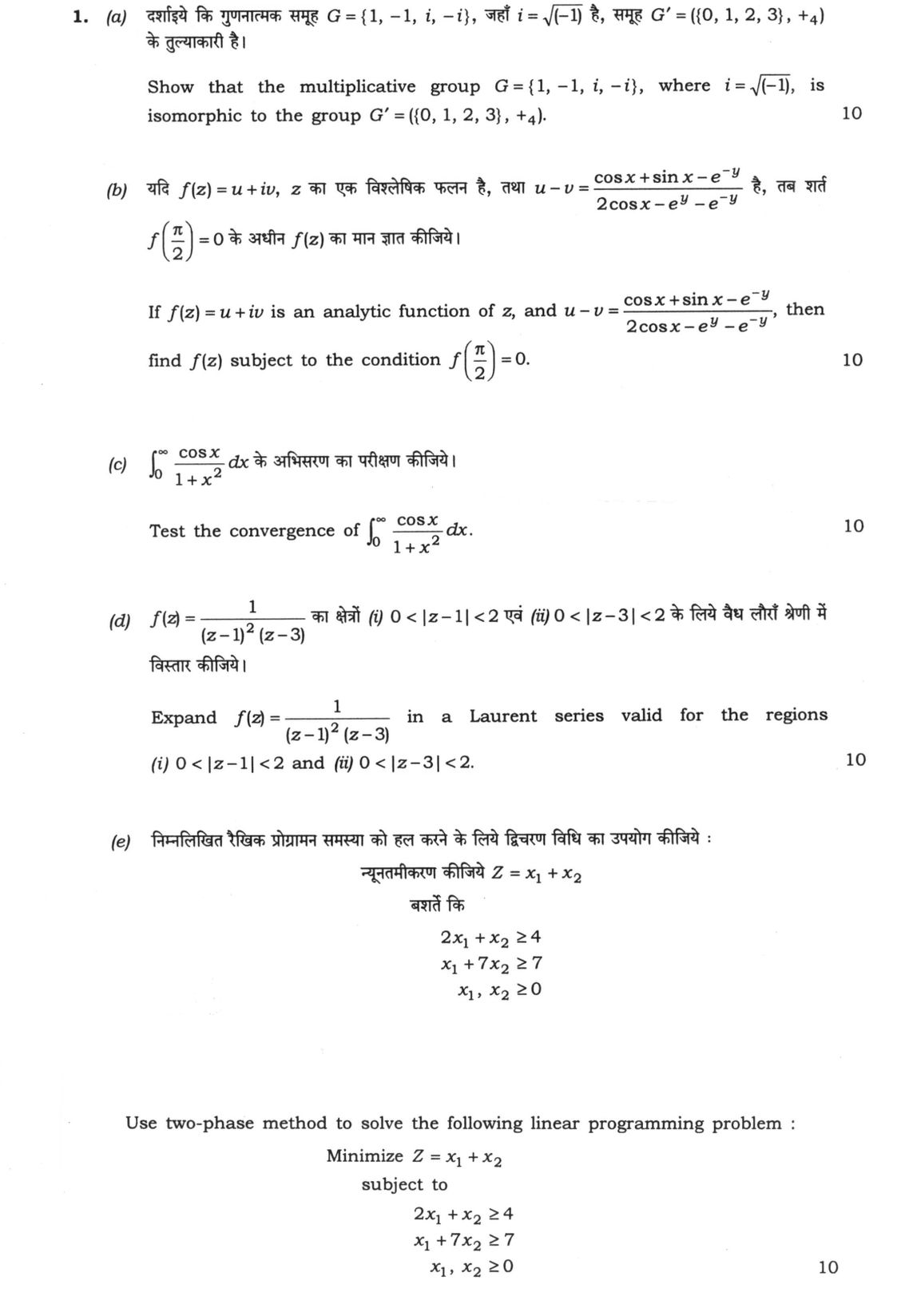
(a) Show that the multiplicative group G = {1, -1, i, -i}, where i = √(-1), is isomorphic to the group G' = ({0, 1, 2, 3}, +₄)…
Show that the multiplicative group G = {1, -1, i, -i}, where i = √(-1), is isomorphic to the group G' = ({0, 1, 2, 3}, +₄). 10 marks
If f(z) = u + iv is an analytic function of z, and u - v = (cos x + sin x - e⁻ʸ)/(2 cos x - eʸ - e⁻ʸ), then find f(z) subject to the condition f(π/2) = 0. 10 marks
Test the convergence of ∫₀^∞ (cos x)/(1+x²) dx. 10 marks
Expand f(z) = 1/((z-1)²(z-3)) in a Laurent series valid for the regions (i) 0 < |z-1| < 2 and (ii) 0 < |z-3| < 2. 10 marks
Use two-phase method to solve the following linear programming problem: Minimize Z = x₁ + x₂ subject to 2x₁ + x₂ ≥ 4, x₁ + 7x₂ ≥ 7, x₁, x₂ ≥ 0. 10 marks
हिंदी में प्रश्न पढ़ें
दर्शाइये कि गुणनात्मक समुह G = {1, -1, i, -i}, जहाँ i = √(-1) है, समुह G' = ({0, 1, 2, 3}, +₄) के तुल्यकारी है। 10 अंक
यदि f(z) = u + iv, z का एक विलोमिक फलन है, तथा u - v = (cos x + sin x - e⁻ʸ)/(2 cos x - eʸ - e⁻ʸ) है, तब शर्त f(π/2) = 0 के अधीन f(z) का मान ज्ञात कीजिये। 10 अंक
∫₀^∞ (cos x)/(1+x²) dx के अभिसरण का परीक्षण कीजिये। 10 अंक
f(z) = 1/((z-1)²(z-3)) का क्षेत्रों (i) 0 < |z-1| < 2 एवं (ii) 0 < |z-3| < 2 के लिये वैध लौरां श्रेणी में विस्तार कीजिये। 10 अंक
निम्नलिखित रैखिक प्रोग्राम समस्या को हल करने के लिये छिद्रण विधि का उपयोग कीजिये: न्यूनतमीकरण कीजिये Z = x₁ + x₂ बशर्ते कि 2x₁ + x₂ ≥ 4, x₁ + 7x₂ ≥ 7, x₁, x₂ ≥ 0। 10 अंक
Model answer
Written by UPSC Answer Check against this question's marking rubric, to the expected length. UPSC does not publish answers for Mains — this is one way to score well, not an official key.
(a)
Define φ: G → G' by φ(1) = 0, φ(i) = 1, φ(-1) = 2, φ(-i) = 3. Since G = {i⁰, i¹, i², i³} and G' = {0,1,2,3}, the map is φ(i^k) = k mod 4, k = 0,1,2,3. It is clearly bijective. For any i^m, i^n ∈ G, φ(i^m i^n) = φ(i^(m+n)) = (m+n) mod 4 = (m mod 4) +₄ (n mod 4) = φ(i^m) +₄ φ(i^n). Thus φ is a homomorphism. Since it is bijective, it is an isomorphism. Hence G ≅ G'.
(b)
Let F(z) = (1+i)f(z). Then F is analytic and Re F = u − v = (cos x + sin x − e⁻ʸ)/(2 cos x − eʸ − e⁻ʸ).
Put w(x,y) = (cos x + sin x − e⁻ʸ)/(2 cos x − eʸ − e⁻ʸ). By Milne-Thomson method, if F = U + iV and U = w, then F'(z) = w_x(z,0) − i w_y(z,0).
At y = 0, w(x,0) = (cos x + sin x − 1)/(2 cos x − 2) = 1/2 − 1/2 cot(x/2). Hence w_x(x,0) = 1/4 csc²(x/2). Also, w_y(x,0) = 1/(2 cos x − 2) = −1/4 csc²(x/2). Therefore F'(z) = 1/4 csc²(z/2) − i(−1/4 csc²(z/2)) = (1+i)/4 csc²(z/2).
Integrating, F(z) = (1+i)/4 · (−2 cot(z/2)) + C = −(1+i)/2 cot(z/2) + C. Since F(z) = (1+i)f(z), f(z) = −1/2 cot(z/2) + C/(1+i). Let K = C/(1+i). Given f(π/2) = 0, 0 = −1/2 cot(π/4) + K = −1/2 + K, so K = 1/2. Thus f(z) = 1/2 − 1/2 cot(z/2) = (1 − cot(z/2))/2.
(c)
Consider ∫₀^∞ (cos x)/(1+x²) dx. Split at x = 1: ∫₀^∞ = ∫₀¹ + ∫₁^∞. The first integral is finite because the integrand is continuous on [0,1]. For x ≥ 1, |cos x|/(1+x²) ≤ 1/(1+x²). Now ∫₁^∞ dx/(1+x²) = [arctan x]₁^∞ = π/2 − π/4 = π/4, which is finite. By the comparison test for improper integrals, ∫₁^∞ |cos x|/(1+x²) dx converges. Therefore the original integral converges absolutely, and hence it converges.
(d)
Given f(z) = 1/((z−1)²(z−3)).
(i) For 0 < |z−1| < 2, put u = z−1. Then z−3 = u−2, so f(z) = 1/(u²(u−2)) = −1/(2u²(1−u/2)). Since |u/2| < 1, 1/(1−u/2) = Σ_n=0^∞ (u/2)^n. Hence f(z) = −1/(2u²) Σ_n=0^∞ (u/2)^n = −Σ_n=0^∞ u^(n−2)/2^(n+1). Thus f(z) = −Σ_n=0^∞ (z−1)^(n−2)/2^(n+1), 0 < |z−1| < 2. Equivalently, f(z) = −1/[2(z−1)²] − 1/[4(z−1)] − 1/8 − (z−1)/16 − (z−1)²/32 − ...
(ii) For 0 < |z−3| < 2, put v = z−3. Then z−1 = v+2, so f(z) = 1/[v(v+2)²] = 1/(4v) · (1+v/2)^(−2). Using (1+t)^(−2) = Σ_n=0^∞ (−1)^n (n+1)t^n, |t| < 1, with t = v/2, we get f(z) = 1/(4v) Σ_n=0^∞ (−1)^n (n+1)(v/2)^n = Σ_n=0^∞ (−1)^n (n+1) v^(n−1)/2^(n+2). Therefore f(z) = Σ_n=0^∞ (−1)^n (n+1)(z−3)^(n−1)/2^(n+2), 0 < |z−3| < 2. Equivalently, f(z) = 1/[4(z−3)] − 1/4 + 3(z−3)/16 − (z−3)²/8 + 5(z−3)³/64 − ...
(e)
Minimize Z = x₁ + x₂ subject to 2x₁ + x₂ ≥ 4, x₁ + 7x₂ ≥ 7, x₁, x₂ ≥ 0.
Introduce surplus variables S₁, S₂ and artificial variables A₁, A₂: 2x₁ + x₂ − S₁ + A₁ = 4, x₁ + 7x₂ − S₂ + A₂ = 7, all variables ≥ 0.
Phase I: Minimize W = A₁ + A₂. Initial basis: A₁ = 4, A₂ = 7, so W = 11. From the constraints, W = 11 − 3x₁ − 8x₂ + S₁ + S₂. The most negative coefficient is −8 for x₂, so x₂ enters. Ratios: 4/1 = 4 for A₁, 7/7 = 1 for A₂. Minimum is 1, so A₂ leaves.
After pivoting on x₂ in the A₂ row: (1/7)x₁ + x₂ − (1/7)S₂ + (1/7)A₂ = 1, (13/7)x₁ − S₁ + (1/7)S₂ + A₁ − (1/7)A₂ = 3, W = 3 − (13/7)x₁ + S₁ − (1/7)S₂ + (8/7)A₂. Now x₁ enters. Ratios: 3/(13/7) = 21/13 and 1/(1/7) = 7. Minimum is 21/13, so A₁ leaves.
After pivoting: x₁ − (7/13)S₁ + (1/13)S₂ + (7/13)A₁ − (1/13)A₂ = 21/13, x₂ + (1/13)S₁ − (2/13)S₂ − (1/13)A₁ + (2/13)A₂ = 10/13. Now W = A₁ + A₂. Since A₁ and A₂ are nonbasic, W = 0. Hence a feasible solution is x₁ = 21/13, x₂ = 10/13, S₁ = S₂ = 0.
Phase II: Use original objective Z = x₁ + x₂. From the Phase I rows, x₁ = 21/13 + (7/13)S₁ − (1/13)S₂ − (7/13)A₁ + (1/13)A₂, x₂ = 10/13 − (1/13)S₁ + (2/13)S₂ + (1/13)A₁ − (2/13)A₂. Thus Z = 31/13 + (6/13)S₁ + (1/13)S₂ − (6/13)A₁ − (1/13)A₂. Setting artificial variables to zero, the coefficients of S₁ and S₂ are positive. Hence Z is minimized at S₁ = S₂ = 0.
Therefore x₁ = 21/13, x₂ = 10/13, and Z_min = 31/13.
What "Solve" is asking you to do
Choose the method, then carry it through to a final answer. Identifying what kind of problem this is and why that method applies is the first thing marked; a correct figure arrived at invisibly earns almost nothing.
Structure that answers it
Given data and what is required → method chosen, with the reason it applies → set-up (equation, circuit, free body, trial balance) → working, step by step → answer with units and any condition of validity
Where marks are lost
Doing the middle steps mentally and writing only the result. In mathematics papers, a further loss comes from giving a decimal where the exact value in surds or fractions was wanted, or from skipping the justification a part explicitly asks for.
How this answer will be evaluated
Approach
(a) justify: claim > 3-4 reasons > evidence > conclusion | (b) calculate: given > formula > substitution > result with units > interpretation | (c) examine: intro > how/why with reasoning > evidence > conclusion | (d) derive: given > assumptions > stepwise derivation > result > check | (e) calculate: given > formula > substitution > result with units > interpretation Full marks: Complete, rigorous derivations with all steps shown and verified.
Key points expected
- Define a mapping φ: G → G'
- Show φ is a homomorphism (φ(ab) = φ(a) +₄ φ(b))
- Show φ is injective (one-to-one)
- Show φ is surjective (onto)
- Use Milne-Thomson method or CR equations
- Substitute z=x, y=0 to find f(z) form
- Simplify the given expression for u-v
- Apply condition f(π/2)=0 to find constant
Evaluation rubric
Each sub-part is marked on its own, against the marks and word limit printed on the paper.
- (a) Prove isomorphism between G = {1, -1, i, -i} and G' = ({0, 1, 2, 3}, +₄). 10 marks
justify— claim → 3-4 reasons → evidence → conclusion
Must cover
- Define a mapping φ: G → G'
- Show φ is a homomorphism (φ(ab) = φ(a) +₄ φ(b))
- Show φ is injective (one-to-one)
- Show φ is surjective (onto)
Loses marks
- Claiming isomorphism without proving homomorphism property
- Confusing additive and multiplicative notation
Earns more
- Explicitly list the mapping (e.g., 1→0, i→1, -1→2, -i→3)
- Verify group axioms for both G and G'
Extra mark
- Mention both are cyclic groups of order 4
- (b) Find analytic function f(z) given u-v and condition f(π/2)=0. 10 marks
calculate— given → formula → substitution → result with units → interpretation
Must cover
- Use Milne-Thomson method or CR equations
- Substitute z=x, y=0 to find f(z) form
- Simplify the given expression for u-v
- Apply condition f(π/2)=0 to find constant
Loses marks
- Incorrect substitution in Milne-Thomson method
- Failing to apply the boundary condition f(π/2)=0
Earns more
- Correctly identify u and v from the given expression
- Show step-by-step differentiation if using CR equations
Extra mark
- Verify the result satisfies the original u-v equation
- (c) Test convergence of ∫₀^∞ (cos x)/(1+x²) dx. 10 marks
examine— intro → how/why with reasoning → evidence → conclusion
Must cover
- Split integral into ∫₀^∞ and ∫₁^∞ (or similar)
- Apply Dirichlet's test for improper integrals
- Show 1/(1+x²) is monotonic and tends to 0
- Show ∫ cos x dx is bounded
Loses marks
- Using comparison test incorrectly for oscillatory integrals
- Failing to justify boundedness of ∫ cos x dx
Earns more
- Explicitly state Dirichlet's test conditions
- Check for absolute convergence separately
Extra mark
- Mention the integral value is π/e
- (d) Expand f(z) = 1/((z-1)²(z-3)) in Laurent series for two regions. 10 marks
derive— given → assumptions → stepwise derivation → result → check
Must cover
- Perform partial fraction decomposition
- Expand 1/(z-3) for |z-1|<2 (region i)
- Expand 1/(z-1) for |z-3|<2 (region ii)
- State the region of validity for each series
Loses marks
- Incorrect partial fraction decomposition
- Using wrong expansion for the given region
Earns more
- Correctly identify singularities at z=1 and z=3
- Show the geometric series expansion steps
Extra mark
- Identify the principal part in each expansion
- (e) Solve LPP using two-phase method: Min Z = x₁ + x₂. 10 marks
calculate— given → formula → substitution → result with units → interpretation
Must cover
- Convert to standard form with surplus/artificial variables
- Set up Phase I objective (minimize sum of artificial vars)
- Solve Phase I simplex table
- Solve Phase II simplex table for original objective
Loses marks
- Skipping Phase I and going directly to Phase II
- Incorrect handling of artificial variables in Phase I
Earns more
- Correctly identify initial basic feasible solution
- Show pivot operations clearly in simplex tables
Extra mark
- Verify the solution satisfies all original constraints
Practice this exact question
Write your answer and it is marked point by point against the model answer above — what you covered, what you missed, what you got wrong.
Evaluate my answer →More from Mathematics 2022 Paper II
- Q1 (a) Show that the multiplicative group G = {1, -1, i, -i}, where i = √(-1), is isomorphic…
- Q2 (a) Let f(x) = x² on [0, k], k > 0. Show that f is Riemann integrable on the closed inter…
- Q3 (a) Evaluate ∫_C (z+4)/(z² + 2z + 5) dz, where C is |z + 1 - i| = 2. (15 marks) (b) Find…
- Q4 (a) Let R be a field of real numbers and S, the field of all those polynomials f(x) ∈ R[x…