Paper II — Q4
(a) Let R be a field of real numbers and S, the field of all those polynomials f(x) ∈ R[x] such that f(0) = 0 = f(1). Prove that…
Let R be a field of real numbers and S, the field of all those polynomials f(x) ∈ R[x] such that f(0) = 0 = f(1). Prove that S is an ideal of R[x]. Is the residue class ring R[x]/S an integral domain? Give justification for your answer. 15 marks
Test for convergence or divergence of the series
x + 2²x²/2! + 3³x³/3! + 4⁴x⁴/4! + 5⁵x⁵/5! + ... (x > 0) 15 marks
Find the initial basic feasible solution of the following transportation problem by Vogel's approximation method and use it to find the optimal solution and the transportation cost of the problem :
Destination A B C D S₁ 21 16 25 13 11 Source S₂ 17 18 14 23 13 Availability S₃ 32 27 18 41 19 Requirement 6 10 12 15 43 20 marks
हिंदी में प्रश्न पढ़ें
मान लीजिये कि R वास्तविक संख्याओं का एक क्षेत्र है तथा S, उन सभी बहुपदों f(x) ∈ R[x], जिनके लिये f(0) = 0 = f(1) है, का क्षेत्र है। सिद्ध कीजिये कि S, R[x] की एक गुणजावली है। क्या अवशेष वर्ग वलय R[x]/S एक पूर्णांकीय प्रांत है? अपने उत्तर का स्पष्टीकरण दीजिये। (15 अंक)
श्रेणी x + 2²x²/2! + 3³x³/3! + 4⁴x⁴/4! + 5⁵x⁵/5! + ... (x > 0) के अभिसरण या अपसरण का परीक्षण कीजिये। (15 अंक)
वोगेल की संविकलन विधि से निम्नलिखित परिवहन समस्या का आरंभिक आधारी सुसंगत हल ज्ञात कीजिये। इस हल का उपयोग कर समस्या का इष्टतम हल एवं परिवहन लागत ज्ञात कीजिये :
गंतव्य A B C D S₁ 21 16 25 13 11 S₂ 17 18 14 23 13 S₃ 32 27 18 41 19 मांग 6 10 12 15 43
उद्गम प्राप्यता (20 अंक)
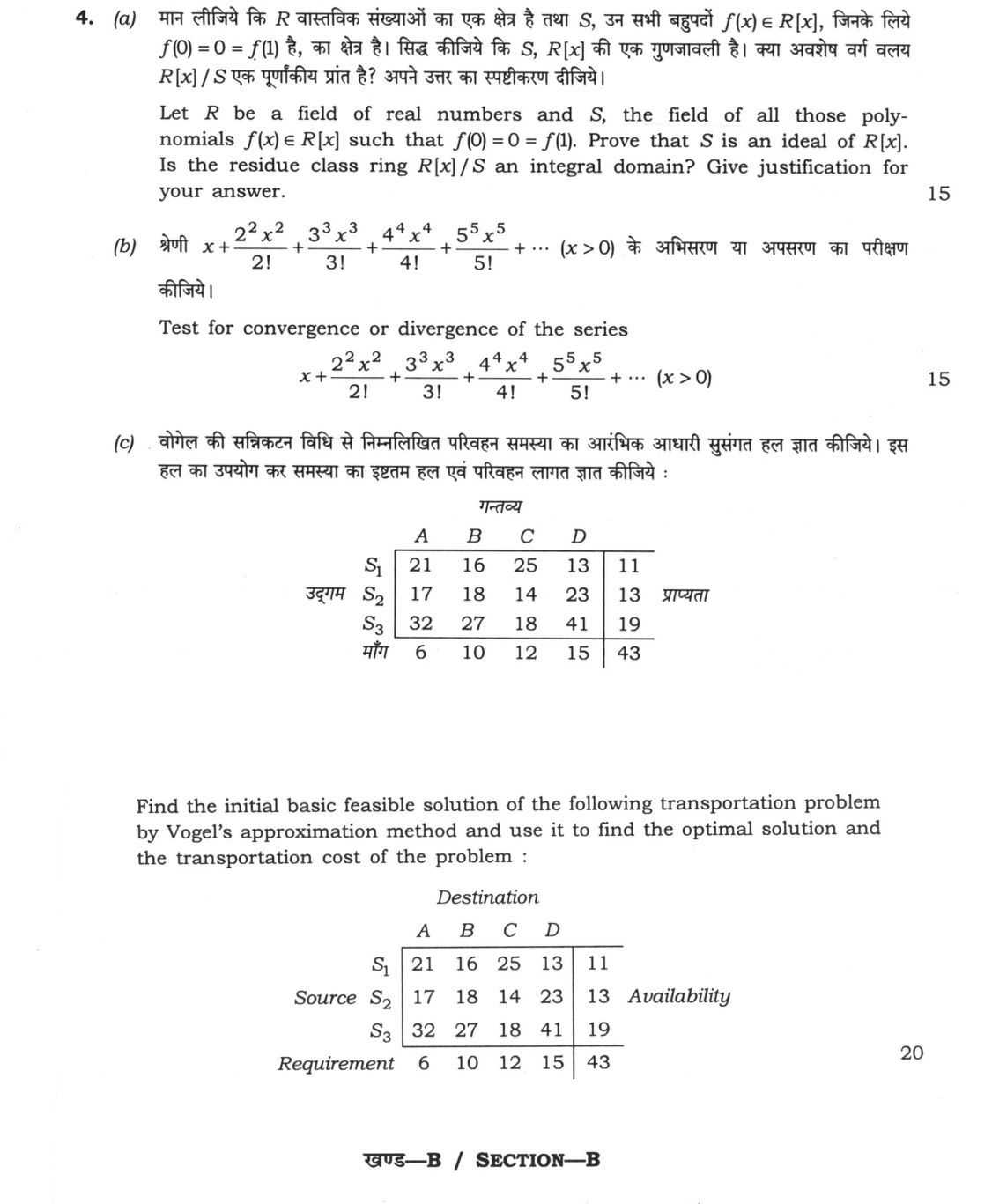
The figure this question refers to, in words
The question paper is a scan and the diagram did not survive as text. This is the figure as read from the original page — every component, value and label — so the question can be worked from the text below.
(c) A transportation table with origins S1, S2, S3 and destinations A, B, C, D: Destination (गन्तव्य): A, B, C, D | Supply (प्राप्यता) Origin (उद्गम) S1: 21, 16, 25, 13 | 11 Origin (उद्गम) S2: 17, 18, 14, 23 | 13 Origin (उद्गम) S3: 32, 27, 18, 41 | 19 Demand (माँग): 6, 10, 12, 15 | Total: 43
Table for a transportation problem: Destination: A, B, C, D, Availability Source S1: 21, 16, 25, 13 | 11 Source S2: 17, 18, 14, 23 | 13 Source S3: 32, 27, 18, 41 | 19 Requirement: 6, 10, 12, 15 | Total: 43
Model answer
Written by UPSC Answer Check against this question's marking rubric, to the expected length. UPSC does not publish answers for Mains — this is one way to score well, not an official key.
(a) Let R denote the field of real numbers and S = {f ∈ R[x] : f(0)=0=f(1)}. First, S is nonempty since 0 ∈ S. If f,g ∈ S and a ∈ R, then (af+g)(0)=a f(0)+g(0)=0 and (af+g)(1)=a f(1)+g(1)=0, so af+g ∈ S. If h ∈ R[x] and f ∈ S, then (hf)(0)=h(0)f(0)=0 and (hf)(1)=h(1)f(1)=0, so hf ∈ S. Hence S is an ideal of R[x].
Define φ:R[x] → R×R by φ(f)=(f(0),f(1)). This is a ring homomorphism with kernel S. It is surjective: for any (a,b) ∈ R×R, the polynomial f(x)=a+(b−a)x satisfies f(0)=a, f(1)=b. Therefore, by the first isomorphism theorem, R[x]/S ≅ R×R. But R×R is not an integral domain, since (1,0)(0,1)=(0,0) while neither factor is zero. Hence R[x]/S is not an integral domain.
(b) The general term is uₙ = nⁿ xⁿ/n!, n≥1, x>0. By the ratio test, uₙ₊₁/uₙ = [ (n+1)ⁿ⁺¹ xⁿ⁺¹/(n+1)! ] / [ nⁿ xⁿ/n! ] = x(1+1/n)ⁿ → xe. Thus the series converges if xe<1, i.e. 0<x<1/e, and diverges if xe>1, i.e. x>1/e.
At x=1/e the ratio test fails. Use Stirling’s formula: n! ∼ √(2πn)(n/e)ⁿ. Then uₙ = nⁿ(1/e)ⁿ/n! ∼ 1/√(2πn). Since ∑1/√n diverges (p=1/2≤1), the series diverges at x=1/e. Therefore the series converges for 0<x<1/e and diverges for x≥1/e.
(c) Total supply = 11+13+19 = 43, total demand = 6+10+12+15 = 43, so the problem is balanced.
(i) By Vogel’s approximation method, initial penalties are: Rows: S₁=16−13=3, S₂=17−14=3, S₃=27−18=9. Columns: A=21−17=4, B=18−16=2, C=18−14=4, D=23−13=10. Largest penalty is D=10. Minimum in D is S₁D=13. Allocate min(11,15)=11 to S₁D. S₁ is exhausted; D demand left 4.
Remaining penalties: rows S₂=3, S₃=9; columns A=32−17=15, B=27−18=9, C=18−14=4, D=41−23=18. Largest is D=18. Minimum in D is S₂D=23. Allocate min(13,4)=4 to S₂D. D is satisfied; S₂ supply left 9.
Remaining rows S₂(9), S₃(19); columns A(6), B(10), C(12). Penalties: S₂=3, S₃=9; A=15, B=9, C=4. Largest A=15. Minimum in A is S₂A=17. Allocate min(9,6)=6 to S₂A. A is satisfied; S₂ supply left 3.
Remaining rows S₂(3), S₃(19); columns B(10), C(12). Penalties: S₂=4, S₃=9; B=9, C=4. Largest 9 (tie; choose column B). Minimum in B is S₂B=18. Allocate min(3,10)=3 to S₂B. S₂ is exhausted; B demand left 7.
Only S₃ remains. Allocate to cheaper C: min(19,12)=12 to S₃C, then remaining 7 to S₃B. Initial BFS: S₁D=11, S₂D=4, S₂A=6, S₂B=3, S₃C=12, S₃B=7; all other entries zero. Number of basic cells = 6 = 3+4−1, so it is nondegenerate. Initial cost = 11×13+4×23+6×17+3×18+12×18+7×27 = 796.
(ii) Use MODI method on the basic cells S₁D, S₂D, S₂A, S₂B, S₃B, S₃C. Let u₁=0. Then v_D=13, u₂=10, v_A=7, v_B=8, u₃=19, v_C=−1. Reduced costs cᵢⱼ−(uᵢ+vⱼ) for nonbasic cells are: S₁A: 21−(0+7)=14 S₁B: 16−(0+8)=8 S₁C: 25−(0−1)=26 S₂C: 14−(10−1)=5 S₃A: 32−(19+7)=6 S₃D: 41−(19+13)=9 All are nonnegative, so the solution is optimal.
Optimal allocation: S₁D=11, S₂A=6, S₂B=3, S₂D=4, S₃B=7, S₃C=12. Optimal transportation cost = 11×13+6×17+3×18+4×23+7×27+12×18 = 143+102+54+92+189+216 = 796.
What "Solve" is asking you to do
Choose the method, then carry it through to a final answer. Identifying what kind of problem this is and why that method applies is the first thing marked; a correct figure arrived at invisibly earns almost nothing.
Structure that answers it
Given data and what is required → method chosen, with the reason it applies → set-up (equation, circuit, free body, trial balance) → working, step by step → answer with units and any condition of validity
Where marks are lost
Doing the middle steps mentally and writing only the result. In mathematics papers, a further loss comes from giving a decimal where the exact value in surds or fractions was wanted, or from skipping the justification a part explicitly asks for.
How this answer will be evaluated
Approach
(a) justify: claim > 3-4 reasons > evidence > conclusion | (b) justify: claim > 3-4 reasons > evidence > conclusion | (c) calculate: given > formula > substitution > result with units > interpretation Full marks: Rigorous proofs, correct application of tests, and complete transportation solution with all steps shown.
Key points expected
- Verify S is non-empty and closed under addition
- Verify S is closed under multiplication by R[x]
- Identify S as the ideal generated by x(x-1)
- Justify integral domain status via quotient ring properties
- Identify the general term of the series
- Apply a convergence test (e.g., Ratio Test)
- Calculate the limit of the ratio of consecutive terms
- State the final conclusion on convergence/divergence
Evaluation rubric
Each sub-part is marked on its own, against the marks and word limit printed on the paper.
- (a) Prove S is an ideal of R[x] and determine if R[x]/S is an integral domain. 15 marks
justify— claim → 3-4 reasons → evidence → conclusion
Must cover
- Verify S is non-empty and closed under addition
- Verify S is closed under multiplication by R[x]
- Identify S as the ideal generated by x(x-1)
- Justify integral domain status via quotient ring properties
Loses marks
- Claiming S is a field without proof
- Failing to check closure under scalar multiplication
- Confusing ideal with subring
Earns more
- Explicitly state the definition of an ideal
- Show R[x]/S is isomorphic to R
- Mention R[x] is a PID
Extra mark
- Alternative proof using kernel of evaluation homomorphism
- (b) Test the convergence or divergence of the given power series for x > 0. 15 marks
justify— claim → 3-4 reasons → evidence → conclusion
Must cover
- Identify the general term of the series
- Apply a convergence test (e.g., Ratio Test)
- Calculate the limit of the ratio of consecutive terms
- State the final conclusion on convergence/divergence
Loses marks
- Incorrect application of the Ratio Test
- Algebraic errors in simplifying the general term
- Failing to state the final conclusion
Earns more
- Correctly simplifying the factorial and power terms
- Showing the limit is 0 for all x > 0
- Concluding the series converges for all x > 0
Extra mark
- Mentioning the radius of convergence is infinite
- (c) Find the initial basic feasible solution using Vogel's method and the optimal solution. 20 marks
calculate— given → formula → substitution → result with units → interpretation
Must cover
- Calculate penalty costs for all rows and columns
- Allocate units to the cell with minimum cost
- Iterate Vogel's method to get the initial solution
- Use MODI/Stepping Stone to find the optimal solution
Loses marks
- Incorrect penalty calculation
- Skipping the optimality check (MODI/Stepping Stone)
- Arithmetic errors in the final cost calculation
Earns more
- Correctly identifying the highest penalty in each iteration
- Showing the allocation table at each step
- Calculating the final minimum transportation cost
Extra mark
- Checking for degeneracy in the initial solution
Practice this exact question
Write your answer and it is marked point by point against the model answer above — what you covered, what you missed, what you got wrong.
Evaluate my answer →More from Mathematics 2022 Paper II
- Q1 (a) Show that the multiplicative group G = {1, -1, i, -i}, where i = √(-1), is isomorphic…
- Q2 (a) Let f(x) = x² on [0, k], k > 0. Show that f is Riemann integrable on the closed inter…
- Q3 (a) Evaluate ∫_C (z+4)/(z² + 2z + 5) dz, where C is |z + 1 - i| = 2. (15 marks) (b) Find…
- Q4 (a) Let R be a field of real numbers and S, the field of all those polynomials f(x) ∈ R[x…
- Q5 (a) It is given that the equation of any cone with vertex at (a, b, c) is f((x-a)/(z-c),…
- Q6 (a) Solve the heat equation ∂u/∂t = ∂²u/∂x², 0 < x < l, t > 0 subject to the conditions u…
- Q7 (a) Find the general solution of the partial differential equation (D² + DD' - 6D'²)z = x…