Paper II — Q8
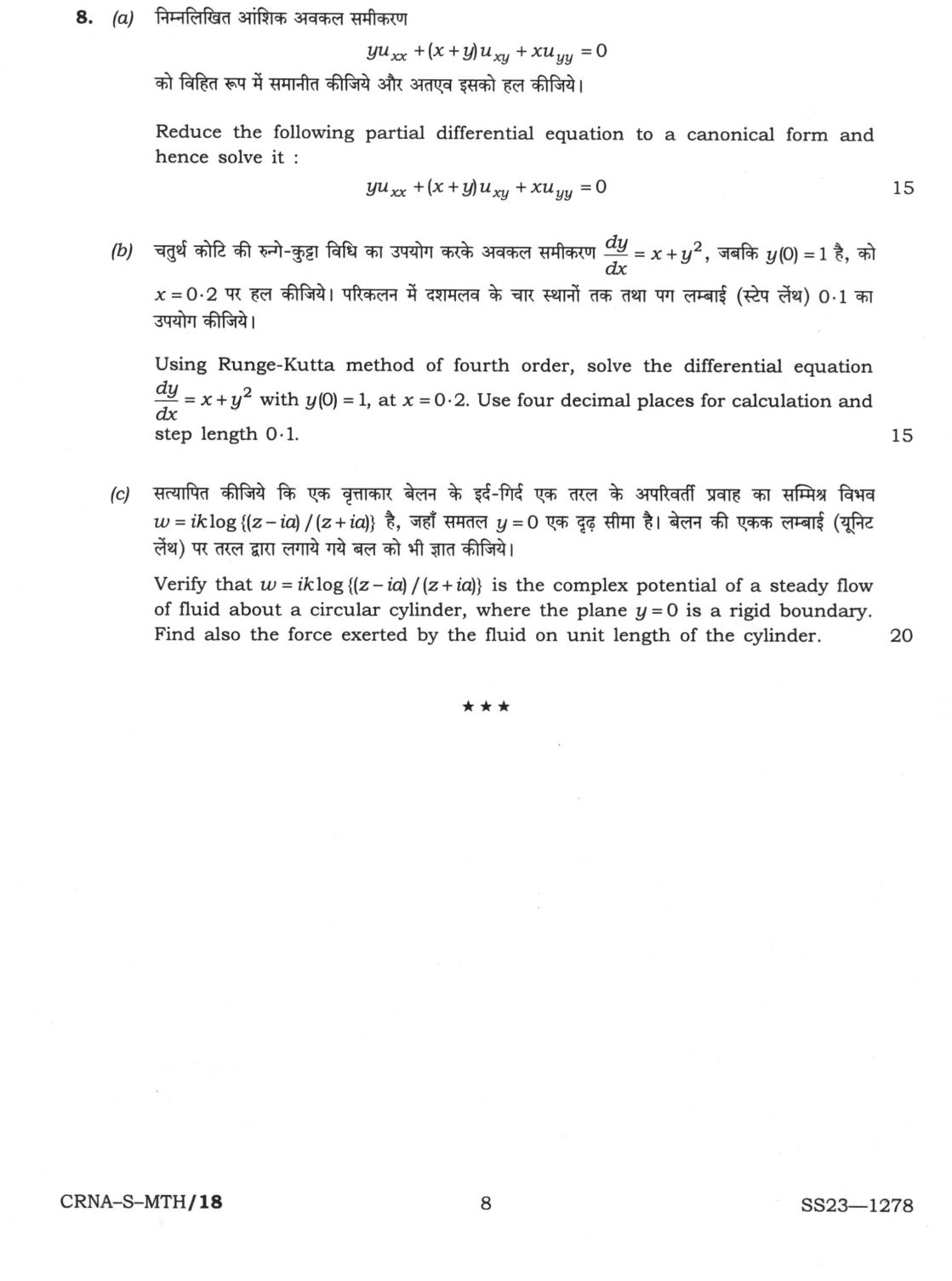
(a) Reduce the following partial differential equation to a canonical form and hence solve it: yuₓₓ + (x+y)u_xy + xu_yy = 0 (15…
Reduce the following partial differential equation to a canonical form and hence solve it: yuₓₓ + (x+y)u_xy + xu_yy = 0 15 marks
Using Runge-Kutta method of fourth order, solve the differential equation dy/dx = x + y² with y(0) = 1, at x = 0.2. Use four decimal places for calculation and step length 0.1. 15 marks
Verify that w = ik log (z-ia)/(z+ia) is the complex potential of a steady flow of fluid about a circular cylinder, where the plane y = 0 is a rigid boundary. Find also the force exerted by the fluid on unit length of the cylinder. 20 marks
हिंदी में प्रश्न पढ़ें
निम्नलिखित आंशिक अवकल समीकरण yuₓₓ + (x+y)u_xy + xu_yy = 0 को विहित रूप में समानीत कीजिये और अतः इसको हल कीजिये। (15 अंक)
चतुर्थ कोटि की रूने-कुट्टा विधि का उपयोग करके अवकल समीकरण dy/dx = x + y², जबकि y(0) = 1 है, को x = 0.2 पर हल कीजिये। परिकलन में दशमलव के चार स्थानों तक तथा पग लम्बाई (स्टेप लैंथ) 0.1 का उपयोग कीजिये। (15 अंक)
सत्यापित कीजिये कि एक वृत्ताकार बेलन के इर्द-गिर्द एक तरल के अपरिवर्ती प्रवाह का सम्मिश्र विभव w = ik log (z-ia)/(z+ia) है, जहाँ समतल y = 0 एक दृढ़ सीमा है। बेलन की एकक लम्बाई (यूनिट लैंथ) पर तरल द्वारा लगाये गये बल को भी ज्ञात कीजिये। (20 अंक)
What "Solve" is asking you to do
Choose the method, then carry it through to a final answer. Identifying what kind of problem this is and why that method applies is the first thing marked; a correct figure arrived at invisibly earns almost nothing.
Structure that answers it
Given data and what is required → method chosen, with the reason it applies → set-up (equation, circuit, free body, trial balance) → working, step by step → answer with units and any condition of validity
Where marks are lost
Doing the middle steps mentally and writing only the result. In mathematics papers, a further loss comes from giving a decimal where the exact value in surds or fractions was wanted, or from skipping the justification a part explicitly asks for.
How this answer will be evaluated
Approach
(a) derive: given > assumptions > stepwise derivation > result > check | (b) calculate: given > formula > substitution > result with units > interpretation | (c) justify: claim > 3-4 reasons > evidence > conclusion Full marks: Complete derivations with all steps shown, correct final answers, and clear justification of methods.
Key points expected
- Identify A, B, C coefficients from the PDE
- Solve the characteristic equation for m
- Define new variables ξ and η
- State the general solution in terms of ξ, η
- State the RK4 formulas for k1, k2, k3, k4
- Perform calculation for the first step (x=0 to 0.1)
- Perform calculation for the second step (x=0.1 to 0.2)
- Maintain four decimal places in all calculations
Evaluation rubric
Each sub-part is marked on its own, against the marks and word limit printed on the paper.
- (a) Canonical form of the PDE and its general solution. 15 marks
derive— given → assumptions → stepwise derivation → result → check
Must cover
- Identify A, B, C coefficients from the PDE
- Solve the characteristic equation for m
- Define new variables ξ and η
- State the general solution in terms of ξ, η
Loses marks
- Incorrect identification of PDE coefficients
- Failure to solve the characteristic equation
Earns more
- Explicit calculation of the discriminant B²-4AC
- Verification of the canonical form
Extra mark
- Alternative method for finding characteristics
- (b) Value of y at x=0.2 using RK4 method. 15 marks
calculate— given → formula → substitution → result with units → interpretation
Must cover
- State the RK4 formulas for k1, k2, k3, k4
- Perform calculation for the first step (x=0 to 0.1)
- Perform calculation for the second step (x=0.1 to 0.2)
- Maintain four decimal places in all calculations
Loses marks
- Arithmetic errors in k calculations
- Incorrect step size usage
Earns more
- Tabular presentation of k values
- Explicit substitution of values into formulas
Extra mark
- Comparison with exact solution if known
- (c) Verification of complex potential and calculation of force. 20 marks
justify— claim → 3-4 reasons → evidence → conclusion
Must cover
- Show that y=0 is a streamline (rigid boundary)
- Identify the circular cylinder geometry from the potential
- Apply Blasius theorem or equivalent for force calculation
- Calculate the force per unit length
Loses marks
- Failure to verify the boundary condition
- Incorrect application of force calculation theorem
Earns more
- Explicit calculation of velocity components
- Clear geometric interpretation of the potential
Extra mark
- Sketch of the flow field
- Mention of lift and drag components
Model answer coming soon
Every evaluation on this site is marked against a verified model answer. This question's answer is still being written; evaluation opens the moment it lands.
More from Mathematics 2022 Paper II
- Q5 (a) It is given that the equation of any cone with vertex at (a, b, c) is f((x-a)/(z-c),…
- Q6 (a) Solve the heat equation ∂u/∂t = ∂²u/∂x², 0 < x < l, t > 0 subject to the conditions u…
- Q7 (a) Find the general solution of the partial differential equation (D² + DD' - 6D'²)z = x…
- Q8 (a) Reduce the following partial differential equation to a canonical form and hence solv…