Paper II — Q3
(a) Evaluate ∫_C (z+4)/(z² + 2z + 5) dz, where C is |z + 1 - i| = 2. (15 marks) (b) Find the maximum and minimum values of x²/a⁴…
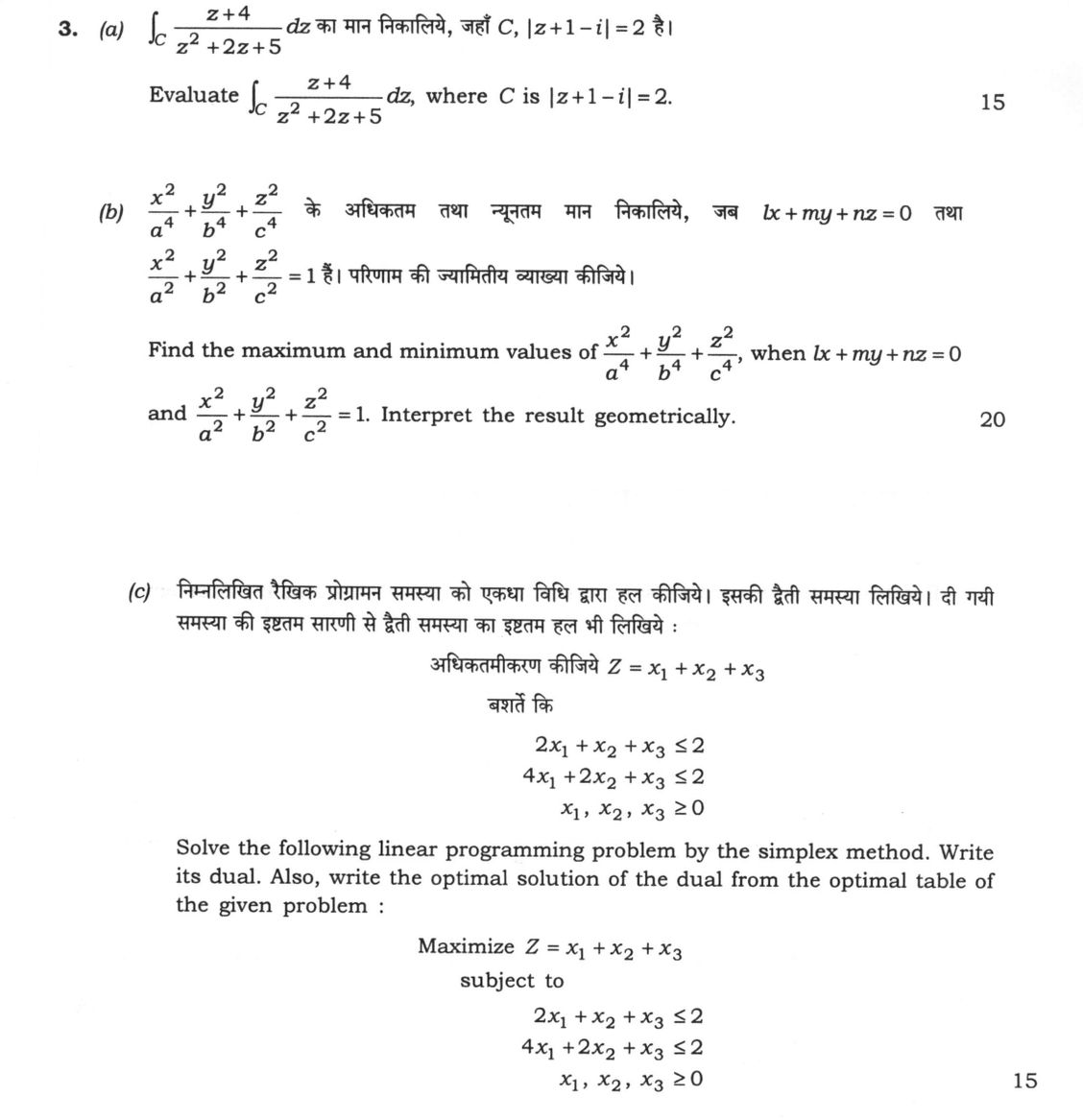
Evaluate ∫_C (z+4)/(z² + 2z + 5) dz, where C is |z + 1 - i| = 2. 15 marks
Find the maximum and minimum values of x²/a⁴ + y²/b⁴ + z²/c⁴, when lx + my + nz = 0 and x²/a² + y²/b² + z²/c² = 1. Interpret the result geometrically. 20 marks
Solve the following linear programming problem by the simplex method. Write its dual. Also, write the optimal solution of the dual from the optimal table of the given problem :
Maximize Z = x₁ + x₂ + x₃
subject to
2x₁ + x₂ + x₃ ≤ 2 4x₁ + 2x₂ + x₃ ≤ 2 x₁, x₂, x₃ ≥ 0 15 marks
हिंदी में प्रश्न पढ़ें
∫_C (z+4)/(z² + 2z + 5) dz का मान निकालिये, जहाँ C, |z + 1 - i| = 2 है। (15 अंक)
x²/a⁴ + y²/b⁴ + z²/c⁴ के अधिकतम तथा न्यूनतम मान निकालिये, जब lx + my + nz = 0 तथा x²/a² + y²/b² + z²/c² = 1 है। परिणाम की ज्यामितीय व्याख्या कीजिए। (20 अंक)
निम्नलिखित रैखिक प्रोग्राम समस्या को एकथा विधि द्वारा हल कीजिये। इसकी द्वैती समस्या लिखिये। दी गयी समस्या की इष्टतम सारणी से द्वैती समस्या का इष्टतम हल भी लिखिये :
अधिकतमीकरण कीजिये Z = x₁ + x₂ + x₃
बशर्ते कि
2x₁ + x₂ + x₃ ≤ 2 4x₁ + 2x₂ + x₃ ≤ 2 x₁, x₂, x₃ ≥ 0 (15 अंक)
Model answer
Written by UPSC Answer Check against this question's marking rubric, to the expected length. UPSC does not publish answers for Mains — this is one way to score well, not an official key.
(a) The denominator factors as z²+2z+5=(z+1-2i)(z+1+2i), so the poles are z=-1+2i and z=-1-2i. The contour C is |z-(-1+i)|=2, a circle with centre -1+i and radius 2. The distances from the centre are |-1+2i-(-1+i)|=1 and |-1-2i-(-1+i)|=3; hence only z0=-1+2i is inside. Assuming C is positively oriented, the residue theorem gives ∫C (z+4)/(z²+2z+5) dz = 2πi Res(z0). Since the pole is simple, Res(z0)=(z0+4)/(2z0+2)=(3+2i)/(4i)=(2-3i)/4. Therefore ∫C (z+4)/(z²+2z+5) dz = 2πi(2-3i)/4 = (3π+2πi)/2 = 3π/2 + πi.
(b) Put u=x/a², v=y/b², w=z/c². Then F=u²+v²+w², a²u²+b²v²+c²w²=1, la²u+mb²v+nc²w=0. Let A=la², B=mb², C=nc². Use Lagrange multipliers: L=u²+v²+w²-λ(a²u²+b²v²+c²w²-1)-μ(Au+Bv+Cw). Stationarity gives 2u-2λa²u-μA=0, 2v-2λb²v-μB=0, 2w-2λc²w-μC=0. Multiplying these by u,v,w and adding, and using the two constraints, gives 2F-2λ=0, so F=λ. In the generic case, the stationarity equations give u=kA/(1-λa²), v=kB/(1-λb²), w=kC/(1-λc²), k=μ/2. Substitution in Au+Bv+Cw=0 gives A²/(1-λa²)+B²/(1-λb²)+C²/(1-λc²)=0. Multiplying by (1-λa²)(1-λb²)(1-λc²) and expanding gives a²b²c²(l²a²+m²b²+n²c²)λ² -[l²a⁴(b²+c²)+m²b⁴(a²+c²)+n²c⁴(a²+b²)]λ +(l²a⁴+m²b⁴+n²c⁴)=0. Let P=l²a²+m²b²+n²c², Q=l²a⁴(b²+c²)+m²b⁴(a²+c²)+n²c⁴(a²+b²), R=l²a⁴+m²b⁴+n²c⁴. Then the equation is a²b²c²P λ²-Qλ+R=0. For a,b,c>0 and (l,m,n) not all zero, P>0 and the two positive roots are λ=(Q±√(Q²-4a²b²c²PR))/(2a²b²c²P). The larger root is the maximum of F and the smaller root is the minimum. If l=m=n=0, the plane condition is absent; then the maximum is 1/min(a²,b²,c²) and the minimum is 1/max(a²,b²,c²). Geometrically, in (u,v,w)-space the constraints are the reciprocal ellipsoid a²u²+b²v²+c²w²=1 cut by the plane Au+Bv+Cw=0. F is the squared distance from the origin to a point of this central ellipse. Hence the two values are the squares of its semi-axes. Since (u,v,w) is one half of the gradient of x²/a²+y²/b²+z²/c², they are also one quarter of the extremal squared lengths of normals to the original ellipsoid at points of lx+my+nz=0.
(c) Add slack variables s₁,s₂≥0: 2x₁+x₂+x₃+s₁=2, 4x₁+2x₂+x₃+s₂=2. Use the Cj-Zj row; for maximization the tableau is optimal when every Cj-Zj entry in the variable columns is ≤0. Columns are x₁ x₂ x₃ s₁ s₂ | RHS. Initial tableau: s₁: 2 1 1 1 0 | 2 s₂: 4 2 1 0 1 | 2 Cj-Zj: 1 1 1 0 0 | 0 Let x₃ enter. The ratios are 2/1 and 2/1; choose s₁ to leave. Pivot on the 1 in the x₃ column of the s₁ row. The new x₃ row is the old s₁ row, and the new s₂ row is old s₂ minus old s₁: x₃: 2 1 1 1 0 | 2 s₂: 2 1 0 -1 1 | 0 With basis cB=(1,0), Zj=(2,1,1,1,0), so Cj-Zj: -1 0 0 -1 0 | 2. The RHS shown in the bottom row is the current Z. The basis columns x₃ and s₂ are unit columns, so the tableau is canonical. All Cj-Zj entries in the variable columns are ≤0, so it is optimal. The non-basic variables are x₁=x₂=s₁=0; hence x₃=2, s₂=0, and Z=2. The dual is Minimize W=2y₁+2y₂ subject to 2y₁+4y₂≥1, y₁+2y₂≥1, y₁+y₂≥1, y₁,y₂≥0. From the optimal table, y_j=-(Cj-Zj) under the slack column s_j, so the dual solution read from this tableau is y₁=1, y₂=0. Then W=2, agreeing with the primal optimum. The dual optimum is not unique, but this is the one obtained from the table. Final answer: primal x₁=0, x₂=0, x₃=2, Z=2; dual y₁=1, y₂=0, W=2.
What "Solve" is asking you to do
Choose the method, then carry it through to a final answer. Identifying what kind of problem this is and why that method applies is the first thing marked; a correct figure arrived at invisibly earns almost nothing.
Structure that answers it
Given data and what is required → method chosen, with the reason it applies → set-up (equation, circuit, free body, trial balance) → working, step by step → answer with units and any condition of validity
Where marks are lost
Doing the middle steps mentally and writing only the result. In mathematics papers, a further loss comes from giving a decimal where the exact value in surds or fractions was wanted, or from skipping the justification a part explicitly asks for.
How this answer will be evaluated
Approach
(a) calculate: given > formula > substitution > result with units > interpretation | (b) calculate: given > formula > substitution > result with units > interpretation | (c) calculate: given > formula > substitution > result with units > interpretation Full marks: Flawless execution of all methods with clear justifications and complete interpretations.
Key points expected
- Factorize denominator to find singularities
- Verify singularities lie inside contour C
- Apply Cauchy's Integral Formula or Residue Theorem
- Compute final value of the integral
- Set up Lagrange multipliers for two constraints
- Derive the characteristic equation for eigenvalues
- Solve for maximum and minimum values
- Provide the geometric interpretation of the result
Evaluation rubric
Each sub-part is marked on its own, against the marks and word limit printed on the paper.
- (a) Value of the contour integral using complex analysis. 15 marks
calculate— given → formula → substitution → result with units → interpretation
Must cover
- Factorize denominator to find singularities
- Verify singularities lie inside contour C
- Apply Cauchy's Integral Formula or Residue Theorem
- Compute final value of the integral
Loses marks
- Incorrect factorization of the quadratic
- Failure to check if poles are inside C
- Arithmetic errors in residue calculation
Earns more
- Correct identification of poles
- Clear statement of the theorem used
- Step-by-step substitution of values
Extra mark
- Sketch of the contour C in complex plane
- (b) Max/min values of the function and geometric interpretation. 20 marks
calculate— given → formula → substitution → result with units → interpretation
Must cover
- Set up Lagrange multipliers for two constraints
- Derive the characteristic equation for eigenvalues
- Solve for maximum and minimum values
- Provide the geometric interpretation of the result
Loses marks
- Incorrect setup of Lagrange equations
- Algebraic errors in the characteristic equation
- Missing or vague geometric interpretation
Earns more
- Correct formulation of the auxiliary equation
- Clear algebraic steps in solving for extrema
- Accurate geometric description of the ellipsoid
Extra mark
- Alternative method using matrix diagonalization
- (c) Simplex solution, dual problem, and dual optimal solution. 15 marks
calculate— given → formula → substitution → result with units → interpretation
Must cover
- Solve primal problem using simplex method
- Formulate the dual linear programming problem
- Extract dual optimal solution from final simplex table
- Verify strong duality theorem (Z = W)
Loses marks
- Incorrect simplex tableau construction
- Failure to identify the correct pivot element
- Incorrect formulation of the dual problem
Earns more
- Correct initial simplex tableau setup
- Clear pivot operations in simplex iterations
- Proper identification of dual variables
Extra mark
- Graphical representation of the feasible region
Practice this exact question
Write your answer and it is marked point by point against the model answer above — what you covered, what you missed, what you got wrong.
Evaluate my answer →More from Mathematics 2022 Paper II
- Q1 (a) Show that the multiplicative group G = {1, -1, i, -i}, where i = √(-1), is isomorphic…
- Q2 (a) Let f(x) = x² on [0, k], k > 0. Show that f is Riemann integrable on the closed inter…
- Q3 (a) Evaluate ∫_C (z+4)/(z² + 2z + 5) dz, where C is |z + 1 - i| = 2. (15 marks) (b) Find…
- Q4 (a) Let R be a field of real numbers and S, the field of all those polynomials f(x) ∈ R[x…
- Q5 (a) It is given that the equation of any cone with vertex at (a, b, c) is f((x-a)/(z-c),…
- Q6 (a) Solve the heat equation ∂u/∂t = ∂²u/∂x², 0 < x < l, t > 0 subject to the conditions u…