Paper II — Q2
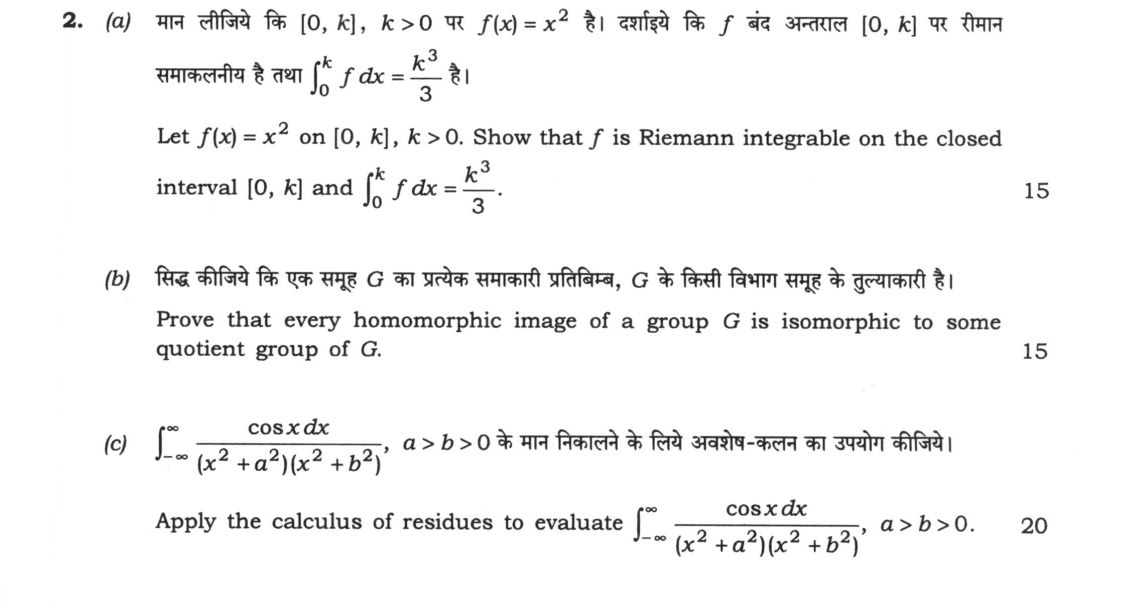
(a) Let f(x) = x² on [0, k], k > 0. Show that f is Riemann integrable on the closed interval [0, k] and ∫₀ᵏ f dx = k³/3. 15…
Let f(x) = x² on [0, k], k > 0. Show that f is Riemann integrable on the closed interval [0, k] and ∫₀ᵏ f dx = k³/3. 15 marks
Prove that every homomorphic image of a group G is isomorphic to some quotient group of G. 15 marks
Apply the calculus of residues to evaluate ∫₋∞^∞ (cos x dx)/((x² + a²)(x² + b²)), a > b > 0. 20 marks
हिंदी में प्रश्न पढ़ें
मान लीजिए कि [0, k], k > 0 पर f(x) = x² है। दर्शाइए कि f बंद अन्तराल [0, k] पर रीमन समाकलनीय है तथा ∫₀ᵏ f dx = k³/3 है। 15 अंक
सिद्ध कीजिए कि एक समूह G का प्रत्येक समाकारी प्रतिबिंब, G के किसी विभाग समूह के तुल्यकारी है। 15 अंक
∫₋∞^∞ (cos x dx)/((x² + a²)(x² + b²)), a > b > 0 के मान निकालने के लिये अवशेष-कलन का उपयोग कीजिए। 20 अंक
Model answer
Written by UPSC Answer Check against this question's marking rubric, to the expected length. UPSC does not publish answers for Mains — this is one way to score well, not an official key.
(a) Let Pₙ = {0, k/n, 2k/n, ..., k}. Since f(x)=x² is increasing on [0,k], on [xⱼ₋₁, xⱼ] its infimum is xⱼ₋₁² and supremum is xⱼ². With Δx = k/n, L(Pₙ,f) = Σⱼ₌₁ⁿ xⱼ₋₁² Δx = (k/n) Σⱼ₌₁ⁿ ((j−1)k/n)² = (k³/n³) Σᵣ₌₀ⁿ⁻¹ r² = (k³/n³) · ((n−1)n(2n−1))/6. Similarly, U(Pₙ,f) = Σⱼ₌₁ⁿ xⱼ² Δx = (k/n) Σⱼ₌₁ⁿ (jk/n)² = (k³/n³) Σⱼ₌₁ⁿ j² = (k³/n³) · (n(n+1)(2n+1))/6. Hence U(Pₙ,f) − L(Pₙ,f) = (k³/n³)[Σⱼ₌₁ⁿ j² − Σⱼ₌₁ⁿ (j−1)²] = k³/n. For every ε>0 choose n > k³/ε. Then U(Pₙ,f) − L(Pₙ,f) < ε. By the Darboux criterion, f is Riemann integrable on [0,k]. Also, L(Pₙ,f) = k³/6 · ((n−1)(2n−1)/n²) = k³/6 (2 − 3/n + 1/n²) → k³/3. Similarly, U(Pₙ,f) = k³/6 · ((n+1)(2n+1)/n²) = k³/6 (2 + 3/n + 1/n²) → k³/3. Thus the lower and upper integrals both equal k³/3, so ∫₀ᵏ x² dx = k³/3.
(b) Let φ:G→H be a group homomorphism. Put K = ker φ. For k∈K and g∈G, φ(gkg⁻¹) = φ(g)φ(k)φ(g)⁻¹ = φ(g) e φ(g)⁻¹ = e, so gkg⁻¹∈K. Thus K is normal in G, and G/K is a quotient group.
Define ψ:G/K→φ(G) by ψ(gK)=φ(g).
Well-defined: if gK=hK, then h⁻¹g∈K, so φ(h⁻¹g)=e. Hence φ(h)⁻¹φ(g)=e, so φ(g)=φ(h).
Homomorphism: for gK,hK∈G/K, ψ((gK)(hK)) = ψ(ghK) = φ(gh) = φ(g)φ(h) = ψ(gK)ψ(hK).
Onto: if y∈φ(G), then y=φ(g) for some g∈G, so y=ψ(gK).
One-one: if ψ(gK)=ψ(hK), then φ(g)=φ(h). Hence φ(h⁻¹g)=e, so h⁻¹g∈K, which gives gK=hK.
Therefore ψ is an isomorphism. Hence every homomorphic image φ(G) of G is isomorphic to the quotient group G/ker φ. Final: φ(G) ≅ G/ker φ.
(c) Let J = ∫ from −∞ to ∞ of exp(ix)/((x²+a²)(x²+b²)) dx. Then the required integral is I = Re J. Consider f(z) = exp(iz)/((z²+a²)(z²+b²)). The poles are z = ±ia and z = ±ib. For R>a, take the contour consisting of the real segment [−R,R] and the upper semicircle γ(R). On γ(R), |exp(iz)| ≤ 1 and |f(z)| = O(R⁻⁴), so by ML inequality or Jordan’s lemma, ∫ over γ(R) of f(z) dz → 0 as R→∞.
The poles in the upper half-plane are z=ia and z=ib.
At z=ia: Res(f,ia) = lim as z→ia of (z−ia)f(z) = exp(−a)/[2ia(b²−a²)] = i exp(−a)/[2a(a²−b²)].
At z=ib: Res(f,ib) = lim as z→ib of (z−ib)f(z) = exp(−b)/[2ib(a²−b²)] = −i exp(−b)/[2b(a²−b²)].
By the residue theorem, J = 2πi [Res(f,ia)+Res(f,ib)] = 2πi · i/(a²−b²) [exp(−a)/(2a) − exp(−b)/(2b)] = −2π/(a²−b²) [exp(−a)/(2a) − exp(−b)/(2b)] = π/(a²−b²) [exp(−b)/b − exp(−a)/a]. This value is real, so I = J. Therefore, for a>b>0, ∫ from −∞ to ∞ of cos x / ((x²+a²)(x²+b²)) dx = π/(a²−b²) (exp(−b)/b − exp(−a)/a).
What "Prove" is asking you to do
Establish that the statement holds for every case it claims, not for one representative case. The argument must be closed: each line follows from a definition, a hypothesis, or a named theorem you are entitled to use.
Structure that answers it
Given and to prove, restated → theorem or construction to be used, named → the argument line by line → conclusion stated as proved
Where marks are lost
Testing one example, which illustrates but proves nothing. On an if and only if claim, proving one direction and stopping forfeits that half outright, and degenerate cases — zero, the empty set, the equality case — have to be disposed of rather than assumed away.
How this answer will be evaluated
Approach
(a) derive: given > assumptions > stepwise derivation > result > check | (b) justify: claim > 3-4 reasons > evidence > conclusion | (c) calculate: given > formula > substitution > result with units > interpretation Full marks: Rigorous proofs with all steps justified, correct final answers, and clear notation.
Key points expected
- Define upper and lower sums for partition of [0,k]
- Show difference between upper and lower sums tends to zero
- Compute limit of Riemann sum to find integral value
- State final result as k³/3
- Define homomorphism φ: G → H and its image
- Define kernel of φ as a normal subgroup
- State and apply the First Isomorphism Theorem
- Construct the isomorphism between G/ker(φ) and im(φ)
Evaluation rubric
Each sub-part is marked on its own, against the marks and word limit printed on the paper.
- (a) Prove Riemann integrability of f(x)=x² on [0,k] and calculate the integral value. 15 marks
derive— given → assumptions → stepwise derivation → result → check
Must cover
- Define upper and lower sums for partition of [0,k]
- Show difference between upper and lower sums tends to zero
- Compute limit of Riemann sum to find integral value
- State final result as k³/3
Loses marks
- Skipping the limit process for Riemann sums
- Failing to prove integrability before calculating value
Earns more
- Explicitly define partition points x_i = ik/n
- Show monotonicity of f(x)=x² on [0,k]
- Verify result for a specific value of k
Extra mark
- Alternative proof using Darboux criterion
- (b) Prove that every homomorphic image of G is isomorphic to a quotient group. 15 marks
justify— claim → 3-4 reasons → evidence → conclusion
Must cover
- Define homomorphism φ: G → H and its image
- Define kernel of φ as a normal subgroup
- State and apply the First Isomorphism Theorem
- Construct the isomorphism between G/ker(φ) and im(φ)
Loses marks
- Failing to show the kernel is a normal subgroup
- Stating the theorem without proving the isomorphism
Earns more
- Explicitly define the map ψ: G/ker(φ) → im(φ)
- Verify ψ is a well-defined homomorphism
- Show ψ is injective and surjective
Extra mark
- Example with a specific group like Z → Z/nZ
- (c) Evaluate the integral ∫₋∞^∞ cos x / ((x²+a²)(x²+b²)) dx using residues. 20 marks
calculate— given → formula → substitution → result with units → interpretation
Must cover
- Identify poles of the complex function in the upper half-plane
- Calculate residues at the poles ia and ib
- Apply the Residue Theorem to the contour integral
- Extract the real part to find the final value
Loses marks
- Incorrect identification of poles in the upper half-plane
- Failing to justify why the arc integral vanishes
Earns more
- Sketch the semicircular contour in the upper half-plane
- Show the integral over the arc vanishes as radius → ∞
- Simplify the algebraic expression for the final answer
Extra mark
- Alternative method using partial fractions
Practice this exact question
Write your answer and it is marked point by point against the model answer above — what you covered, what you missed, what you got wrong.
Evaluate my answer →More from Mathematics 2022 Paper II
- Q1 (a) Show that the multiplicative group G = {1, -1, i, -i}, where i = √(-1), is isomorphic…
- Q2 (a) Let f(x) = x² on [0, k], k > 0. Show that f is Riemann integrable on the closed inter…
- Q3 (a) Evaluate ∫_C (z+4)/(z² + 2z + 5) dz, where C is |z + 1 - i| = 2. (15 marks) (b) Find…
- Q4 (a) Let R be a field of real numbers and S, the field of all those polynomials f(x) ∈ R[x…
- Q5 (a) It is given that the equation of any cone with vertex at (a, b, c) is f((x-a)/(z-c),…