Paper II — Q6
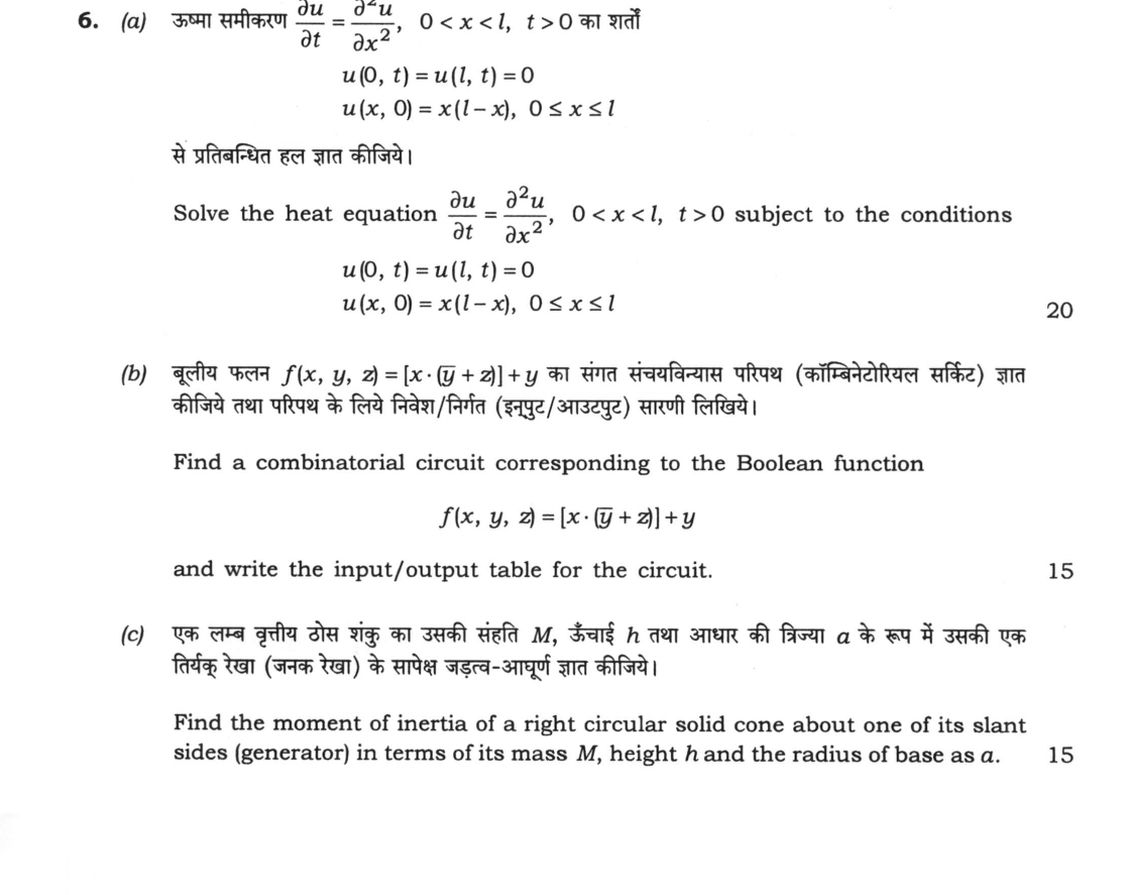
(a) Solve the heat equation ∂u/∂t = ∂²u/∂x², 0 < x < l, t > 0 subject to the conditions u(0, t) = u(l, t) = 0, u(x, 0) = x(l-x)…
Solve the heat equation ∂u/∂t = ∂²u/∂x², 0 < x < l, t > 0 subject to the conditions u(0, t) = u(l, t) = 0, u(x, 0) = x(l-x), 0 ≤ x ≤ l. 20 marks
Find a combinatorial circuit corresponding to the Boolean function f(x, y, z) = [x · (ȳ + z)] + y and write the input/output table for the circuit. 15 marks
Find the moment of inertia of a right circular solid cone about one of its slant sides (generator) in terms of its mass M, height h and the radius of base as a. 15 marks
हिंदी में प्रश्न पढ़ें
उष्मा समीकरण ∂u/∂t = ∂²u/∂x², 0 < x < l, t > 0 का शर्तों u(0, t) = u(l, t) = 0, u(x, 0) = x(l-x), 0 ≤ x ≤ l से प्रतिबंधित हल ज्ञात कीजिये। (20 अंक)
बूलिय फलन f(x, y, z) = [x · (ȳ + z)] + y का संगत संयोजीव्यास परिपथ (कॉम्बिनेटोरियल सर्किट) ज्ञात कीजिये तथा परिपथ के लिये निवेश/निर्गत (इनपुट/आउटपुट) सारणी लिखिये। (15 अंक)
एक लम्ब वृत्तीय ठोस शंकु का उसकी संहति M, ऊँचाई h तथा आधार की त्रिज्या a के रूप में उसकी एक तिर्यक रेखा (जनक रेखा) के सापेक्ष जड़त्व-आघूर्ण ज्ञात कीजिये। (15 अंक)
Model answer
Written by UPSC Answer Check against this question's marking rubric, to the expected length. UPSC does not publish answers for Mains — this is one way to score well, not an official key.
(a) Using separation of variables, write u(x,t)=X(x)T(t). Then
T′/T = X″/X = -λ.
The boundary conditions u(0,t)=u(l,t)=0 give X(0)=X(l)=0. Hence λₙ=(nπ/l)² and Xₙ(x)=sin(nπx/l), n=1,2,3,… . Therefore
u(x,t)=Σₙ₌₁^∞ Bₙ sin(nπx/l) exp(-n²π²t/l²).
At t=0,
x(l-x)=Σₙ₌₁^∞ Bₙ sin(nπx/l),
so by the Fourier sine series,
Bₙ=(2/l)∫₀^l x(l-x) sin(nπx/l) dx.
Let k=nπ/l. Then
Bₙ=(2/l)[l∫₀^l x sin(kx) dx − ∫₀^l x² sin(kx) dx].
Now,
∫₀^l x sin(kx) dx = −l(−1)ⁿ/k,
and
∫₀^l x² sin(kx) dx = −l²(−1)ⁿ/k + 2((−1)ⁿ−1)/k³.
Thus
Bₙ=(2/l)·2(1−(−1)ⁿ)/k³ = 4l²(1−(−1)ⁿ)/(n³π³).
So Bₙ=0 for even n, and for odd n,
Bₙ=8l²/(n³π³).
Hence
u(x,t)=8l²/π³ Σₘ₌₀^∞ sin((2m+1)πx/l) exp(−(2m+1)²π²t/l²)/(2m+1)³, 0≤x≤l, t≥0.
(b) The Boolean function is
f(x,y,z)=[x·(¬y+z)]+y.
Construct the circuit by these gates:
- Take input y through a NOT gate to get ¬y.
- Feed ¬y and z into an OR gate. Its output is A=¬y+z.
- Feed x and A into an AND gate. Its output is B=x·(¬y+z).
- Feed B and y into a final OR gate. Its output is f=B+y.
Thus the gate sequence is: y→NOT→OR with z→AND with x→OR with y→f.
Input/output table:
- x=0, y=0, z=0 → f=0
- x=0, y=0, z=1 → f=0
- x=1, y=0, z=0 → f=1
- x=1, y=0, z=1 → f=1
- x=0, y=1, z=0 → f=1
- x=0, y=1, z=1 → f=1
- x=1, y=1, z=0 → f=1
- x=1, y=1, z=1 → f=1
Equivalently, when y=1 the output is always 1; when y=0 the output equals x. Thus the function simplifies to f=x+y (OR).
(c) Let the cone have apex at the origin, axis along z, height h, base radius a. Its uniform density is
ρ=M/(⅓πa²h)=3M/(πa²h).
Choose one generator, the line from the apex to the base point (a,0,h). Put s²=a²+h². At height z, the cone satisfies 0≤r≤az/h, with x=r cosθ, y=r sinθ. For a point P(x,y,z), the square of its perpendicular distance from the generator is
d²=x²+y²+z²−(ax+hz)²/s².
Substituting x=r cosθ, y=r sinθ gives
d²=r²(1−a²cos²θ/s²)+a²z²/s²−2ah r z cosθ/s².
Integrating over θ from 0 to 2π, the cosθ term vanishes and ∫cos²θ dθ=π, so
∫₀^(2π) d² dθ=πr²(a²+2h²)/s²+2πa²z²/s².
Therefore the moment of inertia about the generator is
I=ρ∫₀^h ∫₀^(az/h) ∫₀^(2π) d²·r dθ dr dz
=ρπ/s²∫₀^h ∫₀^(az/h)[(a²+2h²)r³+2a²z²r] dr dz.
The inner integral equals
(a²+2h²)(az/h)⁴/4+a²z²(az/h)²
=a⁴z⁴(a²+6h²)/(4h⁴).
Hence
I=ρπ/s²·a⁴(a²+6h²)/(4h⁴)·h⁵/5
=ρπa⁴h(a²+6h²)/(20s²).
Using ρ=3M/(πa²h), this becomes
I=3Ma²(a²+6h²)/(20(a²+h²)).
This is valid for a uniform right circular solid cone about a generator, with mass M, height h and base radius a.
What "Solve" is asking you to do
Choose the method, then carry it through to a final answer. Identifying what kind of problem this is and why that method applies is the first thing marked; a correct figure arrived at invisibly earns almost nothing.
Structure that answers it
Given data and what is required → method chosen, with the reason it applies → set-up (equation, circuit, free body, trial balance) → working, step by step → answer with units and any condition of validity
Where marks are lost
Doing the middle steps mentally and writing only the result. In mathematics papers, a further loss comes from giving a decimal where the exact value in surds or fractions was wanted, or from skipping the justification a part explicitly asks for.
How this answer will be evaluated
Approach
(a) derive: given > assumptions > stepwise derivation > result > check | (b) describe: define > structure or process in order > labelled diagram > significance | (c) derive: given > assumptions > stepwise derivation > result > check Full marks: Complete derivations with all steps, correct results, and verification
Key points expected
- Apply separation of variables to find general solution
- Satisfy boundary conditions u(0,t)=u(l,t)=0
- Expand initial condition x(l-x) in Fourier sine series
- Calculate Fourier coefficients explicitly
- Draw circuit with correct logic gates
- Implement function f(x,y,z) = [x·(ȳ+z)]+y
- Provide complete truth table for all 8 inputs
- Label inputs and outputs clearly
Evaluation rubric
Each sub-part is marked on its own, against the marks and word limit printed on the paper.
- (a) Complete solution to the heat equation satisfying boundary and initial conditions. 20 marks
derive— given → assumptions → stepwise derivation → result → check
Must cover
- Apply separation of variables to find general solution
- Satisfy boundary conditions u(0,t)=u(l,t)=0
- Expand initial condition x(l-x) in Fourier sine series
- Calculate Fourier coefficients explicitly
Loses marks
- Skipping intermediate steps in derivation
- Answer without working
- Incorrect Fourier coefficient calculation
Earns more
- State separation of variables method by name
- Show eigenvalue problem for spatial part
- Verify solution satisfies PDE and conditions
- Check special case or limit behavior
Extra mark
- Neat figure showing initial condition
- Alternative method noted briefly
- (b) Combinatorial circuit diagram and complete input/output table for given Boolean function. 15 marks
describe— define → structure or process in order → labelled diagram → significance
Must cover
- Draw circuit with correct logic gates
- Implement function f(x,y,z) = [x·(ȳ+z)]+y
- Provide complete truth table for all 8 inputs
- Label inputs and outputs clearly
Loses marks
- Missing or incorrect truth table entries
- Circuit not matching Boolean function
- Unlabelled or unclear diagram
Earns more
- Show intermediate gate outputs
- Verify circuit against truth table
- Use standard logic gate symbols
- Simplify or optimize circuit if possible
Extra mark
- Neat labelled diagram
- Alternative circuit implementation noted
- (c) Moment of inertia of solid cone about slant side in terms of M, h, a. 15 marks
derive— given → assumptions → stepwise derivation → result → check
Must cover
- Set up coordinate system with slant side as axis
- Use integration to find moment of inertia
- Express result in terms of M, h, a
- Show all integration steps clearly
Loses marks
- Skipping integration steps
- Incorrect coordinate setup
- Final answer without derivation
Earns more
- State parallel axis theorem if used
- Define all variables before use
- Verify dimensions of final result
- Check special case (e.g., h→0 or a→0)
Extra mark
- Neat figure showing cone and axis
- Alternative method noted briefly
Practice this exact question
Write your answer and it is marked point by point against the model answer above — what you covered, what you missed, what you got wrong.
Evaluate my answer →More from Mathematics 2022 Paper II
- Q3 (a) Evaluate ∫_C (z+4)/(z² + 2z + 5) dz, where C is |z + 1 - i| = 2. (15 marks) (b) Find…
- Q4 (a) Let R be a field of real numbers and S, the field of all those polynomials f(x) ∈ R[x…
- Q5 (a) It is given that the equation of any cone with vertex at (a, b, c) is f((x-a)/(z-c),…
- Q6 (a) Solve the heat equation ∂u/∂t = ∂²u/∂x², 0 < x < l, t > 0 subject to the conditions u…
- Q7 (a) Find the general solution of the partial differential equation (D² + DD' - 6D'²)z = x…
- Q8 (a) Reduce the following partial differential equation to a canonical form and hence solv…