Paper II — Q7
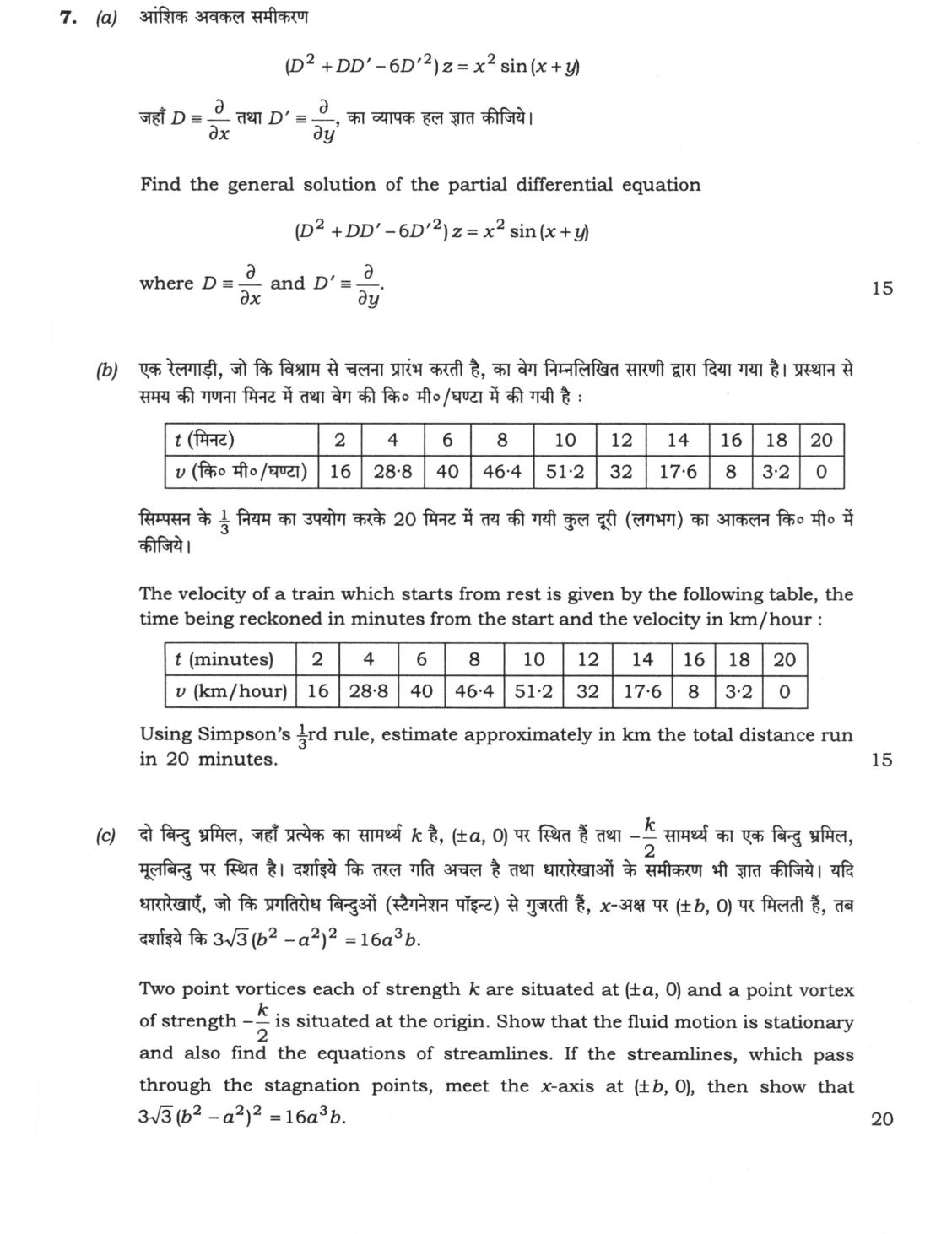
(a) Find the general solution of the partial differential equation (D² + DD' - 6D'²)z = x² sin(x+y) where D ≡ (∂)/(∂ x) and D' ≡…
Find the general solution of the partial differential equation (D² + DD' - 6D'²)z = x² sin(x+y) where D ≡ (∂)/(∂ x) and D' ≡ (∂)/(∂ y). 15 marks
The velocity of a train which starts from rest is given by the following table, the time being reckoned in minutes from the start and the velocity in km/hour:
| t (minutes) | 2 | 4 | 6 | 8 | 10 | 12 | 14 | 16 | 18 | 20 |
|---|---|---|---|---|---|---|---|---|---|---|
| v (km/hour) | 16 | 28.8 | 40 | 46.4 | 51.2 | 32 | 17.6 | 8 | 3.2 | 0 |
Using Simpson's 1/3rd rule, estimate approximately in km the total distance run in 20 minutes. 15 marks
Two point vortices each of strength k are situated at (± a, 0) and a point vortex of strength -k/2 is situated at the origin. Show that the fluid motion is stationary and also find the equations of streamlines. If the streamlines, which pass through the stagnation points, meet the x-axis at (± b, 0), then show that $3√3(b²-a²)² = 16a^3b$. 20 marks
हिंदी में प्रश्न पढ़ें
आंशिक अवकल समीकरण (D² + DD' - 6D'²)z = x² sin(x+y) जहाँ D ≡ (∂)/(∂ x) तथा D' ≡ (∂)/(∂ y), का व्यापक हल ज्ञात कीजिये। (15 अंक)
एक रेलगाड़ी, जो कि विश्राम से चलना प्रारंभ करती है, का वेग निम्नलिखित सारणी द्वारा दिया गया है। प्रस्थान से समय की गणना मिनट में तथा वेग की कि० मी०/घंटा में की गयी है:
| t (मिनट) | 2 | 4 | 6 | 8 | 10 | 12 | 14 | 16 | 18 | 20 |
|---|---|---|---|---|---|---|---|---|---|---|
| v (कि० मी०/घंटा) | 16 | 28.8 | 40 | 46.4 | 51.2 | 32 | 17.6 | 8 | 3.2 | 0 |
सिम्पसन के 1/3 नियम का उपयोग करके 20 मिनट में तय की गयी कुल दूरी (लगभग) का आकलन कि० मी० में कीजिये। (15 अंक)
दो बिंदु भ्रमिल, जहाँ प्रत्येक का सामर्थ्य k है, (± a, 0) पर स्थित हैं तथा -k/2 सामर्थ्य का एक बिंदु भ्रमिल, मूलबिंदु पर स्थित है। दर्शाइये कि तरल गति अचल है तथा धारारेखाओं के समीकरण भी ज्ञात कीजिये। यदि धारारेखाएँ, जो कि प्रगतिरोध बिंदुओं (स्टैगनेशन पॉइंट) से गुजरती हैं, x-अक्ष पर (± b, 0) पर मिलती हैं, तब दर्शाइये कि $3√3(b²-a²)² = 16a^3b$। (20 अंक)
The figure this question refers to, in words
The question paper is a scan and the diagram did not survive as text. This is the figure as read from the original page — every component, value and label — so the question can be worked from the text below.
(b) Table of values: t (minutes): 2, 4, 6, 8, 10, 12, 14, 16, 18, 20 v (km/hour): 16, 28.8, 40, 46.4, 51.2, 32, 17.6, 8, 3.2, 0
Model answer
Written by UPSC Answer Check against this question's marking rubric, to the expected length. UPSC does not publish answers for Mains — this is one way to score well, not an official key.
(a) Let D = ∂/∂x and D' = ∂/∂y. The operator factors as D² + DD' − 6D'² = (D + 3D')(D − 2D').
For the complementary function:
- (D + 3D')z = 0 gives the characteristic y − 3x = constant.
- (D − 2D')z = 0 gives the characteristic y + 2x = constant.
So CF = f(y − 3x) + g(y + 2x), where f and g are twice continuously differentiable.
For the particular integral, write sin(x + y) = Im e^(i(x+y)). Put z_p = Im(e^(i(x+y)) u). For P(D,D') = D² + DD' − 6D'², a direct computation gives P(e^(i(x+y)) u) = e^(i(x+y))[4u + i(3u_x − 11u_y) + P u].
We need 4u + i(3u_x − 11u_y) + P u = x². Take u = x²/4 − (3i/8)x − 13/32. Then P u = 1/2 and 3u_x − 11u_y = 3x/2 − 9i/8. Substitution verifies the equation exactly.
Thus z_p = Im[e^(i(x+y))(x²/4 − 13/32 − 3ix/8)] = (x²/4 − 13/32) sin(x+y) − (3x/8) cos(x+y).
Therefore the general solution is z = f(y − 3x) + g(y + 2x) + (x²/4 − 13/32) sin(x+y) − (3x/8) cos(x+y).
(b) Since the train starts from rest, v(0) = 0. The ordinates at t = 0, 2, 4, …, 20 minutes are 0, 16, 28.8, 40, 46.4, 51.2, 32, 17.6, 8, 3.2, 0.
Here h = 2 minutes. By Simpson’s 1/3rd rule, ∫v dt = h/3 [v0 + v10 + 4(v1 + v3 + v5 + v7 + v9) + 2(v2 + v4 + v6 + v8)].
Now v1 + v3 + v5 + v7 + v9 = 16 + 40 + 51.2 + 17.6 + 3.2 = 128, v2 + v4 + v6 + v8 = 28.8 + 46.4 + 32 + 8 = 115.2.
Hence ∫v dt = (2/3)[0 + 0 + 4(128) + 2(115.2)] = (2/3)(512 + 230.4) = 1484.8/3 = 7424/15 km·min/hour.
Since v is in km/hour and t is in minutes, divide by 60: distance = (7424/15) ÷ 60 = 1856/225 km = 8.2489 km.
Distance ≈ 8.25 km.
(c) For a point vortex of strength Γ at z_j, the complex velocity at z is u − iv = − i/(2π) Σ Γ_j/(z − z_j). Here k ≠ 0.
At z = a, the induced velocity from vortices at −a and 0 is u − iv = − i/(2π)[k/(2a) + (−k/2)/a] = 0. At z = −a, similarly u − iv = − i/(2π)[−k/(2a) + k/(2a)] = 0. At z = 0, u − iv = − i/(2π)[−k/a + k/a] = 0. Thus all three vortices remain at rest; the flow configuration is stationary.
The complex potential is Ω(z) = − i/(2π)[k log(z−a) + k log(z+a) − (k/2) log z] = − ik/(2π) log((z² − a²)/√z).
Hence the stream function is ψ = − k/(2π) log(|z² − a²|/√|z|). So the streamlines are given by |z² − a²|²/|z| = constant.
In real coordinates, [(x² − y² − a²)² + 4x²y²]/√(x² + y²) = constant.
Stagnation points satisfy dΩ/dz = 0: 1/(z−a) + 1/(z+a) − 1/(2z) = 0 ⇒ 2z/(z² − a²) = 1/(2z) ⇒ 4z² = z² − a² ⇒ 3z² = −a² ⇒ z = ± i a/√3.
For z_s = i a/√3, |z_s² − a²|²/|z_s| = (16a⁴/9)/(a/√3) = 16a³/(3√3).
On the x-axis, z = ±b, so |z² − a²|²/|z| = (b² − a²)²/b.
Equating the two values gives (b² − a²)²/b = 16a³/(3√3) ⇒ 3√3(b² − a²)² = 16a³b.
What "Solve" is asking you to do
Choose the method, then carry it through to a final answer. Identifying what kind of problem this is and why that method applies is the first thing marked; a correct figure arrived at invisibly earns almost nothing.
Structure that answers it
Given data and what is required → method chosen, with the reason it applies → set-up (equation, circuit, free body, trial balance) → working, step by step → answer with units and any condition of validity
Where marks are lost
Doing the middle steps mentally and writing only the result. In mathematics papers, a further loss comes from giving a decimal where the exact value in surds or fractions was wanted, or from skipping the justification a part explicitly asks for.
How this answer will be evaluated
Approach
(a) derive: given > assumptions > stepwise derivation > result > check | (b) calculate: given > formula > substitution > result with units > interpretation | (c) derive: given > assumptions > stepwise derivation > result > check Full marks: All parts fully derived with correct methods, units, and verification; no algebraic errors.
Key points expected
- Complementary function from auxiliary equation m² + m - 6 = 0
- Particular integral via operator method for x² sin(x+y)
- General solution z = CF + PI
- Verification of PI by substitution
- Simpson's 1/3rd rule formula stated with h = 2
- Correct identification of y0, y1, ..., y10 from table
- Substitution into (h/3)[y0 + y10 + 4(odd) + 2(even)]
- Final answer in km with unit conversion (min to hr)
Evaluation rubric
Each sub-part is marked on its own, against the marks and word limit printed on the paper.
- (a) General solution of the PDE (D² + DD' - 6D'²)z = x² sin(x+y). 15 marks
derive— given → assumptions → stepwise derivation → result → check
Must cover
- Complementary function from auxiliary equation m² + m - 6 = 0
- Particular integral via operator method for x² sin(x+y)
- General solution z = CF + PI
- Verification of PI by substitution
Loses marks
- Missing CF or PI component
- Incorrect auxiliary equation roots
- No verification of final solution
Earns more
- Correct factorization of operator (D+3D')(D-2D')
- Clear separation of CF and PI steps
- Use of shift theorem for sin(x+y)
Extra mark
- Alternative PI method noted
- (b) Total distance in km using Simpson's 1/3rd rule on given velocity-time data. 15 marks
calculate— given → formula → substitution → result with units → interpretation
Must cover
- Simpson's 1/3rd rule formula stated with h = 2
- Correct identification of y0, y1, ..., y10 from table
- Substitution into (h/3)[y0 + y10 + 4(odd) + 2(even)]
- Final answer in km with unit conversion (min to hr)
Loses marks
- Wrong h value or miscounted intervals
- Missing unit conversion from min to hr
- Arithmetic error in summation
Earns more
- Table of y-values clearly listed
- Step-by-step arithmetic shown
- Note on why Simpson's 1/3rd is applicable (even intervals)
Extra mark
- Comparison with trapezoidal rule result
- (c) Show fluid motion is stationary; find streamlines; prove 3√3(b²-a²)² = 16a³b. 20 marks
derive— given → assumptions → stepwise derivation → result → check
Must cover
- Velocity potential or stream function for three vortices
- Proof of stationarity (time-independence of flow field)
- Equation of streamlines derived from ψ = const
- Stagnation points found and used to derive relation
Loses marks
- No proof of stationarity
- Incorrect stream function for point vortices
- Missing derivation of final algebraic relation
Earns more
- Clear labeling of vortex strengths and positions
- Symmetry argument for stagnation points
- Algebraic steps in deriving final equation
Extra mark
- Sketch of streamline pattern
- Physical interpretation of stagnation points
Practice this exact question
Write your answer and it is marked point by point against the model answer above — what you covered, what you missed, what you got wrong.
Evaluate my answer →More from Mathematics 2022 Paper II
- Q4 (a) Let R be a field of real numbers and S, the field of all those polynomials f(x) ∈ R[x…
- Q5 (a) It is given that the equation of any cone with vertex at (a, b, c) is f((x-a)/(z-c),…
- Q6 (a) Solve the heat equation ∂u/∂t = ∂²u/∂x², 0 < x < l, t > 0 subject to the conditions u…
- Q7 (a) Find the general solution of the partial differential equation (D² + DD' - 6D'²)z = x…
- Q8 (a) Reduce the following partial differential equation to a canonical form and hence solv…