Paper II — Q5
(a) It is given that the equation of any cone with vertex at (a, b, c) is f((x-a)/(z-c), (y-b)/(z-c)) = 0. Find the differential…
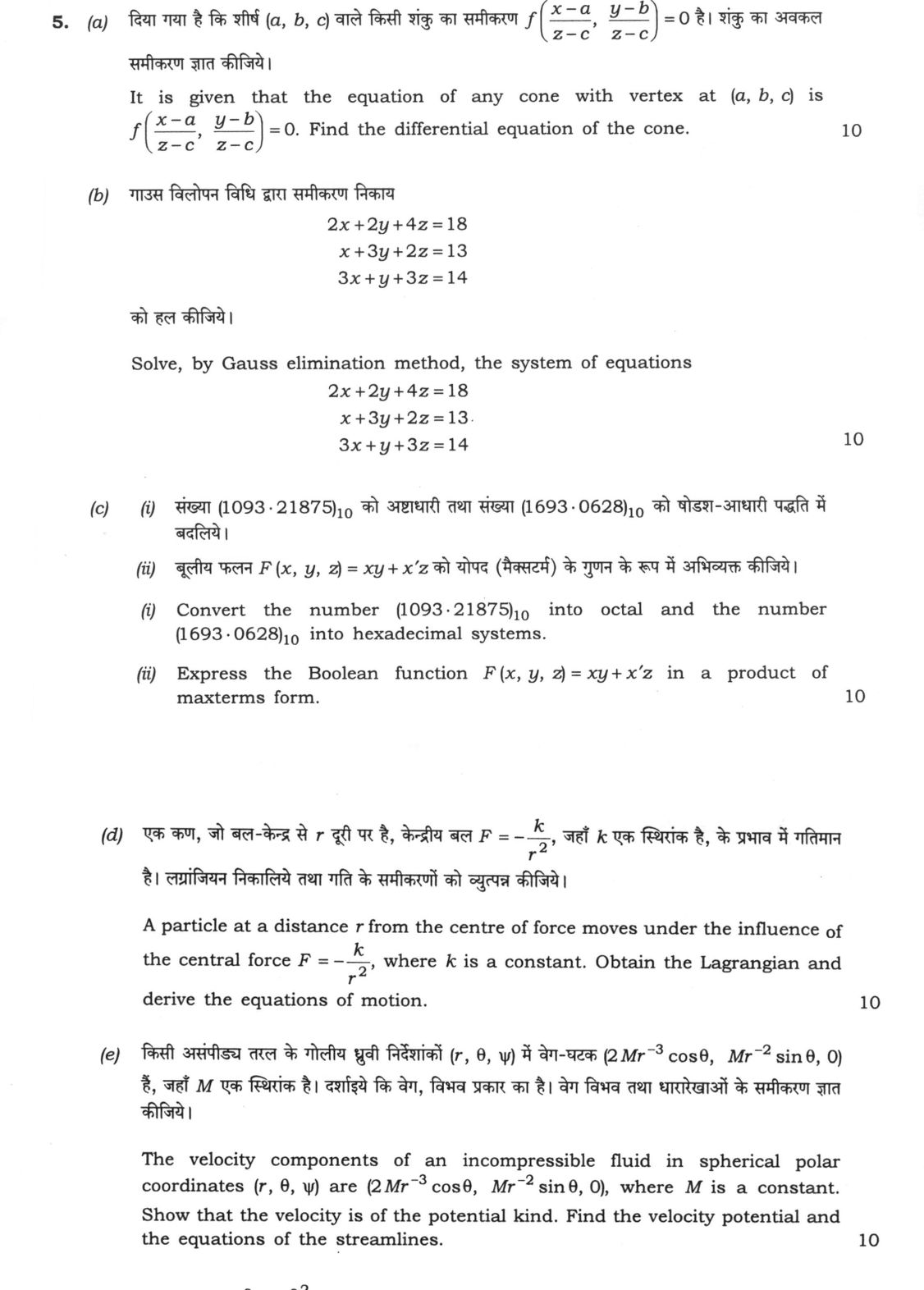
It is given that the equation of any cone with vertex at (a, b, c) is f((x-a)/(z-c), (y-b)/(z-c)) = 0. Find the differential equation of the cone. 10 marks
Solve, by Gauss elimination method, the system of equations 2x + 2y + 4z = 18 x + 3y + 2z = 13 3x + y + 3z = 14 10 marks
Convert the number (1093·21875)₁₀ into octal and the number (1693·0628)₁₀ into hexadecimal systems.
Express the Boolean function F(x, y, z) = xy + x'z in a product of maxterms form. 10 marks
A particle at a distance r from the centre of force moves under the influence of the central force F = -k/r², where k is a constant. Obtain the Lagrangian and derive the equations of motion. 10 marks
The velocity components of an incompressible fluid in spherical polar coordinates (r, θ, ψ) are (2Mr⁻³cosθ, Mr⁻²sinθ, 0), where M is a constant. Show that the velocity is of the potential kind. Find the velocity potential and the equations of the streamlines. 10 marks
हिंदी में प्रश्न पढ़ें
दिया गया है कि शीर्ष (a, b, c) वाले किसी शंकु का समीकरण f((x-a)/(z-c), (y-b)/(z-c)) = 0 है। शंकु का अवकल समीकरण ज्ञात कीजिए। (10 अंक)
गॉस विलोपन विधि द्वारा समीकरण निकाय 2x + 2y + 4z = 18 x + 3y + 2z = 13 3x + y + 3z = 14 को हल कीजिए। (10 अंक)
संख्या (1093·21875)₁₀ को अष्टाधारी तथा संख्या (1693·0628)₁₀ को षोडश-आधारी पद्धति में बदलिए।
बूलिय फलन F(x, y, z) = xy + x'z को योगद (मैक्सटर्म) के गुणन के रूप में अभिव्यक्त कीजिए। (10 अंक)
एक कण, जो बल-केंद्र से r दूरी पर है, केंद्रीय बल F = -k/r², जहाँ k एक स्थिरांक है, के प्रभाव में गतिमान है। लैग्रांजियन निकालिये तथा गति के समीकरणों को व्युत्पन्न कीजिये। (10 अंक)
किसी असंपीड्य तरल के गोलीय ध्रुवी निर्देशांकों (r, θ, ψ) में वेग-घटक (2Mr⁻³cosθ, Mr⁻²sinθ, 0) है, जहाँ M एक स्थिरांक है। दर्शाइये कि वेग, विभव प्रकार का है। वेग विभव तथा धारारेखाओं के समीकरण ज्ञात कीजिये। (10 अंक)
Model answer
Written by UPSC Answer Check against this question's marking rubric, to the expected length. UPSC does not publish answers for Mains — this is one way to score well, not an official key.
(a) Let u = (x−a)/(z−c), v = (y−b)/(z−c). The given cone is f(u,v)=0. Differentiating totally,
f_u du + f_v dv = 0.
Now du = [(z−c)dx − (x−a)dz]/(z−c)², dv = [(z−c)dy − (y−b)dz]/(z−c)².
Substituting,
f_u[(z−c)dx − (x−a)dz] + f_v[(z−c)dy − (y−b)dz] = 0.
Hence
(z−c)(f_u dx + f_v dy) = [(x−a)f_u + (y−b)f_v]dz.
Let z = z(x,y), so dz = p dx + q dy, where p=∂z/∂x, q=∂z/∂y. Comparing coefficients,
p = (z−c)f_u/D, q = (z−c)f_v/D, where D = (x−a)f_u + (y−b)f_v.
Therefore (x−a)p + (y−b)q = (z−c).
Final answer: (x−a)∂z/∂x + (y−b)∂z/∂y = z−c, equivalently (x−a)p + (y−b)q = z−c.
---
(b) The augmented matrix is
[2 2 4 | 18] [1 3 2 | 13] [3 1 3 | 14]
Interchange R1 and R2:
[1 3 2 | 13] [2 2 4 | 18] [3 1 3 | 14]
Perform R2 ← R2 − 2R1:
[1 3 2 | 13] [0 −4 0 | −8] [3 1 3 | 14]
Perform R3 ← R3 − 3R1:
[1 3 2 | 13] [0 −4 0 | −8] [0 −8 −3 | −25]
From R2: −4y = −8, so y = 2.
From R3: −8y − 3z = −25. Putting y = 2, −16 − 3z = −25 ⇒ −3z = −9 ⇒ z = 3.
From R1: x + 3y + 2z = 13. x + 6 + 6 = 13 ⇒ x = 1.
Final answer: (x, y, z) = (1, 2, 3).
---
(c)(i) Convert 1093.21875₁₀ to octal.
Integer part: 1093 ÷ 8 = 136 remainder 5 136 ÷ 8 = 17 remainder 0 17 ÷ 8 = 2 remainder 1 2 ÷ 8 = 0 remainder 2
Reading remainders upwards: 2105₈.
Fractional part: 0.21875 × 8 = 1.75 ⇒ digit 1, remainder 0.75 0.75 × 8 = 6.00 ⇒ digit 6, remainder 0
So fractional part is .16₈.
Final answer: (1093.21875)₁₀ = (2105.16)₈
Now convert 1693.0628₁₀ to hexadecimal.
Integer part: 1693 ÷ 16 = 105 remainder 13 = D 105 ÷ 16 = 6 remainder 9 6 ÷ 16 = 0 remainder 6
Reading upwards: 69D₁₆.
Fractional part: 0.0628 × 16 = 1.0048 ⇒ digit 1 0.0048 × 16 = 0.0768 ⇒ digit 0 0.0768 × 16 = 1.2288 ⇒ digit 1 0.2288 × 16 = 3.6608 ⇒ digit 3 0.6608 × 16 = 10.5728 ⇒ digit A 0.5728 × 16 = 9.1648 ⇒ digit 9 0.1648 × 16 = 2.6368 ⇒ digit 2 0.6368 × 16 = 10.1888 ⇒ digit A and so on.
Thus the hexadecimal fraction is non-terminating: 0.0628₁₀ = .1013A92A...₁₆.
Final answer: (1693.0628)₁₀ = (69D.1013A92A...)₁₆, approximately (69D.1013A9)₁₆ to six hexadecimal places.
---
(c)(ii) F(x,y,z) = xy + x′z.
We need the product of maxterms, i.e. zeros of F.
Truth table:
x y z | xy | x′z | F 0 0 0 | 0 | 0 | 0 0 0 1 | 0 | 1 | 1 0 1 0 | 0 | 0 | 0 0 1 1 | 0 | 1 | 1 1 0 0 | 0 | 0 | 0 1 0 1 | 0 | 0 | 0 1 1 0 | 1 | 0 | 1 1 1 1 | 1 | 0 | 1
F is zero at minterms 0, 2, 4, 5.
Therefore the maxterms are:
M₀ = x + y + z M₂ = x + y′ + z M₄ = x′ + y + z M₅ = x′ + y + z′
Final answer: F(x,y,z) = Π M(0,2,4,5) = (x + y + z)(x + y′ + z)(x′ + y + z)(x′ + y + z′).
---
(d) Use plane polar coordinates (r, θ). Let the mass be m.
Kinetic energy: T = 1/2 m(ṙ² + r²θ̇²).
For central force F = −k/r², the potential V(r) satisfies F = −dV/dr. So −dV/dr = −k/r² ⇒ dV/dr = k/r² ⇒ V = −k/r up to an additive constant.
Thus the Lagrangian is L = T − V = 1/2 m(ṙ² + r²θ̇²) + k/r.
For r:
∂L/∂ṙ = mṙ, d/dt(∂L/∂ṙ) = m r̈.
∂L/∂r = m r θ̇² − k/r².
Euler–Lagrange equation: d/dt(∂L/∂ṙ) − ∂L/∂r = 0.
So m r̈ − m r θ̇² + k/r² = 0, or m(r̈ − r θ̇²) = −k/r².
For θ:
∂L/∂θ̇ = m r² θ̇, d/dt(∂L/∂θ̇) = m(2rṙθ̇ + r²θ̈).
Since ∂L/∂θ = 0, d/dt(m r² θ̇) = 0.
Hence r² θ̇ = h = constant.
Final answer: Lagrangian: L = 1/2 m(ṙ² + r²θ̇²) + k/r.
Equations of motion: m(r̈ − rθ̇²) = −k/r² and r²θ̇ = h = constant.
---
(e) As printed, the θ-component is v_θ = M r⁻² sinθ. Check whether this is compatible with an incompressible potential flow.
Divergence in spherical polars:
∇·v = (1/r²)∂(r² v_r)/∂r + (1/(r sinθ))∂(sinθ v_θ)/∂θ + (1/(r sinθ))∂v_ψ/∂ψ.
With v_r = 2M r⁻³ cosθ, v_θ = M r⁻² sinθ, v_ψ = 0,
∇·v = (1/r²)∂(2M r⁻¹ cosθ)/∂r + (1/(r sinθ))∂(M r⁻² sin²θ)/∂θ = (1/r²)(−2M r⁻² cosθ) + (1/(r sinθ))(2M r⁻² sinθ cosθ) = −2M r⁻⁴ cosθ + 2M r⁻³ cosθ ≠ 0.
So the field as printed is not even incompressible.
Also check irrotationality. The ψ-component of curl v is
(∇×v)_ψ = (1/r)[∂(r v_θ)/∂r − ∂v_r/∂θ].
For v_θ = M r⁻² sinθ,
(∇×v)_ψ = (1/r)[∂(M r⁻¹ sinθ)/∂r − ∂(2M r⁻³ cosθ)/∂θ] = (1/r)[−M r⁻² sinθ + 2M r⁻³ sinθ] = M(2−r)r⁻⁴ sinθ ≠ 0.
Thus, as printed, the velocity is not of potential kind.
The standard intended form of this problem uses v_θ = M r⁻³ sinθ. With that intended exponent, let
v = (2M r⁻³ cosθ, M r⁻³ sinθ, 0).
Then (∇×v)_ψ = (1/r)[∂(M r⁻² sinθ)/∂r − ∂(2M r⁻³ cosθ)/∂θ] = (1/r)[−2M r⁻³ sinθ + 2M r⁻³ sinθ] = 0.
Also the other curl components vanish and the divergence is zero, so v is irrotational and incompressible, hence of potential kind. Write v = ∇φ.
Then ∂φ/∂r = 2M r⁻³ cosθ. Integrating, φ = −M r⁻² cosθ + f(θ,ψ).
Also (1/r)∂φ/∂θ = M r⁻³ sinθ ⇒ ∂φ/∂θ = M r⁻² sinθ.
But ∂/∂θ(−M r⁻² cosθ) = M r⁻² sinθ, so f is independent of θ. Since v_ψ = 0, f is constant. Taking it as zero,
φ = −M r⁻² cosθ.
For streamlines, dr/v_r = r dθ/v_θ = r sinθ dψ/v_ψ.
Since v_ψ = 0 and the motion is axisymmetric, ψ = constant. Then
dr/(2M r⁻³ cosθ) = r dθ/(M r⁻³ sinθ).
Thus dr/(2 cosθ) = r dθ/sinθ ⇒ dr/r = 2 cotθ dθ.
Integrating, ln r = 2 ln sinθ + ln C, so r = C sin²θ.
Final answer: As printed with v_θ = M r⁻² sinθ, the velocity is not of potential kind. For the standard intended component v_θ = M r⁻³ sinθ: Velocity potential: φ = −M r⁻² cosθ. Streamlines: r = C sin²θ, ψ = constant.
What "Solve" is asking you to do
Choose the method, then carry it through to a final answer. Identifying what kind of problem this is and why that method applies is the first thing marked; a correct figure arrived at invisibly earns almost nothing.
Structure that answers it
Given data and what is required → method chosen, with the reason it applies → set-up (equation, circuit, free body, trial balance) → working, step by step → answer with units and any condition of validity
Where marks are lost
Doing the middle steps mentally and writing only the result. In mathematics papers, a further loss comes from giving a decimal where the exact value in surds or fractions was wanted, or from skipping the justification a part explicitly asks for.
How this answer will be evaluated
Approach
(a) derive: given > assumptions > stepwise derivation > result > check | (b) calculate: given > formula > substitution > result with units > interpretation | (c(i)) calculate: given > formula > substitution > result with units > interpretation | (c(ii)) derive: given > assumptions > stepwise derivation > result > check | (d) derive: given > assumptions > stepwise derivation > result > check | (e) derive: given > assumptions > stepwise derivation > result > check Full marks: All parts fully derived with correct notation, verification, and clear step-by-step logic.
Key points expected
- Define p = ∂z/∂x and q = ∂z/∂y
- Differentiate f((x-a)/(z-c), (y-b)/(z-c)) = 0
- Eliminate arbitrary function f
- State final PDE: (x-a)p + (y-b)q = z-c
- Form augmented matrix
- Perform row operations to upper triangular form
- Solve via back-substitution
- State final values for x, y, z
Evaluation rubric
Each sub-part is marked on its own, against the marks and word limit printed on the paper.
- (a) Differential equation of a cone with vertex (a, b, c). 10 marks
derive— given → assumptions → stepwise derivation → result → check
Must cover
- Define p = ∂z/∂x and q = ∂z/∂y
- Differentiate f((x-a)/(z-c), (y-b)/(z-c)) = 0
- Eliminate arbitrary function f
- State final PDE: (x-a)p + (y-b)q = z-c
Loses marks
- Failing to define p and q
- Skipping the elimination of f
- Incorrect partial differentiation of arguments
Earns more
- Explicitly state chain rule application
- Verify result by substituting a simple cone equation
Extra mark
- Mention general solution form
- (b) Solution of the 3x3 linear system via Gauss elimination. 10 marks
calculate— given → formula → substitution → result with units → interpretation
Must cover
- Form augmented matrix
- Perform row operations to upper triangular form
- Solve via back-substitution
- State final values for x, y, z
Loses marks
- Arithmetic errors in row operations
- Skipping back-substitution steps
- Not stating final solution clearly
Earns more
- Show intermediate matrices clearly
- Verify solution by substitution into original equations
Extra mark
- Mention determinant check for uniqueness
- (c(i)) Convert (1093.21875)₁₀ to octal and (1693.0628)₁₀ to hexadecimal.
calculate— given → formula → substitution → result with units → interpretation
Must cover
- Convert integer part of 1093 to octal
- Convert fractional part 0.21875 to octal
- Convert integer part of 1693 to hex
- Convert fractional part 0.0628 to hex
Loses marks
- Incorrect base conversion for integer part
- Error in fractional part conversion
- Not separating integer and fractional parts
Earns more
- Show division/multiplication steps for each part
- Label integer and fractional conversions separately
Extra mark
- Verify by converting back to decimal
- (c(ii)) Express F(x,y,z) = xy + x'z in product of maxterms.
derive— given → assumptions → stepwise derivation → result → check
Must cover
- Find minterms of F(x,y,z)
- Identify missing minterms (maxterms)
- Write product of maxterms form
- Use standard notation ΠM(...)
Loses marks
- Confusing minterms with maxterms
- Incorrect identification of missing minterms
- Not using standard ΠM notation
Earns more
- Show truth table or K-map for minterm identification
- Clearly list which minterms are absent
Extra mark
- Verify by expanding product of maxterms
- (d) Lagrangian and equations of motion for central force F = -k/r². 10 marks
derive— given → assumptions → stepwise derivation → result → check
Must cover
- Write kinetic energy T in polar coordinates
- Write potential energy V = -k/r
- Form Lagrangian L = T - V
- Apply Euler-Lagrange equations for r and θ
Loses marks
- Incorrect potential energy sign or form
- Failing to apply Euler-Lagrange equations
- Missing either radial or angular equation
Earns more
- Show explicit form of T = ½m(ṙ² + r²θ̇²)
- Derive both radial and angular equations of motion
Extra mark
- Mention conservation of angular momentum
- (e) Show velocity is potential; find potential and streamlines. 10 marks
derive— given → assumptions → stepwise derivation → result → check
Must cover
- Verify curl of velocity field is zero
- Integrate to find velocity potential φ
- Derive streamline equations from dV/φ = 0
- State final potential and streamline equations
Loses marks
- Failing to verify irrotationality
- Incorrect integration for potential
- Not deriving streamline equations
Earns more
- Show explicit curl calculation in spherical coordinates
- Integrate each component to find φ
Extra mark
- Sketch or describe streamline geometry
Practice this exact question
Write your answer and it is marked point by point against the model answer above — what you covered, what you missed, what you got wrong.
Evaluate my answer →More from Mathematics 2022 Paper II
- Q2 (a) Let f(x) = x² on [0, k], k > 0. Show that f is Riemann integrable on the closed inter…
- Q3 (a) Evaluate ∫_C (z+4)/(z² + 2z + 5) dz, where C is |z + 1 - i| = 2. (15 marks) (b) Find…
- Q4 (a) Let R be a field of real numbers and S, the field of all those polynomials f(x) ∈ R[x…
- Q5 (a) It is given that the equation of any cone with vertex at (a, b, c) is f((x-a)/(z-c),…
- Q6 (a) Solve the heat equation ∂u/∂t = ∂²u/∂x², 0 < x < l, t > 0 subject to the conditions u…
- Q7 (a) Find the general solution of the partial differential equation (D² + DD' - 6D'²)z = x…
- Q8 (a) Reduce the following partial differential equation to a canonical form and hence solv…