Paper II — Q1
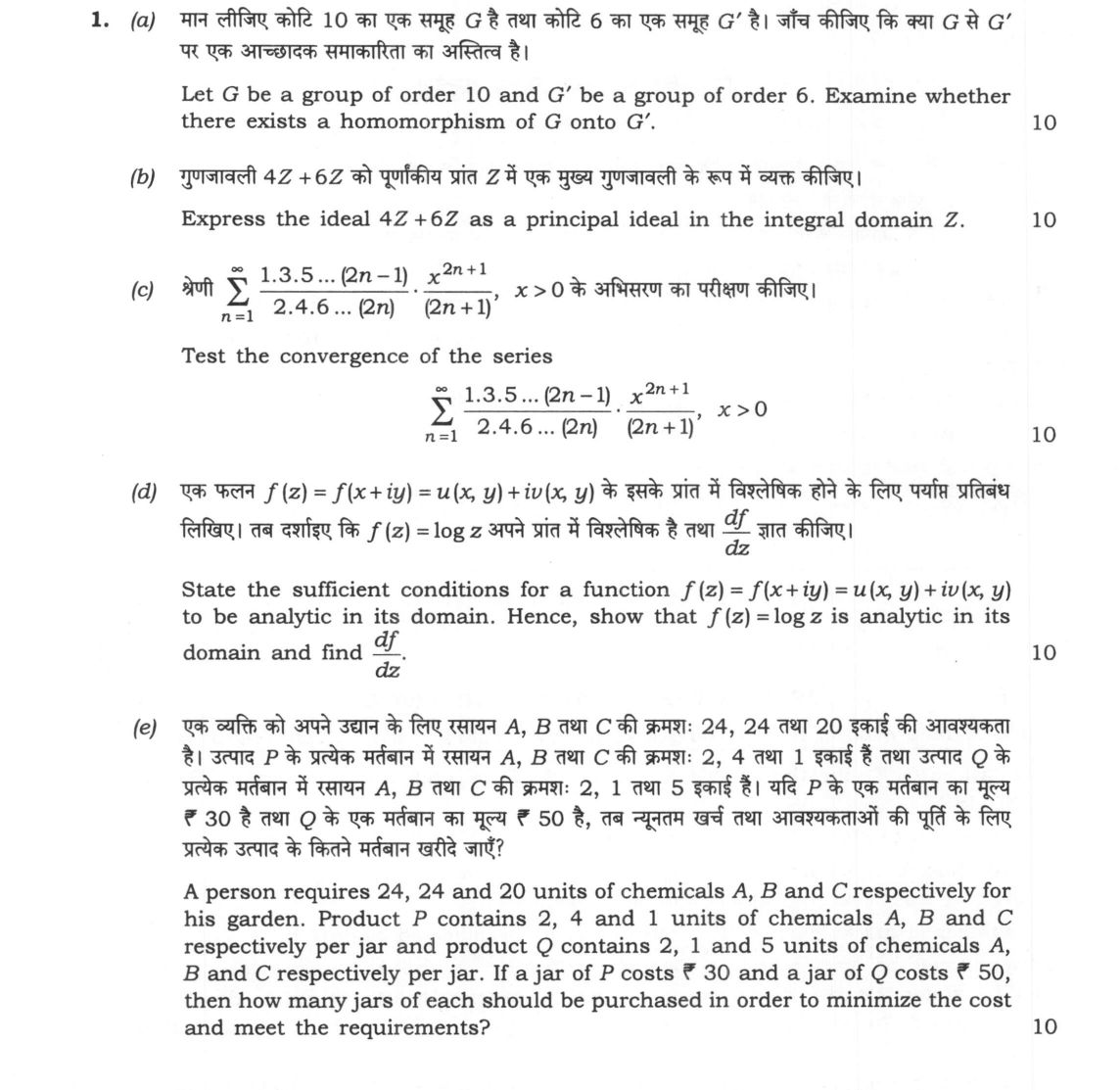
(a) Let G be a group of order 10 and G′ be a group of order 6. Examine whether there exists a homomorphism of G onto G′. (10…
Let G be a group of order 10 and G′ be a group of order 6. Examine whether there exists a homomorphism of G onto G′. 10 marks
Express the ideal 4Z + 6Z as a principal ideal in the integral domain Z. 10 marks
Test the convergence of the series Σlimitsₙ₌₁^∞ (1.3.5...(2n-1))/(2.4.6...(2n)) · (x²ⁿ⁺¹)/((2n+1)), x > 0 10 marks
State the sufficient conditions for a function f(z) = f(x+iy) = u(x,y) + iv(x,y) to be analytic in its domain. Hence, show that f(z) = log z is analytic in its domain and find df/dz 10 marks
A person requires 24, 24 and 20 units of chemicals A, B and C respectively for his garden. Product P contains 2, 4 and 1 units of chemicals A, B and C respectively per jar and product Q contains 2, 1 and 5 units of chemicals A, B and C respectively per jar. If a jar of P costs ₹ 30 and a jar of Q costs ₹ 50, then how many jars of each should be purchased in order to minimize the cost and meet the requirements? 10 marks
हिंदी में प्रश्न पढ़ें
मान लीजिए कोटि 10 का एक समूह G है तथा कोटि 6 का एक समूह G′ है। जाँच कीजिए कि क्या G से G′ पर एक आच्छादक समाकारिता का अस्तित्व है। (10 अंक)
गुणजावली 4Z + 6Z को पूर्णांकीय प्रांत Z में एक मुख्य गुणजावली के रूप में व्यक्त कीजिए। (10 अंक)
श्रेणी Σlimitsₙ₌₁^∞ (1.3.5...(2n-1))/(2.4.6...(2n)) · (x²ⁿ⁺¹)/((2n+1)), x > 0 के अभिसरण का परीक्षण कीजिए। (10 अंक)
एक फलन f(z) = f(x+iy) = u(x,y) + iv(x,y) के इसके प्रांत में विलेखिक होने के लिए पर्याप्त प्रतिबंध लिखिए। तब दर्शाइए कि f(z) = log z अपने प्रांत में विलेखिक है तथा df/dz ज्ञात कीजिए। (10 अंक)
एक व्यक्ति को अपने उद्यान के लिए रसायन A, B तथा C की क्रमशः 24, 24 तथा 20 इकाई की आवश्यकता है। उत्पाद P के प्रत्येक मर्तबान में रसायन A, B तथा C की क्रमशः 2, 4 तथा 1 इकाई है तथा उत्पाद Q के प्रत्येक मर्तबान में रसायन A, B तथा C की क्रमशः 2, 1 तथा 5 इकाई है। यदि P के एक मर्तबान का मूल्य ₹ 30 है तथा Q के एक मर्तबान का मूल्य ₹ 50 है, तब न्यूनतम खर्च तथा आवश्यताओं की पूर्ति के लिए प्रत्येक उत्पाद के कितने मर्तबान खरीदे जाएँ? (10 अंक)
Model answer
Written by UPSC Answer Check against this question's marking rubric, to the expected length. UPSC does not publish answers for Mains — this is one way to score well, not an official key.
(a) Homomorphism. Suppose that a homomorphism φ:G→ G' is onto. Then its image is all of G', so |imφ|=6. By the First Isomorphism Theorem, G/kerφcong G'; therefore |G|/|kerφ|=|G'|=6. Since |G|=10, this would require |kerφ|=10/6, which is not an integer. But kerφ is a subgroup of G, so by Lagrange’s theorem its order must be an integer divisor of 10. Equivalently, the image of a finite group under a homomorphism has order dividing the order of the original group, while an image inside G' has order dividing 6; hence the image order would have to divide gcd(10,6)=2. It cannot be 6. Thus no onto homomorphism from a group of order 10 to a group of order 6 exists. The conclusion depends only on the orders, not on the particular structures of G and G'.
(b) Principal ideal. In the integral domain Z, every ideal is principal, and the sum of two principal ideals is again principal: aZ+bZ=gcd(a,b)Z. Here 4Z+6Z is the set of all integers of the form 4m+6n, where m,ninZ. Since 4m+6n=2(2m+3n), every such integer is even, so 4Z+6Z⊆ 2Z. Conversely, the greatest common divisor 2 can be written as an integer combination of 4 and 6, namely 2=4(-1)+6(1). Hence 2∈4Z+6Z. If 2k is any even integer, then 2k=k·2, so 2k∈4Z+6Z. Thus 2Z⊆4Z+6Z. Combining the two inclusions gives 4Z+6Z=2Z. Therefore the required principal ideal is 2Z, generated by 2. This also shows that the sum ideal is generated by all integer combinations of the original generators.
(c) Convergence. Let aₙ=(1·3·5…(2n-1))/(2·4·6…(2n))·(x²ⁿ⁺¹)/(2n+1), x>0. The product factor can be written as ((2n)!)/(2²ⁿ(n!)²), but the ratio test is simpler. We have (aₙ₊₁)/(aₙ)=(2n+1)/(2n+2)· x²·(2n+1)/(2n+3)=x²((2n+1)²)/((2n+2)(2n+3)). As n→∞, this ratio tends to x². Hence, by the ratio test, the series converges absolutely when x²<1, i.e. when 0<x<1, and diverges when x²>1, i.e. when x>1. Since all terms are positive for x>0, absolute convergence and ordinary convergence coincide in the convergent cases. The remaining case is x=1, where the ratio tends to 1 and the ratio test is inconclusive. For x=1, apply Raabe’s test. Now (aₙ)/(aₙ₊₁)=((2n+2)(2n+3))/((2n+1)²)=1+(6n+5)/(4n²+4n+1). Therefore n((aₙ)/(aₙ₊₁)-1)=(n(6n+5))/(4n²+4n+1)→frac32>1. Raabe’s test gives convergence at x=1. This is also clear from the asymptotic form of the product factor, which is about 1/√(π n); then the nth term is of order 1/n³/2, a convergent p-series. Consequently, the given series converges for 0<x≤1 and diverges for x>1.
(d) Analyticity of log z. A standard sufficient condition for f(z)=u(x,y)+iv(x,y) to be analytic in a domain D is that u and v have continuous first partial derivatives throughout D and satisfy the Cauchy-Riemann equations uₓ=v_y, u_y=-vₓ at every point of D. For the logarithm, one must choose a single-valued branch. Take the principal branch on the domain D consisting of the complex plane with the non-positive real axis removed. Write z=reⁱθ, r>0, where θ=Argz and -π<θ<π. Then u=log r=frac12log(x²+y²), v=θ. In polar coordinates the Cauchy-Riemann equations are uᵣ=frac1r v_θ and frac1r u_θ=-vᵣ. Here uᵣ=1/r, u_θ=0, vᵣ=0, v_θ=1, so both equations are satisfied. The partial derivatives are continuous on D because r>0 and the chosen argument is smooth away from the branch cut. In Cartesian coordinates the same verification gives uₓ=x/(x²+y²), u_y=y/(x²+y²), vₓ=-y/(x²+y²), v_y=x/(x²+y²), so uₓ=v_y and u_y=-vₓ. Hence log z is analytic on its branch domain. The derivative is df/dz=uₓ+ivₓ=x/(x²+y²)-iy/(x²+y²)=(x-iy)/(x²+y²)=frac1x+iy=frac1z. The same argument works for any branch of log z on a simply connected domain not containing 0.
(e) Linear programming. Let x be the number of jars of P and y the number of jars of Q. The requirements are 2x+2y≥24, 4x+y≥24, x+5y≥20, x,y≥0. The first inequality simplifies to x+y≥12. The cost function to be minimized is Z=30x+50y. The feasible region is the intersection of the half-planes determined by these inequalities. Its relevant corner points are obtained from the boundary lines. The intersection of x+y=12 and 4x+y=24 is (4,8), and it satisfies x+5y=44≥20. The intersection of x+y=12 and x+5y=20 is (10,2), and it satisfies 4x+y=42≥24. The intersection of 4x+y=24 and x+5y=20 is (100/19,56/19), but it is not feasible because x+y=156/19<12. The feasible points on the axes are (0,24) and (20,0). Evaluating the objective function at these vertices gives Z(0,24)=1200, Z(4,8)=520, Z(10,2)=400, Z(20,0)=600. The least value is 400, attained at x=10 and y=2. Thus the person should buy 10 jars of P and 2 jars of Q. This gives A=2(10)+2(2)=24, B=4(10)+1(2)=42, C=1(10)+5(2)=20, meeting all requirements, with minimum cost ₹400. Because the optimal point has integer coordinates, it also satisfies the natural whole-jar interpretation.
What "Examine" is asking you to do
Test the proposition the question puts to you and return a finding on how far it holds. Examine stems carry a claim, or ask whether something has happened, and expect evidence weighed both ways before the extent is stated — often with remedial measures attached.
Structure that answers it
Restate the claim as the question frames it → evidence that supports it → evidence that undercuts it → the conditions under which it holds → verdict on how far it stands
Where marks are lost
Stopping at description. An examination has to reach a finding, and “examine with justification” means the extent must be stated, not implied.
How this answer will be evaluated
Approach
(a) examine: intro > how/why with reasoning > evidence > conclusion | (b) derive: given > assumptions > stepwise derivation > result > check | (c) examine: intro > how/why with reasoning > evidence > conclusion | (d) explain: definition/context > points in order > small example > short close | (e) calculate: given > formula > substitution > result with units > interpretation Full marks: All parts fully solved with correct methods and clear justification.
Key points expected
- State Lagrange's Theorem on order of subgroups
- Identify order of image of G under homomorphism
- Apply Lagrange's Theorem to image of G
- Conclude non-existence based on order divisibility
- Define sum of ideals 4Z + 6Z
- Compute gcd(4, 6) = 2
- Show 4Z + 6Z = 2Z
- Verify 2Z is a principal ideal
Evaluation rubric
Each sub-part is marked on its own, against the marks and word limit printed on the paper.
- (a) Determine existence of a surjective homomorphism from G to G'. 10 marks
examine— intro → how/why with reasoning → evidence → conclusion
Must cover
- State Lagrange's Theorem on order of subgroups
- Identify order of image of G under homomorphism
- Apply Lagrange's Theorem to image of G
- Conclude non-existence based on order divisibility
Loses marks
- Claiming existence without proof
- Confusing homomorphism with isomorphism
- Ignoring the 'onto' condition
Earns more
- Mention First Isomorphism Theorem
- Explicitly state order of G and G'
- Note that 6 does not divide 10
- Reference kernel of homomorphism
Extra mark
- Mention specific groups of order 10 and 6
- Note that G must be cyclic or dihedral
- (b) Express 4Z + 6Z as a principal ideal in Z. 10 marks
derive— given → assumptions → stepwise derivation → result → check
Must cover
- Define sum of ideals 4Z + 6Z
- Compute gcd(4, 6) = 2
- Show 4Z + 6Z = 2Z
- Verify 2Z is a principal ideal
Loses marks
- Writing 4Z + 6Z = 12Z
- Failing to show 2 is in the ideal
- Not justifying why 2Z is principal
Earns more
- Use Bezout's identity for gcd
- Show 2 is in the ideal
- State that Z is a PID
- Write explicit generators
Extra mark
- Mention Euclidean algorithm
- Note that 2Z is generated by 2
- (c) Test convergence of the given power series for x > 0. 10 marks
examine— intro → how/why with reasoning → evidence → conclusion
Must cover
- Apply Ratio Test to the series
- Compute limit of a_{n+1}/a_n
- Determine radius of convergence
- Check endpoints if applicable
Loses marks
- Incorrect ratio calculation
- Failing to handle the product terms
- Not checking the limit properly
Earns more
- Simplify the product terms correctly
- Show the limit calculation step-by-step
- State the interval of convergence
- Mention absolute convergence
Extra mark
- Use Stirling's approximation
- Compare with known series
- (d) State conditions for analyticity and show log z is analytic. 10 marks
explain— definition/context → points in order → small example → short close
Must cover
- State Cauchy-Riemann equations
- Show u and v are differentiable
- Verify C-R equations for log z
- Compute df/dz = 1/z
Loses marks
- Failing to verify C-R equations
- Not computing df/dz correctly
- Ignoring the domain of log z
Earns more
- Define u = ln|z| and v = arg(z)
- Show partial derivatives exist
- Mention domain excludes z = 0
- State that C-R equations are sufficient
Extra mark
- Mention branch cuts for log z
- Note that log z is multi-valued
- (e) Minimize cost of purchasing chemicals A, B, C. 10 marks
calculate— given → formula → substitution → result with units → interpretation
Must cover
- Formulate linear programming problem
- Set up objective function 30x + 50y
- Write constraints for A, B, C
- Solve using graphical or simplex method
Loses marks
- Incorrect constraints
- Failing to minimize the cost
- Not checking all corner points
Earns more
- Identify decision variables x, y
- Plot the feasible region
- Evaluate objective at corner points
- State the optimal solution
Extra mark
- Mention duality
- Note if solution is integer
Practice this exact question
Write your answer and it is marked point by point against the model answer above — what you covered, what you missed, what you got wrong.
Evaluate my answer →More from Mathematics 2023 Paper II
- Q1 (a) Let G be a group of order 10 and G′ be a group of order 6. Examine whether there exis…
- Q2 (a) Prove that a non-commutative group of order 2p, where p is an odd prime, must have a…
- Q3 (a) Prove that x² + 1 is an irreducible polynomial in Z₃[x]. Further show that the quotie…
- Q4 (a) Prove that the oscillation of a real-valued bounded function f defined on [a, b] is t…