Paper II — Q8
(a) Reduce the partial differential equation ∂²z/∂y² - ∂²z/∂x∂y + ∂z/∂x - ∂z/∂y(1+1/x) + z/x = 0 to canonical form. (15…
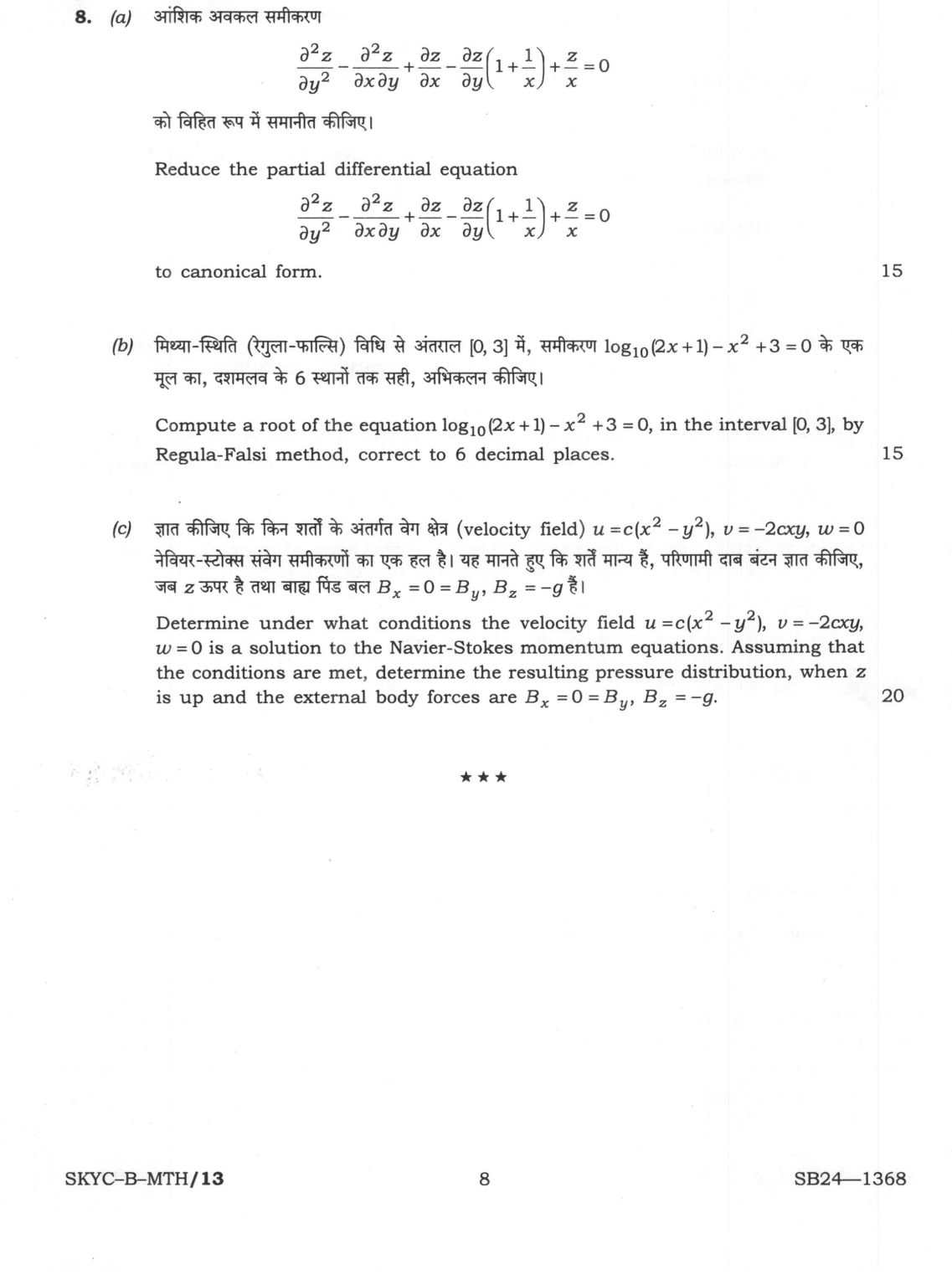
Reduce the partial differential equation ∂²z/∂y² - ∂²z/∂x∂y + ∂z/∂x - ∂z/∂y(1+1/x) + z/x = 0 to canonical form. 15 marks
Compute a root of the equation log₁₀(2x+1) - x² + 3 = 0, in the interval [0, 3], by Regula-Falsi method, correct to 6 decimal places. 15 marks
Determine under what conditions the velocity field u = c(x² - y²), v = -2cxy, w = 0 is a solution to the Navier-Stokes momentum equations. Assuming that the conditions are met, determine the resulting pressure distribution, when z is up and the external body forces are Bₓ = 0 = Bᵧ, Bᵤ = -g. 20 marks
हिंदी में प्रश्न पढ़ें
(क) आंशिक अवकल समीकरण ∂²z/∂y² - ∂²z/∂x∂y + ∂z/∂x - ∂z/∂y(1+1/x) + z/x = 0 को विहित रूप में समानीत कीजिए। (15 अंक)
(ख) मिथ्या-स्थिति (रेगुला-फाल्सि) विधि से अंतराल [0, 3] में, समीकरण log₁₀(2x+1) - x² + 3 = 0 के एक मूल का, दशमलव के 6 स्थानों तक सही, अभिकलन कीजिए। (15 अंक)
(ग) ज्ञात कीजिए कि किन शर्तों के अंतर्गत वेग क्षेत्र (velocity field) u = c(x² - y²), v = -2cxy, w = 0 नेवियर-स्टोक्स संवेग समीकरणों का एक हल है। यह मानते हुए कि शर्तें मान्य हैं, परिणामी दाब बंटन ज्ञात कीजिए, जब z ऊपर है तथा बाह्य पिंड बल Bₓ = 0 = Bᵧ, Bᵤ = -g हैं। (20 अंक)
Model answer
Written by UPSC Answer Check against this question's marking rubric, to the expected length. UPSC does not publish answers for Mains — this is one way to score well, not an official key.
(a) For a second-order linear PDE A zₓₓ + B zₓᵧ + C zᵧᵧ + ... = 0, here A = 0, B = -1, C = 1, so B² - 4AC = 1 > 0. The equation is hyperbolic.
The characteristic equation is A dy² - B dx dy + C dx² = 0, i.e. 0·dy² + dx dy + dx² = 0, so dx(dx + dy) = 0. Thus the characteristics are x = constant and x + y = constant.
Take ξ = x, η = x + y, and write Z(ξ,η) = z(x,y). Then zₓ = Z_ξ + Z_η, zᵧ = Z_η, zᵧᵧ = Z_ηη, zₓᵧ = Z_ξη + Z_ηη.
Substituting in the given PDE: Z_ηη - (Z_ξη + Z_ηη) + (Z_ξ + Z_η) - Z_η(1 + 1/ξ) + Z/ξ = 0. Hence -Z_ξη + Z_ξ - Z_η/ξ + Z/ξ = 0. Multiplying by -1: Z_ξη - Z_ξ + (1/ξ)Z_η - Z/ξ = 0, with ξ = x ≠ 0. This is the canonical form.
(b) Let f(x) = log₁₀(2x + 1) - x² + 3. Now f(0) = 3 > 0 and f(3) = log₁₀ 7 - 6 < 0, so a root lies in [0,3]. Also f(1) = log₁₀ 3 + 2 = 2.477121 > 0, f(2) = log₁₀ 5 - 1 = -0.301030 < 0, so the root lies in [1,2].
By the Regula-Falsi formula, for a bracket [a,b], xₙ₊₁ = (a f(b) - b f(a))/(f(b) - f(a)). Starting with a = 1, b = 2:
- x₁ = (1·f(2) - 2·f(1))/(f(2) - f(1)) = 1.891644, f(x₁) > 0.
- x₂ = 1.918948, f(x₂) > 0.
- x₃ = 1.919562, f(x₃) > 0.
- x₄ = 1.9195753, f(x₄) ≈ -0.00000019.
- x₅ = 1.91957525, f(x₅) ≈ 0.
Thus the root correct to six decimal places is x = 1.919575.
(c) Let u = c(x² - y²), v = -2cxy, w = 0. First check continuity: ∂u/∂x + ∂v/∂y + ∂w/∂z = 2cx - 2cx + 0 = 0, so the flow is incompressible.
The Navier-Stokes momentum equations are ρ(Dv/Dt) = -∇p + μ∇²v + ρB.
For the x-component: u uₓ + v uᵧ = c(x² - y²)(2cx) + (-2cxy)(-2cy) = 2c²x(x² - y²) + 4c²xy² = 2c²x(x² + y²). Also ∇²u = 2c - 2c = 0. Hence ρ·2c²x(x² + y²) = -pₓ, so pₓ = -2ρc²x(x² + y²).
For the y-component: u vₓ + v vᵧ = c(x² - y²)(-2cy) + (-2cxy)(-2cx) = 2c²y(x² + y²), and ∇²v = 0. Therefore pᵧ = -2ρc²y(x² + y²).
For the z-component, w = 0 gives Dw/Dt = 0, and B_z = -g, so 0 = -p_z + ρ(-g), hence p_z = -ρg.
The integrability condition pₓᵧ = pᵧₓ holds identically, so no extra restriction on c is needed. Thus the velocity field is a solution for any constant c, with constant ρ and μ, steady incompressible flow, and body forces Bₓ = Bᵧ = 0, B_z = -g.
Now integrate pₓ: p = -ρc²(x⁴/2 + x²y²) + φ(y). Differentiating with respect to y and comparing with pᵧ: φ′(y) = -2ρc²y³, so φ(y) = -ρc²y⁴/2 + C. Hence p = -ρg z - ρc²(x⁴/2 + x²y² + y⁴/2) + C = -ρg z - (ρc²/2)(x² + y²)² + C, where C is an arbitrary constant.
What "Solve" is asking you to do
Choose the method, then carry it through to a final answer. Identifying what kind of problem this is and why that method applies is the first thing marked; a correct figure arrived at invisibly earns almost nothing.
Structure that answers it
Given data and what is required → method chosen, with the reason it applies → set-up (equation, circuit, free body, trial balance) → working, step by step → answer with units and any condition of validity
Where marks are lost
Doing the middle steps mentally and writing only the result. In mathematics papers, a further loss comes from giving a decimal where the exact value in surds or fractions was wanted, or from skipping the justification a part explicitly asks for.
How this answer will be evaluated
Approach
(a) derive: given > assumptions > stepwise derivation > result > check | (b) calculate: given > formula > substitution > result with units > interpretation | (c) derive: given > assumptions > stepwise derivation > result > check Full marks: Rigorous derivation with all steps shown and verified.
Key points expected
- Identify coefficients A, B, C of second-order terms
- Compute discriminant B² - 4AC to classify PDE
- Determine characteristic equations and new variables
- Transform PDE to canonical form
- Verify sign change of f(x) in the interval [0,3]
- Apply Regula-Falsi formula correctly for each iteration
- Show at least 3-4 iterations with intermediate values
- Final answer correct to 6 decimal places
Evaluation rubric
Each sub-part is marked on its own, against the marks and word limit printed on the paper.
- (a) Canonical form of the given second-order PDE. 15 marks
derive— given → assumptions → stepwise derivation → result → check
Must cover
- Identify coefficients A, B, C of second-order terms
- Compute discriminant B² - 4AC to classify PDE
- Determine characteristic equations and new variables
- Transform PDE to canonical form
Loses marks
- Incorrect identification of A, B, C coefficients
- Skipping the characteristic equation derivation
Earns more
- Explicitly state the type of PDE (hyperbolic/parabolic/elliptic)
- Show the Jacobian of the transformation is non-zero
Extra mark
- Verification of the final canonical form by substitution
- (b) Root of log₁₀(2x+1) - x² + 3 = 0 in [0,3] to 6 d.p. 15 marks
calculate— given → formula → substitution → result with units → interpretation
Must cover
- Verify sign change of f(x) in the interval [0,3]
- Apply Regula-Falsi formula correctly for each iteration
- Show at least 3-4 iterations with intermediate values
- Final answer correct to 6 decimal places
Loses marks
- Using bisection method instead of Regula-Falsi
- Arithmetic errors in function evaluation
Earns more
- Tabular presentation of iterations
- Stopping criterion explicitly stated
Extra mark
- Comparison with Newton-Raphson for convergence rate
- (c) Conditions for Navier-Stokes solution and pressure distribution. 20 marks
derive— given → assumptions → stepwise derivation → result → check
Must cover
- Verify continuity equation for the given velocity field
- Substitute u, v, w into Navier-Stokes momentum equations
- Determine conditions on constant c for validity
- Integrate pressure gradient to find p(x,y,z)
Loses marks
- Ignoring the body force term in momentum equations
- Incorrect integration of pressure gradient
Earns more
- Explicitly state the body force term Bz = -g
- Check if the flow is irrotational
Extra mark
- Physical interpretation of the pressure distribution
Practice this exact question
Write your answer and it is marked point by point against the model answer above — what you covered, what you missed, what you got wrong.
Evaluate my answer →More from Mathematics 2023 Paper II
- Q5 (a) By eliminating the arbitrary functions f and g from z = f(x² - y) + g(x² + y), form p…
- Q6 (a) Find the surface passing through the two lines z = x = 0 and z-1 = x-y = 0, and satis…
- Q7 (a) (i) Find the conjunctive normal form (CNF) of the following Boolean function: f(x, y,…
- Q8 (a) Reduce the partial differential equation ∂²z/∂y² - ∂²z/∂x∂y + ∂z/∂x - ∂z/∂y(1+1/x) +…