Paper II — Q7
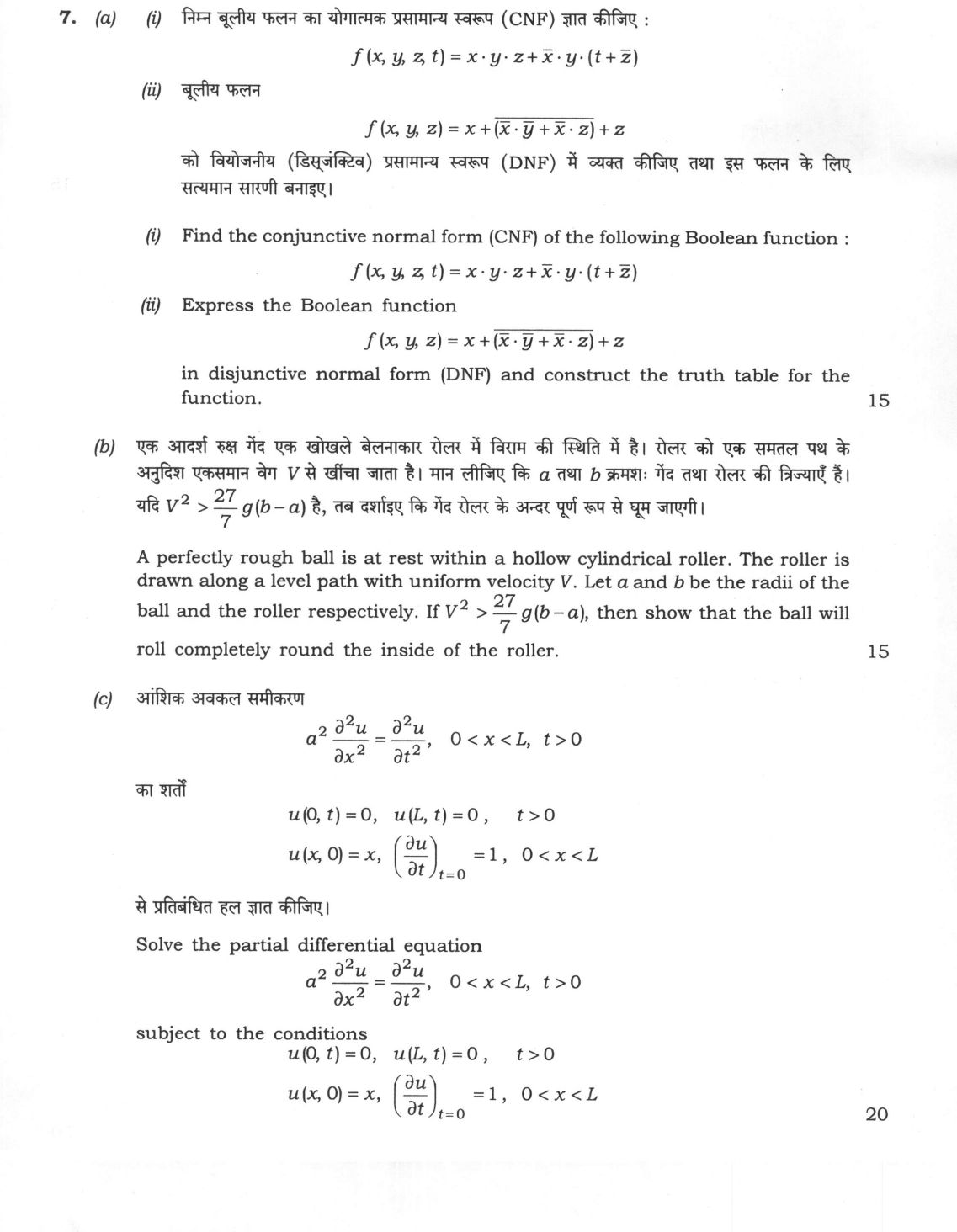
(a) (i) Find the conjunctive normal form (CNF) of the following Boolean function: f(x, y, z, t) = x · y · z + x̄ · y · (t + z̄)…
Find the conjunctive normal form (CNF) of the following Boolean function: f(x, y, z, t) = x · y · z + x̄ · y · (t + z̄) 15 marks
Express the Boolean function f(x, y, z) = x + (x̄ · ȳ + x̄ · z) + z in disjunctive normal form (DNF) and construct the truth table for the function. 15 marks
A perfectly rough ball is at rest within a hollow cylindrical roller. The roller is drawn along a level path with uniform velocity V. Let a and b be the radii of the ball and the roller respectively. If V² > 27/7 g(b-a), then show that the ball will roll completely round the inside of the roller. 15 marks
Solve the partial differential equation a² ∂²u/∂x² = ∂²u/∂t², 0 < x < L, t > 0 subject to the conditions u(0,t) = 0, u(L,t) = 0, t > 0; u(x,0) = x, (∂u/∂t)ₜ₌₀ = 1, 0 < x < L. 20 marks
हिंदी में प्रश्न पढ़ें
(क) (i) निम्न बूलिय फलन का योगात्मक प्रसामान्य स्वरूप (CNF) ज्ञात कीजिए : f(x, y, z, t) = x · y · z + x̄ · y · (t + z̄) (15 अंक)
बूलिय फलन f(x, y, z) = x + (x̄ · ȳ + x̄ · z) + z को विभोजनीय (डिस्जंक्टिव) प्रसामान्य स्वरूप (DNF) में व्यक्त कीजिए तथा इस फलन के लिए सत्यमान सारणी बनाइए। (15 अंक)
(ख) एक आदर्श रक्ष गेंद एक खोखले बेलनाकार रोलर में विराम की स्थिति में है। रोलर को एक समतल पथ के अनुदिश एकसमान वेग V से खींचा जाता है। मान लीजिए कि a तथा b क्रमशः गेंद तथा रोलर की त्रिज्याएँ हैं। यदि V² > 27/7 g(b-a) है, तब दर्शाइए कि गेंद रोलर के अन्दर पूर्ण रूप से घूम जाएगी। (15 अंक)
(ग) अंशिक अवकल समीकरण a² ∂²u/∂x² = ∂²u/∂t², 0 < x < L, t > 0 का शर्तों u(0,t) = 0, u(L,t) = 0, t > 0; u(x,0) = x, (∂u/∂t)ₜ₌₀ = 1, 0 < x < L से प्रतिबंधित हल ज्ञात कीजिए। (20 अंक)
Model answer
Written by UPSC Answer Check against this question's marking rubric, to the expected length. UPSC does not publish answers for Mains — this is one way to score well, not an official key.
(a)(i) f(x,y,z,t) = x·y·z + x̄·y·(t+z̄) = y[x·z + x̄·(t+z̄)]. Let g = x·z + x̄·(t+z̄). Then g = 0 only when either x=1,z=0, or x=0,z=1,t=0. Hence g = (x̄+z)·(x+z̄+t). Therefore the conjunctive normal form is f = y·(x̄+z)·(x+z̄+t).
(a)(ii) f(x,y,z) = x + (x̄·ȳ + x̄·z) + z = x + z + x̄·ȳ + x̄·z. Since z absorbs x̄·z, f = x + z + x̄·ȳ. Now x + x̄·ȳ = (x+x̄)(x+ȳ) = x+ȳ. Thus f = x + ȳ + z. This is already a simplified DNF. Its canonical DNF is f = x̄ȳz̄ + x̄ȳz + x̄yz + xȳz̄ + xȳz + xyz̄ + xyz. The truth table is:
x y z | f 0 0 0 | 1 0 0 1 | 1 0 1 0 | 0 0 1 1 | 1 1 0 0 | 1 1 0 1 | 1 1 1 0 | 1 1 1 1 | 1
(b) Let R = b−a. Take axes moving with the roller centre. The roller rolls without slipping, so the ball initially has relative speed V. Let θ be the angular displacement of the ball centre from the lowest point. For rolling without slipping, R(dθ/dt) + aω = −V, where ω is the spin of the ball. The moment of inertia of the ball is I = (2/5)ma². Eliminating ω gives the effective Lagrangian L = ½mR²(dθ/dt)² + (1/5)m(V + R dθ/dt)² + mgR cos θ. By Euler–Lagrange, d/dt[(7/5)mR²(dθ/dt) + (2/5)mRV] = −mgR sin θ, so (7/5)mR²(d²θ/dt²) = −mgR sin θ. Thus, multiplying by dθ/dt and integrating, (7/10)mR²(dθ/dt)² − mgR cos θ = constant.
At the lowest point θ=0, |dθ/dt| = V/R, so constant = (7/10)mV² − mgR. At the highest point θ=π, let p = dθ/dt. Then (7/10)mR²p² + mgR = (7/10)mV² − mgR, so p² = V²/R² − (20/7)g/R. For contact at the top, the normal reaction N must satisfy N ≥ 0. At the top, mg + N = mR p², so N ≥ 0 requires Rp² ≥ g. Hence V²/R² − (20/7)g/R ≥ g/R, giving V² ≥ (27/7)gR = (27/7)g(b−a). If V² > (27/7)g(b−a), then N > 0 at the top and the ball maintains rolling contact throughout, so it rolls completely round the inside of the roller.
(c) The wave equation is a²∂²u/∂x² = ∂²u/∂t², with u(0,t)=0, u(L,t)=0. Using separation of variables, u(x,t) = Σₙ [Aₙ cos(nπat/L) + Bₙ sin(nπat/L)] sin(nπx/L). At t=0, u(x,0) = Σₙ Aₙ sin(nπx/L) = x. Therefore Aₙ = (2/L)∫₀^L x sin(nπx/L) dx = 2L(−1)^(n+1)/(nπ).
Also, uₜ(x,0) = Σₙ (nπa/L)Bₙ sin(nπx/L) = 1. Hence (nπa/L)Bₙ = (2/L)∫₀^L sin(nπx/L) dx = 2(1−(−1)ⁿ)/(nπ). Thus Bₙ = 2L(1−(−1)ⁿ)/(a n²π²). For even n, Bₙ=0; for odd n, Bₙ=4L/(a n²π²).
Therefore the required solution is u(x,t) = (2L/π) Σₙ₌₁^∞ [(−1)^(n+1)/n] cos(nπat/L) sin(nπx/L) + (4L/(aπ²)) Σₙ odd (1/n²) sin(nπat/L) sin(nπx/L). Equivalently, u(x,t) = Σₙ₌₁^∞ [2L(−1)^(n+1)/(nπ) cos(nπat/L) + 2L(1−(−1)ⁿ)/(a n²π²) sin(nπat/L)] sin(nπx/L).
What "Solve" is asking you to do
Choose the method, then carry it through to a final answer. Identifying what kind of problem this is and why that method applies is the first thing marked; a correct figure arrived at invisibly earns almost nothing.
Structure that answers it
Given data and what is required → method chosen, with the reason it applies → set-up (equation, circuit, free body, trial balance) → working, step by step → answer with units and any condition of validity
Where marks are lost
Doing the middle steps mentally and writing only the result. In mathematics papers, a further loss comes from giving a decimal where the exact value in surds or fractions was wanted, or from skipping the justification a part explicitly asks for.
How this answer will be evaluated
Approach
(a(i)) derive: given > assumptions > stepwise derivation > result > check | (a(ii)) derive: given > assumptions > stepwise derivation > result > check | (b) justify: claim > 3-4 reasons > evidence > conclusion | (c) derive: given > assumptions > stepwise derivation > result > check Full marks: All steps shown with correct theorems and verification
Key points expected
- Expand product terms to minterms
- Identify missing variables in each term
- Apply distributive law to combine terms
- Final expression as product of sums
- Simplify expression to sum of minterms
- Construct complete truth table for x, y, z
- Verify DNF against truth table outputs
- Final DNF expression clearly stated
Evaluation rubric
Each sub-part is marked on its own, against the marks and word limit printed on the paper.
- (a(i)) CNF of f(x, y, z, t) = x·y·z + x̄·y·(t + z̄) 15 marks
derive— given → assumptions → stepwise derivation → result → check
Must cover
- Expand product terms to minterms
- Identify missing variables in each term
- Apply distributive law to combine terms
- Final expression as product of sums
Loses marks
- Skipping expansion of (t + z̄)
- Incorrect handling of complemented variables
Earns more
- Use of Karnaugh map for verification
- Explicit listing of all minterms
Extra mark
- Alternative derivation via truth table
- (a(ii)) DNF of f(x, y, z) and its truth table 15 marks
derive— given → assumptions → stepwise derivation → result → check
Must cover
- Simplify expression to sum of minterms
- Construct complete truth table for x, y, z
- Verify DNF against truth table outputs
- Final DNF expression clearly stated
Loses marks
- Missing rows in truth table
- DNF not in canonical form
Earns more
- Step-by-step simplification shown
- Truth table with all 8 combinations
Extra mark
- K-map used to derive DNF
- (b) Show ball rolls completely if V² > 27/7 g(b-a) 15 marks
justify— claim → 3-4 reasons → evidence → conclusion
Must cover
- Apply energy conservation with rolling constraint
- Derive condition for completing full circle
- Show inequality leads to required result
- State assumptions (no slipping, rigid body)
Loses marks
- Ignoring rotational kinetic energy
- Incorrect potential energy reference
Earns more
- Free body diagram included
- Clear definition of a and b
Extra mark
- Mention of moment of inertia for solid sphere
- (c) Solve PDE a² ∂²u/∂x² = ∂²u/∂t² with given BCs/ICs 20 marks
derive— given → assumptions → stepwise derivation → result → check
Must cover
- Use separation of variables u(x,t)=X(x)T(t)
- Solve spatial ODE with u(0,t)=u(L,t)=0
- Solve temporal ODE with initial conditions
- Construct final series solution
Loses marks
- Incorrect boundary condition application
- Missing time-dependent part of solution
Earns more
- Eigenvalues and eigenfunctions explicitly found
- Fourier coefficients calculated
Extra mark
- Verification of solution satisfies all conditions
Practice this exact question
Write your answer and it is marked point by point against the model answer above — what you covered, what you missed, what you got wrong.
Evaluate my answer →More from Mathematics 2023 Paper II
- Q4 (a) Prove that the oscillation of a real-valued bounded function f defined on [a, b] is t…
- Q5 (a) By eliminating the arbitrary functions f and g from z = f(x² - y) + g(x² + y), form p…
- Q6 (a) Find the surface passing through the two lines z = x = 0 and z-1 = x-y = 0, and satis…
- Q7 (a) (i) Find the conjunctive normal form (CNF) of the following Boolean function: f(x, y,…
- Q8 (a) Reduce the partial differential equation ∂²z/∂y² - ∂²z/∂x∂y + ∂z/∂x - ∂z/∂y(1+1/x) +…