Paper II — Q6
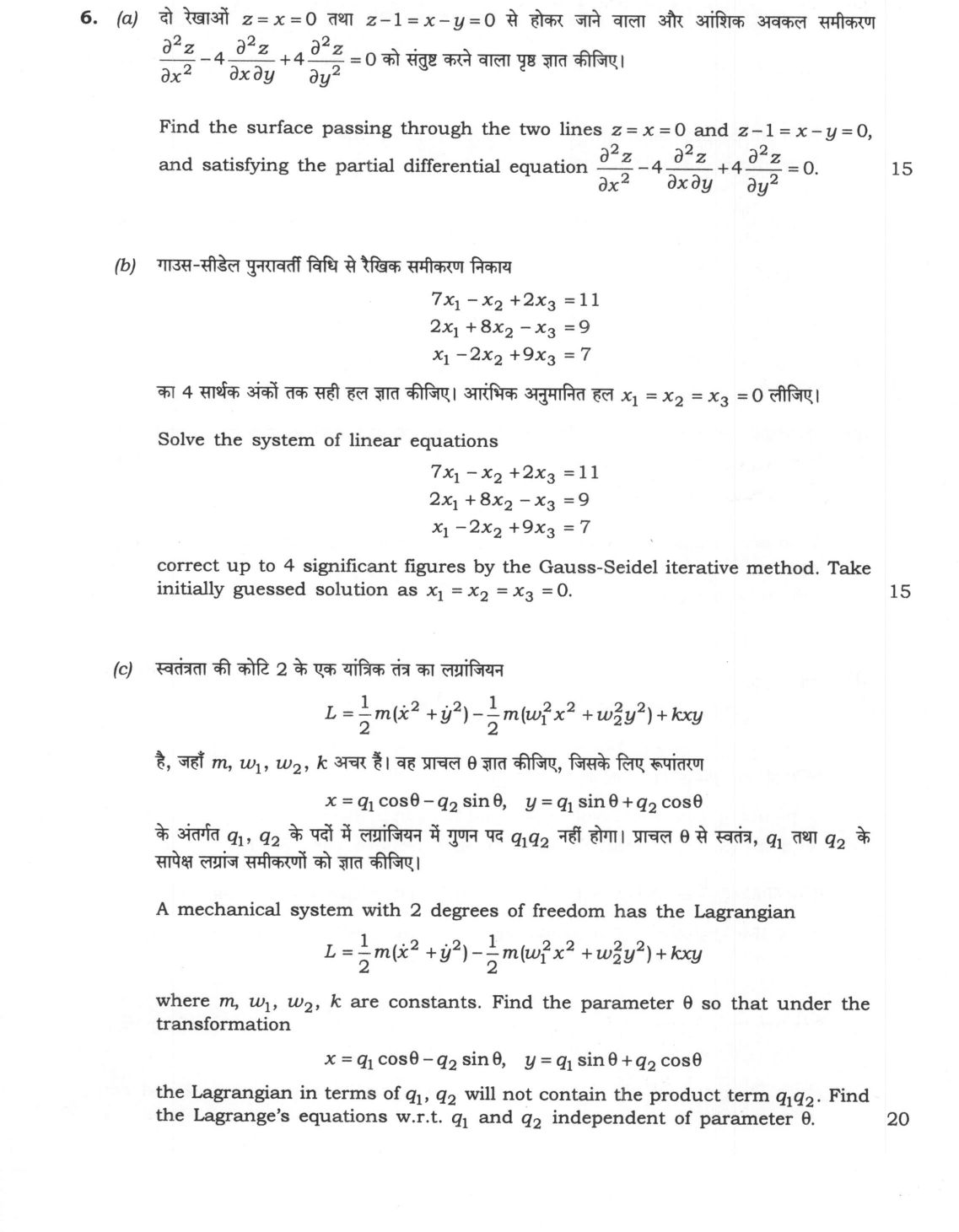
(a) Find the surface passing through the two lines z = x = 0 and z-1 = x-y = 0, and satisfying the partial differential equation…
Find the surface passing through the two lines z = x = 0 and z-1 = x-y = 0, and satisfying the partial differential equation ∂²z/∂x² - 4∂²z/∂x∂y + 4∂²z/∂y² = 0. 15 marks
Solve the system of linear equations 7x₁ - x₂ + 2x₃ = 11, 2x₁ + 8x₂ - x₃ = 9, x₁ - 2x₂ + 9x₃ = 7 correct up to 4 significant figures by the Gauss-Seidel iterative method. Take initially guessed solution as x₁ = x₂ = x₃ = 0. 15 marks
A mechanical system with 2 degrees of freedom has the Lagrangian L = ½m(ẋ² + ẏ²) - ½m(w₁²x² + w₂²y²) + kxy where m, w₁, w₂, k are constants. Find the parameter θ so that under the transformation x = q₁ cos θ - q₂ sin θ, y = q₁ sin θ + q₂ cos θ the Lagrangian in terms of q₁, q₂ will not contain the product term q₁q₂. Find the Lagrange's equations w.r.t. q₁ and q₂ independent of parameter θ. 20 marks
हिंदी में प्रश्न पढ़ें
दो रेखाओं z = x = 0 तथा z-1 = x-y = 0 से होकर जाने वाला और आंशिक अवकल समीकरण ∂²z/∂x² - 4∂²z/∂x∂y + 4∂²z/∂y² = 0 को संतुष्ट करने वाला पृष्ठ ज्ञात कीजिए। (15 अंक)
गॉस-सीडेल पुनरावृत्ति विधि से रैखिक समीकरण निकाय 7x₁ - x₂ + 2x₃ = 11, 2x₁ + 8x₂ - x₃ = 9, x₁ - 2x₂ + 9x₃ = 7 का 4 सार्थक अंकों तक सही हल ज्ञात कीजिए। आरंभिक अनुमानित हल x₁ = x₂ = x₃ = 0 लीजिए। (15 अंक)
स्वतंत्रता की कोटि 2 के एक यांत्रिक तंत्र का लैग्रांजियन L = ½m(ẋ² + ẏ²) - ½m(w₁²x² + w₂²y²) + kxy है, जहाँ m, w₁, w₂, k अचर हैं। वह प्राचल θ ज्ञात कीजिए, जिसके लिए रूपांतरण x = q₁ cos θ - q₂ sin θ, y = q₁ sin θ + q₂ cos θ के अंतर्गत q₁, q₂ के पदों में लैग्रांजियन में गुणन पद q₁q₂ नहीं होगा। प्राचल θ से स्वतंत्र, q₁ तथा q₂ के सापेक्ष लग्रांज समीकरणों को ज्ञात कीजिए। (20 अंक)
Model answer
Written by UPSC Answer Check against this question's marking rubric, to the expected length. UPSC does not publish answers for Mains — this is one way to score well, not an official key.
(a) The PDE is ∂²z/∂x² - 4∂²z/∂x∂y + 4∂²z/∂y² = 0 = (∂/∂x - 2∂/∂y)² z.
Put u = y + 2x, v = x. Then ∂/∂x - 2∂/∂y = ∂/∂v, so the PDE becomes ∂²z/∂v² = 0. Integrating twice, z = F(u) + vG(u) = F(y + 2x) + xG(y + 2x).
On the line z = x = 0, we have x = 0, z = 0 for all y. Hence 0 = F(y), so F ≡ 0. Thus z = xG(y + 2x).
On the line z - 1 = x - y = 0, take x = y = t, z = 1. Then 1 = tG(3t). For t ≠ 0, G(3t) = 1/t, so with u = 3t, G(u) = 3/u.
Therefore the formal surface is z = 3x/(y + 2x), valid where y + 2x ≠ 0.
However, at the origin (x, y) = (0, 0), the first line requires z(0, 0) = 0, while the second line requires z(0, 0) = 1. Hence no single-valued surface over the whole xy-plane can pass through both complete lines. Strictly, the stated boundary-value problem is inconsistent at the origin; if the intended problem excludes the singular point (0, 0), the answer is z = 3x/(y + 2x).
(b) The Gauss-Seidel rearrangement is x₁ = (11 + x₂ - 2x₃)/7, x₂ = (9 - 2x₁ + x₃)/8, x₃ = (7 - x₁ + 2x₂)/9.
Starting with x₁ = x₂ = x₃ = 0:
- Iteration 1: x₁ = 1.571429, x₂ = 0.732143, x₃ = 0.765873
- Iteration 2: x₁ = 1.457200, x₂ = 0.856434, x₃ = 0.806185
- Iteration 3: x₁ = 1.463438, x₂ = 0.859914, x₃ = 0.806266
- Iteration 4: x₁ = 1.463912, x₂ = 0.859805, x₃ = 0.806189
- Iteration 5: x₁ = 1.463918, x₂ = 0.859794, x₃ = 0.806186
- Iteration 6: x₁ = 1.463918, x₂ = 0.859794, x₃ = 0.806186
The values have converged. As an independent check, the exact solution is x₁ = 142/97, x₂ = 417/485, x₃ = 391/485.
Hence, correct to 4 significant figures: x₁ = 1.464, x₂ = 0.8598, x₃ = 0.8062.
(c) Under x = q₁ cosθ - q₂ sinθ, y = q₁ sinθ + q₂ cosθ, the transformation is orthogonal, so ẋ² + ẏ² = q̇₁² + q̇₂². Thus the kinetic part is ½m(q̇₁² + q̇₂²).
Now xy = ½(q₁² - q₂²) sin2θ + q₁q₂ cos2θ. The product term in the Lagrangian is [(m/2)(w₁² - w₂²) sin2θ + k cos2θ] q₁q₂. For the Lagrangian to contain no q₁q₂ term, set this coefficient to zero: (m/2)(w₁² - w₂²) sin2θ + k cos2θ = 0. Hence, for w₁² ≠ w₂², tan2θ = -2k/[m(w₁² - w₂²)]. If w₁² = w₂² and k ≠ 0, then cos2θ = 0, so θ = π/4 modulo π/2.
Let R = √[m²(w₁² - w₂²)² + 4k²]. After diagonalisation, the eigenvalues of the quadratic potential are λ± = ½[m(w₁² + w₂²) ± R]. For the branch in which q₁ corresponds to λ₊, the Lagrange equations become m q̈₁ + ½[m(w₁² + w₂²) + R] q₁ = 0, m q̈₂ + ½[m(w₁² + w₂²) - R] q₂ = 0. With the opposite branch, q₁ and q₂ are interchanged. These equations contain no q₁q₂ coupling and are independent of the parameter θ.
What "Solve" is asking you to do
Choose the method, then carry it through to a final answer. Identifying what kind of problem this is and why that method applies is the first thing marked; a correct figure arrived at invisibly earns almost nothing.
Structure that answers it
Given data and what is required → method chosen, with the reason it applies → set-up (equation, circuit, free body, trial balance) → working, step by step → answer with units and any condition of validity
Where marks are lost
Doing the middle steps mentally and writing only the result. In mathematics papers, a further loss comes from giving a decimal where the exact value in surds or fractions was wanted, or from skipping the justification a part explicitly asks for.
How this answer will be evaluated
Approach
(a) derive: given > assumptions > stepwise derivation > result > check | (b) calculate: given > formula > substitution > result with units > interpretation | (c) derive: given > assumptions > stepwise derivation > result > check Full marks: Complete derivations with all steps shown, correct final answers, and verification.
Key points expected
- Solve characteristic equation m² - 4m + 4 = 0
- State general solution z = f(y+2x) + (y+2x)g(y+2x)
- Apply boundary condition z=x=0 to find f
- Apply boundary condition z-1=x-y=0 to find g
- Rearrange equations for diagonal dominance
- Show at least 3 iterations with intermediate values
- Use updated values immediately in the same iteration
- State final answer to 4 significant figures
Evaluation rubric
Each sub-part is marked on its own, against the marks and word limit printed on the paper.
- (a) Find the surface satisfying the PDE and passing through the two given lines. 15 marks
derive— given → assumptions → stepwise derivation → result → check
Must cover
- Solve characteristic equation m² - 4m + 4 = 0
- State general solution z = f(y+2x) + (y+2x)g(y+2x)
- Apply boundary condition z=x=0 to find f
- Apply boundary condition z-1=x-y=0 to find g
Loses marks
- Incorrect characteristic equation
- Failure to apply both boundary conditions
Earns more
- Explicitly state the final surface equation
- Verify the solution satisfies the original PDE
Extra mark
- Alternative method noted briefly
- (b) Solve the system of linear equations using Gauss-Seidel method to 4 significant figures. 15 marks
calculate— given → formula → substitution → result with units → interpretation
Must cover
- Rearrange equations for diagonal dominance
- Show at least 3 iterations with intermediate values
- Use updated values immediately in the same iteration
- State final answer to 4 significant figures
Loses marks
- Using old values in the same iteration
- Stopping before 4 significant figures are reached
Earns more
- Check convergence criterion
- Verify solution by substitution into original equations
Extra mark
- Comparison with Gauss-Jacobi method
- (c) Find θ to eliminate q₁q₂ term and derive Lagrange's equations for q₁ and q₂. 20 marks
derive— given → assumptions → stepwise derivation → result → check
Must cover
- Substitute transformation into Lagrangian
- Set coefficient of q₁q₂ to zero to find θ
- Derive Lagrange's equation for q₁
- Derive Lagrange's equation for q₂
Loses marks
- Incorrect substitution of transformation
- Failure to eliminate the product term
Earns more
- Show explicit expression for tan(2θ)
- Verify equations are independent of θ
Extra mark
- Physical interpretation of normal modes
Practice this exact question
Write your answer and it is marked point by point against the model answer above — what you covered, what you missed, what you got wrong.
Evaluate my answer →More from Mathematics 2023 Paper II
- Q3 (a) Prove that x² + 1 is an irreducible polynomial in Z₃[x]. Further show that the quotie…
- Q4 (a) Prove that the oscillation of a real-valued bounded function f defined on [a, b] is t…
- Q5 (a) By eliminating the arbitrary functions f and g from z = f(x² - y) + g(x² + y), form p…
- Q6 (a) Find the surface passing through the two lines z = x = 0 and z-1 = x-y = 0, and satis…
- Q7 (a) (i) Find the conjunctive normal form (CNF) of the following Boolean function: f(x, y,…
- Q8 (a) Reduce the partial differential equation ∂²z/∂y² - ∂²z/∂x∂y + ∂z/∂x - ∂z/∂y(1+1/x) +…