Paper II — Q2
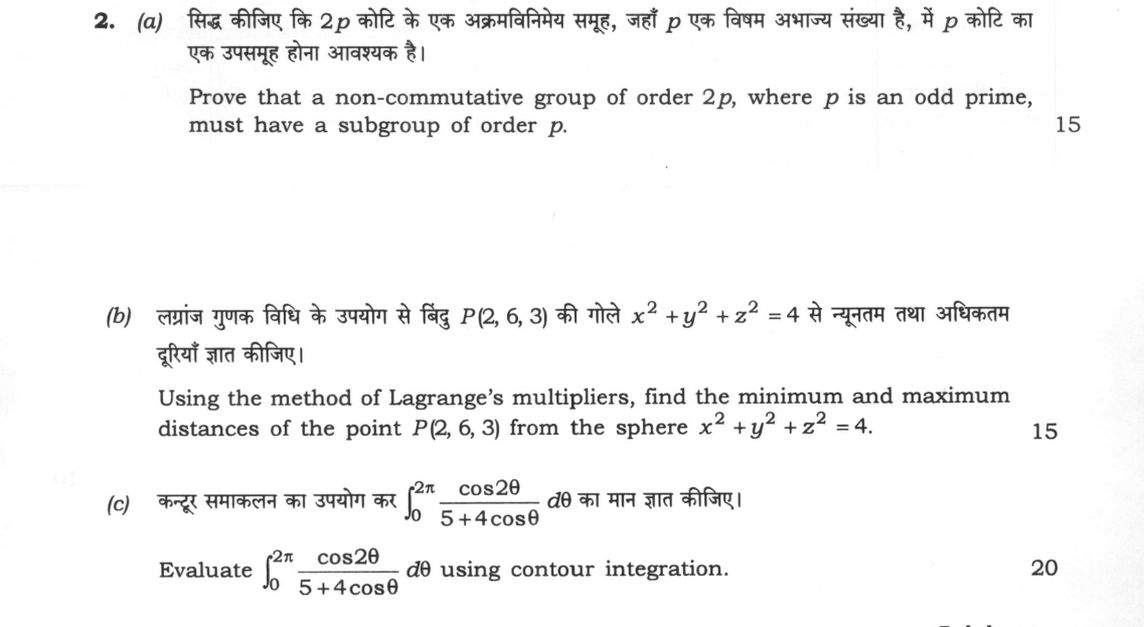
(a) Prove that a non-commutative group of order 2p, where p is an odd prime, must have a subgroup of order p. (15 marks) (b)…
Prove that a non-commutative group of order 2p, where p is an odd prime, must have a subgroup of order p. 15 marks
Using the method of Lagrange's multipliers, find the minimum and maximum distances of the point P(2, 6, 3) from the sphere x² + y² + z² = 4. 15 marks
Evaluate ∫₀²π (cos 2θ)/(5+4cosθ) dθ using contour integration. 20 marks
हिंदी में प्रश्न पढ़ें
सिद्ध कीजिए कि 2p कोटि के एक अक्रमविनिमेय समूह, जहाँ p एक विषम अभाज्य संख्या है, में p कोटि का एक उपसमूह होना आवश्यक है। (15 अंक)
लग्रांज गुणक विधि के उपयोग से बिंदु P(2, 6, 3) की गोले x² + y² + z² = 4 से न्यूनतम तथा अधिकतम दूरियाँ ज्ञात कीजिए। (15 अंक)
कंटूर समाकलन का उपयोग कर ∫₀²π (cos 2θ)/(5+4cosθ) dθ का मान ज्ञात कीजिए। (20 अंक)
Model answer
Written by UPSC Answer Check against this question's marking rubric, to the expected length. UPSC does not publish answers for Mains — this is one way to score well, not an official key.
(a) Let |G| = 2p, where p is an odd prime. By Lagrange’s theorem, every element of G has order 1, 2, p or 2p. Since G is non-commutative, it cannot be cyclic; hence no element can have order 2p, because an element of order 2p would generate a cyclic group of order 2p, which is abelian.
Suppose G has no element of order p. Then every non-identity element must have order 2. For any a, b ∈ G, we then have a² = b² = e and also (ab)² = e. Thus abab = e, so ab = b⁻¹a⁻¹ = ba, since a⁻¹ = a and b⁻¹ = b. Hence G would be abelian, a contradiction.
Therefore G must contain an element a of order p. Then H = ⟨a⟩ is a subgroup of G and |H| = p. Thus a non-commutative group of order 2p must have a subgroup of order p.
(b) Let Q(x, y, z) be any point on the sphere x² + y² + z² = 4. The square of the distance from P(2, 6, 3) to Q is
S = (x − 2)² + (y − 6)² + (z − 3)².
We minimize and maximize S subject to the constraint g = x² + y² + z² − 4 = 0. By Lagrange’s multiplier method, at an extremum,
∇S = λ∇g.
Thus
2(x − 2) = 2λx, 2(y − 6) = 2λy, 2(z − 3) = 2λz.
So
(1 − λ)x = 2, (1 − λ)y = 6, (1 − λ)z = 3.
Let μ = 1 − λ. Then
x = 2/μ, y = 6/μ, z = 3/μ.
Using x² + y² + z² = 4,
(4 + 36 + 9)/μ² = 4,
so 49/μ² = 4, giving μ² = 49/4, hence μ = ±7/2.
For μ = 7/2, the point is (4/7, 12/7, 6/7). The distance squared is
S = (4/7 − 2)² + (12/7 − 6)² + (6/7 − 3)² = (−10/7)² + (−30/7)² + (−15/7)² = (100 + 900 + 225)/49 = 1225/49 = 25.
So the minimum distance is √25 = 5.
For μ = −7/2, the point is (−4/7, −12/7, −6/7). The distance squared is
S = (−4/7 − 2)² + (−12/7 − 6)² + (−6/7 − 3)² = (−18/7)² + (−54/7)² + (−27/7)² = (324 + 2916 + 729)/49 = 3969/49 = 81.
So the maximum distance is √81 = 9.
Minimum distance = 5 at (4/7, 12/7, 6/7); maximum distance = 9 at (−4/7, −12/7, −6/7).
(c) Put z = e^iθ. Then
cos θ = (z + z⁻¹)/2, cos 2θ = (z² + z⁻²)/2, dθ = dz/(iz).
On the unit circle |z| = 1,
I = ∮ over |z|=1 [cos 2θ/(5 + 4 cos θ)] dθ = ∮ [((z² + z⁻²)/2)/(5 + 4((z + z⁻¹)/2))] dz/(iz) = ∮ (z⁴ + 1)/(2i z²(2z² + 5z + 2)) dz.
Now
2z² + 5z + 2 = (2z + 1)(z + 2).
Hence
f(z) = (z⁴ + 1)/(2i z²(2z + 1)(z + 2)).
The poles inside |z| = 1 are z = 0, of order 2, and z = −1/2, a simple pole. The pole z = −2 lies outside the unit circle.
Residue at z = −1/2:
Res(f, −1/2) = [(−1/2)⁴ + 1]/[2i(−1/2)²(−1/2 + 2)·2] = (17/16)/[2i·(1/4)·(3/2)·2] = (17/16)/(3i/2) = −17i/24.
Residue at z = 0: write
f(z) = (z⁴ + 1)/(2i z²(2 + 5z + 2z²)).
Since
1/(2 + 5z + 2z²) = 1/2 − 5z/4 + ⋯,
we get
f(z) = ((z⁴ + 1)/(2i z²))(1/2 − 5z/4 + ⋯) = (1 + z⁴)/(2i z²)(1/2 − 5z/4 + ⋯) = 1/(4i z²) − 5/(8i z) + ⋯.
Thus the residue at z = 0 is
−5/(8i) = 5i/8.
Sum of residues inside |z| = 1 is
5i/8 − 17i/24 = (15i − 17i)/24 = −i/12.
By Cauchy’s residue theorem,
I = 2πi × (−i/12) = π/6.
∫ from 0 to 2π of cos 2θ/(5 + 4 cos θ) dθ = π/6.
What "Prove" is asking you to do
Establish that the statement holds for every case it claims, not for one representative case. The argument must be closed: each line follows from a definition, a hypothesis, or a named theorem you are entitled to use.
Structure that answers it
Given and to prove, restated → theorem or construction to be used, named → the argument line by line → conclusion stated as proved
Where marks are lost
Testing one example, which illustrates but proves nothing. On an if and only if claim, proving one direction and stopping forfeits that half outright, and degenerate cases — zero, the empty set, the equality case — have to be disposed of rather than assumed away.
How this answer will be evaluated
Approach
Framework: UPSC Mathematics Paper 2. (a) justify: claim > 3-4 reasons > evidence > conclusion | (b) calculate: given > formula > substitution > result with units > interpretation | (c) calculate: given > formula > substitution > result with units > interpretation Full marks: Rigorous proofs, correct calculations, clear notation, and verification of results.
Key points expected
- State Sylow's Theorem for order 2p
- Determine number of subgroups of order p
- Use non-commutativity to rule out cyclic group
- Conclude existence of subgroup of order p
- Define objective function (distance squared)
- Set up Lagrange multiplier equations
- Solve system for critical points
- Calculate and compare distances
Evaluation rubric
Each sub-part is marked on its own, against the marks and word limit printed on the paper.
- (a) Proof that a non-commutative group of order 2p has a subgroup of order p. 15 marks
justify— claim → 3-4 reasons → evidence → conclusion
Must cover
- State Sylow's Theorem for order 2p
- Determine number of subgroups of order p
- Use non-commutativity to rule out cyclic group
- Conclude existence of subgroup of order p
Loses marks
- Assuming subgroup existence without proof
- Ignoring the non-commutative condition
- Incorrect application of Sylow's Theorem
Earns more
- Explicit calculation of n_p
- Reference to Lagrange's Theorem
- Clear logical flow of proof
Extra mark
- Mention of specific group structure (Dihedral)
- (b) Minimum and maximum distances of P(2,6,3) from sphere x²+y²+z²=4. 15 marks
calculate— given → formula → substitution → result with units → interpretation
Must cover
- Define objective function (distance squared)
- Set up Lagrange multiplier equations
- Solve system for critical points
- Calculate and compare distances
Loses marks
- Forgetting to square distance in objective
- Algebraic errors in solving system
- Failing to check both min and max
Earns more
- Correct gradient calculation
- Clear identification of min/max
- Geometric interpretation of result
Extra mark
- Verification using geometric distance formula
- (c) Evaluation of ∫₀²π (cos 2θ)/(5+4cosθ) dθ using contour integration. 20 marks
calculate— given → formula → substitution → result with units → interpretation
Must cover
- Substitute z = e^(iθ) and convert to contour integral
- Identify poles of the integrand
- Calculate residues at poles inside unit circle
- Apply Residue Theorem to find final value
Loses marks
- Incorrect substitution for cos2θ
- Missing poles or wrong residue values
- Forgetting factor of 2πi in Residue Theorem
Earns more
- Correct conversion of cosθ and cos2θ
- Accurate residue calculation
- Clear statement of contour (unit circle)
Extra mark
- Alternative method using Fourier series
Practice this exact question
Write your answer and it is marked point by point against the model answer above — what you covered, what you missed, what you got wrong.
Evaluate my answer →More from Mathematics 2023 Paper II
- Q1 (a) Let G be a group of order 10 and G′ be a group of order 6. Examine whether there exis…
- Q2 (a) Prove that a non-commutative group of order 2p, where p is an odd prime, must have a…
- Q3 (a) Prove that x² + 1 is an irreducible polynomial in Z₃[x]. Further show that the quotie…
- Q4 (a) Prove that the oscillation of a real-valued bounded function f defined on [a, b] is t…
- Q5 (a) By eliminating the arbitrary functions f and g from z = f(x² - y) + g(x² + y), form p…