Paper II — Q3
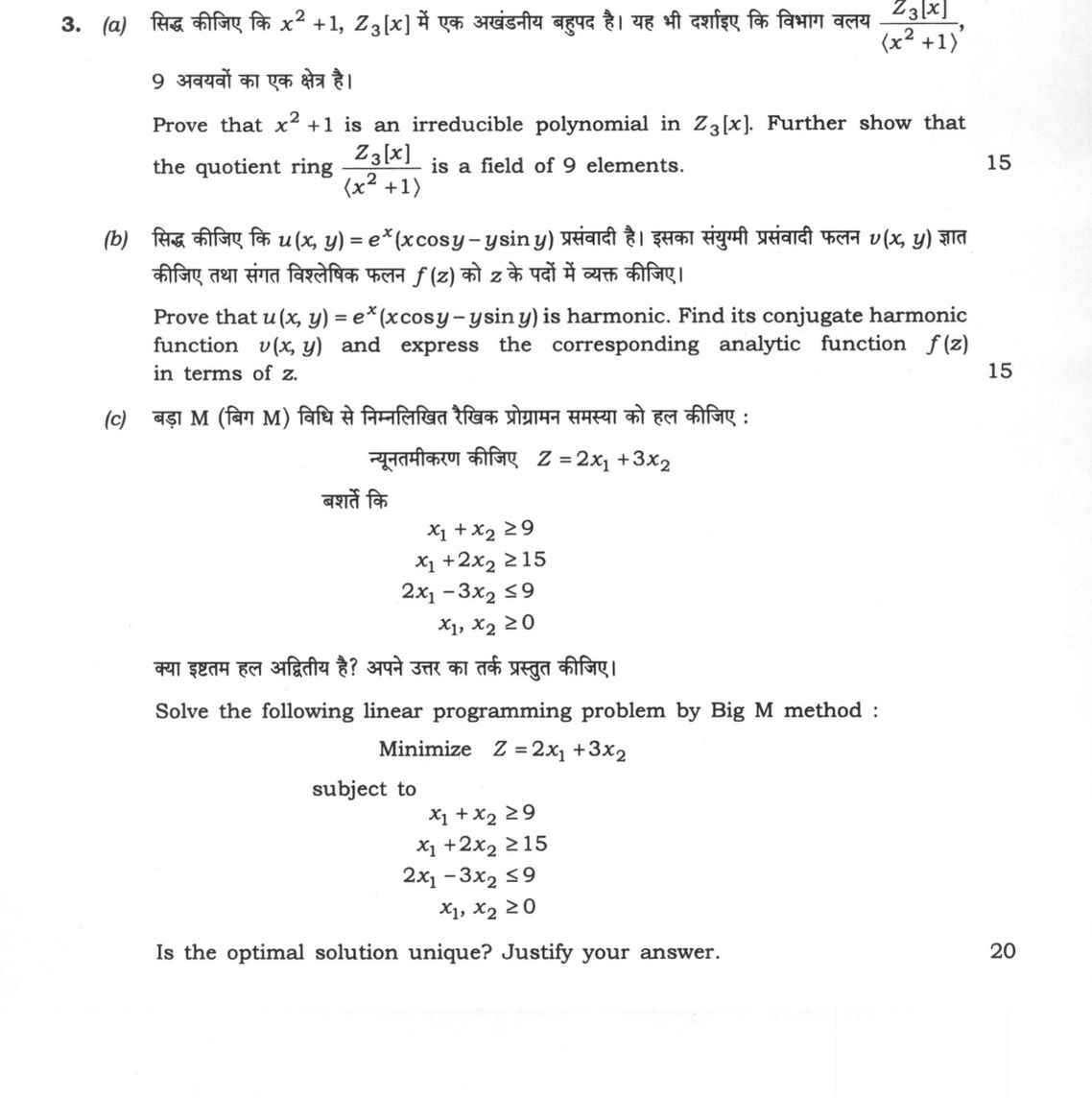
(a) Prove that x² + 1 is an irreducible polynomial in Z₃[x]. Further show that the quotient ring (Z₃[x])/(⟨ x²+1 ⟩) is a field of…
Prove that x² + 1 is an irreducible polynomial in Z₃[x]. Further show that the quotient ring (Z₃[x])/(⟨ x²+1 ⟩) is a field of 9 elements. 15 marks
Prove that u(x, y) = eˣ(x cos y - y sin y) is harmonic. Find its conjugate harmonic function v(x, y) and express the corresponding analytic function f(z) in terms of z. 15 marks
Solve the following linear programming problem by Big M method :
Minimize Z = 2x₁ + 3x₂
subject to x₁ + x₂ ≥ 9 x₁ + 2x₂ ≥ 15 2x₁ - 3x₂ ≤ 9 x₁, x₂ ≥ 0
Is the optimal solution unique? Justify your answer. 20 marks
हिंदी में प्रश्न पढ़ें
सिद्ध कीजिए कि x² + 1, Z₃[x] में एक अविभाज्य बहुपद है। यह भी दर्शाइए कि विभाग वलय (Z₃[x])/(⟨ x²+1 ⟩), 9 अवयवों का एक क्षेत्र है। 15
सिद्ध कीजिए कि u(x, y) = eˣ(x cos y - y sin y) प्रसंवादी है। इसका संयुग्मी प्रसंवादी फलन v(x, y) ज्ञात कीजिए तथा संगत विश्लेषिक फलन f(z) को z के पदों में व्यक्त कीजिए। 15
बड़ा M (बिग M) विधि से निम्नलिखित रैखिक प्रोग्रामन समस्या को हल कीजिए :
न्यूनतमीकरण कीजिए Z = 2x₁ + 3x₂
बशर्ते कि x₁ + x₂ ≥ 9 x₁ + 2x₂ ≥ 15 2x₁ - 3x₂ ≤ 9 x₁, x₂ ≥ 0
क्या इष्टतम हल अद्वितीय है? अपने उत्तर का तर्क प्रस्तुत कीजिए। 20
Model answer
Written by UPSC Answer Check against this question's marking rubric, to the expected length. UPSC does not publish answers for Mains — this is one way to score well, not an official key.
(a) By the theorem: over a field, a quadratic polynomial is irreducible iff it has no root in that field. In Z₃, test roots:
- x = 0: 0² + 1 = 1 ≠ 0.
- x = 1: 1² + 1 = 2 ≠ 0.
- x = 2: 2² + 1 = 4 + 1 = 5 ≡ 2 ≠ 0.
Thus x² + 1 has no root in Z₃, so it is irreducible in Z₃[x].
Since Z₃[x] is a Euclidean domain, an irreducible element generates a maximal ideal. Hence ⟨x² + 1⟩ is maximal, and therefore Z₃[x]/⟨x² + 1⟩ is a field.
Every element of this quotient ring is of the form a + bx with a, b ∈ Z₃, because every polynomial can be reduced modulo x² + 1. There are 3 choices for a and 3 choices for b, hence 3² = 9 elements. So the quotient ring is a field of 9 elements.
Final: x² + 1 is irreducible in Z₃[x], and Z₃[x]/⟨x² + 1⟩ is a field of 9 elements.
(b) For u(x, y) = eˣ(x cos y − y sin y), compute: ∂u/∂x = eˣ[(x + 1)cos y − y sin y], ∂²u/∂x² = eˣ[(x + 2)cos y − y sin y].
Also, ∂u/∂y = eˣ[−x sin y − sin y − y cos y] = eˣ[−(x + 1)sin y − y cos y], ∂²u/∂y² = eˣ[−(x + 2)cos y + y sin y].
Hence ∂²u/∂x² + ∂²u/∂y² = eˣ[(x + 2)cos y − y sin y − (x + 2)cos y + y sin y] = 0. So u is harmonic.
Using the Cauchy–Riemann equations: ∂u/∂x = ∂v/∂y, ∂u/∂y = −∂v/∂x. Thus ∂v/∂y = eˣ[(x + 1)cos y − y sin y]. Integrating with respect to y: v = eˣ[(x + 1)sin y + y cos y − sin y] + φ(x) = eˣ[x sin y + y cos y] + φ(x).
Then ∂v/∂x = eˣ[(x + 1)sin y + y cos y] + φ′(x). Since ∂u/∂y = eˣ[−(x + 1)sin y − y cos y], we get φ′(x) = 0, so φ(x) is constant. Taking it as 0, v(x, y) = eˣ(x sin y + y cos y).
Then f(z) = u + iv = eˣ[x cos y − y sin y + i(x sin y + y cos y)] = eˣ(x + iy)(cos y + i sin y) = z eᶻ.
Final: v(x, y) = eˣ(x sin y + y cos y), and f(z) = z eᶻ + iC.
(c) By the Big M method, introduce surplus variables S₁, S₂, slack S₃, and artificial variables A₁, A₂. Minimize: Z = 2x₁ + 3x₂ + M A₁ + M A₂, subject to x₁ + x₂ − S₁ + A₁ = 9, x₁ + 2x₂ − S₂ + A₂ = 15, 2x₁ − 3x₂ + S₃ = 9, all variables ≥ 0.
Initial basis: A₁ = 9, A₂ = 15, S₃ = 9. Since 3 − 3M < 2 − 2M for large M, x₂ enters. The minimum ratio is 15/2 = 7.5, so A₂ leaves.
After pivot: 0.5x₁ − S₁ + 0.5S₂ + A₁ − 0.5A₂ = 1.5 0.5x₁ + x₂ − 0.5S₂ + 0.5A₂ = 7.5 3.5x₁ − 1.5S₂ + S₃ + 1.5A₂ = 31.5
Now x₁ enters because its reduced cost 0.5 − 0.5M is more negative than that of S₂, namely 1.5 − 0.5M. The minimum ratio is 1.5/0.5 = 3, so A₁ leaves.
Final simplex rows: x₁ − 2S₁ + S₂ + 2A₁ − A₂ = 3 x₂ + S₁ − S₂ − A₁ + A₂ = 6 7S₁ − 5S₂ + S₃ − 7A₁ + 5A₂ = 21
At optimum, artificial variables are zero, so A₁ = A₂ = 0 and S₁ = S₂ = 0. Hence x₁ = 3, x₂ = 6, S₃ = 21.
Check constraints: 3 + 6 = 9, 3 + 12 = 15, 2(3) − 3(6) = −12 ≤ 9. Thus feasible.
Objective: Z = 2(3) + 3(6) = 6 + 18 = 24.
In the final reduced-cost row, the nonbasic variables S₁ and S₂ have reduced costs 1 and 1, while A₁ and A₂ have reduced costs M − 1 > 0. No nonbasic variable has zero reduced cost, so no alternative optimum exists.
Final: x₁ = 3, x₂ = 6, minimum Z = 24. The optimal solution is unique.
What "Solve" is asking you to do
Choose the method, then carry it through to a final answer. Identifying what kind of problem this is and why that method applies is the first thing marked; a correct figure arrived at invisibly earns almost nothing.
Structure that answers it
Given data and what is required → method chosen, with the reason it applies → set-up (equation, circuit, free body, trial balance) → working, step by step → answer with units and any condition of validity
Where marks are lost
Doing the middle steps mentally and writing only the result. In mathematics papers, a further loss comes from giving a decimal where the exact value in surds or fractions was wanted, or from skipping the justification a part explicitly asks for.
How this answer will be evaluated
Approach
(a) justify: claim > 3-4 reasons > evidence > conclusion | (b) derive: given > assumptions > stepwise derivation > result > check | (c) calculate: given > formula > substitution > result with units > interpretation Full marks: Rigorous proofs, correct calculations, clear justification of all steps.
Key points expected
- Check roots in Z3 to prove irreducibility
- State theorem: quotient by irreducible is field
- Count elements to show 9 total
- Verify field axioms or structure
- Verify Laplace equation u_xx + u_yy = 0
- Use Cauchy-Riemann equations to find v
- Integrate to find v(x,y)
- Express f(z) = u + iv in terms of z
Evaluation rubric
Each sub-part is marked on its own, against the marks and word limit printed on the paper.
- (a) Proof of irreducibility and field structure of the quotient ring. 15 marks
justify— claim → 3-4 reasons → evidence → conclusion
Must cover
- Check roots in Z3 to prove irreducibility
- State theorem: quotient by irreducible is field
- Count elements to show 9 total
- Verify field axioms or structure
Loses marks
- Assuming irreducibility without checking roots
- Confusing Z3[x] with R[x]
Earns more
- Explicit listing of 9 elements
- Mention of GF(9) notation
Extra mark
- Alternative proof via Euclidean algorithm
- (b) Verification of harmonicity, finding conjugate v, and analytic f(z). 15 marks
derive— given → assumptions → stepwise derivation → result → check
Must cover
- Verify Laplace equation u_xx + u_yy = 0
- Use Cauchy-Riemann equations to find v
- Integrate to find v(x,y)
- Express f(z) = u + iv in terms of z
Loses marks
- Skipping Laplace equation verification
- Incorrect integration of CR equations
Earns more
- Mentioning Milne-Thomson method
- Checking consistency of v
Extra mark
- Alternative method for finding v
- (c) Solution of LPP via Big M method and uniqueness check. 20 marks
calculate— given → formula → substitution → result with units → interpretation
Must cover
- Formulate standard form with artificial variables
- Construct initial simplex tableau
- Perform iterations to optimality
- Justify uniqueness of optimal solution
Loses marks
- Incorrect setup of artificial variables
- Arithmetic errors in simplex iterations
Earns more
- Correct handling of Big M penalties
- Clear tableau formatting
Extra mark
- Graphical verification of solution
Practice this exact question
Write your answer and it is marked point by point against the model answer above — what you covered, what you missed, what you got wrong.
Evaluate my answer →More from Mathematics 2023 Paper II
- Q1 (a) Let G be a group of order 10 and G′ be a group of order 6. Examine whether there exis…
- Q2 (a) Prove that a non-commutative group of order 2p, where p is an odd prime, must have a…
- Q3 (a) Prove that x² + 1 is an irreducible polynomial in Z₃[x]. Further show that the quotie…
- Q4 (a) Prove that the oscillation of a real-valued bounded function f defined on [a, b] is t…
- Q5 (a) By eliminating the arbitrary functions f and g from z = f(x² - y) + g(x² + y), form p…
- Q6 (a) Find the surface passing through the two lines z = x = 0 and z-1 = x-y = 0, and satis…