Paper II — Q4
(a) Prove that the oscillation of a real-valued bounded function f defined on [a, b] is the supremum of the set {|f(x₁)-f(x₂)| …
Prove that the oscillation of a real-valued bounded function f defined on [a, b] is the supremum of the set {|f(x₁)-f(x₂)| : x₁, x₂ ∈ [a, b]}. 15 marks
Classify the singular point z = 0 of the function f(z) = e^z/(z-sin z) and obtain the principal part of its Laurent series expansion. 15 marks
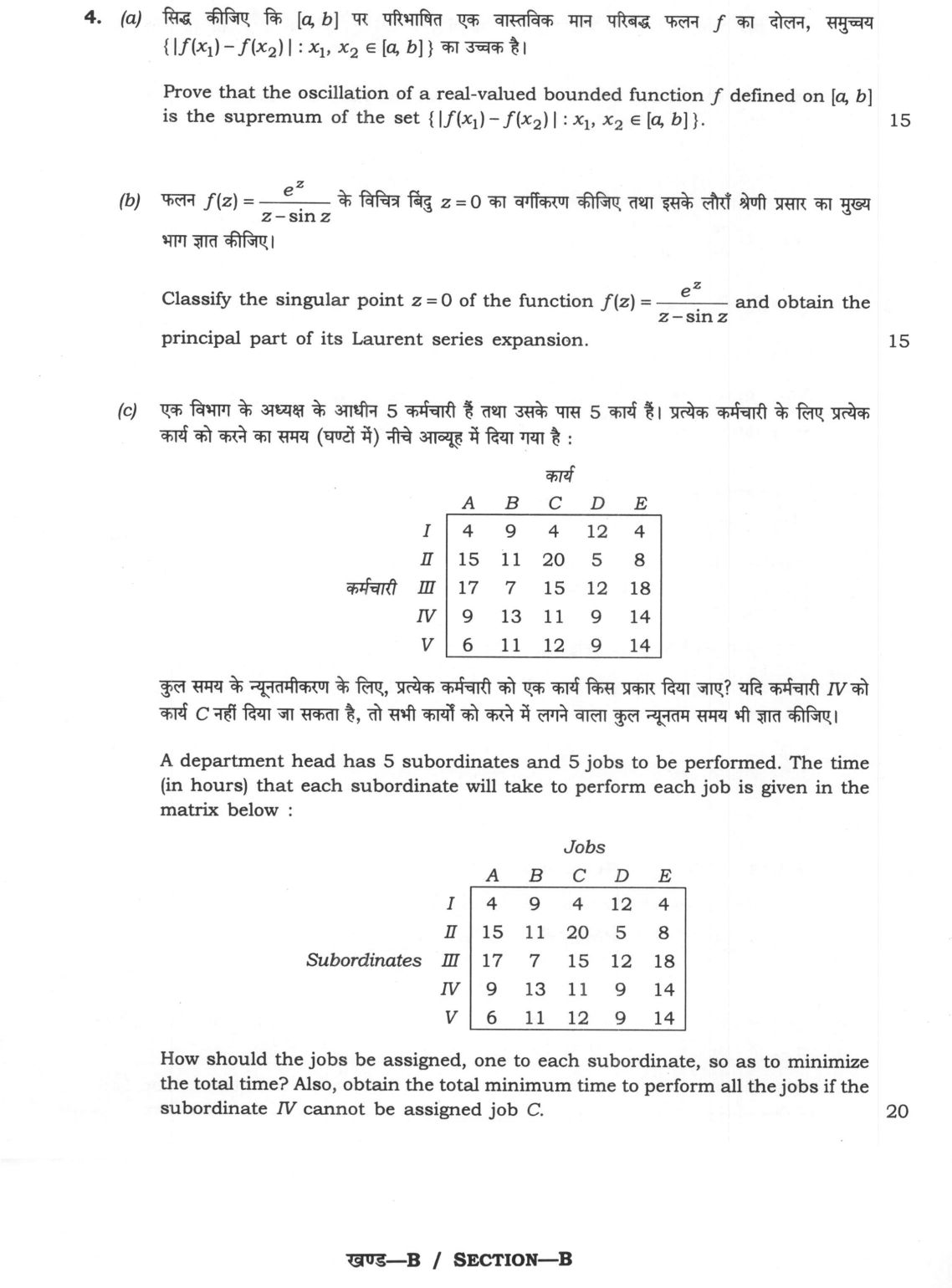
A department head has 5 subordinates and 5 jobs to be performed. The time (in hours) that each subordinate will take to perform each job is given in the matrix below :
How should the jobs be assigned, one to each subordinate, so as to minimize the total time? Also, obtain the total minimum time to perform all the jobs if the subordinate IV cannot be assigned job C. 20 marks
हिंदी में प्रश्न पढ़ें
सिद्ध कीजिए कि [a, b] पर परिभाषित एक वास्तविक मान परिबद्ध फलन f का दोलन, समुच्चय {|f(x₁)-f(x₂)| : x₁, x₂ ∈ [a, b]} का उच्चक है। 15
फलन f(z) = e^z/(z-sin z) के विचित्र बिंदु z = 0 का वर्गीकरण कीजिए तथा इसके लॉरेंट श्रेणी प्रसार का मुख्य भाग ज्ञात कीजिए। 15
एक विभाग के अध्यक्ष के अधीन 5 कर्मचारी हैं तथा उसके पास 5 कार्य हैं। प्रत्येक कर्मचारी के लिए प्रत्येक कार्य को करने का समय (घंटों में) नीचे आव्यूह में दिया गया है :
कुल समय के न्यूनतमीकरण के लिए, प्रत्येक कर्मचारी को एक कार्य किस प्रकार दिया जाए? यदि कर्मचारी IV को कार्य C नहीं दिया जा सकता है, तो सभी कार्यों को करने में लगने वाला कुल न्यूनतम समय भी ज्ञात कीजिए। 20
The figure this question refers to, in words
The question paper is a scan and the diagram did not survive as text. This is the figure as read from the original page — every component, value and label — so the question can be worked from the text below.
(c) Table with rows labeled I, II, III, IV, V and columns labeled A, B, C, D, E. The values in the table are: Row I: 4, 9, 4, 12, 4. Row II: 15, 11, 20, 5, 8. Row III: 17, 7, 15, 12, 18. Row IV: 9, 13, 11, 9, 14. Row V: 6, 11, 12, 9, 14.
Model answer
Written by UPSC Answer Check against this question's marking rubric, to the expected length. UPSC does not publish answers for Mains — this is one way to score well, not an official key.
(a) Let M = sup f(x) and m = inf f(x) for x∈[a,b]. Since f is real-valued and bounded, M and m are finite and M≥m. The oscillation is defined as M-m. Put S = {|f(x₁)-f(x₂)| : x₁, x₂∈[a,b]}. For any x₁, x₂, m≤f(x₁), f(x₂)≤M, so |f(x₁)-f(x₂)|≤M-m. Thus sup S≤M-m. Conversely, let ε>0. By the definitions of supremum and infimum, choose x₁, x₂∈[a,b] with f(x₁)>M-ε/2 and f(x₂)<m+ε/2. Then |f(x₁)-f(x₂)|>M-m-ε, so sup S≥M-m-ε. Since ε>0 is arbitrary, sup S≥M-m. Therefore sup S=M-m. The oscillation is the supremum of S.
(b) Use the Maclaurin series, valid for all z: eᶻ = 1+z+z²/2+z³/6+... sin z = z-z³/6+z⁵/120-z⁷/5040+... Then z-sin z = z³/6-z⁵/120+z⁷/5040-... = z³/6(1-z²/20+z⁴/840-...). The bracket is 1 at z=0, so by continuity it is nonzero in a neighbourhood of 0; hence z-sin z has a zero of exact order 3 at 0. Since eᶻ is analytic and e⁰=1≠0, z=0 is a pole of order 3. For the principal part, write R(z)=(1-z²/20+z⁴/840-...)⁻¹. Let R(z)=1+c z²+O(z⁴). Multiplying by the bracket and equating the z² coefficient gives c=1/20, so R(z)=1+z²/20+O(z⁴). Therefore, in 0<|z|<r, where r is the distance to the nearest other zero of z-sin z, or ∞ if none, eᶻ/(z-sin z)=6z⁻³(1+z+z²/2+O(z³))(1+z²/20+O(z⁴)) =6z⁻³(1+z+(1/2+1/20)z²+O(z³)) =6z⁻³+6z⁻²+(66/20)z⁻¹+O(1) =6z⁻³+6z⁻²+(33/10)z⁻¹+O(1). Principal part: 6z⁻³+6z⁻²+(33/10)z⁻¹.
(c) Use the Hungarian method. Row, column, and Hungarian adjustments preserve optimality, since each complete assignment changes by a constant. Costs are in hours. Row minima are 4, 5, 7, 9, 6. After row reduction:
- I: 0, 5, 0, 8, 0
- II: 10, 6, 15, 0, 3
- III: 10, 0, 8, 5, 11
- IV: 0, 4, 2, 0, 5
- V: 0, 5, 6, 3, 8 Column minima are all 0. The zeros are I-A, I-C, I-E, II-D, III-B, IV-A, IV-D, V-A. No five independent zeros exist. A maximum matching of size 4 is I-C, II-D, III-B, IV-A. From unmatched row V, the alternating tree reaches rows V, IV, II and columns A, D; hence the minimum cover is rows I, III and columns A, D. Since 4<5, let Δ be the smallest uncovered entry. Uncovered entries are in rows II, IV, V and columns B, C, E; their minimum is Δ=2 (IV,C). Subtract Δ from uncovered entries and add Δ to intersections of the covering lines. New reduced matrix:
- I: 2, 5, 0, 10, 0
- II: 10, 4, 13, 0, 1
- III: 12, 0, 8, 7, 11
- IV: 0, 2, 0, 0, 3
- V: 0, 3, 4, 3, 6 Now choose five independent zeros: I-E, II-D, III-B, IV-C, V-A. Since all reduced entries are nonnegative, a zero reduced total is optimal. Original cost: 4+5+7+11+6=33. Minimum assignment: I-E, II-D, III-B, IV-C, V-A; total minimum time = 33 hours.
For the restriction, forbid IV-C by replacing 11 with M=100 hours. Every feasible assignment without this cell has cost at most 5×20=100 hours, while any assignment using IV-C has cost at least 100+4+5+7+6=122 hours, so the modified problem has the same required optimum. Row reduction gives:
- I: 0, 5, 0, 8, 0
- II: 10, 6, 15, 0, 3
- III: 10, 0, 8, 5, 11
- IV: 0, 4, 91, 0, 5
- V: 0, 5, 6, 3, 8 Column minima are 0. The same minimum cover, rows I, III and columns A, D, covers all zeros. The smallest uncovered entry is Δ=3 (II,E). Subtract Δ from uncovered entries and add Δ to intersections. New reduced matrix:
- I: 3, 5, 0, 11, 0
- II: 10, 3, 12, 0, 0
- III: 13, 0, 8, 8, 11
- IV: 0, 1, 88, 0, 2
- V: 0, 2, 3, 3, 5 Five independent zeros are I-C, II-E, III-B, IV-D, V-A. The forbidden cell IV-C is not used, so the restriction is satisfied. Original restricted cost: 4+8+7+9+6=34. With IV not assigned C, minimum assignment: I-C, II-E, III-B, IV-D, V-A; total minimum time = 34 hours.
What "Prove" is asking you to do
Establish that the statement holds for every case it claims, not for one representative case. The argument must be closed: each line follows from a definition, a hypothesis, or a named theorem you are entitled to use.
Structure that answers it
Given and to prove, restated → theorem or construction to be used, named → the argument line by line → conclusion stated as proved
Where marks are lost
Testing one example, which illustrates but proves nothing. On an if and only if claim, proving one direction and stopping forfeits that half outright, and degenerate cases — zero, the empty set, the equality case — have to be disposed of rather than assumed away.
How this answer will be evaluated
Approach
(a) justify: claim > 3-4 reasons > evidence > conclusion | (b) derive: given > assumptions > stepwise derivation > result > check | (c) calculate: given > formula > substitution > result with units > interpretation Full marks: Rigorous proof in (a), correct pole order and residue in (b), and a fully worked Hungarian method solution in (c).
Key points expected
- Define oscillation as sup f - inf f
- Prove sup |f(x1)-f(x2)| ≤ sup f - inf f
- Prove sup f - inf f ≤ sup |f(x1)-f(x2)|
- Conclude equality of the two quantities
- Expand sin z to determine the order of the zero
- Identify z=0 as a pole of order 2
- Derive the principal part terms (1/z^2 and 1/z)
- State the coefficient of the 1/z term (residue)
Evaluation rubric
Each sub-part is marked on its own, against the marks and word limit printed on the paper.
- (a) Proof that oscillation equals the supremum of the set of absolute differences. 15 marks
justify— claim → 3-4 reasons → evidence → conclusion
Must cover
- Define oscillation as sup f - inf f
- Prove sup |f(x1)-f(x2)| ≤ sup f - inf f
- Prove sup f - inf f ≤ sup |f(x1)-f(x2)|
- Conclude equality of the two quantities
Loses marks
- Assumes continuity without proof
- Confuses supremum with maximum
Earns more
- Uses epsilon-delta argument for sup/inf
- Explicitly handles the boundedness condition
Extra mark
- Mentions uniform continuity as a related concept
- (b) Classification of z=0 and the principal part of the Laurent series. 15 marks
derive— given → assumptions → stepwise derivation → result → check
Must cover
- Expand sin z to determine the order of the zero
- Identify z=0 as a pole of order 2
- Derive the principal part terms (1/z^2 and 1/z)
- State the coefficient of the 1/z term (residue)
Loses marks
- Incorrectly identifies the order of the pole
- Fails to expand the numerator e^z
Earns more
- Shows the limit calculation for the residue
- Explicitly writes the first few terms of the series
Extra mark
- Calculates the full Laurent series up to the constant term
- (c) Optimal job assignment and minimum time with a specific constraint. 20 marks
calculate— given → formula → substitution → result with units → interpretation
Must cover
- Apply the Hungarian method (row/column reduction)
- Determine the optimal assignment for the base case
- Calculate the total minimum time for the base case
- Re-solve or adjust for the constraint (IV not C)
Loses marks
- Assigns multiple jobs to one subordinate
- Ignores the constraint in the final calculation
Earns more
- Shows the intermediate reduced matrices
- Clearly states the final assignment pairs (e.g., I-A, II-D...)
Extra mark
- Uses the penalty method to handle the constraint
Practice this exact question
Write your answer and it is marked point by point against the model answer above — what you covered, what you missed, what you got wrong.
Evaluate my answer →More from Mathematics 2023 Paper II
- Q1 (a) Let G be a group of order 10 and G′ be a group of order 6. Examine whether there exis…
- Q2 (a) Prove that a non-commutative group of order 2p, where p is an odd prime, must have a…
- Q3 (a) Prove that x² + 1 is an irreducible polynomial in Z₃[x]. Further show that the quotie…
- Q4 (a) Prove that the oscillation of a real-valued bounded function f defined on [a, b] is t…
- Q5 (a) By eliminating the arbitrary functions f and g from z = f(x² - y) + g(x² + y), form p…
- Q6 (a) Find the surface passing through the two lines z = x = 0 and z-1 = x-y = 0, and satis…
- Q7 (a) (i) Find the conjunctive normal form (CNF) of the following Boolean function: f(x, y,…