Paper II — Q5
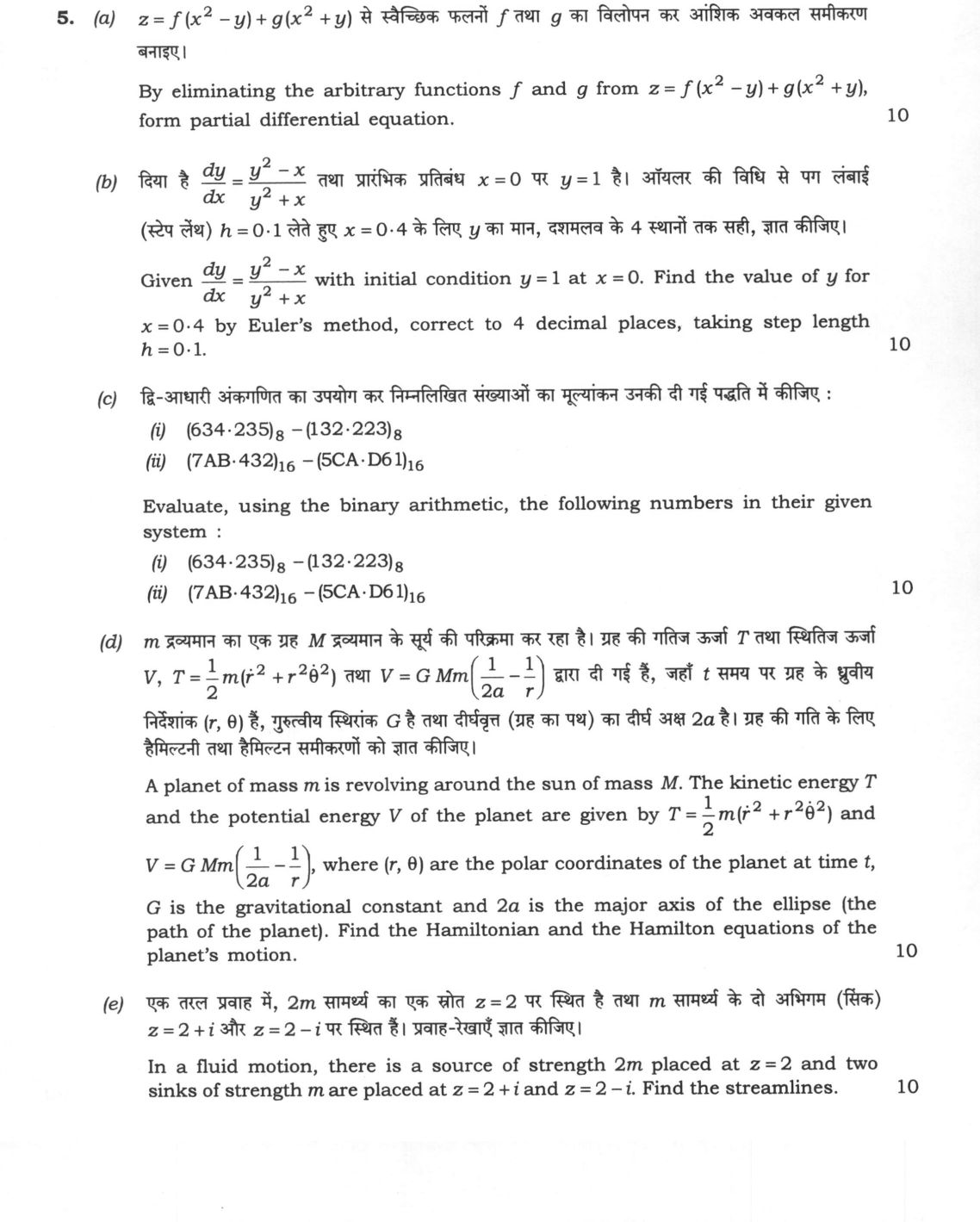
(a) By eliminating the arbitrary functions f and g from z = f(x² - y) + g(x² + y), form partial differential equation. (10…
By eliminating the arbitrary functions f and g from z = f(x² - y) + g(x² + y), form partial differential equation. 10 marks
Given dy/dx = (y² - x)/(y² + x) with initial condition y = 1 at x = 0. Find the value of y for x = 0.4 by Euler's method, correct to 4 decimal places, taking step length h = 0.1. 10 marks
Evaluate, using the binary arithmetic, the following numbers in their given system: (634.235)₈ - (132.223)₈
(7AB.432)₁₆ - (5CA.D61)₁₆ 10 marks
A planet of mass m is revolving around the sun of mass M. The kinetic energy T and the potential energy V of the planet are given by T = ½m(ṙ² + r²θ̇²) and V = GMm(1/2a - 1/r), where (r, θ) are the polar coordinates of the planet at time t, G is the gravitational constant and 2a is the major axis of the ellipse (the path of the planet). Find the Hamiltonian and the Hamilton equations of the planet's motion. 10 marks
In a fluid motion, there is a source of strength 2m placed at z = 2 and two sinks of strength m are placed at z = 2 + i and z = 2 - i. Find the streamlines. 10 marks
हिंदी में प्रश्न पढ़ें
z = f(x² - y) + g(x² + y) से स्वेच्छिक फलनों f तथा g का विलोपन कर अंशिक अवकल समीकरण बनाइए। (10 अंक)
दिया है dy/dx = (y² - x)/(y² + x) तथा प्रारंभिक प्रतिबंध x = 0 पर y = 1 है। ऑयलर की विधि से पद लंबाई (स्टेप लैंथ) h = 0.1 लेते हुए x = 0.4 के लिए y का मान, दशमलव के 4 स्थानों तक सही, ज्ञात कीजिए। (10 अंक)
द्वि-आधारी अंकगणित का उपयोग कर निम्नलिखित संख्याओं का मूल्यांकन उनकी दी गई पद्धति में कीजिए: (634.235)₈ - (132.223)₈
(7AB.432)₁₆ - (5CA.D61)₁₆ (10 अंक)
m द्रव्यमान का एक ग्रह M द्रव्यमान के सूर्य की परिक्रमा कर रहा है। ग्रह की गतिज ऊर्जा T तथा स्थितिज ऊर्जा V, T = ½m(ṙ² + r²θ̇²) तथा V = GMm(1/2a - 1/r) द्वारा दी गई हैं, जहाँ t समय पर ग्रह के ध्रुवीय निर्देशांक (r, θ) हैं, गुरुत्वीय स्थिरांक G है तथा दीर्घवृत्त (ग्रह का पथ) का दीर्घ अक्ष 2a है। ग्रह की गति के लिए हैमिल्टोनी तथा हैमिल्टन समीकरणों को ज्ञात कीजिए। (10 अंक)
एक तरल प्रवाह में, 2m सामर्थ्य का एक स्रोत z = 2 पर स्थित है तथा m सामर्थ्य के दो अभिगम (सिंक) z = 2 + i और z = 2 - i पर स्थित हैं। प्रवाह-रेखाएँ ज्ञात कीजिए। (10 अंक)
Model answer
Written by UPSC Answer Check against this question's marking rubric, to the expected length. UPSC does not publish answers for Mains — this is one way to score well, not an official key.
(a) Let u = x² - y, v = x² + y, and set p = ∂z/∂x, q = ∂z/∂y. Since z = f(u) + g(v), the chain rule gives p = 2x f′(u) + 2x g′(v), q = -f′(u) + g′(v). Put A = f′(u), B = g′(v). Then p/(2x) = A + B, q = -A + B. Solving, A = p/(4x) - q/2, B = p/(4x) + q/2. Since A is a function of u alone, ∂A/∂v = 0. Now u = x² - y, v = x² + y. Holding u constant, du = 2x dx - dy = 0 ⇒ dy = 2x dx, dv = 2x dx + dy = 4x dx. Thus ∂/∂v = (1/(4x)) ∂/∂x + (1/2) ∂/∂y. Let r = ∂²z/∂x², s = ∂²z/∂x∂y, t = ∂²z/∂y². Then ∂A/∂x = r/(4x) - p/(4x²) - s/2, ∂A/∂y = s/(4x) - t/2. Hence (1/(4x))∂A/∂x + (1/2)∂A/∂y = 0 gives r/(16x²) - p/(16x³) - t/4 = 0. Multiplying by 16x³, x ∂²z/∂x² - ∂z/∂x - 4x³ ∂²z/∂y² = 0. This equation also holds at x = 0, where it reduces to ∂z/∂x = 0, as required by the original form. Thus the required PDE is x ∂²z/∂x² - ∂z/∂x - 4x³ ∂²z/∂y² = 0.
(b) Euler’s method is yₙ₊₁ = yₙ + h f(xₙ,yₙ), f(x,y) = (y² - x)/(y² + x), with h = 0.1, x₀ = 0, y₀ = 1.
- n = 0: x₀ = 0, y₀ = 1. f = (1 - 0)/(1 + 0) = 1. y₁ = 1 + 0.1(1) = 1.1000.
- n = 1: x₁ = 0.1, y₁ = 1.1. y₁² = 1.21. f = (1.21 - 0.1)/(1.21 + 0.1) = 1.11/1.31 = 0.8473282443. y₂ = 1.1 + 0.1(0.8473282443) = 1.1847328244.
- n = 2: x₂ = 0.2, y₂ = 1.1847328244. y₂² = 1.4035918653. f = (1.4035918653 - 0.2)/(1.4035918653 + 0.2) = 1.2035918653/1.6035918653 = 0.7505599719. y₃ = 1.1847328244 + 0.1(0.7505599719) = 1.2597888216.
- n = 3: x₃ = 0.3, y₃ = 1.2597888216. y₃² = 1.5870678751. f = (1.5870678751 - 0.3)/(1.5870678751 + 0.3) = 1.2870678751/1.8870678751 = 0.6820464129. y₄ = 1.2597888216 + 0.1(0.6820464129) = 1.3279934629.
Therefore, y(0.4) ≈ 1.3280 correct to 4 decimal places. The initial condition y(0) = 1 is exactly satisfied.
(c)(i) Convert each octal digit to 3 binary bits: (634.235)₈ = 110 011 100 . 010 011 101 = 110011100.010011101₂ (132.223)₈ = 001 011 010 . 010 010 011 = 001011010.010010011₂ Subtracting in binary: 110011100.010011101
- 001011010.010010011 = 101000010.000001010₂ Regrouping in threes: 101 000 010 . 000 001 010 = (502.012)₈. Answer: (502.012)₈
(c)(ii) Convert each hexadecimal digit to 4 binary bits: (7AB.432)₁₆ = 0111 1010 1011 . 0100 0011 0010₂ (5CA.D61)₁₆ = 0101 1100 1010 . 1101 0110 0001₂ Subtracting in binary: 0111 1010 1011 . 0100 0011 0010
- 0101 1100 1010 . 1101 0110 0001 = 0001 1110 0000 . 0110 1101 0001₂ Regrouping in fours: 0001 1110 0000 . 0110 1101 0001 = (1E0.6D1)₁₆. Answer: (1E0.6D1)₁₆
(d) The Lagrangian is L = T - V. With T = ½m(ṙ² + r²θ̇²), V = GMm(1/(2a) - 1/r), the canonical momenta are pᵣ = ∂L/∂ṙ = mṙ, pθ = ∂L/∂θ̇ = mr²θ̇. Hence ṙ = pᵣ/m, θ̇ = pθ/(mr²). The Hamiltonian is H = pᵣṙ + pθθ̇ - L = T + V. Thus H = pᵣ²/(2m) + pθ²/(2mr²) + GMm(1/(2a) - 1/r). Hamilton’s equations are ṙ = ∂H/∂pᵣ = pᵣ/m, θ̇ = ∂H/∂pθ = pθ/(mr²), ṗᵣ = -∂H/∂r = pθ²/(mr³) - GMm/r², ṗθ = -∂H/∂θ = 0. Therefore pθ is constant, so angular momentum is conserved. The additive constant GMm/(2a) in V does not affect the equations of motion.
(e) For a source of strength q at z₀, the complex potential is W = (q/(2π)) log(z - z₀), and for a sink of strength q the sign is reversed. Here the source of strength 2m is at z = 2, and the two sinks of strength m are at z = 2 + i and z = 2 - i. Hence W = (2m/(2π)) log(z - 2) - (m/(2π)) log(z - 2 - i) - (m/(2π)) log(z - 2 + i) = (m/(2π)) log[ (z - 2)² / ((z - 2)² + 1) ]. Writing W = φ + iψ, the streamlines are ψ = constant. Therefore Im log[ (z - 2)² / ((z - 2)² + 1) ] = constant, or equivalently arg[ (z - 2)² / ((z - 2)² + 1) ] = constant. In Cartesian coordinates, with z = x + iy, ψ = (m/(2π))[ 2 tan⁻¹(y/(x - 2)) - tan⁻¹((y - 1)/(x - 2)) - tan⁻¹((y + 1)/(x - 2)) ]. Thus the streamlines are given by 2 tan⁻¹(y/(x - 2)) - tan⁻¹((y - 1)/(x - 2)) - tan⁻¹((y + 1)/(x - 2)) = constant. The branches of the inverse tangents are chosen modulo π; the singular lines x = 2 correspond to the source and sinks and are excluded from the streamline equation.
What "Solve" is asking you to do
Choose the method, then carry it through to a final answer. Identifying what kind of problem this is and why that method applies is the first thing marked; a correct figure arrived at invisibly earns almost nothing.
Structure that answers it
Given data and what is required → method chosen, with the reason it applies → set-up (equation, circuit, free body, trial balance) → working, step by step → answer with units and any condition of validity
Where marks are lost
Doing the middle steps mentally and writing only the result. In mathematics papers, a further loss comes from giving a decimal where the exact value in surds or fractions was wanted, or from skipping the justification a part explicitly asks for.
How this answer will be evaluated
Approach
(a) derive: given > assumptions > stepwise derivation > result > check | (b) calculate: given > formula > substitution > result with units > interpretation | (c(i)) calculate: given > formula > substitution > result with units > interpretation | (c(ii)) calculate: given > formula > substitution > result with units > interpretation | (d) derive: given > assumptions > stepwise derivation > result > check | (e) derive: given > assumptions > stepwise derivation > result > check Full marks: Complete, accurate derivations with all steps shown and verified.
Key points expected
- Define u = x² - y and v = x² + y
- Differentiate z to find z_x and z_y
- Eliminate f' and g' to form PDE
- Simplify to final PDE form
- State Euler's method formula
- Show step-by-step calculation for h=0.1
- Calculate y for x=0.1, 0.2, 0.3, 0.4
- Final answer correct to 4 decimal places
Evaluation rubric
Each sub-part is marked on its own, against the marks and word limit printed on the paper.
- (a) Partial differential equation by eliminating f and g. 10 marks
derive— given → assumptions → stepwise derivation → result → check
Must cover
- Define u = x² - y and v = x² + y
- Differentiate z to find z_x and z_y
- Eliminate f' and g' to form PDE
- Simplify to final PDE form
Loses marks
- Skipping intermediate differentiation steps
- Incorrect elimination of arbitrary functions
Earns more
- Explicitly states chain rule application
- Verifies result by substitution
Extra mark
- Alternative method noted briefly
- (b) Value of y at x=0.4 using Euler's method. 10 marks
calculate— given → formula → substitution → result with units → interpretation
Must cover
- State Euler's method formula
- Show step-by-step calculation for h=0.1
- Calculate y for x=0.1, 0.2, 0.3, 0.4
- Final answer correct to 4 decimal places
Loses marks
- Arithmetic errors in intermediate steps
- Incorrect application of Euler's formula
Earns more
- Tabular presentation of steps
- Verification of initial condition
Extra mark
- Comparison with exact solution
- (c(i)) Subtraction of octal numbers using binary arithmetic.
calculate— given → formula → substitution → result with units → interpretation
Must cover
- Convert octal numbers to binary
- Perform binary subtraction
- Convert result back to octal
- Show all intermediate steps
Loses marks
- Incorrect binary conversion
- Arithmetic errors in binary subtraction
Earns more
- Clear labeling of conversion steps
- Verification of final result
Extra mark
- Alternative method noted briefly
- (c(ii)) Subtraction of hexadecimal numbers using binary arithmetic.
calculate— given → formula → substitution → result with units → interpretation
Must cover
- Convert hexadecimal numbers to binary
- Perform binary subtraction
- Convert result back to hexadecimal
- Show all intermediate steps
Loses marks
- Incorrect binary conversion
- Arithmetic errors in binary subtraction
Earns more
- Clear labeling of conversion steps
- Verification of final result
Extra mark
- Alternative method noted briefly
- (d) Hamiltonian and Hamilton's equations for planet's motion. 10 marks
derive— given → assumptions → stepwise derivation → result → check
Must cover
- Define generalized coordinates and momenta
- Derive Hamiltonian H = T + V
- Write Hamilton's equations for r and θ
- Simplify equations to final form
Loses marks
- Incorrect definition of momenta
- Algebraic errors in deriving Hamiltonian
Earns more
- Explicitly states Lagrangian L = T - V
- Verification of equations of motion
Extra mark
- Physical interpretation of terms
- (e) Streamlines for given source and sinks. 10 marks
derive— given → assumptions → stepwise derivation → result → check
Must cover
- Define complex potential w(z)
- Write w(z) for source and sinks
- Find imaginary part of w(z) for streamlines
- Simplify to final streamline equation
Loses marks
- Incorrect complex potential formulation
- Algebraic errors in simplification
Earns more
- Sketch of streamline pattern
- Verification of symmetry
Extra mark
- Alternative method noted briefly
Practice this exact question
Write your answer and it is marked point by point against the model answer above — what you covered, what you missed, what you got wrong.
Evaluate my answer →More from Mathematics 2023 Paper II
- Q2 (a) Prove that a non-commutative group of order 2p, where p is an odd prime, must have a…
- Q3 (a) Prove that x² + 1 is an irreducible polynomial in Z₃[x]. Further show that the quotie…
- Q4 (a) Prove that the oscillation of a real-valued bounded function f defined on [a, b] is t…
- Q5 (a) By eliminating the arbitrary functions f and g from z = f(x² - y) + g(x² + y), form p…
- Q6 (a) Find the surface passing through the two lines z = x = 0 and z-1 = x-y = 0, and satis…
- Q7 (a) (i) Find the conjunctive normal form (CNF) of the following Boolean function: f(x, y,…
- Q8 (a) Reduce the partial differential equation ∂²z/∂y² - ∂²z/∂x∂y + ∂z/∂x - ∂z/∂y(1+1/x) +…