Paper I — Q1
(a) Let H be a subspace of R⁴ spanned by the vectors v₁ = (1, –2, 5, –3), v₂ = (2, 3, 1, –4), v₃ = (3, 8, –3, –5). Then find a…
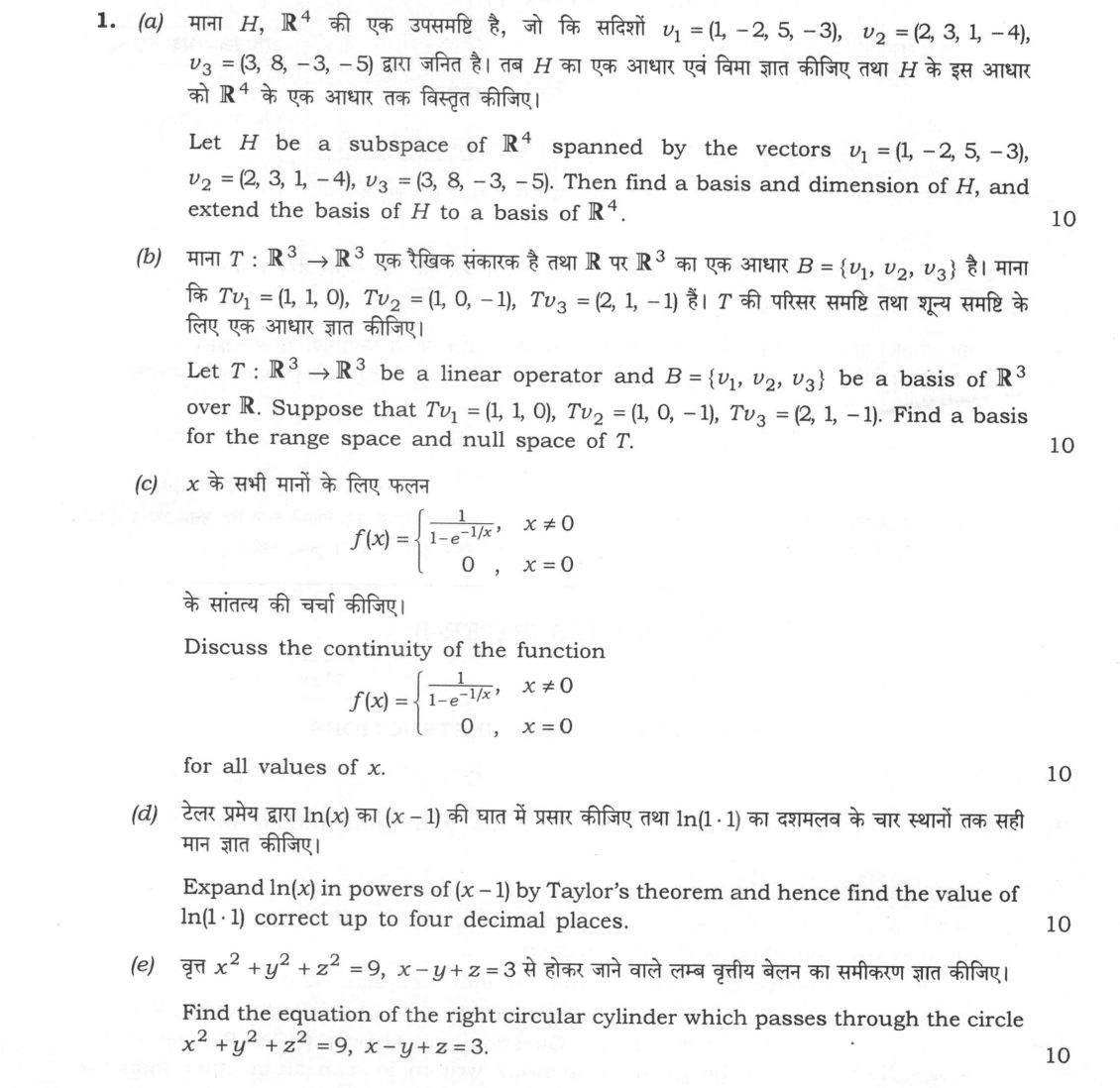
Let H be a subspace of R⁴ spanned by the vectors v₁ = (1, –2, 5, –3), v₂ = (2, 3, 1, –4), v₃ = (3, 8, –3, –5). Then find a basis and dimension of H, and extend the basis of H to a basis of R⁴. 10 marks
Let T : R³ → R³ be a linear operator and B = {v₁, v₂, v₃} be a basis of R³ over R. Suppose that Tv₁ = (1, 1, 0), Tv₂ = (1, 0, –1), Tv₃ = (2, 1, –1). Find a basis for the range space and null space of T. 10 marks
Discuss the continuity of the function
f(x) = { 1/(1–e^(–1/x)), x ≠ 0 { 0, x = 0
for all values of x. 10 marks
Expand ln(x) in powers of (x–1) by Taylor's theorem and hence find the value of ln(1·1) correct up to four decimal places. 10 marks
Find the equation of the right circular cylinder which passes through the circle x² + y² + z² = 9, x – y + z = 3. 10 marks
हिंदी में प्रश्न पढ़ें
माना H, R⁴ की एक उपसमष्टि है, जो कि सदिशों v₁ = (1, –2, 5, –3), v₂ = (2, 3, 1, –4), v₃ = (3, 8, –3, –5) द्वारा जनित है। तब H का एक आधार एवं विमा ज्ञात कीजिए तथा H के इस आधार को R⁴ के एक आधार तक विस्तृत कीजिए। (10 अंक)
माना T : R³ → R³ एक रैखिक संकारक है तथा R पर R³ का एक आधार B = {v₁, v₂, v₃} है। माना कि Tv₁ = (1, 1, 0), Tv₂ = (1, 0, –1), Tv₃ = (2, 1, –1) है। T की परिसर समष्टि तथा शून्य समष्टि के लिए एक आधार ज्ञात कीजिए। (10 अंक)
x के सभी मानों के लिए फलन
f(x) = { 1/(1–e^(–1/x)), x ≠ 0 { 0, x = 0
के सांतत्य की चर्चा कीजिए। (10 अंक)
टेलर प्रमेय द्वारा ln(x) का (x–1) की घात में प्रसार कीजिए तथा ln(1·1) का दशमलव के चार स्थानों तक सही मान ज्ञात कीजिए। (10 अंक)
वृत्त x² + y² + z² = 9, x – y + z = 3 से होकर जाने वाले लम्ब वृत्तीय बेलन का समीकरण ज्ञात कीजिए। (10 अंक)
Model answer
Written by UPSC Answer Check against this question's marking rubric, to the expected length. UPSC does not publish answers for Mains — this is one way to score well, not an official key.
(a) Let c₁v₁ + c₂v₂ + c₃v₃ = 0. Using the coordinates of v₁, v₂, v₃:
c₁ + 2c₂ + 3c₃ = 0 –2c₁ + 3c₂ + 8c₃ = 0 5c₁ + c₂ – 3c₃ = 0 –3c₁ – 4c₂ – 5c₃ = 0
From the first equation, c₁ = –2c₂ – 3c₃. Substitute in the second:
–2(–2c₂ – 3c₃) + 3c₂ + 8c₃ = 0 ⇒ 4c₂ + 6c₃ + 3c₂ + 8c₃ = 0 ⇒ 7c₂ + 14c₃ = 0 ⇒ c₂ = –2c₃.
Then c₁ = –2(–2c₃) – 3c₃ = c₃. The third and fourth equations are then automatically satisfied. Hence
c₃v₁ – 2c₃v₂ + c₃v₃ = 0 ⇒ v₁ – 2v₂ + v₃ = 0 ⇒ v₃ = 2v₂ – v₁.
So v₃ is dependent on v₁ and v₂, while v₁ and v₂ are not scalar multiples, hence independent. Therefore
Basis of H = {v₁, v₂} = {(1, –2, 5, –3), (2, 3, 1, –4)}, dim H = 2.
To extend this basis to R⁴, take e₃ = (0, 0, 1, 0), e₄ = (0, 0, 0, 1). Consider
αv₁ + βv₂ + γe₃ + δe₄ = 0.
Comparing the first two coordinates:
α + 2β = 0 –2α + 3β = 0.
The determinant is 1·3 – 2(–2) = 7 ≠ 0, so α = β = 0. Then the third and fourth coordinates give γ = 0 and δ = 0. Thus the four vectors are independent, and since R⁴ has dimension 4,
Basis of R⁴ = {v₁, v₂, e₃, e₄}.
(b) Since B = {v₁, v₂, v₃} is a basis of R³, every vector is of the form a v₁ + b v₂ + c v₃. By linearity,
T(a v₁ + b v₂ + c v₃) = aTv₁ + bTv₂ + cTv₃ = a(1, 1, 0) + b(1, 0, –1) + c(2, 1, –1) = (a + b + 2c, a + c, –b – c).
The range of T is spanned by Tv₁, Tv₂, Tv₃. But
Tv₃ = (2, 1, –1) = (1, 1, 0) + (1, 0, –1) = Tv₁ + Tv₂.
Hence Tv₃ is dependent on Tv₁ and Tv₂, which are independent. Therefore
Basis of range T = {(1, 1, 0), (1, 0, –1)}, rank T = 2.
For the null space, set T(a v₁ + b v₂ + c v₃) = 0:
a + b + 2c = 0 a + c = 0 –b – c = 0.
From a + c = 0, a = –c. From –b – c = 0, b = –c. The first equation is then automatically satisfied. Thus
kernel T = {–c v₁ – c v₂ + c v₃ : c ∈ R} = span{v₃ – v₁ – v₂}.
Therefore
Basis of null space T = {v₃ – v₁ – v₂}, nullity T = 1.
Rank-nullity theorem checks: 2 + 1 = 3 = dim R³.
(c) For x ≠ 0, the function is a quotient of continuous functions,
f(x) = 1/(1 – e^(–1/x)).
The denominator vanishes only if e^(–1/x) = 1, i.e. –1/x = 0, which is impossible for finite x ≠ 0. Hence f is continuous for every x ≠ 0.
Now examine x = 0.
Right-hand limit:
x → 0⁺ ⇒ –1/x → –∞ ⇒ e^(–1/x) → 0.
Therefore
lim_x→0⁺ f(x) = 1/(1 – 0) = 1.
Left-hand limit:
x → 0⁻ ⇒ –1/x → +∞ ⇒ e^(–1/x) → +∞.
Therefore
lim_x→0⁻ f(x) = 1/(1 – ∞) = 0.
The left and right limits are different, so lim_x→0 f(x) does not exist. Since f(0) = 0, the function is discontinuous at x = 0. It is continuous on (–∞, 0) and (0, ∞), and is left-continuous at 0 but not right-continuous.
Hence f is continuous for all x ≠ 0 and has a jump discontinuity at x = 0.
(d) Let f(x) = ln x. By Taylor’s theorem about x = 1,
f(x) = f(1) + f′(1)(x – 1) + f″(1)(x – 1)²/2! + f‴(1)(x – 1)³/3! + …
Now f(1) = 0. Also,
f′(x) = 1/x ⇒ f′(1) = 1, f″(x) = –1/x² ⇒ f″(1) = –1, f‴(x) = 2/x³ ⇒ f‴(1) = 2.
In general,
fⁿ(x) = (–1)^(n–1)(n – 1)!/xⁿ, so fⁿ(1) = (–1)^(n–1)(n – 1)!.
Hence
ln x = (x – 1) – (x – 1)²/2 + (x – 1)³/3 – (x – 1)⁴/4 + … = Σ (n=1 to ∞) (–1)^(n+1)(x – 1)ⁿ/n.
This expansion is valid for |x – 1| < 1, and at x = 2 it converges conditionally.
Put x = 1.1, so x – 1 = 0.1. Then
ln(1.1) = 0.1 – 0.1²/2 + 0.1³/3 – 0.1⁴/4 + 0.1⁵/5 – 0.1⁶/6 + 0.1⁷/7 – …
= 0.1 – 0.005 + 0.0003333333 – 0.000025 + 0.000002 – 0.0000001667 + 0.0000000143 – …
Summing,
ln(1.1) ≈ 0.0953101798.
Therefore, correct up to four decimal places,
ln(1·1) = 0.0953.
(e) The given circle is the intersection of the sphere
x² + y² + z² = 9
and the plane
x – y + z = 3.
The plane has normal vector n = (1, –1, 1). The distance of the plane from the origin is
|3|/√(1² + (–1)² + 1²) = 3/√3 = √3.
The sphere has radius 3, so the radius of the circle of intersection is
r = √(3² – (√3)²) = √(9 – 3) = √6.
The centre of this circle is the foot of the perpendicular from the origin to the plane:
c = (3/3)(1, –1, 1) = (1, –1, 1).
For a right circular cylinder to contain this circle, the plane of the circle must be perpendicular to the cylinder axis. Hence the axis is parallel to n = (1, –1, 1), and it passes through c = (1, –1, 1). The radius of the cylinder is √6.
Let X = (x, y, z). The perpendicular distance from X to the axis line through c in direction n is given by
d² = |(X – c) × n|² / |n|².
Now
X – c = (x – 1, y + 1, z – 1),
and
(X – c) × n = (y + z, z – x, –x – y).
Also |n|² = 3. Since d = √6, we get
(y + z)² + (z – x)² + (x + y)² = 6 × 3 = 18.
Simplifying,
2(x² + y² + z² + xy + yz – xz) = 18,
so
x² + y² + z² + xy + yz – xz = 9.
What "Solve" is asking you to do
Choose the method, then carry it through to a final answer. Identifying what kind of problem this is and why that method applies is the first thing marked; a correct figure arrived at invisibly earns almost nothing.
Structure that answers it
Given data and what is required → method chosen, with the reason it applies → set-up (equation, circuit, free body, trial balance) → working, step by step → answer with units and any condition of validity
Where marks are lost
Doing the middle steps mentally and writing only the result. In mathematics papers, a further loss comes from giving a decimal where the exact value in surds or fractions was wanted, or from skipping the justification a part explicitly asks for.
How this answer will be evaluated
Approach
Framework: UPSC Mathematics Paper 1. (a) calculate: given > formula > substitution > result with units > interpretation | (b) calculate: given > formula > substitution > result with units > interpretation | (c) discuss: intro > 3-4 dimensions > example > balanced close | (d) calculate: given > formula > substitution > result with units > interpretation | (e) derive: given > assumptions > stepwise derivation > result > check Full marks: All parts solved with full working, correct results, and verification steps.
Key points expected
- Row-reduce matrix of v₁, v₂, v₃ to find rank
- Identify linearly independent vectors as basis of H
- State dimension of H explicitly
- Extend basis by adding standard unit vectors
- Form matrix of T using given images
- Row-reduce to find rank and nullity
- Extract basis for range from pivot columns
- Solve T(x)=0 to find basis for null space
Evaluation rubric
Each sub-part is marked on its own, against the marks and word limit printed on the paper.
- (a) Basis and dimension of H, and extension to a basis of R⁴. 10 marks
calculate— given → formula → substitution → result with units → interpretation
Must cover
- Row-reduce matrix of v₁, v₂, v₃ to find rank
- Identify linearly independent vectors as basis of H
- State dimension of H explicitly
- Extend basis by adding standard unit vectors
Loses marks
- Claiming dimension without row-reduction
- Extending with dependent vectors
Earns more
- Verify linear dependence of v₃ on v₁, v₂
- Show row-reduction steps clearly
Extra mark
- Alternative method using cross product or determinant
- (b) Basis for range space and null space of T. 10 marks
calculate— given → formula → substitution → result with units → interpretation
Must cover
- Form matrix of T using given images
- Row-reduce to find rank and nullity
- Extract basis for range from pivot columns
- Solve T(x)=0 to find basis for null space
Loses marks
- Confusing range with column space of Aᵀ
- Failing to solve homogeneous system for null space
Earns more
- Verify rank-nullity theorem
- Check that basis vectors span the spaces
Extra mark
- Geometric interpretation of range and null space
- (c) Continuity of f(x) for all x, especially at x=0. 10 marks
discuss— intro → 3-4 dimensions → example → balanced close
Must cover
- Check continuity for x ≠ 0 (rational function)
- Compute limit as x→0⁺ of 1/(1-e⁻¹ˣ)
- Compute limit as x→0⁻ of 1/(1-e⁻¹ˣ)
- Compare limits with f(0)=0 to conclude discontinuity
Loses marks
- Assuming continuity without checking limit
- Incorrect evaluation of e⁻¹ˣ as x→0
Earns more
- Use L'Hôpital's rule or series expansion for limit
- State one-sided limits explicitly
Extra mark
- Graphical sketch showing jump discontinuity
- (d) Taylor expansion of ln(x) about x=1 and value of ln(1.1). 10 marks
calculate— given → formula → substitution → result with units → interpretation
Must cover
- State Taylor's theorem for ln(x) at x=1
- Compute derivatives f⁽ⁿ⁾(1) for n=1,2,3,...
- Write series: ln(x) = (x-1) - (x-1)²/2 + (x-1)³/3 - ...
- Substitute x=1.1 and compute to 4 decimal places
Loses marks
- Using wrong expansion point (e.g., x=0)
- Arithmetic error in decimal calculation
Earns more
- Show convergence justification (ratio test)
- Calculate at least 3 terms for accuracy
Extra mark
- Error bound using remainder term
- (e) Equation of right circular cylinder through given circle. 10 marks
derive— given → assumptions → stepwise derivation → result → check
Must cover
- Identify circle as intersection of sphere and plane
- Find center and radius of the circle
- Determine axis direction (normal to plane x-y+z=3)
- Write cylinder equation using distance from axis
Loses marks
- Assuming cylinder axis is z-axis
- Failing to compute radius correctly
Earns more
- Verify that all points on circle satisfy cylinder eq
- Use vector projection to find axis
Extra mark
- Alternative method using coordinate transformation
Practice this exact question
Write your answer and it is marked point by point against the model answer above — what you covered, what you missed, what you got wrong.
Evaluate my answer →More from Mathematics 2024 Paper I
- Q1 (a) Let H be a subspace of R⁴ spanned by the vectors v₁ = (1, –2, 5, –3), v₂ = (2, 3, 1,…
- Q2 (a) Consider a linear operator T on R³ over R defined by T(x, y, z) = (2x, 4x – y, 2x + 3…
- Q3 (a) Let V = M₂ₓ₂(ℝ) denote a vector space over the field of real numbers. Find the matrix…
- Q4 (a) Let A = 3 & 2 & 4 2 & 0 & 2 4 & 2 & 3 be a 3×3 matrix. Find the eigenvalues and the c…