Paper I — Q8
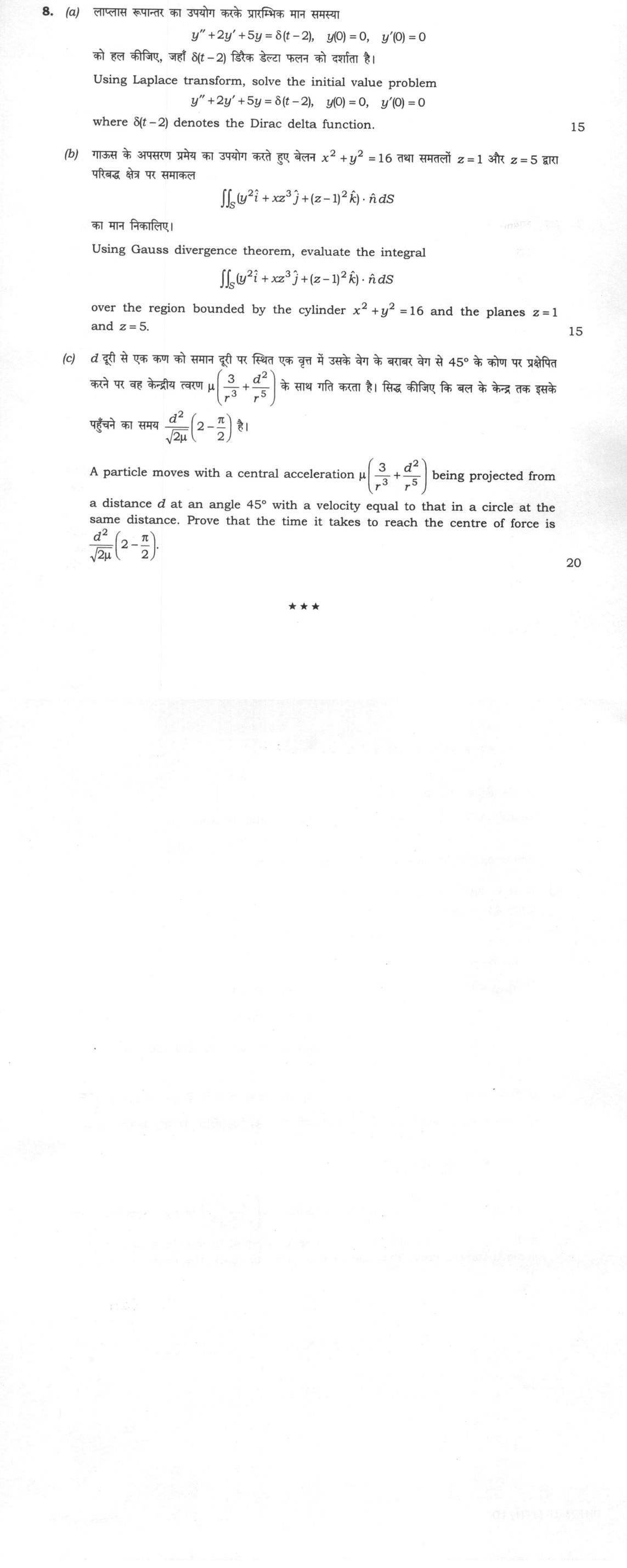
(a) Using Laplace transform, solve the initial value problem y'' + 2y' + 5y = δ(t-2), y(0) = 0, y'(0) = 0 where δ(t-2) denotes…
Using Laplace transform, solve the initial value problem y'' + 2y' + 5y = δ(t-2), y(0) = 0, y'(0) = 0 where δ(t-2) denotes the Dirac delta function. 15 marks
Using Gauss divergence theorem, evaluate the integral ∬_S (y²î + xz³ĵ + (z-1)²k̂) · n̂ dS over the region bounded by the cylinder x² + y² = 16 and the planes z = 1 and z = 5. 15 marks
A particle moves with a central acceleration μ(3/r³ + d²/r⁵) being projected from a distance d at an angle 45° with a velocity equal to that in a circle at the same distance. Prove that the time it takes to reach the centre of force is d²/√(2μ) (2 - π/2). 20 marks
हिंदी में प्रश्न पढ़ें
लाप्लास रूपांतर का उपयोग करके प्रारंभिक मान समस्या y'' + 2y' + 5y = δ(t-2), y(0) = 0, y'(0) = 0 को हल कीजिए, जहाँ δ(t-2) डिरैक डेल्टा फलन को दर्शाता है। (15 अंक)
गॉस के अपसरण प्रमेय का उपयोग करते हुए बेलन x² + y² = 16 तथा समतलों z = 1 और z = 5 द्वारा परिबद्ध क्षेत्र पर समाकल ∬_S (y²î + xz³ĵ + (z-1)²k̂) · n̂ dS का मान निकालिए। (15 अंक)
d दूरी से एक कण को समान दूरी पर स्थित एक वृत्त में उसके वेग के बराबर वेग से 45° के कोण पर प्रक्षेपित करने पर वह केंद्रीय त्वरण μ(3/r³ + d²/r⁵) के साथ गति करता है। सिद्ध कीजिए कि बल के केंद्र तक इसके पहुँचने का समय d²/√(2μ) (2 - π/2) है। (20 अंक)
Model answer
Written by UPSC Answer Check against this question's marking rubric, to the expected length. UPSC does not publish answers for Mains — this is one way to score well, not an official key.
(a) Let Y(s) = L{y(t)}. By the Laplace transform of derivatives and the zero initial conditions y(0)=y′(0)=0, L{y″} = s²Y, L{y′} = sY. Also L{δ(t−2)} = exp(−2s). Hence s²Y + 2sY + 5Y = exp(−2s), so Y = exp(−2s)/(s² + 2s + 5) = exp(−2s)/((s+1)² + 4). Now the standard inverse Laplace transform gives L⁻¹{1/((s+1)² + 4)} = (1/2) exp(−t) sin 2t. Using the second shifting theorem, L⁻¹{exp(−2s)F(s)} = f(t−2)u(t−2), where u is the unit step function. Therefore y(t) = (1/2) exp(−(t−2)) sin(2(t−2)) u(t−2), that is, y(t)=0 for t<2 and y(t)=(1/2) exp(−(t−2)) sin(2(t−2)) for t≥2.
(b) Let F = y²î + xz³ĵ + (z−1)²k̂. By the Gauss divergence theorem, for the outward normal n̂, ∬ F·n̂ dS = ∭ div F dV, where V is the solid cylinder x² + y² ≤ 16, 1 ≤ z ≤ 5. Now div F = ∂(y²)/∂x + ∂(xz³)/∂y + ∂((z−1)²)/∂z = 0 + 0 + 2(z−1) = 2z − 2. Use cylindrical coordinates x = r cosθ, y = r sinθ, z = z, with dV = r dr dθ dz. The limits are 0 ≤ r ≤ 4, 0 ≤ θ ≤ 2π, 1 ≤ z ≤ 5. Hence ∭ (2z−2) dV = (∫ dθ from 0 to 2π)(∫ r dr from 0 to 4)(∫ (2z−2) dz from 1 to 5) = (2π)(8)(16) = 256π. Thus the required surface integral is 256π for outward normal. For inward normal, the sign is −256π.
(c) Let r be the radial distance and θ the angular coordinate. For a central acceleration μ(3/r³ + d²/r⁵) directed toward the centre, the equations of motion in polar form are r″ − r(θ′)² = −μ(3/r³ + d²/r⁵), r²θ′ = h, where h is the constant angular momentum per unit mass.
At distance r = d, the circular speed v_c satisfies v_c²/d = μ(3/d³ + d²/d⁵) = μ(3/d³ + 1/d³) = 4μ/d³. Hence v_c = 2√μ/d. Since the particle is projected at 45°, the angular momentum is h = d v_c sin45° = d(2√μ/d)(1/√2) = √(2μ). Thus h² = 2μ. The initial radial speed is v_r = v_c cos45° = √(2μ)/d, directed inward.
Substituting h² = 2μ in the radial equation gives r″ = h²/r³ − μ(3/r³ + d²/r⁵) = 2μ/r³ − 3μ/r³ − μd²/r⁵ = −μ/r³ − μd²/r⁵. Multiply by r′ and integrate: (1/2)(r′)² = μ/(2r²) + μd²/(4r⁴) + C. At r = d, (r′)² = 2μ/d², so μ/d² = μ/(2d²) + μ/(4d²) + C, which gives C = μ/(4d²). Therefore (r′)² = μ/r² + μd²/(2r⁴) + μ/(2d²). Put u = r/d. Then (r′)² = μ/(2d²)(1 + 1/u²)². Since the motion is inward, |r′| = √μ/(d√2)(1 + 1/u²). The time T to reach the centre r = 0 from r = d is T = ∫ (r from 0 to d) dr/|r′| = d∫ (u from 0 to 1) du/[√μ/(d√2)(1 + 1/u²)] = d²√2/√μ ∫ (u from 0 to 1) u²/(1 + u²) du. Now ∫ u²/(1 + u²) du = ∫ (1 − 1/(1 + u²)) du = u − arctan u. Thus ∫ from 0 to 1 u²/(1 + u²) du = 1 − π/4. Therefore T = d²√2/√μ (1 − π/4) = d²/√(2μ)(2 − π/2). Hence the time taken to reach the centre of force is d²/√(2μ) (2 − π/2).
What "Solve" is asking you to do
Choose the method, then carry it through to a final answer. Identifying what kind of problem this is and why that method applies is the first thing marked; a correct figure arrived at invisibly earns almost nothing.
Structure that answers it
Given data and what is required → method chosen, with the reason it applies → set-up (equation, circuit, free body, trial balance) → working, step by step → answer with units and any condition of validity
Where marks are lost
Doing the middle steps mentally and writing only the result. In mathematics papers, a further loss comes from giving a decimal where the exact value in surds or fractions was wanted, or from skipping the justification a part explicitly asks for.
How this answer will be evaluated
Approach
(a) calculate: given > formula > substitution > result with units > interpretation | (b) calculate: given > formula > substitution > result with units > interpretation | (c) justify: claim > 3-4 reasons > evidence > conclusion Full marks: Complete stepwise derivation with all theorems named and verified
Key points expected
- Apply Laplace transform to y'' + 2y' + 5y
- Use L{δ(t-2)} = e^(-2s) property
- Solve algebraic equation for Y(s)
- Perform inverse Laplace transform to find y(t)
- State Gauss divergence theorem by name
- Compute divergence of vector field F
- Set up triple integral over cylindrical region
- Evaluate integral with correct limits
Evaluation rubric
Each sub-part is marked on its own, against the marks and word limit printed on the paper.
- (a) Solution for y(t) using Laplace transform of the given IVP. 15 marks
calculate— given → formula → substitution → result with units → interpretation
Must cover
- Apply Laplace transform to y'' + 2y' + 5y
- Use L{δ(t-2)} = e^(-2s) property
- Solve algebraic equation for Y(s)
- Perform inverse Laplace transform to find y(t)
Loses marks
- Skipping intermediate steps in transform
- Incorrect application of delta function property
- Answer without working
Earns more
- Correctly handle initial conditions y(0)=0, y'(0)=0
- Use second shifting theorem for inverse transform
- Verify solution satisfies original differential equation
Extra mark
- Alternative method noted briefly
- (b) Evaluation of surface integral using Gauss divergence theorem. 15 marks
calculate— given → formula → substitution → result with units → interpretation
Must cover
- State Gauss divergence theorem by name
- Compute divergence of vector field F
- Set up triple integral over cylindrical region
- Evaluate integral with correct limits
Loses marks
- Incorrect divergence calculation
- Wrong integration limits for cylinder
- Skipping intermediate steps
Earns more
- Correctly identify region boundaries x²+y²=16, z=1, z=5
- Use cylindrical coordinates for integration
- Verify result or check special case
Extra mark
- Neat figure of the region
- (c) Proof that time to reach centre is d²/√(2μ)(2-π/2). 20 marks
justify— claim → 3-4 reasons → evidence → conclusion
Must cover
- Set up equations of motion for central force
- Use given acceleration μ(3/r³ + d²/r⁵)
- Apply initial conditions: distance d, angle 45°, circular velocity
- Integrate to find time expression
Loses marks
- Skipping intermediate integration steps
- Incorrect initial condition setup
- Answer without working
Earns more
- Correctly relate velocity to circular orbit at distance d
- Proper handling of angular momentum conservation
- Stepwise derivation with justified steps
Extra mark
- Alternative method noted briefly
- Neat figure of trajectory
Practice this exact question
Write your answer and it is marked point by point against the model answer above — what you covered, what you missed, what you got wrong.
Evaluate my answer →More from Mathematics 2024 Paper I
- Q5 (a) Find the orthogonal trajectories of the family of curves r = c(sec θ + tan θ), where…
- Q6 (a) A regular tetrahedron, formed of six light rods, each of length l, rests on a smooth…
- Q7 (a) State uniqueness theorem for the existence of unique solution of the initial value pr…
- Q8 (a) Using Laplace transform, solve the initial value problem y'' + 2y' + 5y = δ(t-2), y(0…